
Hypoid gears are widely used in automotive and industrial applications due to their high load-carrying capacity and smooth power transmission. This study investigates the evolution of meshing parameters under varying loads through loaded tooth contact analysis (LTCA), focusing on equivalent meshing force, loaded transmission error, comprehensive elastic deformation, time-varying meshing stiffness, and actual contact ratio.
Mathematical Formulation of Meshing Parameters
The equivalent meshing force vector $\vec{F}_Q$ for hypoid gears is calculated as:
$$ \vec{F}_Q = \sum_{i=1}^q \vec{f}_i $$
$$ F_x = \sum_{i=1}^q f_{ix},\quad F_y = \sum_{i=1}^q f_{iy},\quad F_z = \sum_{i=1}^q f_{iz} $$
where $q$ represents the number of simultaneous contact pairs.
Transmission error (TE) is defined as:
$$ \delta(\phi_1) = (\phi_2 – \phi_2^0) – \frac{z_1}{z_2}(\phi_1 – \phi_1^0) $$
where $z_{1,2}$ denote tooth counts and $\phi_{1,2}$ represent angular displacements.
| Parameter | Pinion | Gear |
|---|---|---|
| Number of Teeth | 10 | 41 |
| Module (mm) | 4.741 | |
| Offset (mm) | -31.8 | |
| Spiral Angle (°) | 49.98 | 29.00 |
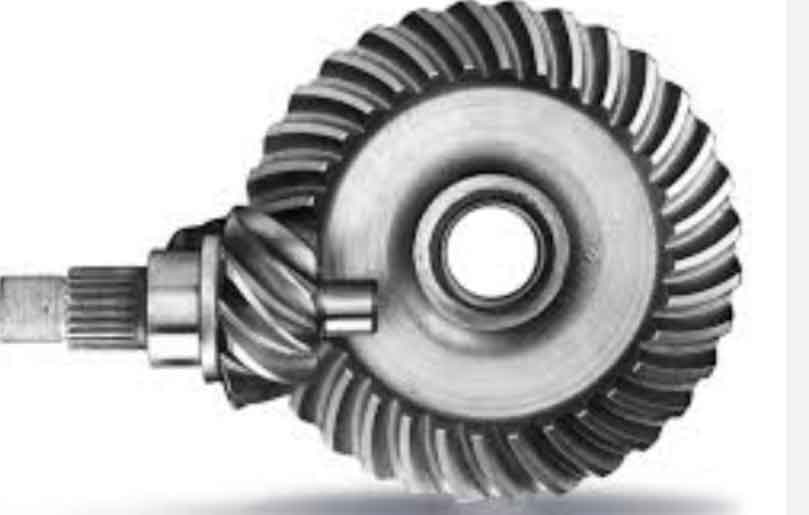
Time-Varying Meshing Stiffness
The comprehensive elastic deformation $u_n$ combines contact, bending, and shear components:
$$ u_n = \sum_{i=1}^2 (u_{h,i} + u_{b,i} + u_{s,i}) $$
Meshing stiffness $k_n$ is derived from:
$$ k_n(t) = \frac{\|\vec{F}_Q(t)\|}{u_n(t)} $$
| Parameter | Value |
|---|---|
| Cutter Diameter (inch) | 7.5 |
| Blade Pressure Angle (°) | -24 (outer)/17 (inner) |
| Machine Root Angle (°) | 68.13 |
Load-Dependent Parameter Evolution
The actual contact ratio $\varepsilon_\alpha$ exhibits nonlinear growth with load:
$$ \varepsilon_\alpha = \frac{\text{Contact Arc Length}}{\text{Base Pitch}} $$
Key observations under varying loads (100-6000 N·m):
- Equivalent meshing force increases linearly with torque
- Transmission error shows parabolic trend (minimal at 4000 N·m)
- Meshing stiffness asymmetry intensifies with higher loads
| Load (N·m) | Contact Ratio | TE Peak-Peak (arcmin) |
|---|---|---|
| 1000 | 1.82 | 2.15 |
| 4000 | 2.37 | 1.08 |
| 6000 | 2.41 | 1.92 |
Numerical Implementation
The finite element model incorporates:
$$ \text{Element Type: C3D8R} $$
$$ \text{Contact Algorithm: Penalty Method} $$
$$ \text{Friction Coefficient: 0.1} $$
Boundary conditions enforce:
$$ \sum M_x = 0,\quad \sum F_z = T_{\text{applied}} $$
Conclusion
This analysis reveals significant load-dependent characteristics in hypoid gear meshing behavior. The nonlinear relationship between load and meshing parameters necessitates consideration in dynamic modeling and NVH optimization. The derived time-varying stiffness and transmission error profiles provide essential inputs for system-level vibration analysis of hypoid gear transmissions.