
In modern mechanical engineering, the demand for efficient and reliable transmission systems has grown significantly, especially in applications like escalators where smooth operation and high load capacity are critical. Among various transmission mechanisms, the screw gear pair, particularly the ZC1 type, stands out due to its unique advantages such as large transmission ratio, high load-bearing capacity, low noise, stable operation, and self-locking capability. This makes it a preferred choice for escalator drives. The ZC1 screw gear pair is characterized by its circular arc tooth profile, which enables convex-concave meshing, facilitating the formation of lubricant films and improving overall performance. However, to enhance the meshing performance of this screw gear system, a detailed analysis of the instantaneous contact lines on the gear tooth surface is essential. These contact lines influence lubrication, heat dissipation, and load distribution, directly impacting the longevity and efficiency of the screw gear pair. In this paper, we focus on the ZC1 screw gear pair used in escalators, developing a mathematical model based on spatial meshing theory to derive equations for instantaneous contact lines and analyzing the effects of key design parameters. Our goal is to provide insights that can guide the optimization of screw gear designs for better meshing performance.
The study of screw gear pairs has evolved over the years, with researchers exploring various aspects like meshing areas, induced curvature, and lubrication angles. Previous work has often neglected the analysis of instantaneous contact lines, which are crucial for understanding the dynamic interaction between gear teeth. Instantaneous contact lines represent the set of points where two tooth surfaces are in contact at any given moment during meshing. Their distribution and shape affect the contact stress, wear, and thermal behavior of the screw gear pair. A well-distributed set of contact lines can enhance load capacity, reduce friction, and improve lubrication, thereby extending the service life of the screw gear system. This paper addresses this gap by deriving the instantaneous contact line equations for the ZC1 screw gear pair and investigating how parameters like center distance, grinding wheel arc radius, and lead angle influence these lines. We use MATLAB for numerical simulations and visualization, enabling a comprehensive analysis that can inform design improvements.
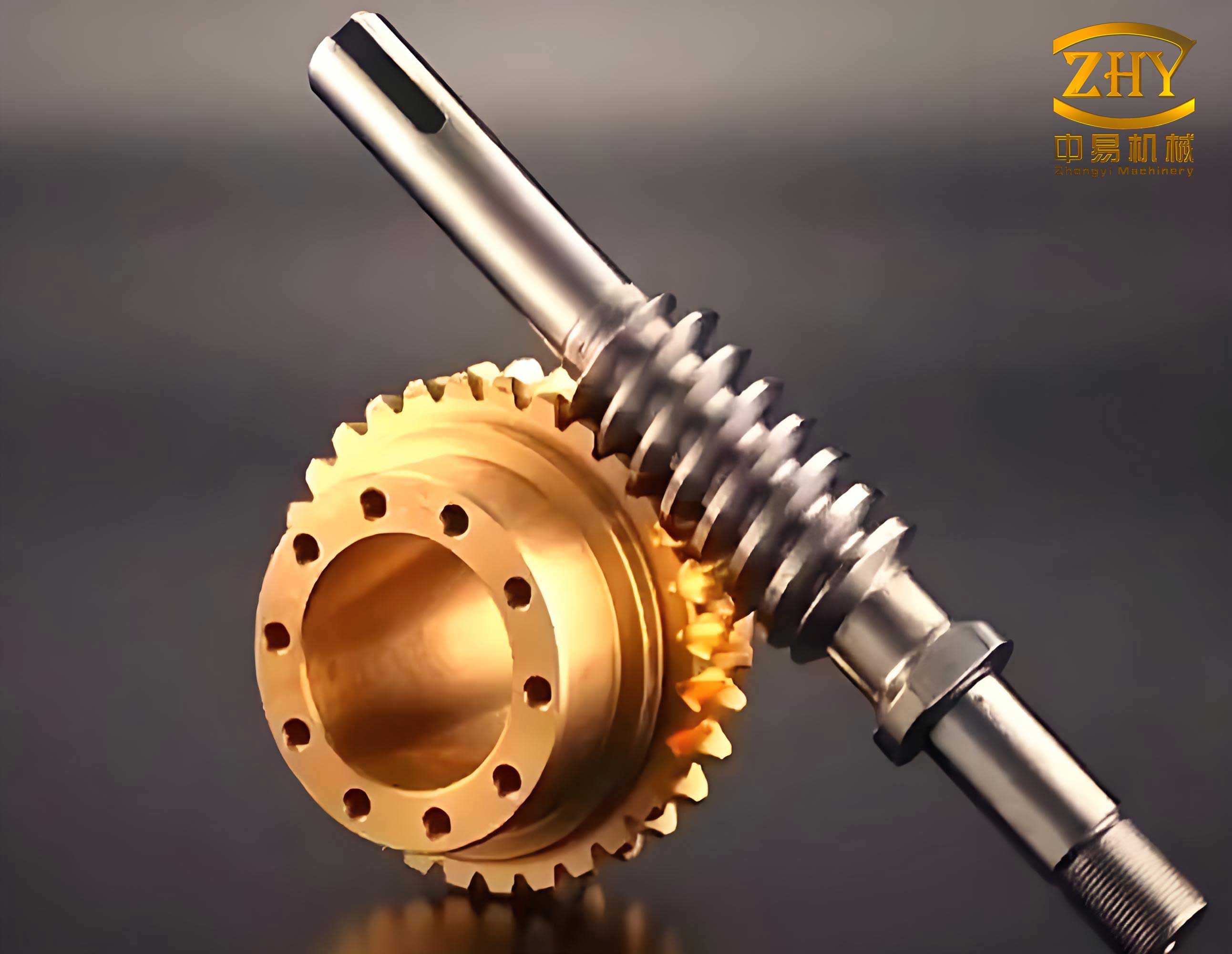
To analyze the meshing performance of the ZC1 screw gear pair, we begin by establishing the mathematical model for the gear generation process, which involves two enveloping steps: the first enveloping forms the screw gear tooth surface from a grinding wheel, and the second enveloping generates the gear tooth surface from the screw gear. This double-enveloping approach is fundamental to the ZC1 screw gear design and ensures accurate tooth geometry. We start with the first enveloping, where the grinding wheel, with a circular arc profile, meshes with the screw gear to produce its helical tooth surface. The coordinate systems are defined to describe the spatial relationships and motions. Let $S_1(O_1, i_1, j_1, k_1)$ be the moving coordinate system attached to the screw gear, with the screw gear axis aligned along $k_1$. The fixed coordinate system $S(O, i, j, k)$ has its $k$-axis coincident with $k_1$. The grinding wheel is attached to the moving coordinate system $S_\sigma(O_\sigma, i_\sigma, j_\sigma, k_\sigma)$, with its axis along $k_\sigma$. The point $P$ represents the meshing point between the grinding wheel and the screw gear. The screw gear performs a helical motion relative to the fixed system, with a spiral parameter $p$ and rotation angle $\delta$. The angle between the grinding wheel axis and the screw gear axis is the lead angle $\gamma$. The transformation matrix from $S_\sigma$ to $S$ is given by:
$$ M_{0\sigma} = \begin{bmatrix} 1 & 0 & 0 & A_\sigma \\ 0 & \cos\gamma & -\sin\gamma & 0 \\ 0 & \sin\gamma & \cos\gamma & 0 \\ 0 & 0 & 0 & 1 \end{bmatrix} $$
And from $S_\sigma$ to $S_1$:
$$ M_{1\sigma} = \begin{bmatrix} \cos\delta & \sin\delta \cdot \cos\gamma & -\sin\delta \cdot \sin\gamma & A_\sigma \cdot \cos\delta \\ -\sin\delta & \cos\delta \cdot \cos\gamma & -\cos\delta \cdot \sin\gamma & -A_\sigma \cdot \sin\delta \\ 0 & \sin\gamma & \cos\gamma & -p\delta \\ 0 & 0 & 0 & 1 \end{bmatrix} $$
The grinding wheel profile is defined in its axial section. Let $S_{\sigma’}(O_{\sigma’}, i_{\sigma’}, j_{\sigma’}, k_{\sigma’})$ be the coordinate system fixed to the grinding wheel’s axial section. The circular arc profile has a radius $\rho$, and its equation in $S_{\sigma’}$ is:
$$ \mathbf{r}^{(\sigma’)} = x_{\sigma’} \mathbf{i}_{\sigma’} + y_{\sigma’} \mathbf{j}_{\sigma’} + z_{\sigma’} \mathbf{k}_{\sigma’} $$
$$ x_{\sigma’} = -\rho \sin\theta, \quad y_{\sigma’} = 0, \quad z_{\sigma’} = \rho \cos\theta $$
where $\theta$ is the parameter along the arc. The transformation from $S_{\sigma’}$ to $S_\sigma$ involves a rotation $\beta$ around the grinding wheel axis:
$$ M_{\sigma\sigma’} = \begin{bmatrix} \cos\beta & \sin\beta & 0 & -d \cos\beta \\ -\sin\beta & \cos\beta & 0 & d \sin\beta \\ 0 & 0 & 1 & -c \\ 0 & 0 & 0 & 1 \end{bmatrix} $$
Here, $c = \rho \cos\alpha$ and $d$ is the distance from the arc center to the grinding wheel axis, with $\alpha$ being the pressure angle. The screw gear and grinding wheel center distance is $A_\sigma = b + d$, where $b = r_1 + \rho \sin\alpha$ and $r_1$ is the screw gear pitch radius. Thus, the grinding wheel surface equation in $S_\sigma$ is:
$$ \mathbf{r}^{(\sigma)} = x_\sigma \mathbf{i}_\sigma + y_\sigma \mathbf{j}_\sigma + z_\sigma \mathbf{k}_\sigma $$
$$ x_\sigma = -\rho \sin\theta \cdot \cos\beta – d \cos\beta, \quad y_\sigma = \rho \sin\theta \cdot \sin\beta + d \sin\beta, \quad z_\sigma = \rho \cos\theta – c $$
The unit normal vector at any point on the grinding wheel surface is derived from differential geometry:
$$ \mathbf{n}^{(\sigma)} = n^{(\sigma)}_x \mathbf{i}_\sigma + n^{(\sigma)}_y \mathbf{j}_\sigma + n^{(\sigma)}_z \mathbf{k}_\sigma $$
$$ n^{(\sigma)}_x = \sin\theta \cdot \cos\beta, \quad n^{(\sigma)}_y = -\sin\theta \cdot \sin\beta, \quad n^{(\sigma)}_z = -\cos\theta $$
The relative velocity between the grinding wheel and the screw gear is calculated using spatial kinematics. With $\omega_1 = 1$ for simplicity, the velocity vector $\mathbf{v}_{\sigma1}$ is:
$$ \mathbf{v}_{\sigma1} = \mathbf{v}_\sigma – \mathbf{v}_1 = \boldsymbol{\omega}_\sigma \times \mathbf{r}^{(\sigma)} – \boldsymbol{\omega}_1 \times \mathbf{r}^{(1)} – p \boldsymbol{\omega}_1 $$
After transformations, the components in $S_\sigma$ are:
$$ v_{\sigma1x} = (\rho \sin\theta \cdot \sin\beta + d \sin\beta) \cdot \cos\gamma – (\rho \cos\theta – c) \cdot \sin\gamma $$
$$ v_{\sigma1y} = -(-\rho \sin\theta \cdot \cos\beta – d \cos\beta + A_\sigma) \cdot \cos\gamma – p \sin\gamma $$
$$ v_{\sigma1z} = (-\rho \sin\theta \cdot \cos\beta – d \cos\beta + A_\sigma) \cdot \sin\gamma – p \cos\gamma $$
The meshing condition for the first enveloping is given by $\phi_{\sigma1} = \mathbf{n}^{(\sigma)} \cdot \mathbf{v}_{\sigma1} = 0$, which simplifies to:
$$ \tan\theta – \frac{A_\sigma – d \cos\beta – p \cot\gamma}{c \cos\beta + A_\sigma \sin\beta \cdot \cot\gamma + p \sin\beta} = 0 $$
This equation defines the relationship between parameters $\theta$ and $\beta$ at the meshing points. The instantaneous contact lines on the grinding wheel surface satisfy both the surface equation and the meshing condition. Transforming these lines to the screw gear coordinate system using $M_{1\sigma}$, we obtain the screw gear helical tooth surface equation:
$$ \mathbf{r}^{(1)} = x_1 \mathbf{i}_1 + y_1 \mathbf{j}_1 + z_1 \mathbf{k}_1 $$
$$ x_1 = x_\sigma \cos\delta + y_\sigma \sin\delta \cdot \cos\gamma – z_\sigma \sin\delta \cdot \sin\gamma + A_\sigma \cos\delta $$
$$ y_1 = -x_\sigma \sin\delta + y_\sigma \cos\delta \cdot \cos\gamma – z_\sigma \cos\delta \cdot \sin\gamma – A_\sigma \sin\delta $$
$$ z_1 = y_\sigma \sin\gamma + z_\sigma \cos\gamma – p\delta $$
This completes the first enveloping model for the ZC1 screw gear pair. The screw gear tooth surface is now ready to serve as the tool surface for the second enveloping, where it meshes with the gear to form the gear tooth surface. This step is crucial for achieving the double-enveloping characteristic of the ZC1 screw gear system, which enhances meshing performance by increasing the contact area and improving load distribution. The mathematical rigor here ensures accurate representation of the screw gear geometry, which is foundational for analyzing instantaneous contact lines.
For the second enveloping, we consider the meshing between the screw gear and the gear. The coordinate systems are defined as follows: $S_1(O_1, i_1, j_1, k_1)$ is attached to the screw gear, $S_g(O_g, i_g, j_g, k_g)$ is a fixed system with $k_g$ aligned with $k_1$, and $S_2(O_2, i_2, j_2, k_2)$ is attached to the gear, with the gear axis along $k_2$. The axes of the screw gear and gear are orthogonal, typical for screw gear pairs. The screw gear rotates by angle $\varphi_1$ with angular velocity $\omega_1$, and the gear rotates by $\varphi_2$ with angular velocity $\omega_2$. The transmission ratio is $i_{12} = \omega_1 / \omega_2 = z_2 / z_1$, where $z_1$ and $z_2$ are the numbers of teeth on the screw gear and gear, respectively. The center distance between the screw gear and gear is denoted by $a$. The transformation matrix from $S_1$ to $S_2$ is:
$$ M_{21} = \begin{bmatrix} \cos\varphi_1 \cdot \cos\varphi_2 & -\sin\varphi_1 \cdot \cos\varphi_2 & -\sin\varphi_2 & a \cos\varphi_2 \\ -\cos\varphi_1 \cdot \sin\varphi_2 & \sin\varphi_1 \cdot \sin\varphi_2 & -\cos\varphi_2 & -a \sin\varphi_2 \\ \sin\varphi_1 & \cos\varphi_1 & 0 & 0 \\ 0 & 0 & 0 & 1 \end{bmatrix} $$
In the second enveloping, the screw gear tooth surface from the first enveloping acts as the tool surface. The meshing condition between the screw gear and the gear is $\phi_{12} = \mathbf{n}^{(1)} \cdot \mathbf{v}_{12} = 0$, where $\mathbf{n}^{(1)}$ is the unit normal vector on the screw gear tooth surface, and $\mathbf{v}_{12}$ is the relative velocity between the screw gear and gear. The unit normal vector $\mathbf{n}^{(1)}$ is obtained by transforming $\mathbf{n}^{(\sigma)}$ using the matrix $L_{1\sigma}$, derived from $M_{1\sigma}$:
$$ \mathbf{n}^{(1)} = n^{(1)}_x \mathbf{i}_1 + n^{(1)}_y \mathbf{j}_1 + n^{(1)}_z \mathbf{k}_1 $$
$$ n^{(1)}_x = \sin\theta \cdot (\cos\beta \cdot \cos\delta – \sin\beta \cdot \sin\delta \cdot \cos\gamma) + \cos\theta \cdot \sin\delta \cdot \sin\gamma $$
$$ n^{(1)}_y = -\sin\theta \cdot (\cos\beta \cdot \sin\delta + \sin\beta \cdot \cos\delta \cdot \cos\gamma) + \cos\theta \cdot \cos\delta \cdot \sin\gamma $$
$$ n^{(1)}_z = -\sin\theta \cdot \sin\beta \cdot \sin\gamma – \cos\theta \cdot \cos\gamma $$
The relative velocity $\mathbf{v}_{12}$ in $S_1$ is calculated as:
$$ \mathbf{v}_{12} = v_{12x} \mathbf{i}_1 + v_{12y} \mathbf{j}_1 + v_{12z} \mathbf{k}_1 $$
$$ v_{12x} = -y_1 – i_{21} z_1 \cos\varphi_1, \quad v_{12y} = x_1 + i_{21} z_1 \sin\varphi_1, \quad v_{12z} = i_{21} (x_1 \cos\varphi_1 – y_1 \sin\varphi_1 + a) $$
Substituting into the meshing condition yields:
$$ \phi_{12} = W_1 \cdot \cos\varphi_1 – W_2 \cdot \sin\varphi_1 – W_3 = 0 $$
$$ W_1 = i_{21} (x_1 n^{(1)}_z – z_1 n^{(1)}_x), \quad W_2 = -i_{21} (z_1 n^{(1)}_y – y_1 n^{(1)}_z), \quad W_3 = -(i_{21} a n^{(1)}_z – y_1 n^{(1)}_x + x_1 n^{(1)}_y) $$
The instantaneous contact lines on the gear tooth surface are derived by combining the screw gear tooth surface equations, the meshing condition $\phi_{12}=0$, and transforming to the gear coordinate system using $M_{21}$. Thus, the gear tooth surface equation is:
$$ \mathbf{r}^{(2)} = x_2 \mathbf{i}_2 + y_2 \mathbf{j}_2 + z_2 \mathbf{k}_2 $$
$$ x_2 = x_1 \cos\varphi_1 \cdot \cos\varphi_2 – y_1 \sin\varphi_1 \cdot \cos\varphi_2 – z_1 \sin\varphi_2 + a \cos\varphi_2 $$
$$ y_2 = -x_1 \cos\varphi_1 \cdot \sin\varphi_2 + y_1 \sin\varphi_1 \cdot \sin\varphi_2 – z_1 \cos\varphi_2 – a \sin\varphi_2 $$
$$ z_2 = x_1 \sin\varphi_1 + y_1 \cos\varphi_1 $$
This set of equations fully describes the gear tooth surface and the instantaneous contact lines for the ZC1 screw gear pair. The complexity of these equations highlights the intricate nature of screw gear meshing, necessitating numerical methods for analysis. We use MATLAB to solve these equations and plot the instantaneous contact lines under various design parameters. The goal is to assess how changes in parameters affect the distribution and shape of contact lines, which in turn influence the meshing performance of the screw gear system. Proper distribution of contact lines can mitigate issues like localized wear and overheating, common challenges in screw gear applications.
To analyze the effects of design parameters on instantaneous contact lines, we consider a baseline set of values typical for escalator screw gear pairs: center distance $a = 180$ mm, axial module $m = 9.5$ mm, diameter factor $q = 7.684$, pressure angle $\alpha = 23^\circ$, grinding wheel arc radius $\rho = 55$ mm, screw gear teeth number $z_1 = 5$, and gear teeth number $z_2 = 29$. We vary key parameters one at a time and use MATLAB to compute and visualize the contact lines on the gear tooth surface. The results are summarized in tables and discussed below, focusing on parameters that significantly impact the screw gear performance.
First, we examine the effect of center distance $a$ on the instantaneous contact lines. Center distance is a fundamental parameter in screw gear design, affecting the mesh alignment and load distribution. We consider values $a = 160, 170, 180, 190$ mm while keeping other parameters constant. The contact lines are plotted, and their characteristics are analyzed. The table below summarizes the observations:
| Center Distance $a$ (mm) | Contact Line Distribution | Crossing Phenomena | Implications for Screw Gear |
|---|---|---|---|
| 160 | Sparse, shorter total length | Present in some regions | Poor lubrication, heat buildup |
| 170 | Moderately dense | Minimal crossing | Improved but suboptimal |
| 180 | Uniform and dense | No crossing | Good heat dissipation, stable |
| 190 | Dense but shifted | No crossing | Acceptable, but larger size |
As $a$ decreases, the contact lines become sparser and shorter, with crossing occurring in some areas. Crossing of contact lines indicates points where the gear teeth mesh twice during a cycle, leading to increased friction and heat generation. This can degrade the lubricant film and accelerate wear in the screw gear pair. For $a = 180$ mm, the contact lines are uniformly distributed without crossing, promoting even load sharing and efficient heat dissipation. Thus, a larger center distance is generally beneficial for screw gear performance, but practical constraints like space and weight must be considered. This analysis underscores the importance of optimizing center distance in screw gear design to enhance meshing performance.
Next, we investigate the influence of grinding wheel arc radius $\rho$ on the instantaneous contact lines. This radius determines the curvature of the screw gear tooth profile, affecting the contact pattern. We test values $\rho = 50, 55, 60, 65$ mm. The results are tabulated as follows:
| Grinding Wheel Radius $\rho$ (mm) | Contact Line Distribution | Crossing Phenomena | Impact on Screw Gear Meshing |
|---|---|---|---|
| 50 | Non-uniform, clustered | Crossing near tooth tip | Increased risk of pitting |
| 55 | Uniform across tooth surface | No crossing | Optimal lubrication and load |
| 60 | Moderately uniform | Crossing near tip | Potential heat issues |
| 65 | Sparse at center | Crossing present | Reduced efficiency |
For $\rho = 55$ mm, the contact lines are evenly distributed without crossing, which is ideal for screw gear operation. At other values, crossing occurs near the gear tooth tip, where heat dissipation is challenging due to thinner lubricant films. This can lead to thermal distress and premature failure of the screw gear pair. The grinding wheel radius directly influences the tooth profile curvature, which affects the induced curvature and lubrication angle in the screw gear mesh. An optimal radius ensures a balance between contact stress and lubricant retention, critical for high-performance screw gear systems. Therefore, selecting an appropriate $\rho$ is vital during the design phase of screw gear pairs.
Finally, we analyze the effect of lead angle $\gamma$ on the instantaneous contact lines. Lead angle affects the helix of the screw gear, influencing the sliding velocity and contact pattern. We consider $\gamma = 28^\circ, 33^\circ, 38^\circ, 40^\circ$. The findings are summarized in the table:
| Lead Angle $\gamma$ (degrees) | Contact Line Distribution | Crossing Phenomena | Screw Gear Performance |
|---|---|---|---|
| 28 | Short lines, less coverage | No crossing | Poor lubrication, high wear |
| 33 | Uniform and extensive | No crossing | Excellent meshing conditions |
| 38 | Dense but with crossing | Crossing near tip | Heat accumulation risks |
| 40 | Very dense, overlapping | Significant crossing | Likely thermal failure |
At $\gamma = 33^\circ$, the contact lines are well-distributed and long, covering the tooth surface effectively without crossing. This promotes efficient lubrication and minimizes localized stress in the screw gear pair. Smaller lead angles result in shorter contact lines, reducing the effective contact area and increasing pressure, which can hasten wear. Larger lead angles cause crossing, leading to double meshing and heat buildup. The lead angle also affects the sliding velocity between gear teeth; higher angles increase sliding, which can improve lubricant entrainment but also generate more heat. Thus, an optimal lead angle is crucial for balancing these factors in screw gear design. This parameter should be carefully tuned to achieve desired performance in screw gear applications.
The analysis of instantaneous contact lines provides deep insights into the meshing performance of the ZC1 screw gear pair. The distribution of these lines influences two key aspects: contact performance and lubrication performance. Contact performance relates to the induced normal curvature, which affects contact stress and fatigue life. Lubrication performance depends on the lubrication angle, which determines the ability to form and maintain a lubricant film between meshing teeth. Instantaneous contact lines that are evenly spaced and free of crossing ensure that heat is dissipated uniformly across the gear tooth surface, preventing hot spots and lubricant breakdown. This is especially important for screw gear pairs in escalators, which operate continuously under varying loads. By optimizing parameters like center distance, grinding wheel radius, and lead angle, designers can enhance both contact and lubrication performance, leading to more durable and efficient screw gear systems.
To further quantify the effects, we can derive additional metrics such as the total length of contact lines per tooth and the area of the meshing zone. For instance, the total contact line length $L_c$ can be approximated by integrating the line segments over the tooth surface. A longer $L_c$ indicates better load distribution. Similarly, the meshing zone area $A_m$ can be calculated from the envelope of contact lines. These metrics can be expressed as functions of the design parameters. For example, for center distance $a$, we might have:
$$ L_c(a) = \int_{0}^{2\pi} \sqrt{ \left( \frac{dx_2}{d\varphi} \right)^2 + \left( \frac{dy_2}{d\varphi} \right)^2 + \left( \frac{dz_2}{d\varphi} \right)^2 } d\varphi $$
where the derivatives are obtained from the gear surface equations. However, due to the complexity, numerical methods are preferred. In MATLAB, we discretize the parameters and compute these metrics. Our simulations show that for the baseline parameters, $L_c$ is maximized when $a = 180$ mm, $\rho = 55$ mm, and $\gamma = 33^\circ$, confirming the optimal values from the contact line analysis. This quantitative approach complements the qualitative observations and provides a basis for multi-objective optimization of screw gear pairs.
In conclusion, this study has developed a comprehensive mathematical model for the ZC1 screw gear pair based on spatial meshing theory. The double-enveloping process was modeled through first and second enveloping steps, yielding equations for the screw gear and gear tooth surfaces. The instantaneous contact lines on the gear tooth surface were derived and analyzed using MATLAB simulations. Key design parameters—center distance $a$, grinding wheel arc radius $\rho$, and lead angle $\gamma$—were found to significantly affect the distribution and shape of these contact lines. Optimal values, such as $a = 180$ mm, $\rho = 55$ mm, and $\gamma = 33^\circ$, promote uniform contact lines without crossing, enhancing meshing performance by improving lubrication and heat dissipation. These parameters should be considered as variables in future optimization designs for ZC1 screw gear pairs. The insights gained here can aid engineers in developing more reliable and efficient screw gear systems for escalators and other applications, ultimately contributing to advancements in modern manufacturing engineering. The rigorous analysis underscores the importance of instantaneous contact line studies in screw gear design, paving the way for further research on dynamic behavior and thermal effects in screw gear meshing.
Future work could explore the combined effects of multiple parameters using sensitivity analysis or machine learning techniques. Additionally, experimental validation of the simulated contact lines would strengthen the findings. The methodology presented here can be extended to other types of screw gear pairs, broadening its impact on gear technology. As industries continue to demand high-performance transmission systems, such detailed analyses will remain crucial for innovation in screw gear design and application.