
In high-speed rotary offset presses, the ink distribution system plays a critical role in ensuring uniform ink transfer to the printing plate. The transmission spur gears in this system are subject to dynamic loads that can lead to vibrations due to variations in meshing stiffness. These vibrations negatively impact print quality by causing inconsistencies in ink distribution. Traditional methods for analyzing meshing stiffness, such as the Ishikawa formula, often fall short in accurately capturing the influence of tooth profile parameters. This paper proposes an improved potential energy method that models spur gears as variable-section cantilever beams. By deriving analytical expressions for meshing stiffness based on material mechanics and incorporating Hertz contact deformation, this approach provides a more precise representation of stiffness variations. The method is validated through MATLAB numerical calculations and ANSYS finite element simulations, demonstrating high accuracy and efficiency. Furthermore, the effects of key parameters like tooth width and module on meshing stiffness are investigated to support gear design optimization for reduced vibration and noise.
The ink distribution system in rotary offset presses relies on precise gear transmission to maintain stable operation. Spur gears are commonly used due to their simplicity and efficiency, but their meshing stiffness exhibits periodic fluctuations during engagement. This time-varying stiffness is a primary source of vibration, which can propagate through the system and affect the uniformity of ink application. Understanding and controlling meshing stiffness is essential for improving the dynamic performance of spur gears in printing machinery. The proposed method addresses limitations in existing approaches by integrating detailed tooth geometry into the stiffness calculation, enabling better prediction of vibrational behavior.
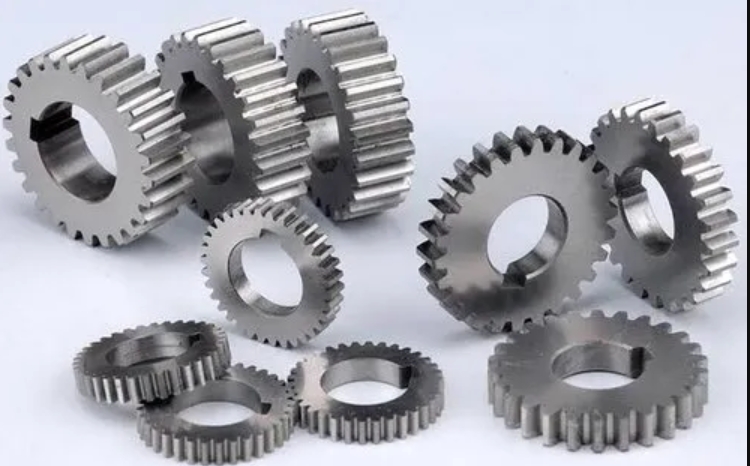
The foundation of this analysis lies in modeling spur gear teeth as variable-section cantilever beams fixed at the base circle. When a meshing force is applied, the tooth undergoes bending, shear, and compression deformations, each contributing to the overall elastic potential energy. The total potential energy stored in the gear tooth under a meshing force \( F_d \) can be expressed as the sum of energies from these deformation modes:
$$ U = \frac{1}{2} K \Delta x^2 $$
where \( \Delta x \) is the deformation in the direction of the force, and \( K \) is the equivalent meshing stiffness. The potential energies for bending, shear, and compression are given by:
$$ U_b = \frac{F_d^2}{2K_b}, \quad U_s = \frac{F_d^2}{2K_s}, \quad U_a = \frac{F_d^2}{2K_a} $$
Here, \( K_b \), \( K_s \), and \( K_a \) represent the stiffness components due to bending, shear, and axial compression, respectively. Using beam theory from material mechanics, the inverses of these stiffness values are derived as integrals along the tooth profile:
$$ \frac{1}{K_b} = \int_0^d \frac{[\cos\alpha_1 (d – x) – h_x \sin\alpha_1]^2}{E I_x} dx $$
$$ \frac{1}{K_s} = \int_0^d \frac{3 \cos^2\alpha_1}{5 G A_x} dx $$
$$ \frac{1}{K_a} = \int_0^d \frac{\sin^2\alpha_1}{2 E A_x} dx $$
In these equations, \( E \) is the elastic modulus, \( G \) is the shear modulus, \( I_x \) is the area moment of inertia at position \( x \), \( A_x \) is the cross-sectional area, \( d \) is the distance from the meshing point to the fixed base, \( h_x \) is half the tooth thickness at \( x \), and \( \alpha_1 \) is the pressure angle at the meshing point. The involute tooth profile is described by parametric equations based on the base circle radius \( r_b \) and the involute angle \( \theta \):
$$ x(\theta) = r_b \cos\phi (\cos\theta + \theta \sin\theta) + r_b \sin\phi (\sin\theta – \theta \cos\theta) $$
$$ y(\theta) = r_b \sin\phi (\cos\theta + \theta \sin\theta) – r_b \cos\phi (\sin\theta – \theta \cos\theta) $$
where \( \phi = \pi / z \) is half the tooth thickness angle, and \( z \) is the number of teeth. The pressure angle \( \alpha_1 \) at any meshing point is calculated using the coordinates derived from these equations. Additionally, Hertz contact deformation is considered, and the contact stiffness \( K_H \) is given by:
$$ K_H = \frac{\pi E W}{4(1 – \nu^2)} $$
where \( \nu \) is Poisson’s ratio, and \( W \) is the tooth width. The comprehensive single-tooth meshing stiffness \( K \) for a pair of spur gears is then obtained by combining all stiffness components:
$$ K = \left( \frac{1}{K_{b1}} + \frac{1}{K_{b2}} + \frac{1}{K_{s1}} + \frac{1}{K_{s2}} + \frac{1}{K_{a1}} + \frac{1}{K_{a2}} + \frac{1}{K_H} \right)^{-1} $$
The time-varying meshing stiffness during gear engagement is influenced by the contact ratio, which determines the number of tooth pairs in contact. For spur gears, the contact ratio \( \epsilon \) is calculated as:
$$ \epsilon = \frac{z_1 (\tan\alpha_{a1} – \tan\alpha_1) + z_2 (\tan\alpha_{a2} – \tan\alpha_1)}{2\pi} $$
where \( \alpha_{a1} \) and \( \alpha_{a2} \) are the tip pressure angles of the driving and driven gears, respectively. The meshing cycle involves alternating single and double tooth contact zones, leading to stiffness variations. The rotation angles for these zones are defined as \( \gamma_1 = 2\pi / z_1 \) and \( \gamma_2 = \epsilon \gamma_1 \), where \( \gamma_1 \) is the angle for one tooth to complete engagement, and \( \gamma_2 \) defines the transition between single and double contact.
To validate the proposed method, numerical calculations were performed using MATLAB for a typical spur gear pair in a rotary offset press ink distribution system. The gear parameters are listed in Table 1.
| Parameter | Driving Gear | Driven Gear |
|---|---|---|
| Number of Teeth | 25 | 34 |
| Module (mm) | 2 | 2 |
| Pressure Angle (°) | 20 | 20 |
| Elastic Modulus (GPa) | 200 | 200 |
| Poisson’s Ratio | 0.27 | 0.27 |
| Shear Modulus (GPa) | 78.7 | 78.7 |
The single-tooth meshing stiffness was computed over a full engagement cycle, revealing periodic fluctuations. The results showed a maximum stiffness of 173.534 N/μm, a minimum of 170.680 N/μm, and an average of 172.728 N/μm for individual teeth. For the gear pair, the comprehensive meshing stiffness varied between 170.680 N/μm and 278.766 N/μm, with an average of 254.328 N/μm. These values were compared with ANSYS finite element simulations, which yielded a maximum stiffness of 267.107 N/μm, a minimum of 163.519 N/μm, and an average of 242.920 N/μm. The error between the proposed method and simulations was less than 5%, confirming the accuracy of the approach. The periodic stiffness characteristics were effectively captured, and the computational efficiency was significantly improved compared to traditional methods.
The influence of gear parameters on meshing stiffness was further analyzed. Tooth width \( W \) and module \( m \) are critical factors affecting the stiffness of spur gears. As tooth width increases, the contact area expands, reducing contact stress and enhancing bending and shear resistance. The relationship between tooth width and meshing stiffness is summarized in Table 2 for a module of 2 mm.
| Tooth Width (mm) | Maximum Stiffness (N/μm) | Minimum Stiffness (N/μm) | Average Stiffness (N/μm) |
|---|---|---|---|
| 10 | 210.45 | 130.22 | 190.15 |
| 15 | 245.78 | 150.67 | 225.43 |
| 20 | 278.77 | 170.68 | 254.33 |
The data indicates that increasing tooth width from 10 mm to 20 mm results in approximately a 30% rise in average meshing stiffness, demonstrating a nearly linear improvement due to enhanced sectional rigidity. Similarly, the module affects stiffness by altering tooth dimensions and engagement geometry. Table 3 shows the stiffness variations for different modules at a constant tooth width of 20 mm.
| Module (mm) | Maximum Stiffness (N/μm) | Minimum Stiffness (N/μm) | Average Stiffness (N/μm) |
|---|---|---|---|
| 1.5 | 225.63 | 140.45 | 205.18 |
| 2.0 | 278.77 | 170.68 | 254.33 |
| 2.5 | 315.92 | 195.33 | 285.45 |
The module increase from 1.5 mm to 2.5 mm leads to a stiffness gain of about 39%, but the rate of increase diminishes at higher modules, indicating a nonlinear relationship. This is attributed to the geometric constraints and contact line curvature in spur gears. The combined effect of tooth width and module is synergistic; simultaneous increases in both parameters yield stiffness enhancements greater than the sum of individual effects. For instance, at a module of 2.5 mm and tooth width of 20 mm, the stiffness peaks higher than in cases where only one parameter is varied. This interaction is crucial for optimizing spur gear designs to achieve desired dynamic performance without excessive size or weight.
The proposed potential energy method offers a robust analytical framework for evaluating meshing stiffness in spur gears. By accurately modeling tooth deformations and incorporating Hertz contact, it provides insights into stiffness variations that drive vibrations in rotary offset presses. The method’s efficiency makes it suitable for iterative design processes, such as tooth profile modification aimed at reducing stiffness fluctuations. For practical applications, designers should prioritize increasing tooth width to linearly boost stiffness and improve load distribution. Modules should be selected to balance strength and engagement characteristics, with moderate values often yielding optimal stiffness without compromising other performance aspects. In summary, the improved potential energy method enables better prediction and control of meshing stiffness in spur gears, contributing to enhanced stability and print quality in high-speed printing machinery.
Further research could explore the application of this method to helical gears or gear systems with profile modifications. Additionally, experimental validation under operational conditions would strengthen the reliability of the stiffness predictions. The integration of this approach with dynamic models could also facilitate the development of active vibration control strategies for advanced printing systems.