
In modern mechanical transmission systems, the helical gear stands out due to its advantages of smooth operation, high load capacity, and low noise. Its characteristic of gradual tooth engagement allows for higher operational speeds and greater power transmission compared to spur gears. The performance of a helical gear pair is fundamentally governed by its time-varying meshing stiffness (TVMS), which is a primary source of vibration and dynamic excitation. An accurate prediction of this stiffness is therefore paramount for reliable design and noise-vibration-harshness (NVH) optimization.
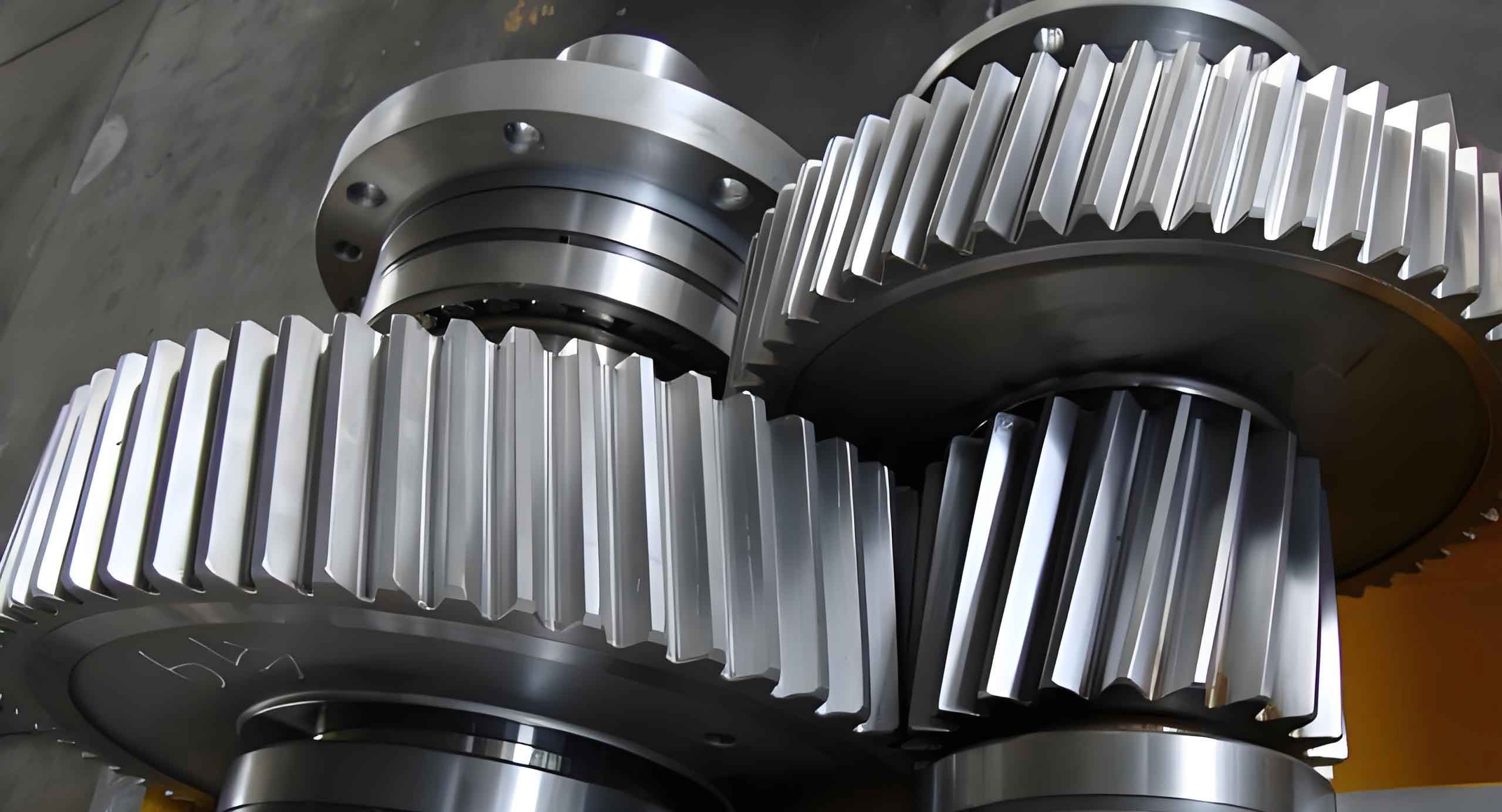
However, in practical installations, perfect alignment of gear shafts is seldom achieved. Angular misalignment, arising from assembly tolerances, shaft deflection under load, or bearing clearance, is a prevalent fault. This misalignment disrupts the ideal line contact of the helical gear teeth, leading to a skewed and non-uniform load distribution across the face width. The consequences are severe: localized high contact stresses accelerate surface wear and pitting, increased vibration and noise levels, and a potential reduction in the overall system’s reliability and service life. Consequently, developing a precise analytical model to quantify the impact of angular misalignment on the meshing stiffness of a helical gear is of significant engineering importance. Traditional models often simplify the problem or neglect certain stiffness components induced by the misalignment, particularly those related to axial loading. This study aims to address this gap by proposing a comprehensive iterative model based on the slice method, which integrally accounts for the axial bending and torsional stiffness caused by angular misalignment error.
1. Characterization of Angular Misalignment in Helical Gears
Angular misalignment in a helical gear pair refers to the situation where the axes of rotation of the mating gears are not parallel. For the purpose of modeling, we typically consider misalignment at one gear (e.g., the pinion) relative to the ideal position of the other. A three-dimensional coordinate system is established with the ideal gear axis direction as the z-axis. As shown in the schematic (conceptualized from the source material), when angular misalignment exists, the actual axis of the pinion is rotated from its ideal position. This rotation can be decomposed into two orthogonal components: a rotation of angle $\theta_x$ around the x-axis and a rotation of angle $\theta_y$ around the y-axis.
From the perspective of the gear mesh, it is more practical to define the misalignment with respect to the plane of action. The misalignment can be resolved into two distinct components:
- Parallel to the Plane of Action (POA) Misalignment ($\theta_{POA}$): This component lies within the plane where the gears mesh. It directly shortens the theoretical line of contact.
- Out-of-Plane of Action (OPOA) Misalignment ($\theta_{OPOA}$): This component is perpendicular to the plane of action. It causes the contact line to tilt relative to the gear axis.
These angles are derived from the shaft misalignment angles $\theta_x$ and $\theta_y$ and the normal pressure angle $\alpha_n$ as follows:
$$
\theta_{POA} = \arctan(\tan\theta_y \sin\alpha_n + \tan\theta_x \cos\alpha_n)
$$
$$
\theta_{OPOA} = \arctan\left(\frac{\tan\theta_y \cos\alpha_n – \tan\theta_x \sin\alpha_n}{\sqrt{1+(\tan\theta_y \sin\alpha_n + \tan\theta_x \cos\alpha_n)^2}}\right)
$$
The effect of these components on the contact pattern of a helical gear is qualitatively different:
- Effect of $\theta_{POA}$: The POA misalignment drastically reduces the effective contact length. Instead of a full face-width line contact, the contact becomes localized, often resembling a point contact at the edges of the teeth during the initial and final stages of mesh. The middle of the mesh may retain a short, nearly horizontal contact line.
- Effect of $\theta_{OPOA}$: The OPOA misalignment primarily tilts the line of contact. For small misalignment angles, the effect on the contact area’s projection is minor. A common simplification is to model this tilt as an effective change in the base helix angle $\beta_b$ of the gear:
$$
\beta_b’ = \beta_b \pm \theta_{OPOA}
$$where $\beta_b’$ is the effective helix angle under misalignment. The sign depends on the direction of the tilt relative to the gear’s hand.
2. Comprehensive Meshing Stiffness Model for Misaligned Helical Gears
The core of this analysis is an enhanced iterative model for calculating the TVMS of a helical gear pair with angular misalignment. The model is built upon the “slice method” or “slice theory,” where the gear tooth is discretized along its face width into a finite number of independent, thin slices. The total meshing stiffness is then the sum of the stiffness contributions from all slices in contact, considering their coupling.
A critical insight is that under misalignment, the resultant mesh force $F$ on a helical gear tooth is not purely transverse. Due to the effective helix angle $\beta_b’$, it resolves into two key components:
$$
F_t = F \cos\beta_b’ \quad \text{(Transverse component)}
$$
$$
F_a = F \sin\beta_b’ \quad \text{(Axial component)}
$$
Traditional models often focus only on the stiffness arising from $F_t$. Our proposed model explicitly includes the stiffness components generated by the axial force $F_a$.
2.1 Transverse Meshing Stiffness Components
The transverse force $F_t$ is further decomposed within the tooth cross-section (treated as a cantilever beam) into a radial component $F_{ta}$ and a tangential component $F_{tb}$:
$$
F_{ta} = F_t \sin\alpha_i = F \cos\beta_b’ \sin\alpha_i
$$
$$
F_{tb} = F_t \cos\alpha_i = F \cos\beta_b’ \cos\alpha_i
$$
where $\alpha_i$ is the instantaneous pressure angle at the contact point of the i-th slice.
For each slice of width $\Delta y$, the individual stiffness components due to $F_t$ are calculated. The total compliance (inverse of stiffness) for the i-th slice is the sum of the compliances from various deformation modes:
$$
\frac{1}{k_{g\_transverse, i}} = \frac{1}{k_{h,i}} + \frac{1}{k_{b,i}} + \frac{1}{k_{s,i}} + \frac{1}{k_{a,i}} + \frac{1}{k_{f,i}}
$$
Where:
- $k_{h,i}$: Hertzian contact stiffness. A nonlinear formulation is used:
$$
k_{h,i} = \frac{E_e^{0.9} L_i^{0.8}}{1.275 F_i^{0.1}}
$$Here, $E_e$ is the equivalent Young’s modulus, $L_i$ is the slice contact length, and $F_i$ is the load on the slice.
- $k_{b,i}, k_{s,i}, k_{a,i}$: Bending, shear, and axial compressive stiffness. These are derived from cantilever beam theory integrating along the tooth profile from the contact point to the base. For a slice, they take the form:
$$
\frac{1}{k_{b,i}} = \int_{0}^{d} \frac{[(\cos\alpha_i (h_i – x \tan\alpha_i) – \sin\alpha_i \cdot x]^2}{E I_x} dx \cdot \cos^2\beta_b’
$$$$
\frac{1}{k_{s,i}} = \int_{0}^{d} \frac{1.2 \cos^2\alpha_i}{G A_x} dx \cdot \cos^2\beta_b’
$$$$
\frac{1}{k_{a,i}} = \int_{0}^{d} \frac{\sin^2\alpha_i}{E A_x} dx \cdot \cos^2\beta_b’
$$where $E$ is Young’s modulus, $G$ is shear modulus, $I_x$, $A_x$ are the area moment of inertia and cross-sectional area at distance $x$, and $d$ is the distance from the load point to the tooth root.
- $k_{f,i}$: Fillet foundation stiffness. This accounts for the deformation of the gear body below the tooth. We employ the formula derived by Sainsot et al.:
$$
\frac{1}{k_{f,i}} = \frac{\cos^2\beta_b’ \cos^2\alpha_i}{E W} \left[ L^* \left(\frac{u_f}{S_f}\right)^2 + M^* \left(\frac{u_f}{S_f}\right) + P^* (1 + Q^* \tan^2\alpha_i) \right]
$$where $W$ is the face width, $u_f$ and $S_f$ are geometric parameters at the fillet, and $L^*, M^*, P^*, Q^*$ are dimensionless coefficients.
2.2 Axial Meshing Stiffness Components
The novel aspect of this model is the incorporation of stiffness due to the axial force component $F_a$. This force induces additional deformation modes:
- Axial Bending Stiffness ($k_{ab,i}$): The axial force applied off the tooth’s shear center causes bending in the plane perpendicular to the transverse direction. Using beam theory, the compliance for a slice can be expressed as:
$$
\frac{1}{k_{ab,i}} = \int_{0}^{d} \frac{ (h_i – x \tan\alpha_i)^2 }{E I_{y}} dx \cdot \sin^2\beta_b’
$$where $I_{y}$ is the area moment of inertia for bending in the axial plane.
- Torsional Stiffness ($k_{at,i}$): The axial force also creates a torque about the tooth’s longitudinal axis, leading to torsional deformation. The corresponding compliance is:
$$
\frac{1}{k_{at,i}} = \int_{0}^{d} \frac{ r^2 }{G J} dx \cdot \sin^2\beta_b’
$$where $r$ is the moment arm (related to the tooth geometry) and $J$ is the torsional constant of the tooth cross-section.
2.3 Iterative Model Considering Slice Coupling and Load Distribution
Under misalignment, the geometric separation (or initial gap) between mating teeth varies along the face width. This means not all slices come into contact simultaneously, and the load is not uniformly distributed. Slices that are in contact deform, and this deformation affects neighboring slices through the gear body—an effect known as slice coupling.
The coupling stiffness $k_{c,i}$ between adjacent slices i and i+1 is modeled as:
$$
k_{c,i} = C_c \cdot \left( \frac{k_{t,i} + k_{t,(i+1)}}{2} \right) \cdot \left( \frac{m}{\Delta l} \right)^2
$$
where $C_c$ is an empirical coupling coefficient, $k_{t,i}$ is the total stiffness of slice i, $m$ is the module, and $\Delta l$ is the slice width.
The overall meshing stiffness for a single tooth pair is found through an iterative algorithm:
- Initialization: Input gear parameters and misalignment angles ($\theta_x, \theta_y$). Discretize the face width into N slices. Calculate the geometric error $e_{m,i}$ (initial gap) for each slice due to misalignment.
- Load Guess: Assume an initial uniform load distribution $F_i = F_{total}/N$ on all potential contact slices.
- Deformation Calculation: For each slice, calculate the total deformation $\delta_i$ under the guessed load $F_i$, considering all stiffness components (transverse and axial) and the coupling effect from neighbors:
$$
\delta_i = \frac{F_i}{k_{total,i}} + \text{coupling terms from neighbors}
$$where $ \frac{1}{k_{total,i}} = \frac{1}{k_{g\_transverse,i}} + \frac{1}{k_{ab,i}} + \frac{1}{k_{at,i}} $.
- Contact Condition Check: Compare the calculated deformation $\delta_i$ with the geometric error $e_{m,i}$. If $\delta_i > e_{m,i}$, the slice is in contact. If $\delta_i \le e_{m,i}$, the slice is not in contact and its load is set to zero.
- Load Redistribution: Solve the system of equations for the slice loads $F_i$ that satisfy the compatibility condition (equal approach at all contacting slices) and equilibrium condition (sum of $F_i$ equals total transmitted load $F_{total}$), including the coupling stiffness matrix.
- Iteration: Compare the newly calculated loads with the previous guess. If the change is above a tolerance threshold, return to step 3 with the new load distribution. Iterate until convergence.
- Stiffness Calculation: Once the final load distribution and the maximum deformation $\delta_{max}$ among contacting slices are found, the overall mesh stiffness $k_m$ for that meshing position is:
$$
k_m = \frac{F_{total}}{\delta_{max}}
$$
This process is repeated for all angular positions within a mesh cycle to obtain the complete TVMS curve.
3. Finite Element Model Verification
To validate the proposed analytical model, a three-dimensional finite element (FE) model of a helical gear pair with intentional angular misalignment was constructed. The basic parameters of the gear set used for verification are summarized in the table below:
| Parameter | Pinion | Gear |
|---|---|---|
| Number of Teeth | 18 | 81 |
| Module (mm) | 3.5 | |
| Face Width (mm) | 65 | |
| Pressure Angle (°) | 20 | |
| Helix Angle (°) | 15 | |
| Young’s Modulus (GPa) | 206 | |
| Poisson’s Ratio | 0.3 | |
A combined misalignment of $\theta_x = \theta_y = 0.05°$ was modeled. In the FE simulation, the gear was fixed, and a torque of 50 Nm was applied to the pinion. The static transmission error was extracted from the FE solution, and the mesh stiffness was calculated using the relationship between torque and angular displacement:
$$
k_{m,FE} = \frac{T_p}{(r_{bp}\theta_p – r_{bg}\theta_g) r_{bp}}
$$
where $T_p$ is the input torque, $r_{bp}$ and $r_{bg}$ are the base circle radii, and $\theta_p$, $\theta_g$ are the rotational displacements of the pinion and gear, respectively.
The FE results clearly showed the edge-contact phenomenon and a significantly reduced contact pattern due to misalignment, confirming the basic premise. The TVMS curve obtained from the proposed analytical model was then compared with the FE-derived stiffness and the result from a traditional model that neglects axial stiffness components. The comparison demonstrated that the proposed model’s prediction was in excellent agreement with the FE model, with a maximum error of only 2.2%, whereas the traditional model showed a larger discrepancy of 3.7%. This confirms the importance of including axial force-induced stiffness in the model for misaligned helical gear pairs.
4. Parametric Study and Results Analysis
Using the validated model, a systematic parametric study was conducted to investigate the influence of angular misalignment parameters and operating load on the meshing stiffness of a helical gear.
4.1 Influence of Misalignment Direction and Magnitude
The analysis was performed for misalignment angles ranging from $0.01°$ to $0.05°$ in different directions (pure x-direction $\theta_x$, pure y-direction $\theta_y$, and combined $\theta_x=\theta_y$), under a constant load of 50 Nm. The results for the TVMS over one mesh cycle for the combined direction case are illustrative: as the misalignment angle increases, the amplitude of the TVMS curve decreases substantially. This is a direct result of the loss of contact length and the increasing number of slices that remain out of contact during parts of the mesh cycle.
The average mesh stiffness reduction across a cycle is a key metric. The table below quantifies this reduction for different misalignment directions and magnitudes:
| Misalignment Angle | Reduction (X-Dir) | Reduction (Y-Dir) | Reduction (Combined) |
|---|---|---|---|
| 0.01° | 75.80% | 60.09% | 79.38% |
| 0.02° | 82.95% | 71.88% | 85.45% |
| 0.03° | 86.07% | 77.14% | 88.13% |
| 0.04° | 87.95% | 80.27% | 89.73% |
| 0.05° | 89.20% | 82.32% | 90.80% |
The critical observations are:
- The average mesh stiffness decreases monotonically with increasing misalignment angle.
- The rate of stiffness reduction is highest at small misalignment angles and gradually tapers off.
- Misalignment in the x-direction (which contributes more strongly to $\theta_{POA}$ in this specific geometry) has a more severe impact on stiffness reduction than misalignment in the y-direction.
- The combined misalignment leads to the most drastic stiffness loss, reaching over 90% for an angle of $0.05°$. This highlights the critical nature of controlling assembly tolerances in helical gear systems.
4.2 Influence of Applied Load
Next, the effect of transmitted load was analyzed for a fixed, severe misalignment (combined $\theta_x=\theta_y=0.05°$). The load was varied from 50 Nm to 250 Nm. Contrary to the misalignment effect, increasing the load leads to a gradual increase in the meshing stiffness. This is because a higher force causes greater elastic deformation, which helps to “close” the initial geometric gap ($e_{m,i}$) for more slices along the face width, effectively recruiting more slices into contact and improving the load sharing.
The following table shows how the average mesh stiffness reduction (compared to a perfectly aligned case at the same load) changes with increasing load:
| Applied Load (Nm) | Reduction (X-Dir) | Reduction (Y-Dir) | Reduction (Combined) |
|---|---|---|---|
| 50 | 89.20% | 82.32% | 90.80% |
| 100 | 84.73% | 75.09% | 87.05% |
| 150 | 81.34% | 69.46% | 84.11% |
| 200 | 78.48% | 64.82% | 81.69% |
| 250 | 75.98% | 60.63% | 79.55% |
The key finding is that while high load can partially compensate for the stiffness loss caused by misalignment, the compensation is limited. Even at 250 Nm, the stiffness is still nearly 80% lower than the aligned case for combined misalignment. Therefore, relying on operational load to mitigate the effects of poor alignment is not a viable design strategy for helical gear applications.
5. Conclusion
This study has presented a comprehensive and refined iterative model for calculating the time-varying meshing stiffness of helical gear pairs operating under angular misalignment error. The principal contribution of this model is the explicit incorporation of axial force-induced stiffness components—namely, axial bending stiffness and torsional stiffness—which are significant in the skewed load state of a misaligned helical gear. The model, grounded in the slice method and accounting for slice-to-slice coupling effects, accurately predicts the non-uniform load distribution along the face width.
The validity of the proposed model was conclusively verified through correlation with detailed three-dimensional finite element analysis, showing superior accuracy compared to traditional models that omit the axial stiffness effects.
The parametric investigation yielded two fundamental insights for the design and analysis of helical gear transmission systems:
- Detrimental Effect of Misalignment: Angular misalignment causes a severe and non-linear reduction in the effective meshing stiffness. This reduction is primarily due to the loss of contact length and poor load sharing. Even minute misalignment angles (on the order of $0.01°$) can lead to stiffness reductions exceeding 60-75%, with combined misalignment of $0.05°$ causing a reduction of over 90%. This underscores the extreme sensitivity of helical gear dynamics to alignment quality and the critical importance of precise manufacturing and assembly tolerances.
- Limited Compensatory Effect of Load: While increasing the transmitted load can marginally improve the meshing stiffness by engaging more tooth slices in contact, this effect is relatively weak. The stiffness remains drastically lower than the aligned-case baseline even under high load. Therefore, system design cannot depend on operational load to correct for inherent misalignment faults.
In summary, the proposed model provides a powerful and accurate theoretical tool for predicting the meshing characteristics of misaligned helical gear pairs. It offers essential support for stiffness calculation in dynamic modeling, root-cause analysis of vibration problems, and the design of effective profile or lead modifications to counteract the negative effects of unavoidable misalignment errors in practical helical gear applications.