
In my research, I focus on the dynamic behavior of helical gear transmission systems, which are widely used in various mechanical equipment due to their compact structure, high transmission efficiency, and smooth operation. As machinery advances toward higher speeds, greater power, and improved precision, the stability and reliability of helical gears become increasingly critical. I aim to understand how key parameters such as backlash and excitation frequency affect the nonlinear dynamics of helical gears, thereby providing theoretical guidance for the design and optimization of helical gear systems. Through numerical simulation, I investigate the non-smooth bifurcation characteristics of a single-stage helical gear pair, employing methods such as continuation shooting and Floquet theory to analyze coexistence of attractors, stability, and bifurcation transitions.
Helical gears offer advantages over spur gears in terms of noise reduction and load capacity, but their dynamics are more complex due to the helical angle. My work specifically addresses the gap in literature where studies on helical gears with non-smooth bifurcations and coexistence of attractors are limited. I construct a dynamic model incorporating backlash, time-varying mesh stiffness, damping, and transmission error. By solving the dimensionless equations of motion, I reveal how the system transitions between periodic and chaotic motions as parameters vary. The key findings include the influence of backlash on enlarging chaotic and hysteresis regions, and the presence of multiple coexisting attractors in certain frequency ranges, which significantly impact system stability.
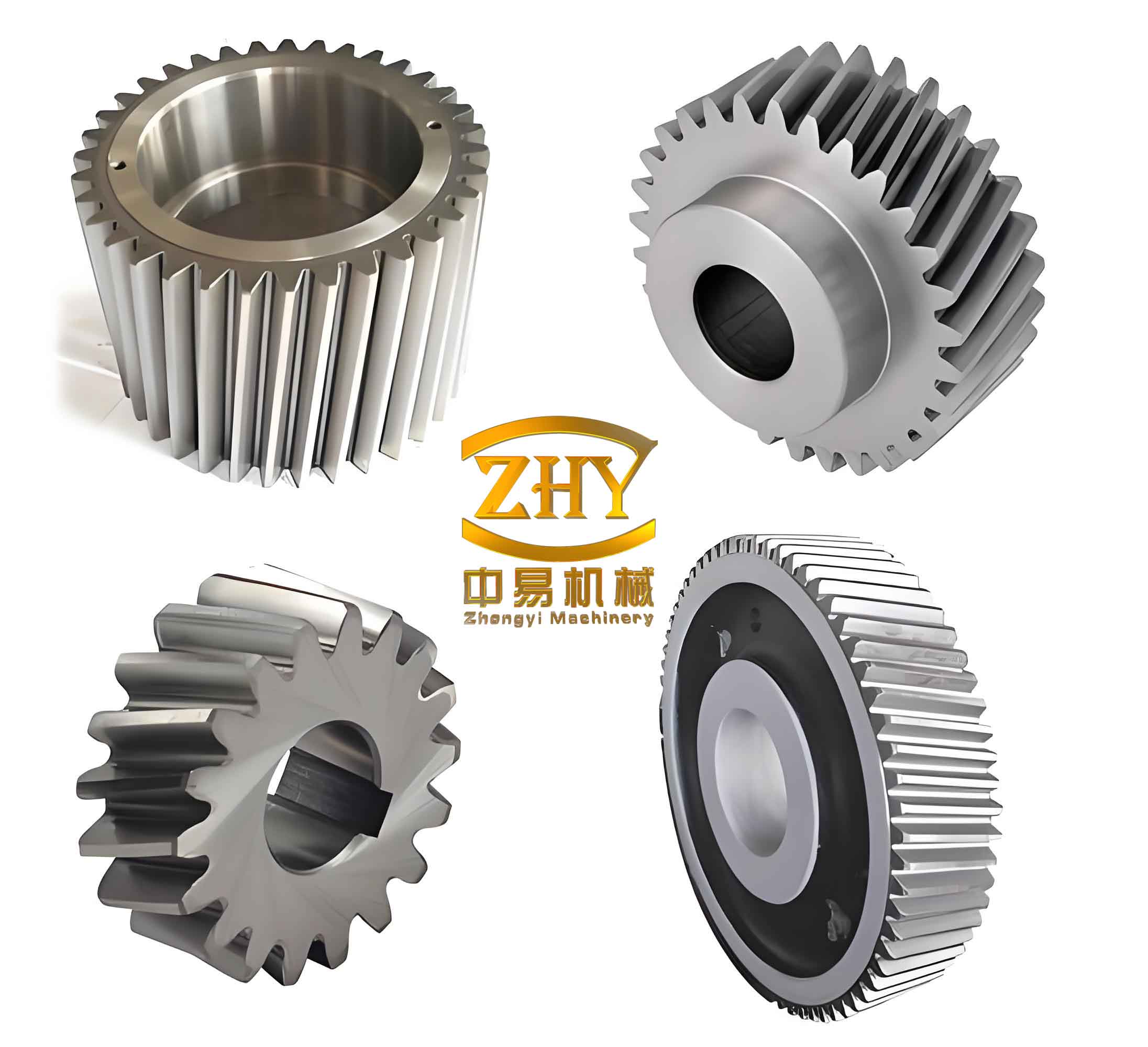
In the following sections, I present the mechanical model and mathematical formulation, followed by global dynamic analysis with bifurcation diagrams, parameter studies, and basin of attraction maps. I conclude with practical implications for helical gear design.
1. Mechanical Model and Motion Equations
I consider a typical single-stage helical gear pair. The parameters are listed in Table 1. The simplified model consists of two gears with rotational inertia, masses, torques, and base radii. The helical angle β introduces an axial component in the mesh force. I derive the equations of motion based on Newton’s second law.
| Parameter (Unit) | Value |
|---|---|
| Number of teeth on driving gear | 25 |
| Number of teeth on driven gear | 46 |
| Normal module (mm) | 3 |
| Normal pressure angle (°) | 20 |
| Helix angle (°) | 21 |
| Face width (mm) | 30 |
| Driving torque (Nm) | 1500 |
| Driving speed (rpm) | 300 |
Let ψ₁, ψ₂ be the angular displacements of the driving and driven gears, I₁, I₂ their moments of inertia, m₁, m₂ masses, T₁, T₂ torques, and r₁, r₂ base radii. The relative displacement coordinate is defined as X = r₁ψ₁ – r₂ψ₂ – e(t), where e(t) is the composite transmission error. The equivalent mass mₑ is:
$$ m_e = \frac{I_1 I_2}{I_1 r_2^2 + I_2 r_1^2} $$
The dimensionless equation of motion becomes:
$$ \ddot{x} + 2\xi \cos\beta \, \dot{x} + k(t) \cos\beta \, f(x) = F_m + F_e \omega^2 \cos(\omega t) $$
where:
$$ k(t) = 1 – k \cos(\omega t) $$
and f(x) is the backlash function:
$$ f(x) = \begin{cases}
x – b, & x > b \\
0, & -b < x < b \\
x + b, & x < -b
\end{cases} $$
I use the dimensionless parameters: x = X/bc, ξ = C/(2mₑ ωₙ), Fm = fm/(mₑ b c ωₙ²), Fe = error amplitude, b = B/bc (normalized backlash), ω = excitation frequency ratio, and ωₙ = natural frequency.
2. Global Dynamic Analysis
2.1 Influence of Backlash b
Backlash in helical gears is unavoidable due to manufacturing and assembly constraints. I study its effect on system dynamics by fixing other parameters: Fm = 0.15, Fe = 0.15, ξ = 0.04, k = 0.1. I vary backlash b = 0.2, 0.4, 0.6 and compute bifurcation diagrams with respect to excitation frequency ω using the fourth-order Runge-Kutta method. The resulting plots show forward (red) and backward (blue) continuation, along with the maximum Lyapunov exponent (TLE).
For b = 0.2 (Figure not shown, but described), the system exhibits saddle-node bifurcations at ω = 0.6856, 0.6196, 0.9154, 0.8782, leading to transitions between period-1 motions. A period-doubling bifurcation occurs at ω = 1.1056, transforming period-1 into period-2, which persists until ω ≈ 1.645. Chaos begins at ω = 1.5856, followed by periodic windows. At ω = 1.8256, period-4 appears, then period-2 after inverse period doubling at ω = 1.8436, and finally period-1 after ω = 1.9396.
For b = 0.6, I observe more complex behavior: saddle-node bifurcations at ω = 0.6856, 0.5656, 0.5208, 0.5792; period-doubling at ω = 1.1064 leads to period-2. A prominent hysteresis region emerges in ω ∈ [1.1064, 1.3232] with coexistence of two period-2 attractors and a period-4 attractor. Chaos appears at ω = 1.3232 and persists until ω = 1.824, after which period-4, period-2, and finally period-1 emerge again.
Table 2 summarizes the key bifurcation points for different backlash values.
| Bifurcation Type | b = 0.2 | b = 0.6 |
|---|---|---|
| Saddle-node (first) | ω = 0.6856 | ω = 0.6856, 0.5656 |
| Period-doubling (PD1) | ω = 1.1056 | ω = 1.1064 |
| Chaos onset | ω = 1.5856 | ω = 1.3232 |
| Inverse PD to period-1 | ω = 1.9396 | ω = 1.9368 |
Comparing the results, increasing backlash significantly expands the chaotic and hysteresis regions, introduces new periodic motions (e.g., period-4 attractors), and enhances coexistence. Therefore, appropriate reduction of backlash within a reasonable range can improve the stability and reduce vibration and noise of helical gears.
2.2 Evolution and Bifurcation of Coexisting Attractors vs. Frequency ω
To investigate the influence of excitation frequency ω on coexistence, I perform continuation shooting method and Floquet theory on the system with b = 0.6. The resulting bifurcation diagram (extended) reveals multiple branches of stable (solid) and unstable (dashed) periodic solutions. Saddle-node (SN), grazing (GR), and period-doubling (PD) bifurcation points are identified.
For increasing ω, the system starts with a 1-0-0 motion (no contact in negative gap region) and eventually becomes a 1-1-0 motion (one impact on each side). The initial attractor undergoes a grazing bifurcation GR1 to become 1-1-0. Then at SN1, the 1-1-0 loses stability and undergoes a grazing-saddle-node bifurcation (GR2-SN2) at ω = 0.5120304, regaining stability as a 1-1-1 attractor. Later, at SN3 (ω = 0.719001915), it loses stability and at GR3-SN4 (ω = 0.56693721) transforms back to 1-1-0.
At PD1 (ω = 1.12362), the 1-1-0 attractor doubles to a 2-2-0 attractor, creating an unstable U1-1-0 branch. The 2-2-0 attractor undergoes grazing GR4 (ω = 1.2167001231) to become 2-1-0. Then at SN5 (ω = 1.30790591) it loses stability, and at GR5-SN6 (ω = 1.0581531573) it regains stability as 2-1-1. Further evolution through period bubbles leads to SN7 and GR6-SN8, eventually returning to 2-1-0. At PD2 (ω = 1.07578163), a period-doubling to 4-2-0 occurs. The branch of 4-2-0 undergoes a period-doubling cascade to chaos, then inverse cascade to period-4, and finally inverse PD back to 2-2-0 and then 1-1-0 at PD6 (ω = 1.948989).
Thus, within ω ∈ [0.56693721, 0.6892072805] and ω ∈ [1.0581532, 1.3079059156], multiple attractors coexist. Table 3 lists the main bifurcation types and their effects.
| Bifurcation Type | Symbol | Effect |
|---|---|---|
| Saddle-node | SN | Creation/destruction of periodic orbits, loss of stability |
| Period-doubling | PD | Transition to higher period, route to chaos |
| Grazing (regular) | GR | Change in impact pattern without altering basin structure |
| Grazing-saddle-node | GR-SN | Significant change in attractor type and basin topology |
2.3 Stability Analysis of Coexisting Attractors
To understand the stability of coexisting attractors, I compute basins of attraction using the cell mapping method for selected ω values. For the hysteresis region ω ∈ [0.56693721, 0.6892072805], three attractors coexist: a stable 1-0-0 (blue basin), a stable 1-1-1 (cyan basin), and an unstable U1-1-0 (boundary). As ω increases toward GR3-SN4, the basin of 1-0-0 shrinks while the basin of 1-1-1 expands. After crossing GR3-SN4, a new stable 1-1-0 attractor (yellow basin) appears, leading to three stable period-1 attractors coexisting. The basins become interwoven, indicating sensitive dependence on initial conditions.
In the second hysteresis region ω ∈ [1.0581532, 1.3079059156], I observe two period-2 attractors (2-2-0 and 2-1-0 or 2-1-1) and a period-4 attractor (4-2-0) coexisting. As ω increases, the basin of 2-1-0 shrinks, while the basin of 4-2-0 expands. The unstable U2-1-0 and U2-1-1 act as basin boundaries. The system exhibits complex riddled basins, typical of non-smooth systems with impact.
Table 4 summarizes the coexistence scenarios and stability features.
| Frequency Range | Coexisting Attractors | Stability |
|---|---|---|
| [0.5669, 0.6892] | 1-0-0, 1-1-1, U1-1-0 (boundary) | Two stable, one unstable saddle |
| [0.6892, 0.7190] | 1-0-0, 1-1-1, 1-1-0 (three stable) | All stable, basins interwoven |
| [1.0582, 1.3079] | 2-2-0, 2-1-0/2-1-1, 4-2-0, U2-1-0,U2-1-1 | Stable period-2 and period-4, unstable saddles |
My analysis confirms that grazing-saddle-node bifurcations (GR-SN) significantly alter the basin structure and system stability, while regular grazing (GR) only changes the impact pattern without affecting the basin topology. This distinction is crucial for predicting the dynamic response of helical gears under varying operating conditions.
3. Conclusions
Through comprehensive numerical analysis of a single-stage helical gear transmission system, I draw the following conclusions:
- Backlash has a strong influence on the dynamics of helical gears. Increasing backlash expands chaotic and hysteresis regions, introduces new periodic motions (such as 4-2-0), and increases the complexity of nonlinear vibrations. Appropriately reducing backlash within a reasonable range can enhance system stability and reduce noise and vibration in helical gears.
- Under fixed other parameters, helical gear systems exhibit rich dynamic behavior in the low-frequency region. Small changes in excitation frequency can cause significant response variations due to internal resonance. Coexisting attractors and chaos appear, requiring careful selection of operating frequencies to ensure stable transmission. I discovered that grazing-saddle-node bifurcations (GR-SN) are characteristic non-smooth bifurcations in helical gears.
- Multiple coexisting attractors are prevalent in helical gear systems. The GR-SN bifurcation leads to a change in attractor type and significant alteration of the basin of attraction, strongly affecting system stability. In contrast, regular grazing (GR) only modifies the impact pattern without changing the basin structure, having a minor effect on overall stability. These findings provide theoretical guidance for the design and optimization of helical gears to achieve smoother and more reliable operation.
My work highlights the importance of considering non-smooth dynamics in helical gear systems. Future research could extend to multi-stage helical gear trains, wear effects, and experimental validation.