
In mechanical engineering, gear systems are pivotal for power and motion transmission, with their dynamic behavior critically influencing overall equipment performance. Among these, spiral bevel gears stand out due to their high load capacity, superior transmission ratios, and smooth operation, making them indispensable in automotive, aerospace, and precision machinery applications. However, the nonlinear dynamics of spiral bevel gears, characterized by factors like time-varying mesh stiffness, damping, and gear mesh frequencies, can lead to complex behaviors such as chaos and instability, which may compromise system reliability. In this study, I aim to delve into the nonlinear dynamic characteristics of spiral bevel gear systems by developing a mathematical model and applying advanced analytical techniques, including phase space reconstruction, recurrence plots, and recurrence quantification analysis. By examining the effects of key parameters—mesh frequency, stiffness coefficient, and damping coefficient—I seek to uncover patterns that can guide the design and operation of spiral bevel gears for enhanced stability and efficiency. The insights gained will contribute to a deeper understanding of how these systems respond under varying conditions, ultimately aiding in the optimization of mechanical transmissions.
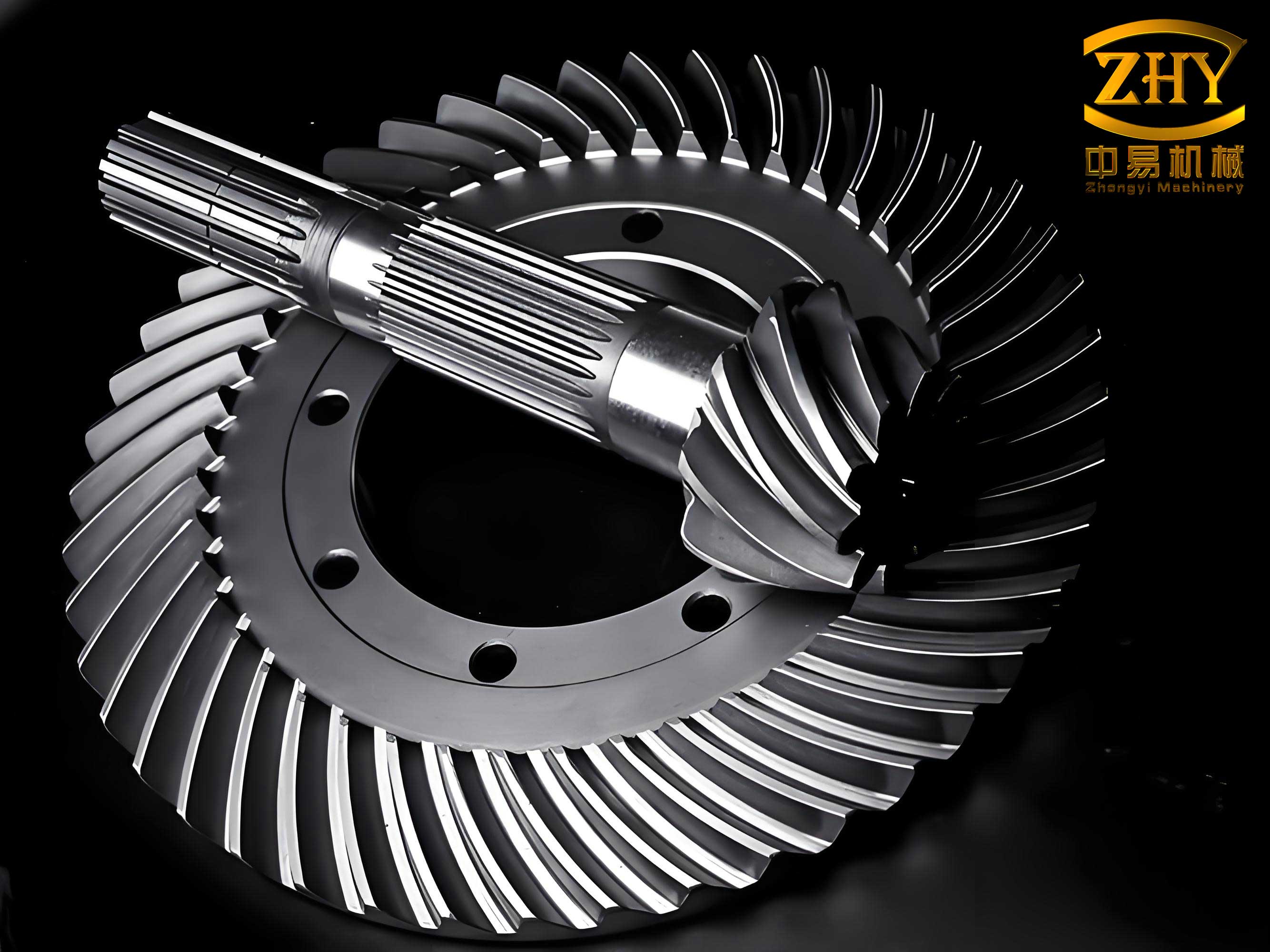
To analyze the nonlinear dynamics of spiral bevel gears, I first establish a comprehensive mathematical model that captures the essential physical interactions within the gear system. The model considers an eight-degree-of-freedom representation, treating both gears as rigid bodies with vibrations and errors incorporated. The relative displacement along the normal direction at the mesh point, denoted as $\lambda_n$, is derived from the gear kinematics and includes contributions from translational and rotational motions, as well as static transmission errors. This displacement is expressed as: $$\lambda_n = (X_1 – X_2)c_1 – (Y_1 – Y_2)c_2 – (Z_1 – Z_2 + r_1\theta_1 – r_2\theta_2)c_3 – e_n(t)$$ where $X_i$, $Y_i$, $Z_i$, and $\theta_i$ represent the displacements and rotations of the gears, $r_i$ are the radii at the mesh point, $c_1$, $c_2$, $c_3$ are geometric constants dependent on the spiral angle $\beta_m$ and pressure angle $\alpha_n$, and $e_n(t)$ is the normal static transmission error. The error is modeled as a Fourier series: $$e_n(t) = \sum_{l=1}^{N_e} A_{el} \cos(l\Omega_h t + \Phi_{el})$$ with $\Omega_h$ as the mesh frequency, $A_{el}$ as amplitude, and $\Phi_{el}$ as phase. The dynamic normal load $F_n$ during meshing accounts for time-varying stiffness $k_h(t)$ and damping $c_h$, given by: $$F_n = k_h(t) f(\lambda_n) + c_h \dot{\lambda}_n$$ Here, $f(\lambda_n)$ is a clearance function that incorporates gear backlash: $$f(\lambda_n) = \begin{cases} \lambda_n – b_m & \lambda_n > b_m \\ \lambda_n & |\lambda_n| \le b_m \\ \lambda_n + b_m & \lambda_n < -b_m \end{cases}$$ where $b_m$ is half the normal average backlash. The time-varying mesh stiffness $k_h(t)$ is similarly expressed as: $$k_h(t) = k_m + \sum_{l=1}^{N_k} A_{kl} \cos(l\Omega_h t + \Phi_{kl})$$ where $k_m$ is the mean stiffness, and $A_{kl}$ and $\Phi_{kl}$ are harmonic coefficients. For simplicity, I often consider the fundamental component, leading to $k_h(t) = 1 + \varepsilon \cos(\omega_h \tau + \Phi_k)$ after normalization, with $\varepsilon$ as the stiffness coefficient. The forces along coordinate directions are derived from $F_n$ using trigonometric relations based on gear geometry. To non-dimensionalize the equations, I define parameters such as $\omega_n = \sqrt{k_m / m_e}$ as the natural frequency, $\tau = \omega_n t$ as dimensionless time, and $\omega_h = \Omega_h / \omega_n$ as dimensionless mesh frequency. The resulting dimensionless system of equations for the spiral bevel gear dynamics is: $$\begin{aligned} &\ddot{x}_1 + 2\xi_{x1}\dot{x}_1 + 2\xi_{h1}c_4\dot{\lambda} + k_{x1}x_1 + k_{h1}f(\lambda) = 0 \\ &\ddot{y}_1 + 2\xi_{y1}\dot{y}_1 – 2\xi_{h1}c_5\dot{\lambda} + k_{y1}y_1 – k_{h1}f(\lambda) = 0 \\ &\ddot{z}_1 + 2\xi_{z1}\dot{z}_1 – 2\xi_{h1}c_6\dot{\lambda} + k_{z1}z_1 – k_{h1}f(\lambda) = 0 \\ &\ddot{x}_2 + 2\xi_{x2}\dot{x}_2 – 2\xi_{h2}c_4\dot{\lambda} + k_{x2}x_2 – k_{h2}f(\lambda) = 0 \\ &\ddot{y}_2 + 2\xi_{y2}\dot{y}_2 + 2\xi_{h2}c_5\dot{\lambda} + k_{y2}y_2 + k_{h2}f(\lambda) = 0 \\ &\ddot{z}_2 + 2\xi_{z2}\dot{z}_2 + 2\xi_{h1}c_6\dot{\lambda} + k_{z2}z_2 + k_{h2}f(\lambda) = 0 \\ &-c_1\ddot{x}_1 + c_2\ddot{y}_1 + c_3\ddot{z}_1 + c_1\ddot{x}_2 – c_2\ddot{y}_2 – c_3\ddot{z}_2 + \ddot{\lambda} + 2\xi_m c_6\dot{\lambda} + \tilde{k}_h c_6 f(\lambda) = f_{1m} + f_{1v} + f_e \end{aligned}$$ where $x_i, y_i, z_i$ are dimensionless displacements, $\xi_{ij}$ are damping ratios, $k_{ij}$ are stiffness ratios, and $f_{1m}$, $f_{1v}$, $f_e$ represent dimensionless force components from mean torque, varying torque, and error excitation, respectively. The parameters $c_4, c_5, c_6$ are derived from $c_1, c_2, c_3$ and gear angles. This model forms the basis for simulating the time series responses of spiral bevel gears under different operating conditions, which I then analyze using nonlinear methods.
To investigate the nonlinear dynamics, I employ phase space reconstruction, a technique that recovers the underlying attractor from a one-dimensional time series. According to Taken’s embedding theorem, for a discrete time series $\{x(t), t = 1, 2, \dots, n\}$, the reconstructed phase space vectors are: $$X_t = [x(t), x(t+\tau), x(t+2\tau), \dots, x(t+(m-1)\tau)]$$ for $t = 1, 2, \dots, N$, where $\tau$ is the delay time and $m$ is the embedding dimension. The matrix representation is: $$Y = [X_1, X_2, \dots, X_N] = \begin{bmatrix} x(1) & x(2) & \dots & x(N – (m-1)\tau) \\ x(1+\tau) & x(2+\tau) & \dots & x(N – (m-2)\tau) \\ \vdots & \vdots & \ddots & \vdots \\ x(1+(m-1)\tau) & x(2+(m-1)\tau) & \dots & x(N) \end{bmatrix}$$ Determining $\tau$ and $m$ is crucial. I use the autocorrelation function method for $\tau$: $$C(\tau) = \frac{\sum [x(i+\tau)x(i)]}{N}$$ selecting $\tau$ when $C(\tau)$ first drops to $C(0)/e$. For $m$, I apply the false nearest neighbors (FNN) method, which computes: $$f_m(t) = \sqrt{\frac{R_{m+1}^2(t) – R_m^2(t)}{R_m^2(t)}} = \frac{|x(t+m\tau) – x_{NN}(t+m\tau)|}{R_m(t)}$$ where $x_{NN}$ is the nearest neighbor, and $R_m(t)$ is the distance. The optimal $m$ is found when $f_m(t)$ stabilizes. These parameters ensure an accurate reconstruction for analyzing attractor structures in spiral bevel gear systems.
In addition to phase space reconstruction, I utilize recurrence plots (RPs) and recurrence quantification analysis (RQA) to visualize and quantify the dynamics. Recurrence plots are based on the recurrence matrix: $$R_{ij} = \Theta(\varepsilon – \|X_i – X_j\|), \quad i,j = 1,2,\dots,N$$ where $\Theta$ is the Heaviside function, $\varepsilon$ is a threshold, and $\|\cdot\|$ is the Euclidean norm. Black dots indicate recurrence, forming patterns that reveal system behavior. The threshold $\varepsilon$ is chosen to maintain a recurrence rate around 0.02 for clarity. For quantitative insights, I compute RQA measures: recurrence rate (RR), recurrence entropy (ENTR), and trapping time (TT). Recurrence rate is: $$RR = \frac{1}{N^2} \sum_{i,j=1}^{N} R_{ij}$$ Recurrence entropy, which reflects system complexity, is: $$ENTR = -\sum_{l=l_{\min}}^{N} p(l) \ln p(l)$$ where $p(l)$ is the distribution of diagonal line lengths. Trapping time, indicating the duration in a state, is: $$TT = \frac{\sum_{v=v_{\min}}^{N} v P(v)}{\sum_{v=v_{\min}}^{N} P(v)}$$ with $P(v)$ as the distribution of vertical line lengths. These methods allow me to systematically assess how parameters like mesh frequency, stiffness coefficient, and damping coefficient influence the nonlinear dynamics of spiral bevel gears.
I now present the results from analyzing the spiral bevel gear system under varying parameters. The time series are generated by solving the dimensionless equations using numerical integration, such as the Runge-Kutta method, for different values of $\omega_h$ (dimensionless mesh frequency), $\varepsilon$ (stiffness coefficient), and $\xi_m$ (damping coefficient). The baseline parameters are set as: $\beta_m = 35^\circ$, $\alpha_n = 20^\circ$, $\xi_{ij} = 0.01$, $\xi_{h1} = \xi_{h2} = 0.0125$, $\xi_h = 0.05$, $f_{pv} = 0$, $f_e = 0.2\omega_h^2 \cos(\omega_h \tau)$, $f_{pm} = 0.5$, $k_{ij} = 1.25$, $k_h = 1 + 0.2\cos(\omega_h \tau)$, $k_{h1} = k_{h2} = 0.5$. First, I examine the effect of mesh frequency $\omega_h$. The attractors in the reconstructed phase space and corresponding recurrence plots show distinct patterns. For instance, at $\omega_h = 0.30$, the attractor is a simple closed curve, indicating periodic motion, and the recurrence plot displays parallel diagonal lines. As $\omega_h$ increases to 1.65, the attractor becomes tangled with overlapping trajectories, and the recurrence plot shows complex, chaotic-like structures. At $\omega_h = 2.00$, the system returns to quasi-periodic motion with simpler patterns. The RQA measures for different $\omega_h$ values are summarized in Table 1.
| $\omega_h$ | $RR$ | $ENTR$ | $TT$ |
|---|---|---|---|
| 0.30 | 0.01992 | 5.6903 | 23.7937 |
| 0.55 | 0.02009 | 4.0923 | 13.0949 |
| 0.70 | 0.02015 | 5.9160 | 10.3184 |
| 0.90 | 0.01904 | 4.8286 | 15.4563 |
| 1.30 | 0.02085 | 5.0137 | 5.7481 |
| 1.65 | 0.02066 | 5.9390 | 27.6131 |
| 1.85 | 0.02071 | 4.6106 | 4.0128 |
| 2.00 | 0.02031 | 4.5170 | 3.6408 |
From Table 1, at $\omega_h = 1.65$, both $ENTR$ and $TT$ peak, indicating heightened complexity and chaotic behavior. This suggests that spiral bevel gears operating near this mesh frequency may experience instability, so it should be avoided in design. Next, I analyze the impact of stiffness coefficient $\varepsilon$ with fixed $\omega_h = 1.65$ and $\xi_m = 0.05$. The attractors evolve from regular cycles at low $\varepsilon$ to twisted shapes at intermediate values, then back to simplicity at high $\varepsilon$. Recurrence plots mirror this: at $\varepsilon = 0.1$ and 1.0, they show clean diagonal lines; at $\varepsilon = 0.5$, they exhibit short, disordered segments. RQA results for $\xi_m = 0.05$ and $\xi_m = 0.07$ are in Tables 2 and 3.
| $\varepsilon$ | $RR$ | $ENTR$ | $TT$ |
|---|---|---|---|
| 0.1 | 0.0203 | 4.9762 | 4.4200 |
| 0.3 | 0.0206 | 4.9004 | 17.8529 |
| 0.5 | 0.0197 | 5.1669 | 44.6562 |
| 0.6 | 0.0196 | 5.3563 | 19.1473 |
| 0.8 | 0.0203 | 4.0895 | 4.3997 |
| 1.0 | 0.0192 | 3.9290 | 4.1642 |
| $\varepsilon$ | $RR$ | $ENTR$ | $TT$ |
|---|---|---|---|
| 0.1 | 0.0204 | 4.0680 | 4.4279 |
| 0.3 | 0.0209 | 4.8913 | 18.1799 |
| 0.5 | 0.0210 | 5.0877 | 18.2166 |
| 0.6 | 0.0204 | 5.2858 | 38.3728 |
| 0.8 | 0.0208 | 3.9940 | 4.5159 |
| 1.0 | 0.0201 | 4.4031 | 4.3746 |
In both cases, $ENTR$ and $TT$ vary non-monotonically, with peaks at $\varepsilon = 0.5$ or 0.6, implying that moderate stiffness can induce chaotic dynamics in spiral bevel gears, whereas high stiffness promotes stability. Lastly, I study damping coefficient $\xi_m$ effects with $\omega_h = 1.65$ and $\varepsilon = 0.2$ or 0.5. Attractors transition from complex, overlapping patterns at low $\xi_m$ to smooth curves at $\xi_m = 0.10$. Recurrence plots show diagonal lines throughout, but with vertical segments appearing at intermediate damping. RQA results for $\varepsilon = 0.2$ and 0.5 are in Tables 4 and 5.
| $\xi_m$ | $RR$ | $ENTR$ | $TT$ |
|---|---|---|---|
| 0.01 | 0.0202 | 4.7725 | 17.5770 |
| 0.05 | 0.0200 | 4.9910 | 29.3635 |
| 0.07 | 0.0196 | 5.7224 | 18.6100 |
| 0.10 | 0.0211 | 4.0549 | 4.5733 |
| $\xi_m$ | $RR$ | $ENTR$ | $TT$ |
|---|---|---|---|
| 0.01 | 0.0192 | 4.6865 | 19.8113 |
| 0.05 | 0.0197 | 5.1669 | 44.6562 |
| 0.07 | 0.0190 | 5.2409 | 38.8932 |
| 0.10 | 0.0204 | 5.0867 | 17.7056 |
$ENTR$ and $TT$ generally decrease at high $\xi_m$, confirming that increased damping stabilizes spiral bevel gear systems. Overall, these analyses highlight that spiral bevel gears exhibit rich nonlinear dynamics, with chaos emerging under specific parameter combinations. To ensure reliable operation, designers should select higher stiffness and damping coefficients while avoiding critical mesh frequencies. This study underscores the value of nonlinear methods in diagnosing and optimizing spiral bevel gear performance.
In conclusion, the nonlinear dynamics of spiral bevel gears are profoundly influenced by operational parameters such as mesh frequency, stiffness coefficient, and damping coefficient. Through mathematical modeling and advanced analytical techniques—including phase space reconstruction, recurrence plots, and recurrence quantification analysis—I have demonstrated that spiral bevel gears can transition between periodic, quasi-periodic, and chaotic states depending on these factors. Specifically, when stiffness and damping are high, and the mesh frequency is away from resonant regions, spiral bevel gears tend to exhibit simpler attractor structures and recurrence patterns, indicating stable motion. Conversely, lower stiffness or damping, or operating near critical frequencies, can lead to complex, chaotic behaviors that may compromise system integrity. The quantitative measures from RQA, such as recurrence entropy and trapping time, provide clear indicators of these dynamics, with peaks corresponding to heightened complexity. These insights are crucial for the design and maintenance of spiral bevel gears in practical applications, as they guide parameter selection to minimize instability and enhance longevity. Future work could explore additional factors like lubrication or wear in spiral bevel gears, further enriching our understanding of their nonlinear behavior. Ultimately, this research contributes to the broader field of gear dynamics, offering tools and findings that can be applied to improve the performance of spiral bevel gears across various industries.