
In modern mechanical systems, spur gears are widely used due to their simplicity and efficiency in transmitting power. However, at high speeds, effective lubrication becomes critical to minimize wear, reduce friction, and dissipate heat. Oil jet lubrication is a common method where oil is injected directly into the gear mesh to ensure adequate coverage. This study focuses on analyzing the lubrication performance of spur gears under various oil jet parameters using computational fluid dynamics (CFD). The interaction between high-speed airflow and the oil jet is investigated to optimize lubrication efficiency. By examining factors such as injection angle, speed, distance, and gear rotational speed, we aim to provide insights into designing efficient lubrication systems for spur gears.
The geometry of spur gears is characterized by straight teeth parallel to the axis of rotation, which simplifies manufacturing and analysis. The mathematical model for spur gear tooth surfaces can be derived based on involute profiles. For a standard spur gear, the tooth profile is defined by the base circle and pressure angle. The position vector and unit normal vector for the tooth surface can be expressed using coordinate transformations. Consider a spur gear with parameters such as number of teeth, module, and pressure angle. The tooth surface equation for spur gears can be represented as follows:
$$ \mathbf{r}^{(d)} = \mathbf{M}_{di} \mathbf{M}_{i1} \mathbf{r}^{(1)} $$
$$ \mathbf{n}^{(d)} = \mathbf{L}_{di} \mathbf{L}_{i1} \mathbf{n}^{(1)} $$
where $\mathbf{r}^{(d)}$ is the position vector in the gear coordinate system, $\mathbf{n}^{(d)}$ is the unit normal vector, and $\mathbf{M}$ and $\mathbf{L}$ are transformation matrices. For spur gears, the contact between teeth is typically line contact, but under load, it deforms into an elliptical area due to elasticity. The contact ellipse dimensions can be determined using curvature analysis. The equation for the contact ellipse is given by:
$$ A x^2 + B y^2 = \delta $$
where $A$ and $B$ are coefficients derived from the principal curvatures of the gear surfaces, and $\delta$ is the deformation at the contact point. The semi-major axis $a$ and semi-minor axis $b$ of the ellipse are calculated as:
$$ a = \sqrt{\frac{\delta}{A}}, \quad b = \sqrt{\frac{\delta}{B}} $$
This contact analysis helps in understanding the lubrication requirements for spur gears, as the oil must penetrate the contact zone to reduce friction and wear.
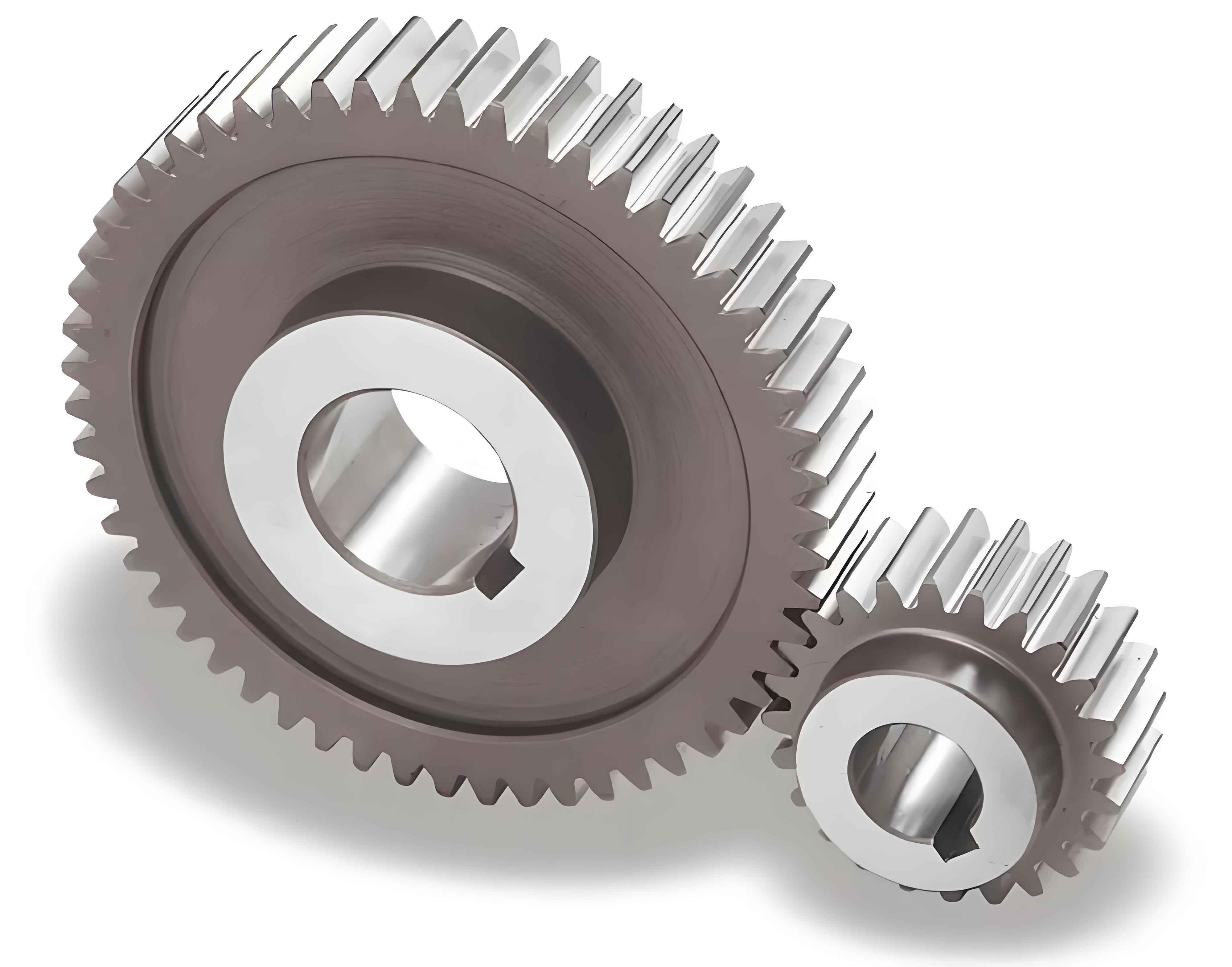
To model the oil jet lubrication for spur gears, we employ the Eulerian multiphase flow approach with the Volume of Fluid (VOF) method. This allows us to simulate the interaction between air and oil phases. The governing equations include the continuity equation and momentum conservation equation. For incompressible flow, the continuity equation is:
$$ \frac{\partial \rho}{\partial t} + \nabla \cdot (\rho \mathbf{U}) = 0 $$
where $\rho$ is the density, $t$ is time, and $\mathbf{U}$ is the velocity vector. The momentum equation is:
$$ \frac{\partial (\rho \mathbf{U})}{\partial t} + \nabla \cdot (\rho \mathbf{U} \mathbf{U}) = -\nabla p + \nabla \cdot [\mu (\nabla \mathbf{U} + (\nabla \mathbf{U})^T)] + \rho \mathbf{g} + \mathbf{F} $$
Here, $p$ is pressure, $\mu$ is dynamic viscosity, $\mathbf{g}$ is gravity, and $\mathbf{F}$ represents external forces. For turbulent flow, the standard $k$-$\epsilon$ model is used, where $k$ is turbulent kinetic energy and $\epsilon$ is dissipation rate. The equations for $k$ and $\epsilon$ are:
$$ \frac{\partial (\rho k)}{\partial t} + \nabla \cdot (\rho \mathbf{U} k) = \nabla \cdot \left[ \left( \mu + \frac{\mu_t}{\sigma_k} \right) \nabla k \right] + G_k – \rho \epsilon $$
$$ \frac{\partial (\rho \epsilon)}{\partial t} + \nabla \cdot (\rho \mathbf{U} \epsilon) = \nabla \cdot \left[ \left( \mu + \frac{\mu_t}{\sigma_\epsilon} \right) \nabla \epsilon \right] + C_{1\epsilon} \frac{\epsilon}{k} G_k – C_{2\epsilon} \rho \frac{\epsilon^2}{k} $$
where $\mu_t = \rho C_\mu \frac{k^2}{\epsilon}$ is the turbulent viscosity, and $C_\mu$, $C_{1\epsilon}$, $C_{2\epsilon}$, $\sigma_k$, $\sigma_\epsilon$ are constants. These equations are solved numerically using CFD software to simulate the oil jet behavior around spur gears.
The dynamic mesh technique is applied to account for gear rotation. The spring-based smoothing method updates the mesh nodes based on displacements, preventing grid distortion. The displacement of a node $i$ is given by:
$$ \Delta x_i = \frac{\sum_{j=1}^{n_i} k_{ij} \Delta x_j}{\sum_{j=1}^{n_i} k_{ij}} $$
where $n_i$ is the number of adjacent nodes, and $k_{ij}$ is the spring constant. The node position is updated as $x_i^{n+1} = x_i^n + \Delta x_i$. This ensures accurate simulation of the moving spur gears during rotation.
For the CFD analysis, a computational domain representing the gearbox is created. The spur gears are modeled with specific geometric parameters, as shown in Table 1. The oil jet nozzle is positioned at various angles and distances to study the lubrication performance. The injection parameters include nozzle diameter, oil density, and injection velocity. The mesh is refined near the nozzle and gear teeth to capture detailed flow characteristics.
| Parameter | Pinion | Gear |
|---|---|---|
| Number of Teeth | 21 | 29 |
| Module (mm) | 4 | 4 |
| Pressure Angle (°) | 20 | 20 |
| Rotational Speed (rpm) | 6000 | 4345 |
| Center Distance (mm) | 100 | 100 |
| Face Width (mm) | 40 | 40 |
| Nozzle Diameter (mm) | 5 | 5 |
| Oil Density (kg/m³) | 960 | 960 |
| Injection Height (mm) | 45 | 45 |
| Injection Velocity (m/s) | 60 | 60 |
The optimization of the oil jet angle is crucial for effective lubrication of spur gears. High-speed rotation creates an air barrier around the gear teeth, which can deflect the oil jet. By analyzing the airflow streamlines, we identify a trajectory with minimal airflow interference. For spur gears, the optimal injection angle is found to be 10.73 degrees towards the pinion. This angle allows the oil jet to penetrate the mesh zone with reduced resistance. Simulations at different angles (-5°, 0°, 5°, and 10.73°) confirm that 10.73° provides the highest oil volume fraction on the tooth surface, indicating better lubrication.
The oil volume fraction on the tooth surface is used to evaluate lubrication performance. For spur gears, a higher oil volume fraction in the contact zone implies improved lubricant coverage. The average oil volume fraction over a detection surface is calculated during meshing. The results show that at 10.73°, the oil is more concentrated, and the pressure difference in the mesh zone is maximized, enhancing oil entrainment. The pressure statistics for different angles are summarized in Table 2.
| Injection Angle (°) | Positive Pressure (MPa) | Negative Pressure (MPa) | Pressure Difference (MPa) |
|---|---|---|---|
| -5 | 0.45 | 0.32 | 0.77 |
| 0 | 0.52 | 0.38 | 0.90 |
| 5 | 0.61 | 0.44 | 1.05 |
| 10.73 | 0.68 | 0.49 | 1.17 |
Next, the effect of injection velocity on spur gear lubrication is investigated. Velocities ranging from 30 m/s to 80 m/s are tested. The oil distribution on the tooth surface becomes more concentrated at higher velocities, as the oil jet gains momentum to overcome airflow. The average oil volume fraction increases with velocity up to 60 m/s, beyond which the improvement plateaus. This is because higher velocities cause oil splashing and reduced efficiency. The pressure difference in the mesh zone also increases with velocity, promoting oil entrainment. Table 3 shows the trend in oil volume fraction and pressure for different velocities.
| Injection Velocity (m/s) | Max Oil Volume Fraction | Pressure Difference (MPa) |
|---|---|---|
| 30 | 0.45 | 0.85 |
| 40 | 0.58 | 1.02 |
| 50 | 0.67 | 1.15 |
| 60 | 0.75 | 1.28 |
| 70 | 0.76 | 1.30 |
| 80 | 0.77 | 1.32 |
Injection height, or the distance from the nozzle to the gear centerline, also affects lubrication. Heights from 30 mm to 55 mm are analyzed. Shorter distances (e.g., 30-40 mm) result in higher oil volume fractions and pressures, as the oil jet is less affected by airflow. At greater heights, oil dispersion increases, reducing lubrication efficiency. For spur gears, a height of 40 mm is optimal, balancing coverage and resistance. The pressure difference decreases significantly beyond 40 mm, as shown in Table 4.
| Injection Height (mm) | Max Oil Volume Fraction | Pressure Difference (MPa) |
|---|---|---|
| 30 | 0.78 | 1.35 |
| 35 | 0.76 | 1.30 |
| 40 | 0.74 | 1.25 |
| 45 | 0.65 | 1.10 |
| 50 | 0.58 | 0.95 |
| 55 | 0.52 | 0.82 |
Gear rotational speed influences lubrication due to centrifugal forces and airflow changes. Speeds from 3000 rpm to 8000 rpm are considered. As speed increases, the oil volume fraction on the tooth surface decreases because higher airflow disrupts the oil jet. Additionally, centrifugal force throws oil away from the teeth, reducing residual oil after meshing. The pressure difference in the mesh zone also drops with speed, weakening oil entrainment. For spur gears, lower speeds favor lubrication, but operational requirements may dictate higher speeds. Table 5 summarizes the results for different speeds.
| Gear Speed (rpm) | Max Oil Volume Fraction | Pressure Difference (MPa) |
|---|---|---|
| 3000 | 0.80 | 1.40 |
| 4000 | 0.78 | 1.35 |
| 5000 | 0.75 | 1.28 |
| 6000 | 0.72 | 1.20 |
| 7000 | 0.68 | 1.12 |
| 8000 | 0.65 | 1.05 |
In conclusion, the lubrication of spur gears via oil jet injection is highly dependent on injection parameters and operational conditions. The optimal injection angle for spur gears is 10.73 degrees towards the pinion, which minimizes airflow interference. Higher injection velocities up to 60 m/s improve lubrication, but further increases yield diminishing returns. Shorter injection heights (around 40 mm) enhance oil coverage, while lower gear speeds reduce oil displacement. These findings provide a foundation for designing efficient lubrication systems for spur gears in high-speed applications. Future work could explore advanced nozzle designs and multi-phase flow models to further optimize spur gear performance.
The mathematical models and CFD simulations demonstrated here highlight the importance of parametric studies in spur gear lubrication. By integrating curvature analysis, fluid dynamics, and optimization techniques, we can achieve reliable and durable gear systems. The use of spur gears in various industries underscores the need for continued research into their lubrication mechanisms to enhance efficiency and longevity.