
In this study, I focus on the heat treatment process of spiral bevel gears, which are critical components in transmission systems such as those used in helicopters and automotive applications. The performance and longevity of these spiral bevel gears heavily depend on their heat treatment, particularly carburizing and quenching, which induces residual stresses and deformation. Traditional experimental methods face limitations in measuring these parameters accurately, so I employ finite element simulation using DEFORM software to analyze the process. This approach allows me to track the evolution of microstructure, residual stress, and deformation in spiral bevel gears over time, providing insights that can guide manufacturing processes. I aim to explore how quenching temperature affects these factors, ultimately improving the fatigue resistance and service life of spiral bevel gears.
The spiral bevel gear is characterized by its complex curved tooth geometry, which poses challenges during heat treatment due to varying cooling rates across the tooth profile. This can lead to non-uniform residual stress distribution and significant deformation, impacting the gear’s precision and load-bearing capacity. By simulating the process, I can predict these effects and optimize the heat treatment parameters. In this article, I will detail the theoretical foundations, numerical modeling, and simulation results, emphasizing the role of finite element analysis in enhancing the quality of spiral bevel gears. Throughout, I will use tables and equations to summarize key data and relationships, ensuring a comprehensive understanding of the phenomena involved.
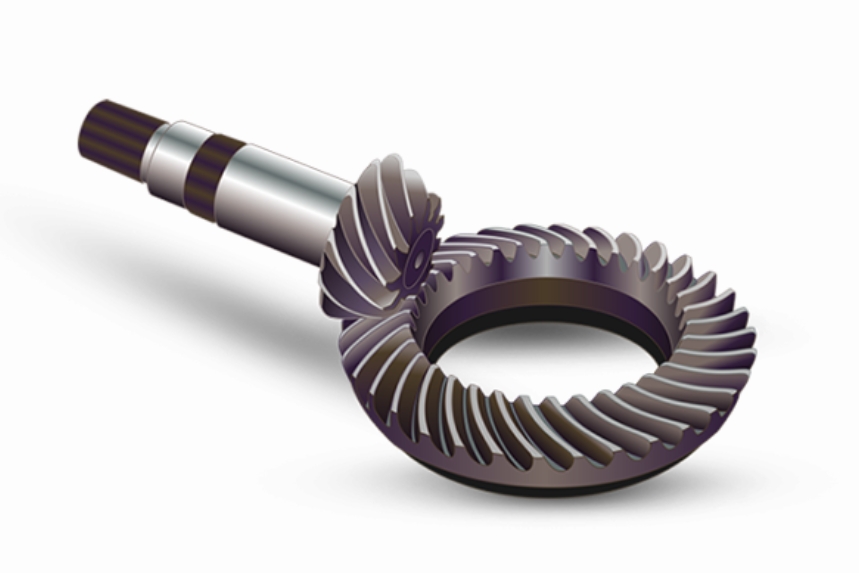
To begin, I review the heat treatment process for spiral bevel gears. The material used is 12Cr2Ni4A steel, known for its high strength and toughness, making it suitable for demanding applications. The chemical composition and mechanical properties are summarized in Table 1 and Table 2 below. These properties influence the response during heat treatment, and understanding them is essential for accurate simulation.
| Element | Content |
|---|---|
| C | 0.10 – 0.15 |
| Mn | 0.30 – 0.60 |
| Si | 0.17 – 0.37 |
| Cr | 1.25 – 1.75 |
| Ni | 3.25 – 3.75 |
| P | < 0.025 |
| S | < 0.015 |
| Property | Value |
|---|---|
| Yield Strength (σ_s) | 1085 MPa |
| Tensile Strength (σ_b) | 1175 MPa |
| Elongation (δ_b) | 12% |
| Reduction of Area (ψ) | 55% |
| Impact Toughness (α_K) | 80 J/cm² |
The heat treatment process for spiral bevel gears involves multiple stages: normalizing, quenching, tempering, carburizing, deep cooling, and low-temperature tempering. These steps are designed to enhance surface hardness while maintaining core toughness. The process curve, as implemented in the simulation, includes heating to austenitizing temperatures, followed by carburizing to enrich the surface with carbon, and then quenching to form martensite. The specific temperature-time profile is critical for controlling residual stresses and deformation in spiral bevel gears. I simulate this using DEFORM, which accounts for thermal and phase transformation effects.
Next, I delve into the theoretical background for heat transfer and stress analysis during the heat treatment of spiral bevel gears. The governing equation for transient heat conduction in a three-dimensional domain, considering internal heat generation, is derived from Fourier’s law and energy conservation. For a material with isotropic thermal conductivity, the equation is expressed as:
$$ \lambda \left( \frac{\partial^2 T}{\partial r^2} + \frac{1}{r} \frac{\partial T}{\partial r} + \frac{\partial^2 T}{\partial x^2} \right) + Q = \rho c_p \frac{\partial T}{\partial t} $$
Here, \( T \) represents the temperature, \( t \) is time, \( \lambda \) is the thermal conductivity, \( \rho \) is density, \( c_p \) is specific heat at constant pressure, and \( Q \) accounts for heat sources such as plastic work and phase transformation enthalpy. For spiral bevel gears, these parameters are temperature-dependent, and I incorporate them into the simulation. The initial condition assumes a uniform temperature distribution at time zero:
$$ T = T_0 \quad \text{at} \quad t = 0 $$
Boundary conditions are categorized into three types. First, temperature boundary conditions specify the surface temperature:
$$ T|_{\Gamma_1} = f(x, y, z, t) $$
Second, heat flux boundary conditions define the heat flow at the surface:
$$ -k \frac{\partial T}{\partial n}|_{\Gamma_2} = g(x, y, z, t) $$
For adiabatic surfaces, this reduces to \( -k \frac{\partial T}{\partial n}|_{\Gamma_2} = 0 \). Third, convection boundary conditions account for heat transfer with the environment:
$$ k \frac{\partial T}{\partial n}|_{\Gamma_3} = \alpha (T – T_f) $$
where \( \alpha \) is the heat transfer coefficient and \( T_f \) is the ambient temperature. During quenching of spiral bevel gears, convection plays a key role due to the cooling medium. The stress analysis is based on thermo-elasto-plastic theory, where thermal expansion and phase transformations induce strains. The total strain \( \epsilon_{total} \) is composed of elastic, plastic, thermal, and transformation strains:
$$ \epsilon_{total} = \epsilon_{el} + \epsilon_{pl} + \epsilon_{th} + \epsilon_{tr} $$
With the elastic strain given by Hooke’s law, plastic strain by yield criteria, thermal strain by \( \epsilon_{th} = \alpha_T (T – T_0) \), and transformation strain due to volume changes during martensitic transformation. For spiral bevel gears, the simulation solves these equations numerically to predict residual stresses and deformation.
I now describe the finite element model for the spiral bevel gear. The gear has a module of 3.25 mm, pressure angle of 20°, spiral angle of 30°, 27 teeth, pitch diameter of 87.75 mm, outer cone distance of 132.50 mm, addendum of 4.20 mm, and dedendum of 2.24 mm. These geometric parameters define the complex shape of the spiral bevel gear, which I discretize using tetrahedral elements. To capture surface effects accurately, I refine the mesh near the tooth surfaces, resulting in a model with 8,588 nodes and 35,364 elements. The material properties are assigned based on 12Cr2Ni4A steel, and the heat treatment process from Figure 1 is applied. The simulation in DEFORM considers temperature-dependent properties, phase transformations, and cooling rates, enabling a detailed analysis of the spiral bevel gear behavior.
The simulation results for microstructure evolution show that after carburizing and quenching, the surface of the spiral bevel gear attains a high martensite content. Specifically, the martensite volume fraction reaches approximately 0.954 at the tooth surface, corresponding to a hardness of HRC 62.5. In contrast, the core region has a lower martensite content, with hardness around HRC 30. This gradient ensures that the spiral bevel gear has a hard, wear-resistant surface and a tough, ductile core, meeting performance requirements. The distribution of martensite is influenced by carbon diffusion during carburizing, which I model using Fick’s law:
$$ \frac{\partial C}{\partial t} = D \nabla^2 C $$
where \( C \) is carbon concentration and \( D \) is diffusion coefficient. For spiral bevel gears, this diffusion is non-uniform due to geometry, affecting the final microstructure.
Regarding residual stress, the simulation reveals a transition during quenching. Initially, thermal stresses dominate: as the surface cools rapidly, it contracts and experiences tensile stress, while the core resists this contraction, leading to compressive stress. However, as cooling progresses, phase transformations come into play. The core, with lower carbon content, undergoes martensitic transformation at a higher temperature (M_s) than the surface, causing volume expansion and shifting stresses. Eventually, the surface transforms to martensite, but the core constrains this expansion, resulting in compressive residual stress at the surface and tensile stress in the core. This is summarized in Table 3 for different points on the spiral bevel gear tooth.
| Time (s) | Surface Stress (MPa) | Core Stress (MPa) | Phase Transformation Status |
|---|---|---|---|
| 10 | Tensile (+150) | Compressive (-100) | No martensite |
| 50 | Tensile (+80) | Compressive (-50) | Core transformation starts |
| 100 | Compressive (-200) | Tensile (+120) | Surface transformation occurs |
| 200 | Compressive (-300) | Tensile (+180) | Full transformation |
The stress state can be expressed mathematically. For instance, the von Mises stress \( \sigma_{vm} \) is calculated as:
$$ \sigma_{vm} = \sqrt{\frac{1}{2} \left[ (\sigma_1 – \sigma_2)^2 + (\sigma_2 – \sigma_3)^2 + (\sigma_3 – \sigma_1)^2 \right]} $$
where \( \sigma_1, \sigma_2, \sigma_3 \) are principal stresses. In spiral bevel gears, these stresses vary along the tooth profile due to curvature effects. I analyze points at the surface (P1), 0.9 mm below the surface (P2), and the core (P3) to capture this variation. The results indicate that residual compressive stress at the surface improves fatigue resistance, which is beneficial for spiral bevel gears under cyclic loading.
Deformation analysis shows that the spiral bevel gear undergoes dimensional changes during quenching, primarily due to volume expansion from martensitic transformation. The axial deformation is most significant, with tooth tips displacing outward. The deformation \( \delta \) can be related to the volumetric strain \( \epsilon_v \) from phase transformation:
$$ \delta = \int \epsilon_v \, dV $$
where \( \epsilon_v = \frac{\Delta V}{V} \) and \( \Delta V \) is the volume change. For spiral bevel gears, the deformation is non-uniform, with higher distortion at thin sections. Simulation data for deformation over time is presented in Table 4, highlighting how it stabilizes after cooling.
| Time (s) | Deformation at Tooth Tip (mm) | Deformation at Tooth Root (mm) |
|---|---|---|
| 0 | 0.000 | 0.000 |
| 30 | +0.050 | +0.020 |
| 60 | +0.120 | +0.040 |
| 120 | +0.180 | +0.060 |
| 300 | +0.200 | +0.065 |
This deformation must be controlled to ensure the spiral bevel gear meets precision standards for subsequent grinding processes. By simulating it, I can predict the required allowances for machining.
I further investigate the effect of quenching temperature on the spiral bevel gear properties. Varying the quenching temperature from 800°C to 950°C, I observe changes in hardness, residual stress, and deformation. The results are summarized in Table 5, showing that higher temperatures generally increase surface hardness and compressive residual stress, but also increase deformation. This trade-off is critical for optimizing the heat treatment of spiral bevel gears.
| Quenching Temperature (°C) | Surface Hardness (HRC) | Surface Residual Stress (MPa) | Axial Deformation (mm) |
|---|---|---|---|
| 800 | 60.0 | -250 | +0.150 |
| 850 | 61.5 | -280 | +0.180 |
| 900 | 62.5 | -300 | +0.200 |
| 950 | 62.8 | -310 | +0.220 |
The relationship between quenching temperature \( T_q \) and hardness \( H \) can be approximated by a polynomial fit based on simulation data:
$$ H = a T_q^2 + b T_q + c $$
where \( a, b, c \) are constants derived from regression analysis. Similarly, residual stress \( \sigma_{res} \) correlates with temperature through:
$$ \sigma_{res} = \alpha_\sigma (T_q – T_{ref}) + \beta_\sigma $$
where \( \alpha_\sigma \) and \( \beta_\sigma \) are material-specific coefficients, and \( T_{ref} \) is a reference temperature. For spiral bevel gears, these equations help in selecting optimal quenching parameters to balance performance and distortion.
The underlying mechanisms involve dissolution of carbides at higher temperatures, increasing alloy content in austenite and enhancing martensite hardness. However, excessive temperatures can lead to grain growth and retained austenite, which may reduce strength. The residual stress increase is attributed to greater thermal gradients and transformation strains. Deformation rises due to enhanced thermal expansion and phase transformation volume changes. These factors are interconnected, and I analyze them using sensitivity studies in the simulation for spiral bevel gears.
To quantify the fatigue performance, I relate residual compressive stress to fatigue life. The modified Goodman equation is often used:
$$ \sigma_a = \sigma_{fat} \left(1 – \frac{\sigma_m}{\sigma_{uts}}\right) $$
where \( \sigma_a \) is the alternating stress amplitude, \( \sigma_{fat} \) is the fatigue limit, \( \sigma_m \) is the mean stress, and \( \sigma_{uts} \) is the ultimate tensile strength. For spiral bevel gears, compressive residual stress reduces \( \sigma_m \), thereby increasing \( \sigma_a \) and extending fatigue life. My simulation confirms that higher quenching temperatures improve this effect, but deformation must be managed to avoid geometric inaccuracies that could induce stress concentrations.
In practice, the heat treatment process for spiral bevel gears can be optimized using the simulation results. For instance, I can recommend a quenching temperature of 900°C for a balance of hardness, residual stress, and deformation. Additionally, controlled cooling rates or press quenching might be explored to minimize distortion. The finite element model allows for virtual testing of such alternatives, saving time and resources in physical trials.
In conclusion, my simulation of spiral bevel gear heat treatment using DEFORM provides valuable insights into residual stress and deformation. The results show that carburizing and quenching produce a desirable compressive stress on the tooth surface and tensile stress in the core, enhancing fatigue resistance. Higher quenching temperatures increase these benefits but also raise deformation, which must be accounted for in subsequent grinding. The use of finite element analysis enables a detailed understanding of the complex interactions during heat treatment, guiding the manufacturing of high-performance spiral bevel gears. Future work could involve experimental validation or extending the model to include other heat treatment processes for spiral bevel gears.