
In this study, I delve into the intricate rolling-sliding mechanism inherent to planetary roller screw assemblies, which are pivotal components in converting rotational motion into linear motion with high precision and load capacity. The planetary roller screw assembly consists of a screw, a nut, and multiple rollers that engage via threaded paths, facilitating planetary motion. Understanding the interplay between rolling and sliding is crucial, as sliding components can increase frictional torque, generate heat, and degrade performance. My focus is on developing a comprehensive model that accounts for elastic deformation to reveal the true nature of contact kinematics in planetary roller screw assemblies. This analysis aims to provide insights into parameter design for enhancing efficiency and durability.
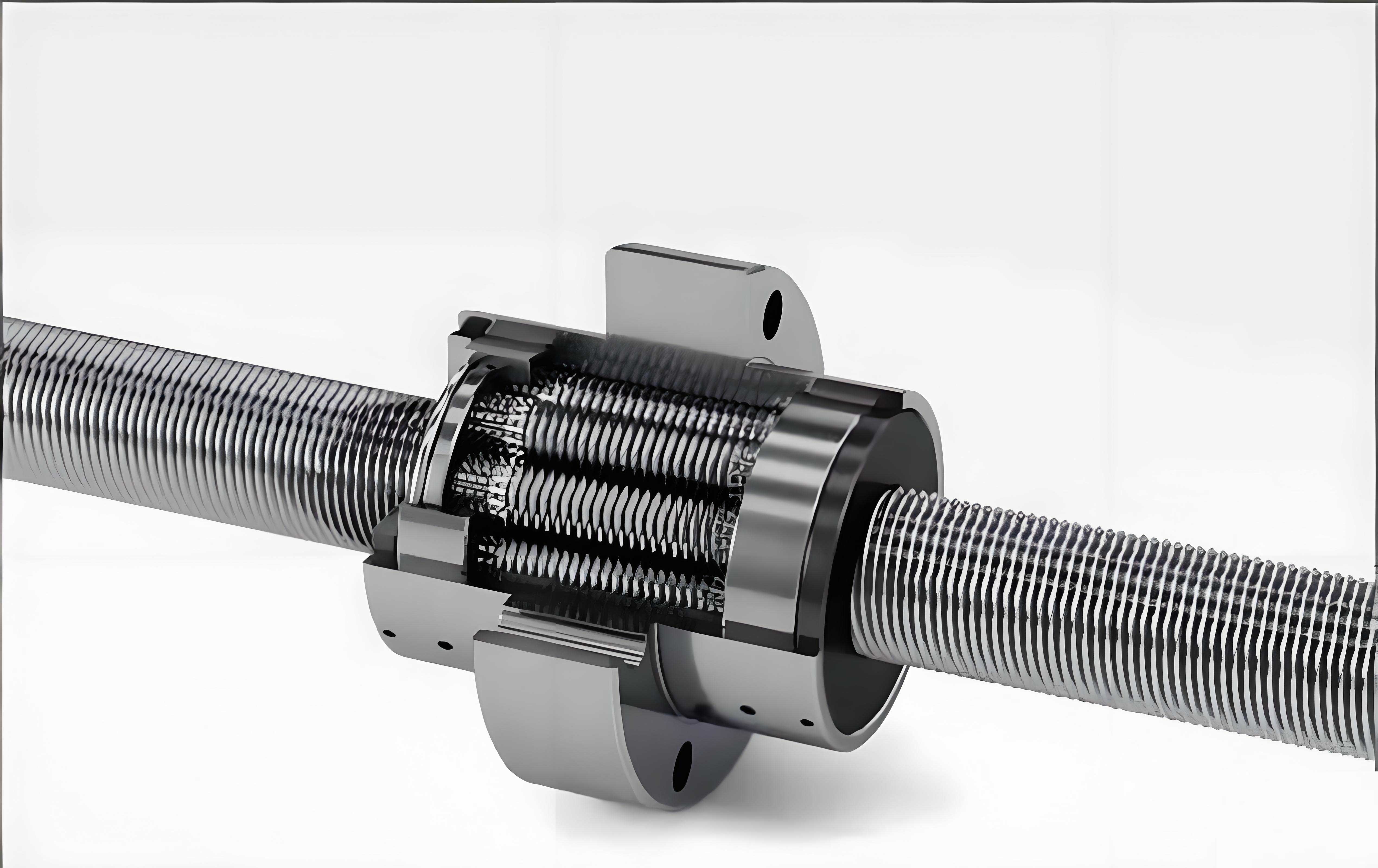
The planetary roller screw assembly operates through the planetary movement of rollers within the helical grooves of the screw and nut. This motion inherently combines rolling and sliding, with sliding arising due to constraints on roller spin axes. To analyze this, I adopt an equivalent sphere method based on the spherical profile of roller threads. By modeling the roller thread as a sphere, I establish kinematic and contact models for both the screw-roller and nut-roller interfaces. The inclusion of elastic deformation is essential, as it affects contact geometry and relative velocities, thereby influencing the sliding tendencies in planetary roller screw assemblies.
I define coordinate systems to facilitate velocity analysis: a fixed Cartesian frame, a rotating frame attached to the screw, and Frenet frames along the helical trajectory of the roller equivalent sphere center. The position vectors for contact points are derived, considering both undeformed and deformed states. For the planetary roller screw assembly, the equivalent sphere radius is given by:
$$ R = \frac{d_r}{2\sin\beta} $$
where \(d_r\) is the roller pitch diameter and \(\beta\) is the contact angle. In the undeformed case, contact points are idealized, but with elastic deformation, contact ellipses form, altering the relative positions. The curvature radii at contact points are calculated as:
$$ R_Q = \frac{2r_{Q,s} r_{RQ}}{r_{Q,s} + r_{RQ}}, \quad R_P = \frac{2r_{P,n} r_{RP}}{r_{P,n} + r_{RP}} $$
where subscripts denote screw-side and nut-side parameters. This deformation is quantified as \(\tilde{r}_Q = R_Q – \sqrt{R_Q^2 – a_Q^2}\) for the screw side, and similarly for the nut side.
The relative sliding velocities are computed by differentiating position vectors. For the planetary roller screw assembly, the velocity of the roller equivalent sphere center in the fixed frame is:
$$ \mathbf{w} \dot{\mathbf{R}}_{oo’} = \begin{bmatrix} d\dot{\theta} + r_m \cos\lambda \dot{\Omega} \\ 0 \\ -r_m \sin\lambda \dot{\Omega} \end{bmatrix}^T \begin{bmatrix} \mathbf{t} \\ \mathbf{n} \\ \mathbf{b} \end{bmatrix} $$
where \(d = r_m / \cos\lambda\), \(r_m\) is the projection radius, \(\lambda\) is the helix angle, \(\dot{\theta}\) is the angular velocity of the sphere center, and \(\dot{\Omega}\) is the screw angular velocity. The velocities at contact points, accounting for roller spin \(\omega_b\) around the binormal axis, are derived. Without elastic deformation, the sliding velocities simplify to:
For the nut side: \(\mathbf{V}_{s,A} = [0, d(\dot{\theta} + \dot{\Omega}) + R\omega_b \cos\beta, 0]^T\) in contact coordinates.
For the screw side: \(\mathbf{V}_{s,B} = [-R\dot{\Omega}\sin\lambda, d\dot{\theta} – R\cos\beta(\omega_b – \dot{\Omega}\cos\lambda), 0]^T\).
With elastic deformation, the sliding velocities become more complex, incorporating terms from contact ellipse coordinates \((x_A, y_A)\) and \((x_B, y_B)\), and deformation offsets \(\tilde{r}_P\) and \(\tilde{r}_Q\). For instance, on the screw side:
$$ \mathbf{V}_{s,Q} = \begin{bmatrix} -y_B \sin\beta (\omega_b – \cos\lambda \dot{\Omega}) – \tilde{r}_Q \sin\lambda \dot{\Omega} \\ d\dot{\theta} + x_B \sin\beta (\omega_b – \cos\lambda \dot{\Omega}) – \tilde{r}_Q \cos\beta (\omega_b – \cos\lambda \dot{\Omega}) \\ x_B \sin\lambda \dot{\Omega} + y_B \cos\beta (\omega_b – \cos\lambda \dot{\Omega}) \end{bmatrix} $$
On the nut side:
$$ \mathbf{V}_{s,P} = \begin{bmatrix} -y_A \sin\beta \omega_b \\ d(\dot{\theta} + \dot{\Omega}) + \tilde{r}_P \cos\beta \omega_b + x_A \sin\beta \omega_b \\ y_A \cos\beta \omega_b \end{bmatrix} $$
These expressions show that in planetary roller screw assemblies, sliding occurs in multiple directions when elastic deformation is considered, with the tangential component along the helix being predominant.
To quantify the sliding behavior, I introduce the slide-roll ratio, defined as:
$$ \zeta = \frac{2 |\mathbf{V}_{dr} – \mathbf{V}_{pr}|}{|\mathbf{V}_{dr} + \mathbf{V}_{pr}|} $$
where \(\mathbf{V}_{dr}\) and \(\mathbf{V}_{pr}\) are the velocities of the driving and driven surfaces, respectively. For the planetary roller screw assembly, the slide-roll ratios on the screw side (\(\zeta_{sr}\)) and nut side (\(\zeta_{nr}\)) are calculated using the velocities derived above. This ratio effectively captures the relative amount of sliding to rolling, providing a metric for assessing performance.
I investigate the influence of key design parameters on the slide-roll ratios in planetary roller screw assemblies. The parameters include contact angle \(\beta\), helix angle \(\lambda\), and number of roller threads \(\tau\). The analysis is based on a reference planetary roller screw assembly with specifications summarized in Table 1.
| Parameter | Value |
|---|---|
| Screw pitch diameter (right-hand) | 39 mm |
| Number of screw starts | 5 |
| Pitch | 5 mm |
| Helix angle | 11.533° |
| Number of roller threads | 10 |
| Contact angle | 45° |
| Roller pitch diameter | 13 mm |
| Roller orbit radius | 26 mm |
| Equivalent sphere radius | 9.192 mm |
| Screw speed | 3000 rpm |
The impact of the contact angle on slide-roll ratios in planetary roller screw assemblies is analyzed under varying axial loads. Results are summarized in Table 2, showing trends for both screw and nut sides.
| Axial Load | Contact Angle Increase | Screw-Side \(\zeta_{sr}\) Trend | Nut-Side \(\zeta_{nr}\) Trend |
|---|---|---|---|
| Low (e.g., 20 kN) | From 30° to 60° | Decreases slightly | Increases moderately |
| Medium (e.g., 50 kN) | From 30° to 60° | Decreases | Increases |
| High (e.g., 80 kN) | From 30° to 60° | Decreases significantly | Increases significantly |
Mathematically, the contact angle affects the normal force distribution and curvature radii. For the screw side, the curvature radius is \(r_{Q,s} = \frac{d_m – 2R\cos\beta}{2\cos\beta}\), where \(d_m\) is the screw pitch diameter. As \(\beta\) increases, the contact area changes, reducing sliding on the screw side but increasing it on the nut side due to larger coordinate values in the contact ellipse. This highlights a trade-off in planetary roller screw assembly design: higher contact angles may benefit the screw side but detriment the nut side under load.
The helix angle influence is explored in Table 3. In planetary roller screw assemblies, a larger helix angle increases the lead, affecting roller spin velocities and sliding components.
| Helix Angle Range | Screw-Side \(\zeta_{sr}\) Trend | Nut-Side \(\zeta_{nr}\) Trend | Notes |
|---|---|---|---|
| 2.337° to 12.650° | Increases | Decreases | Based on axial load of 80 kN |
| Low \(\lambda\) (e.g., 5°) | Lower sliding | Higher sliding | Reduced lead limits motion |
| High \(\lambda\) (e.g., 15°) | Higher sliding | Lower sliding | Increased lead enhances nut-side efficiency |
The relative sliding velocity components depend on \(\lambda\) through terms like \(\sin\lambda\) and \(\cos\lambda\). For example, on the screw side, the sliding velocity includes \(-R\dot{\Omega}\sin\lambda\), which grows with \(\lambda\), exacerbating sliding. Conversely, on the nut side, the linear displacement per rotation is \(\Omega r_m \tan\lambda\), so a higher \(\lambda\) reduces the sliding proportion per unit travel, benefiting efficiency. This parameter is critical in planetary roller screw assemblies for balancing speed and friction.
The number of roller threads, \(\tau\), is examined in Table 4. In planetary roller screw assemblies, more threads distribute load but increase axial size.
| Number of Roller Threads | Screw-Side \(\zeta_{sr}\) Change | Nut-Side \(\zeta_{nr}\) Change | Load Distribution Impact |
|---|---|---|---|
| 5 to 50 threads | Minor decrease | Minor increase | Negligible effect on contact area per thread |
| Low count (e.g., 10) | Moderate values | Moderate values | Higher load per thread, but stable kinematics |
| High count (e.g., 50) | Slight reduction | Slight elevation | Improved load sharing, but minimal slide-roll shift |
The contact area for a single thread in a planetary roller screw assembly is derived from Hertzian theory. For the screw side, the semi-major axis \(a_Q\) is given by:
$$ a_Q = \sqrt[3]{\frac{3F_n R_{eq,Q}}{2E’}} $$
where \(F_n\) is the normal force, \(R_{eq,Q}\) is the equivalent radius, and \(E’\) is the effective elastic modulus. As \(\tau\) increases, \(F_n\) per thread decreases, but the contact area change is minimal, leading to small variations in slide-roll ratios. Thus, while more threads enhance load capacity, they have limited impact on the rolling-sliding dynamics in planetary roller screw assemblies.
To further elucidate the relationships, I present a consolidated formula for the slide-roll ratio in planetary roller screw assemblies. Considering the screw side with elastic deformation, an approximate expression is:
$$ \zeta_{sr} \approx \frac{2 \sqrt{ (d\dot{\theta} – R\cos\beta(\omega_b – \dot{\Omega}\cos\lambda) + x_B \sin\beta(\omega_b – \cos\lambda \dot{\Omega}) )^2 + ( -R\dot{\Omega}\sin\lambda – y_B \sin\beta(\omega_b – \cos\lambda \dot{\Omega}) )^2 }}{ |\mathbf{V}_{Q,b}| + |\mathbf{V}_{Q,s}| } $$
where the velocities are magnitude sums from earlier equations. This highlights how parameters like \(\beta\), \(\lambda\), and deformation terms modulate sliding.
In practical terms, the design of planetary roller screw assemblies must optimize these parameters. For instance, to minimize sliding on the nut side—often critical for efficiency—increasing the helix angle is beneficial, as shown by a reduction in \(\zeta_{nr}\) by up to 13.67% for a change from 2.337° to 12.650° under high load. However, this may increase sliding on the screw side, necessitating compromises. The contact angle selection should consider load conditions: higher angles reduce screw-side sliding but exacerbate nut-side sliding, especially under heavy loads in planetary roller screw assemblies.
My analysis underscores the complexity of rolling-sliding behavior in planetary roller screw assemblies. The elastic deformation model reveals that sliding is omnipresent, with tangential components dominating. The slide-roll ratio serves as a valuable metric for evaluating design choices. Future work could explore dynamic effects or temperature influences in planetary roller screw assemblies.
In conclusion, through this first-person investigation, I have developed a detailed model for analyzing rolling-sliding characteristics in planetary roller screw assemblies with elastic deformation. The findings emphasize the opposing effects of contact angle and helix angle on slide-roll ratios, while the number of roller threads has negligible impact. These insights can guide engineers in parameter selection for enhancing the performance and longevity of planetary roller screw assemblies in applications such as aerospace, robotics, and precision machinery. By repeatedly considering the planetary roller screw assembly in various contexts, this study aims to solidify understanding and promote optimized designs for this critical mechanical component.