
In my research, I explore the vibration behavior of rotor systems incorporating spiral bevel gears, which are widely used in high-speed transmissions such as those in aerospace applications. The engagement of spiral bevel gears introduces complex dynamic interactions due to forces that depend on spiral angles, rotational directions, and support stiffness. This article presents a comprehensive method for analyzing the vibration characteristics, including lateral-torsional coupled critical speeds, unbalance responses, and initial bending responses. The methodology accounts for the meshing forces of spiral bevel gears, and I validate it through comparisons with experimental data and exact solutions. The goal is to provide insights into how spiral bevel gears affect rotor dynamics, with emphasis on practical engineering implications.
The analysis focuses on a dual-rotor system where a driving shaft and a driven shaft are connected via spiral bevel gears. The system includes disks, bearings, and the gear pair, as illustrated in a schematic model. For confidentiality, specific geometric details are omitted, but the model consists of nodes representing key components: bearings at nodes 2 and 11, a disk at node 5, and the spiral bevel gears at nodes 19 (driving gear) and 29 (driven gear). The driving gear has a left-hand spiral with a spiral angle of 35°, and the driven gear has a right-hand spiral with the same angle. I consider both rigid and elastic support conditions to assess stiffness effects.
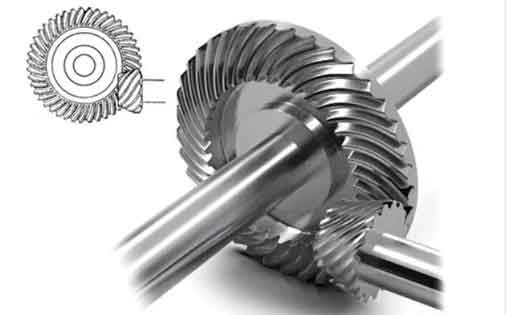
The meshing forces in spiral bevel gears are critical for vibration analysis. When the driving gear rotates at speed \( n \) (in rpm) and transmits power \( P \) (in kW), the torque is calculated as:
$$T_n = 9549.0 \times \frac{P}{n} \, \text{N} \cdot \text{m}$$
The tangential force at the mean pitch diameter \( d_{m1} \) of the driving gear is:
$$F_{tm} = \frac{2.0 \times T_n}{d_{m1}} \, \text{N}$$
For spiral bevel gears, the radial and axial forces depend on the spiral angle \( \beta_m \), pressure angle \( \alpha_n \), and pitch cone angles \( \delta_1 \) and \( \delta_2 \) for the driving and driven gears, respectively. The forces are given by:
Radial force on driving gear: $$F_{r1} = \frac{F_{tm}}{\cos \beta_m} (\tan \alpha_n \cos \delta_1 + \sin \beta_m \sin \delta_1)$$
Axial force on driving gear: $$F_{a1} = -\frac{F_{tm}}{\cos \beta_m} (\tan \alpha_n \sin \delta_1 – \sin \beta_m \cos \delta_1)$$
Radial force on driven gear: $$F_{r2} = \frac{F_{tm}}{\cos \beta_m} (\tan \alpha_n \cos \delta_2 + \sin \beta_m \sin \delta_2)$$
Axial force on driven gear: $$F_{a2} = -\frac{F_{tm}}{\cos \beta_m} (\tan \alpha_n \sin \delta_2 – \sin \beta_m \cos \delta_2)$$
The axial moments are \( M_{a1} = F_{a1} d_{m1}/2 \) and \( M_{a2} = F_{a2} d_{m2}/2 \). The sign conventions depend on the rotational direction; for clockwise rotation of the driving shaft, all signs in parentheses are reversed. These forces significantly influence the rotor’s dynamic response, especially when spiral bevel gears are engaged.
To analyze the vibration characteristics, I employ a transfer matrix method that accounts for lateral-torsional coupling. The state vector at each node includes parameters for displacement, slope, moment, shear force in two lateral directions, and torsional angle and torque. For the driving shaft, the state vector at node \( i \) is:
$$\mathbf{Z}_{i1} = [x, \theta_x, M_x, Q_x, y, \theta_y, M_y, Q_y, \Phi, T]^T_{i1}$$
For the driven shaft, it is \(\mathbf{Z}_{i2} = [x, \theta_x, M_x, Q_x, y, \theta_y, M_y, Q_y, \Phi, T]^T_{i2}\). The coupling between shafts due to spiral bevel gear meshing is incorporated through force and moment relationships. For example, at the gear nodes, the bending moments and shear forces are modified by the meshing forces, and the torque is transmitted. This allows the construction of a coupled transfer matrix for the entire system, enabling the computation of critical speeds and dynamic responses.
The vibration analysis covers several key aspects. First, I compute the lateral-torsional coupled critical speeds, which are natural frequencies where bending and torsion modes interact. Second, I evaluate the unbalance response, considering eccentricities in disks, and the initial bending response, which simulates shaft misalignment or thermal effects. Third, I investigate how factors like spiral angle, gear rotational direction, and support stiffness affect these responses. Specifically, for spiral bevel gears, the spiral angle and handedness alter force distributions, thereby impacting vibration amplitudes and critical speeds.
I begin with critical speed calculations. Using the transfer matrix method, I determine the critical speeds for both rigid and elastic supports. The results are summarized in Table 1, showing the first five critical speeds in rad/s. The fourth critical speed remains unchanged with support stiffness, indicating a torsional vibration mode.
| Mode | 1 | 2 | 3 | 4 | 5 |
|---|---|---|---|---|---|
| Rigid Supports | 239.300 | 906.002 | 2516.093 | 3219.074 | 6900.781 |
| Elastic Supports | 223.554 | 665.838 | 1532.328 | 3219.074 | 3278.195 |
Next, I analyze the steady-state unbalance response. Assume an eccentricity \( e = 0.001 \) cm at the disk (node 5), with damping of 0.1 kg·s/cm, and a speed range of 100 to 300 rad/s. When the driving shaft rotates counterclockwise, the meshing forces for spiral bevel gears vary with speed, as shown in Table 2. The axial forces point toward the small end of the gears under this rotation.
| Speed ω (rad/s) | Fa1 | Fa2 | Fr1 | Fr2 | Ftm |
|---|---|---|---|---|---|
| 100.0 | -14.80 | -9.14 | 32.00 | -35.20 | 42.50 |
| 200.0 | -7.41 | -4.57 | 16.00 | -17.60 | 21.20 |
| 239.3 | -6.91 | -3.82 | 13.40 | -14.70 | 17.70 |
| 300.0 | -4.94 | -3.05 | 10.70 | -11.70 | 14.20 |
Under rigid supports, the bearing forces, system potential energy (PPI), and displacements at key points are computed. Table 3 presents these results. The displacements at the disk and spiral bevel gear nodes highlight the influence of meshing forces, with noticeable peaks near critical speeds.
| ω (rad/s) | Qx(2) | Qy(2) | Qx(11) | Qy(11) | PPI | Ye(5) | Ye(19) | Ye(29) |
|---|---|---|---|---|---|---|---|---|
| 100.0 | 13.30 | 9.00 | 51.10 | 37.80 | 1.100 | 0.658×10⁻² | 0.118×10⁻¹ | 0.549×10⁻⁴ |
| 200.0 | 30.60 | 22.10 | 18.10 | 13.60 | 0.250 | 0.109×10⁻¹ | 0.118×10⁻¹ | 0.275×10⁻⁴ |
| 239.3 | 131.00 | 98.20 | 72.70 | 47.90 | 1.600 | 0.286×10⁻¹ | 0.183×10⁻¹ | 0.279×10⁻⁴ |
| 300.0 | 14.10 | 11.70 | 27.10 | 19.03 | 0.032 | 0.254×10⁻² | 0.254×10⁻³ | 0.184×10⁻⁴ |
The effect of driving shaft rotation direction and spiral angle on the unbalance response is significant. For a speed of 200 rad/s, Table 4 compares forces and displacements under different conditions. When the spiral angle is 0° (straight bevel gears), the axial and radial forces follow simpler relationships. With a spiral angle of 35°, counterclockwise rotation yields axial forces toward the small end, while clockwise rotation directs them toward the large end, resulting in smaller displacements at the spiral bevel gears.
| Rotation | βm | Fa1 (N) | Fa2 (N) | Fr1 (N) | Fr2 (N) | Ftm (N) | ye(19) (cm) |
|---|---|---|---|---|---|---|---|
| Counterclockwise | 35° | -14.80 | -9.14 | 32.00 | -35.20 | 21.20 | 0.0118 |
| Any | 0° | -4.18 | -6.50 | 6.50 | -4.18 | 21.20 | 0.0104 |
| Clockwise | 35° | 17.60 | 20.40 | -0.104 | 7.41 | 21.20 | 0.0099 |
An important observation is that peak response speeds differ from critical speeds when spiral bevel gears are engaged. Without meshing forces, peak and critical speeds coincide. However, with spiral bevel gear engagement, peak speeds are lower, as shown in Table 5. This indicates that the meshing forces modify the system’s resonance characteristics.
| Support Condition | Mode | Critical Speed | Peak Speed |
|---|---|---|---|
| Rigid | 1st | 239.300 | 233.00 |
| 2nd | 906.002 | 740.000 | |
| Elastic | 1st | 223.554 | 219.000 |
| 2nd | 665.838 | 560.000 |
Torsional vibration is another key aspect. Near the torsional critical speed (approximately 3219 rad/s), the torsional angle at the spiral bevel gear node varies dramatically. Table 6 lists the torsional angle \( \phi \) and radial displacement \( R \) at node 19 for speeds around the critical value. The torsional angle peaks at the critical speed, highlighting the coupling effect.
| ω (rad/s) | φ(19) (rad) | R(19) (cm) | PPI |
|---|---|---|---|
| 3000.0 | 0.447×10⁻¹² | 0.353×10⁻⁴ | 0.330×10⁻¹ |
| 3050.0 | 0.559×10⁻² | 0.225×10⁻⁴ | 0.280×10⁻¹ |
| 3100.0 | 0.774×10⁻² | 0.154×10⁻⁴ | 0.240×10⁻¹ |
| 3150.0 | 0.130×10⁻¹ | 0.122×10⁻⁴ | 0.210×10⁻¹ |
| 3200.0 | 0.461×10⁻¹ | 0.114×10⁻⁴ | 0.18×10⁻¹ |
| 3219.074 | 0.369×10⁵ | 0.114×10⁻⁴ | 0.18×10⁻¹ |
| 3250.0 | 0.278×10⁻¹ | 0.117×10⁻⁴ | 0.170×10⁻¹ |
I also analyze the initial bending response, which simulates shaft pre-bending due to installation errors or thermal effects. Under rigid supports, Table 7 compares the displacement at the spiral bevel gear node with and without meshing forces. The engagement of spiral bevel gears increases displacements across all speeds, emphasizing their influence on static and dynamic deformations.
| ω (rad/s) | With Spiral Bevel Gears | Without Spiral Bevel Gears |
|---|---|---|
| 100.0 | 0.125×10⁻¹ | 0.86×10⁻³ |
| 200.0 | 0.142×10⁻¹ | 0.22×10⁻² |
| 239.3 | 0.271×10⁻¹ | 0.143×10⁻³ |
| 300.0 | 0.109×10⁻² | 0.54×10⁻³ |
| 400.0 | 0.128×10⁻² | 0.42×10⁻³ |
| 500.0 | 0.182×10⁻² | 0.22×10⁻³ |
Similarly, Table 8 shows the unbalance response comparison. The presence of spiral bevel gears elevates displacements, particularly in the sub-critical region, demonstrating that meshing forces amplify vibration amplitudes.
| ω (rad/s) | With Spiral Bevel Gears | Without Spiral Bevel Gears |
|---|---|---|
| 100.0 | 0.118×10⁻¹ | 0.115×10⁻³ |
| 200.0 | 0.118×10⁻¹ | 0.13×10⁻³ |
| 239.3 | 0.183×10⁻¹ | 0.155×10⁻¹ |
| 300.0 | 0.254×10⁻³ | 0.17×10⁻² |
| 400.0 | 0.162×10⁻² | 0.11×10⁻² |
| 500.0 | 0.206×10⁻² | 0.11×10⁻² |
To validate the analysis method, I conduct program verification. First, I consider a simply supported rotor test rig with geometry identical to part of the spiral bevel gear system. The computed first critical speed and unbalance response match experimental values closely, as shown in Table 9. This confirms the accuracy of the lateral vibration analysis.
| Condition | Parameter | Computed Value | Experimental Value |
|---|---|---|---|
| Rigid Supports | 1st Critical Speed (rad/s) | 248.61 | 249.76 |
| Unbalance Response (cm) | 0.1021 | 0.1040 | |
| Elastic Supports | 1st Critical Speed (rad/s) | 229.566 | 229.3 |
| Unbalance Response (cm) | 0.1557 | 0.1540 |
Second, for torsional vibration, I analyze a simple rotor with two disks connected by a shaft. The theoretical torsional critical speed is given by:
$$\omega_1 = \sqrt{\frac{G I_p (I_1 + I_2)}{I_1 I_2 l}}$$
where \( G \) is the shear modulus, \( I_p \) the polar moment of inertia, \( I_1 \) and \( I_2 \) the disk moments of inertia, and \( l \) the shaft length. The theoretical value is 367.197 rad/s, and my computation yields 367.195 rad/s, demonstrating excellent agreement.
In summary, the engagement of spiral bevel gears significantly affects rotor vibration characteristics. The meshing forces, dependent on spiral angles and rotational directions, alter critical speeds, increase unbalance and initial bending responses, and shift peak response speeds. Specifically, for spiral bevel gears with a spiral angle of 35°, counterclockwise rotation produces axial forces toward the small end, while clockwise rotation directs them toward the large end, resulting in smaller displacements. The analysis method, based on a transfer matrix approach with lateral-torsional coupling, proves accurate through verification with experiments and theoretical solutions. These findings are valuable for designing rotor systems with spiral bevel gears, particularly in high-speed applications where vibration control is crucial.
Further research could extend this analysis to include nonlinear effects, such as gear backlash or time-varying meshing stiffness, to better capture real-world dynamics. Additionally, optimizing spiral bevel gear parameters for minimal vibration could be explored using this methodology. Overall, understanding the vibration behavior of rotors with spiral bevel gears is essential for ensuring reliability and performance in advanced mechanical systems.