
In modern mechanical systems, spur gears play a critical role in transmitting power and motion efficiently. However, the presence of assembly errors and tooth surface friction significantly influences the mesh stiffness and dynamic behavior of spur gears, leading to vibrations, noise, and reduced transmission accuracy. This study aims to develop a comprehensive model to analyze the combined effects of assembly errors and tooth surface friction on the mesh stiffness and dynamic response of spur gears. We employ a geometric relationship analysis integrated with the energy method to derive the time-varying mesh stiffness, and establish a 6-degree-of-freedom bending-torsional coupling vibration model based on the lumped mass method. Numerical solutions are obtained using the Runge-Kutta method to simulate the dynamic characteristics under various conditions. The results provide insights into optimizing spur gear design for enhanced performance and reliability.
The geometric model of spur gears considering assembly errors is essential for accurate stiffness calculation. Assembly errors, such as eccentricities in the gear shafts, alter the actual meshing line, pressure angles, and contact points between gear teeth. In an ideal scenario, the meshing line is straight and parallel to the line of action, but errors introduce deviations that affect the load distribution and stiffness. The position of the gear centers can be described by coordinates in a global reference frame. For instance, the actual center positions of the driving and driven gears, denoted as O’_p and O’_g, are given by (e_{xp}, e_{yp}) and (e_{xg} + a \sin \phi_g, e_{yg} + a \cos \phi_g), respectively, where a is the ideal center distance, \phi_g is the ideal pressure angle, and e_{xi}, e_{yi} represent the assembly errors in the x and y directions for gear i (i = p, g). The actual meshing line A’B’ is determined by solving the equations of the base circles and the line equation, with endpoints calculated based on the intersection with the gear base circles. The pressure angle at any meshing point X is derived as \alpha_i = \arccos(R_{bi} / R_{Xi}), where R_{bi} is the base radius and R_{Xi} is the distance from point X to the gear center. This geometric adjustment is crucial for subsequent stiffness calculations.
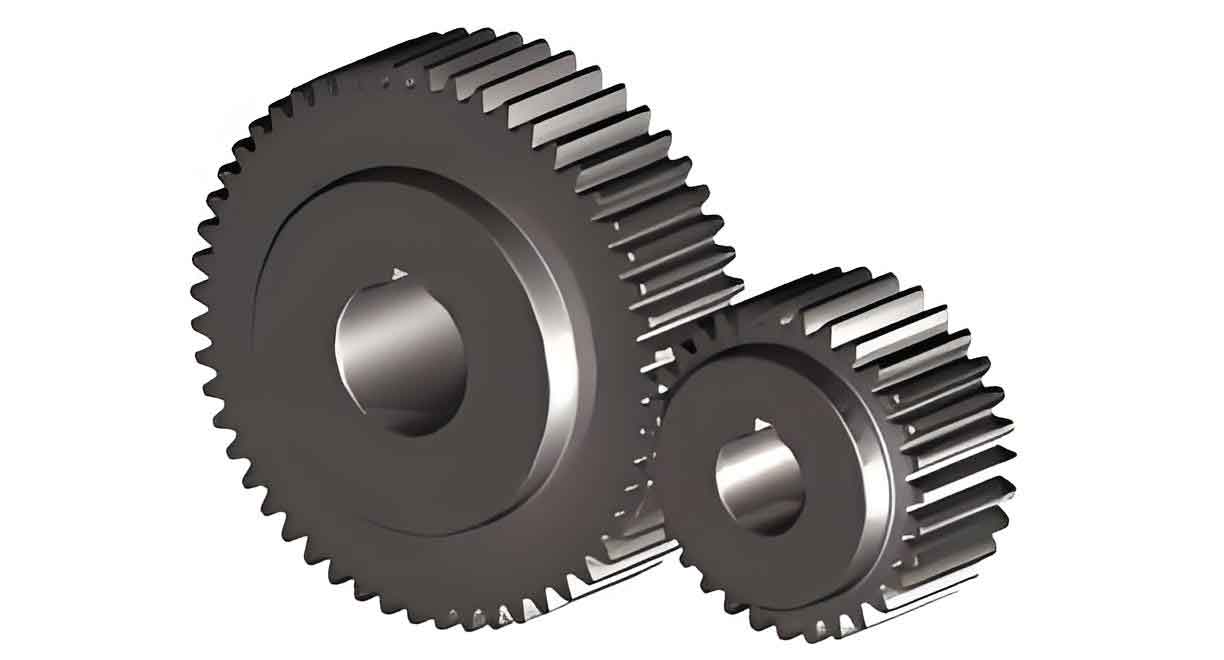
To compute the mesh stiffness of spur gears under the influence of tooth surface friction, we utilize the energy method, which models the gear teeth as cantilever beams. The total potential energy stored in the meshing teeth comprises several components: bending strain energy U_b, axial compression strain energy U_a, shear strain energy U_s, Hertzian contact strain energy U_h, and fillet foundation strain energy U_f. The bending stiffness k_b, axial stiffness k_a, and shear stiffness k_s are derived from the integrals of the respective energy expressions. For example, the bending stiffness is given by:
$$ \frac{1}{k_b} = \int_0^d \frac{M^2}{2E_i I_x} dx $$
where M is the bending moment, E_i is the elastic modulus, I_x is the area moment of inertia, and d is the distance from the tooth root. Similarly, the axial and shear stiffnesses are expressed as:
$$ \frac{1}{k_a} = \int_0^d \frac{F_a^2}{2E_i A_x} dx $$
$$ \frac{1}{k_s} = \int_0^d \frac{1.2F_b^2}{2G_i A_x} dx $$
Here, F_a and F_b are the axial and tangential components of the meshing force, respectively, A_x is the cross-sectional area, and G_i is the shear modulus, related to the elastic modulus and Poisson’s ratio v_i by G_i = E_i / [2(1 + v_i)]. The Hertzian contact stiffness k_h accounts for the local deformation at the contact point and is calculated as:
$$ \frac{1}{k_h} = \frac{1 – v_p^2}{E_p \pi L} \left[ 2 \ln \left( \frac{4 \rho_{Xp}}{b} \right) – 1 \right] + \frac{1 – v_g^2}{E_g \pi L} \left[ 2 \ln \left( \frac{4 \rho_{Xg}}{b} \right) – 1 \right] $$
where \rho_{Xi} is the radius of curvature at the meshing point, L is the tooth width, and b is the half-width of the contact area. The fillet foundation stiffness k_f is modified to include the effects of tooth root geometry, using empirical coefficients L^*, M^*, P^*, and Q^* as per literature. The overall mesh stiffness k_m(t) for a spur gear pair at time t is then obtained by summing the contributions from all mating tooth pairs:
$$ \frac{1}{k_m(t)} = \sum_{i=1}^n \left[ \sum_{j=p,g} \left( \frac{1}{k_{bj}} + \frac{1}{k_{aj}} + \frac{1}{k_{sj}} \right) + \frac{1}{k_h} \right] + \frac{1}{\varepsilon_p k_{fp}} + \frac{1}{\varepsilon_g k_{fg}} $$
where n is the number of tooth pairs in contact, and \varepsilon_j is the foundation correction factor, typically set to 1.1. Tooth surface friction introduces additional complexities, as the friction force f affects the force components F_a and F_b. Depending on the meshing position (approach or recess), the signs in the force equations vary, influencing the stiffness values. This model allows us to analyze how friction coefficients and assembly errors collectively alter the mesh stiffness of spur gears.
The dynamic behavior of spur gears is modeled using a 6-degree-of-freedom bending-torsional coupling vibration system. The equations of motion for the driving and driven gears are derived from Newton’s second law, considering displacements in the x, y, and rotational \theta directions. The dynamic meshing force F_m is expressed as:
$$ F_m = k_m(t) \delta_{pg} + c_m \dot{\delta}_{pg} $$
where c_m is the mesh damping, and \delta_{pg} is the dynamic transmission error, given by:
$$ \delta_{pg} = x_p – x_g + R_{bp} \theta_p – R_{bg} \theta_g $$
The system of differential equations is solved numerically using the Runge-Kutta method to obtain the dynamic response, including displacements and velocities. This approach enables the investigation of how variations in mesh stiffness due to assembly errors and friction impact the overall dynamics of spur gear systems.
To illustrate the effects of tooth surface friction on spur gear mesh stiffness, we consider different friction coefficients. The mesh stiffness decreases as the friction coefficient increases, due to the additional energy dissipation and altered force distribution. For instance, at a friction coefficient of 0.05, the mesh stiffness exhibits higher amplitudes compared to 0.1 or 0.2. This reduction is more pronounced in the double-tooth contact regions, where the load sharing among teeth is affected. The dynamic transmission error, which indicates the deviation from ideal motion, also varies with friction. Lower friction coefficients tend to minimize the error, improving transmission accuracy. The following table summarizes the mesh stiffness values under different friction coefficients for a sample spur gear pair:
| Friction Coefficient | Average Mesh Stiffness (N/m) | Peak Dynamic Transmission Error (μm) |
|---|---|---|
| 0.00 | 5.2e8 | 12.5 |
| 0.05 | 4.8e8 | 10.8 |
| 0.10 | 4.5e8 | 13.2 |
| 0.20 | 4.0e8 | 15.7 |
Assembly errors, such as eccentricities, alter the actual center distance and pressure angle, leading to changes in the meshing line and contact conditions. For example, in the presence of errors, the actual pressure angle \alpha_{gp2} deviates from the ideal value, affecting the load angle and stiffness. The double-tooth contact region may shorten, reducing the effective contact ratio and increasing the load per tooth. The mesh stiffness under different assembly error conditions shows significant variations, as summarized in the table below:
| Error Condition | Actual Center Distance (mm) | Mesh Stiffness Amplitude (N/m) | Dynamic Transmission Error (μm) |
|---|---|---|---|
| Ideal (No error) | 150.0 | 5.0e8 | 11.0 |
| Small errors (e_{xg}=10μm, e_{yg}=10μm) | 150.1 | 4.7e8 | 14.5 |
| Large errors (e_{xg}=100μm, e_{yg}=100μm) | 151.0 | 4.2e8 | 9.8 |
The dynamic response analysis reveals that spur gears with optimized assembly conditions and moderate friction coefficients exhibit lower vibration levels and improved accuracy. For instance, a friction coefficient of 0.05 combined with minimal errors results in a smoother dynamic transmission error profile. The governing equations for the dynamic model are:
$$ m_p \ddot{x}_p + k_{xp} x_p + c_{xp} \dot{x}_p = -F_m $$
$$ m_p \ddot{y}_p + k_{yp} y_p + c_{yp} \dot{y}_p = 0 $$
$$ I_p \ddot{\theta}_p + F_m R_{bp} = T_p $$
$$ m_g \ddot{x}_g + k_{xg} x_g + c_{xg} \dot{x}_g = F_m $$
$$ m_g \ddot{y}_g + k_{yg} y_g + c_{yg} \dot{y}_g = 0 $$
$$ I_g \ddot{\theta}_g + F_m R_{bg} = -T_g $$
where m_i, I_i, k_{xi}, k_{yi}, c_{xi}, c_{yi}, and T_i are the mass, moment of inertia, bearing stiffnesses, damping coefficients, and torque for gear i, respectively. The numerical simulation of these equations under various parameters highlights the importance of controlling assembly errors and selecting appropriate friction conditions for spur gears.
In conclusion, the integration of geometric analysis and energy method provides a robust framework for modeling spur gear mesh stiffness under assembly errors and tooth surface friction. The results demonstrate that increased friction coefficients reduce mesh stiffness, while assembly errors alter the meshing geometry and dynamic response. Proper adjustment of these factors can enhance the performance of spur gear systems, reducing vibrations and improving transmission precision. This study underscores the need for comprehensive modeling in the design and optimization of spur gears for high-speed and high-power applications.