
The rapid advancement of control technologies has propelled the manufacturing sector into a new era, accelerating the transition from a manufacturing giant to a manufacturing powerhouse. Gears, as critical components in mechanical systems like transmissions and steering mechanisms, directly influence equipment stability, safety, and comfort. Consequently, meticulous analysis and stringent control of gear machining processes are paramount for ensuring high quality. Gear technology underpins the reliability of power transmission systems.
1. Research Background
Machining fundamentally alters a workpiece’s shape and geometric parameters. In gear manufacturing, precision and efficiency determine product value. The journey from rough casting to finished gear involves numerous processes and measurements. Beyond process control, the performance of cutting tools significantly impacts workpiece quality. Advancements in gear technology increasingly focus on tool materials and coating protection to enhance cutting precision.
Tool Material Innovation: The pursuit of higher machining quality necessitates superior cutting tools. Carbide alloys, particularly Titanium Nitride (TiN) based alloys, represent a significant advancement. These alloys offer exceptional toughness, hardness, and wear resistance, substantially improving cutting tool performance. The material removal rate \( MRR \) in gear cutting can be expressed as:
$$ MRR = f \cdot d \cdot v_c $$
where \( f \) is the feed rate, \( d \) is the depth of cut, and \( v_c \) is the cutting speed. TiN-coated tools allow higher \( v_c \) and \( f \) values due to their superior thermal stability and wear resistance, directly boosting productivity and surface finish quality. This evolution in tool materials is a key trend in modern gear technology.
Coating Protection Technology: This surface modification technology applies one or more layers to a tool’s surface via physical or chemical processes, altering its microstructure to enhance properties like toughness, wear resistance, and corrosion resistance. Widely adopted, it significantly improves the comprehensive performance of cutting tools, leading to higher gear precision and quality. The coating’s effectiveness can be modeled by its influence on tool life \( T \), often described by Taylor’s extended equation:
$$ v_c \cdot T^n \cdot f^m \cdot d^p = C $$
where \( v_c \) is cutting speed, \( T \) is tool life, \( f \) is feed rate, \( d \) is depth of cut, and \( n, m, p, C \) are constants determined by tool-workpiece material and coating properties. Advanced coatings increase the constant \( C \), signifying longer tool life under the same cutting conditions.
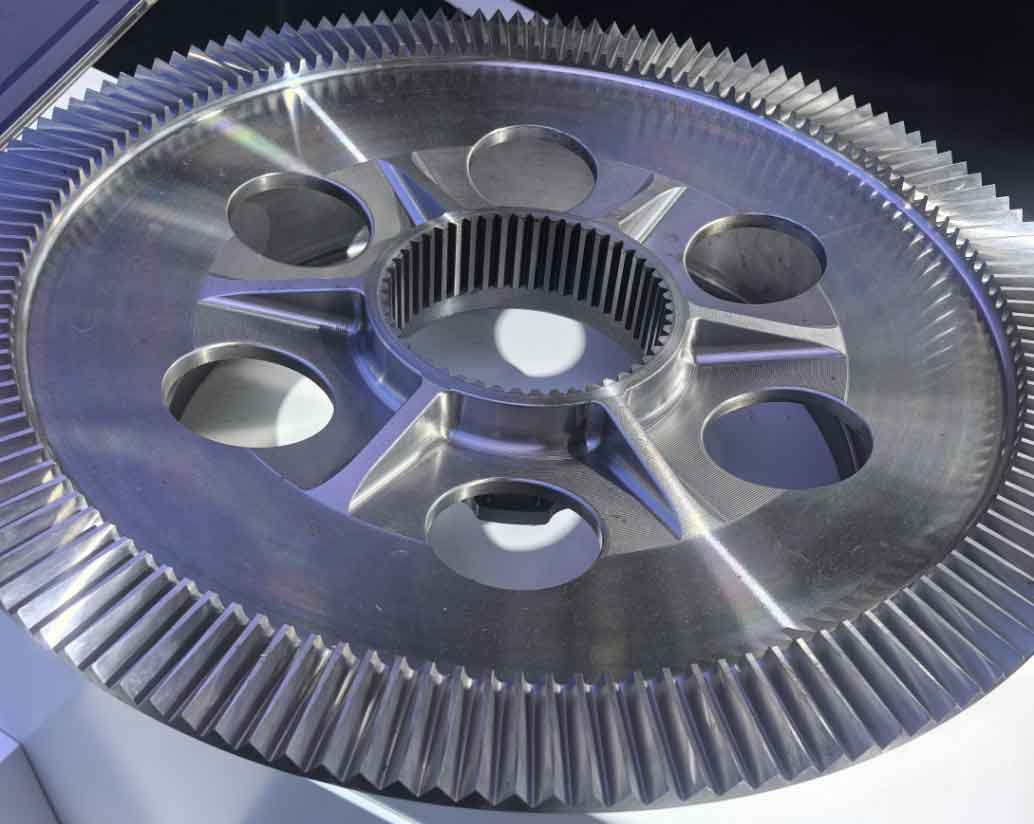
2. Gear Machining Process
Analyzing the gear’s working conditions, function, and load profile is essential before machining. A tailored process route ensures precision, cost-effectiveness, high efficiency, quality, and extended service life. Gear technology integration is vital throughout.
Confirming the Machining Scheme: Based on working conditions, loads, existing equipment, and environment, a specific scheme is formulated. For example, consider a common transmission gear: Module = 2, Number of teeth = 44, Profile slope deviation ≤ 0.0075 mm, Single pitch deviation ≤ 0.011 mm, Required accuracy ≥ IT7, subject to variable alternating loads. After comparative analysis and optimization, a preliminary process flow is established.
Blank Selection: Gears transmit power and change torque direction, enduring significant stresses. Materials must possess high hardness, strength, and toughness. Forged blanks are preferred due to superior mechanical properties. Material 20CrMnTi is a common choice. Post-forging, inspection of flow lines, microstructure, decarburization depth, and grain size is crucial. The choice of blank material and forming method is a foundational aspect of gear technology.
Process Flow: A standardized sequence ensures quality. Key stages include:
- Blank Forging: Hot die forging or wedge cross rolling produces blanks with enhanced mechanical properties. Wedge cross rolling improves precision and efficiency in batch production.
- Normalizing: Removes forging stresses and refines microstructure. Traditional normalizing suffers from inconsistent cooling. Isothermal Normalizing provides uniform cooling, improving machinability and quality – a significant upgrade in gear technology.
- Cutting Machining: Machining features like end faces and holes using lathes or CNC machines. Precise fixturing is critical. CNC enables multi-operation machining in one setup, boosting efficiency and precision. Conventional wet machining uses cutting fluids, posing environmental and health hazards and high costs. Dry Cutting Technology (e.g., Dry Hobbing, Dry Shaping) eliminates coolants, integrating special cooling systems. It doubles efficiency and significantly reduces costs, representing a leap forward in sustainable gear technology.
- Hobbing & Shaping: Gear tooth generation using generating or forming principles. While accurate, efficiency can be low for mass production. Coating protection technology applied to hobs and shaper cutters enhances tool hardness, wear resistance, and lifespan, reducing costs and improving tooth form quality – a key application of modern gear technology.
- Shaving: A high-precision finishing process correcting tooth profile and reducing helix deviations. It operates via crossed helical gear engagement between shaving cutter and workpiece. Relative sliding at the contact point enables fine material removal. Highly efficient and accurate for medium/large batches, it’s a mature gear technology stage.
- Heat Treatment (Carburizing & Quenching): Critical for final gear properties. Precise control of temperature uniformity and cooling rates is vital to minimize distortion and achieve target hardness. Process optimization (e.g., reverse distortion compensation, pre-expansion of shrinkage ends) and improved furnace technology are essential gear technology focuses to ensure quality.
- Grinding: Corrects heat treatment distortion of critical features (faces, bores). CNC Grinding Machines dominate this stage, offering high precision, efficiency, and repeatability. They are central to achieving the tight tolerances required in advanced gear technology.
- Gear Deburring/Finishing: Final inspection and removal of burrs to prevent noise or misalignment during operation, often checked via meshing tests in gearboxes. Ensures the finished gear meets all quality standards of modern gear technology.
| Process Stage | Primary Function | Key Technology Advancements | Impact on Gear Technology |
|---|---|---|---|
| Blank Forging | Create near-net shape blank | Wedge Cross Rolling | ↑ Efficiency, ↑ Dimensional Precision |
| Normalizing | Stress relief, Structure refinement | Isothermal Normalizing | ↑ Microstructure Uniformity, ↑ Machinability |
| Cutting (Roughing) | Machine features (faces, holes) | CNC Machining, Dry Cutting | ↑ Precision, ↑ Efficiency, ↓ Cost (Dry) |
| Hobbing/Shaping | Generate gear teeth | Coated Tooling, Dry Hobbing/Shaping | ↑ Tool Life, ↑ Surface Finish, ↓ Cost (Dry) |
| Shaving | Pre-finish teeth (Profile/Helix) | Optimized Cutter Design | ↑ Accuracy, ↑ Efficiency for medium batches |
| Heat Treatment | Achieve final hardness & strength | Controlled Atmosphere Furnaces, Distortion Modeling | ↑ Core Properties, ↓ Distortion |
| Grinding | Correct distortion, Final dimensions | CNC Grinding, CBN Grinding Wheels | ↑↑ Precision (IT3-IT5), ↑ Surface Finish (Ra) |
| Deburring/Finishing | Remove burrs, Final inspection | Automated Deburring, Gear Roll Testing | ↑ Noise Performance, ↑ Quality Assurance |
3. High-Precision Gear Technology
Demands for higher efficiency, quality, and precision necessitate advanced gear technology beyond conventional methods.
Hard Gear Machining Technology: This targets gears with hardened tooth flanks (typically > 45 HRC) after initial heat treatment, requiring high precision (e.g., IT5 or better). It utilizes specialized processes and tooling in finishing stages (shaving, grinding, honing). Innovations include:
- Hobbing with Advanced Tooling: Using coated carbide or CBN hobs allows machining pre-hardened blanks (up to ~60 HRC), reducing or eliminating subsequent grinding needs. Tool life is significantly extended, lowering costs. The process capability is enhanced by higher \( v_c \) values enabled by these tools.
- Grinding with CBN Wheels: Cubic Boron Nitride (CBN) grinding wheels offer exceptional hardness and thermal stability. Combining roughing and finishing grits in one wheel reduces process steps and boosts efficiency. This gear technology achieves surface roughness down to Ra 0.2 μm and precision levels of IT5. The material removal rate in grinding \( Q’_w \) can be expressed as:
$$ Q’_w = a_e \cdot v_w \cdot b $$
where \( a_e \) is the depth of cut, \( v_w \) is the workpiece speed, and \( b \) is the grinding width. CBN wheels permit higher \( a_e \) and \( v_w \), increasing \( Q’_w \) while maintaining surface integrity. - Hard Shaving with Super-Hard Cutters: Utilizing Polycrystalline Cubic Boron Nitride (PCBN) or advanced ceramic shaving cutters enables finishing hardened gears (45-65 HRC). This reduces surface roughness and can improve gear accuracy by up to 2 grades compared to pre-hard shaving, while achieving speeds up to 10 times faster than conventional grinding in some applications – a transformative gear technology for high-volume precision gears.
Power Honing Technology: This is a high-efficiency finishing process performed after grinding, achieving similar precision levels but at lower cost and higher throughput. It is particularly effective for correcting heat treatment distortions (up to 0.05 mm in profile/lead) and micro-defects, achieving surface roughness down to Ra 0.2 μm. Advantages of this advanced gear technology include:
- Eliminates grinding marks, reducing vibration and noise in transmission.
- Lower cutting speeds compared to grinding prevent surface burns.
- Induces beneficial compressive residual stresses \( \sigma_r \) on the gear surface:
$$ \sigma_r \approx \frac{E \cdot \alpha \cdot \Delta T}{1 – \nu} $$
where \( E \) is Young’s modulus, \( \alpha \) is the coefficient of thermal expansion, \( \Delta T \) is the localized temperature gradient, and \( \nu \) is Poisson’s ratio. These stresses enhance fatigue strength, wear resistance, and micropitting resistance. - Capable of machining gears with complex geometries (e.g., shoulders) difficult for grinding.
- Offers comparable accuracy to grinding but with significantly lower cost and higher efficiency, making it ideal for high-volume, high-precision gear technology applications.
| Technology | Typical Workpiece Hardness (HRC) | Achievable Accuracy (DIN/ISO) | Typical Surface Roughness (Ra μm) | Key Advantages | Key Limitations |
|---|---|---|---|---|---|
| Hard Shaving (PCBN) | 45 – 65 | DIN 5-6 | 0.4 – 0.8 | High speed, Good profile correction, Lower cost than grinding | Limited correction capacity, Tool cost |
| Grinding (CBN Wheel) | 55 – 65 | DIN 3-5 | 0.2 – 0.4 | Highest precision, Excellent surface finish, Large correction capacity | High investment/running cost, Thermal damage risk |
| Power Honing | 55 – 65 | DIN 4-6 | 0.2 – 0.4 | Induces compressive stress, Lower cost than grinding, High efficiency, Handles complex shapes | Abrasive tool wear, Limited stock removal |
4. Conclusion
Gear machining process technology is fundamental to mechanical manufacturing quality. Rigorous control at every stage is non-negotiable for ensuring gear qualification rates. Meeting the evolving demands of modern manufacturing, particularly with new energy applications, requires continuous innovation. Integrating advanced technologies like coated tooling, dry cutting, hard gear machining, and power honing with well-established traditional processes is the pathway forward. This synergistic approach within gear technology enables the production of higher quality gears – achieving superior precision, durability, and performance – without necessarily escalating costs. The future of gear manufacturing lies in this intelligent fusion of proven and cutting-edge gear technology, driving efficiency and quality to unprecedented levels.