
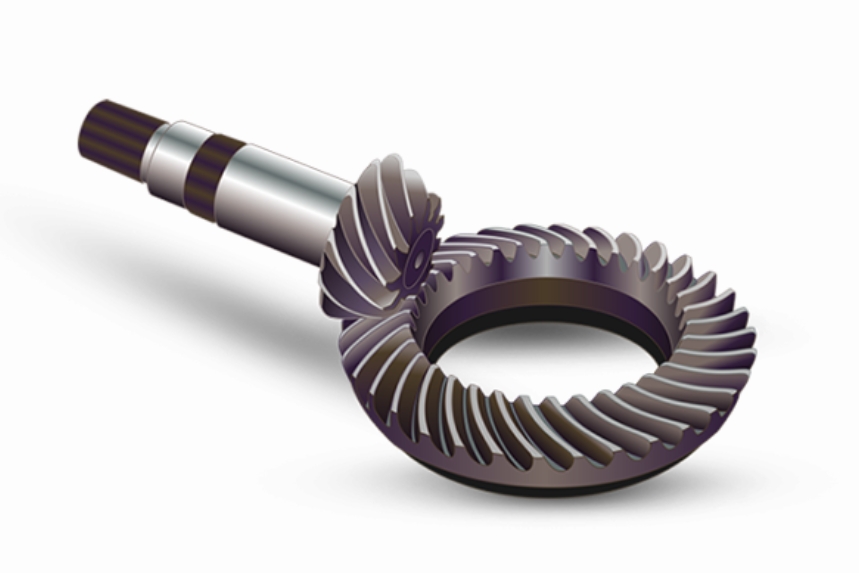
In recent years, the adoption of the “Oerlikon” type spiral bevel gear generating machines has been gradually increasing in domestic production. This type of gear cutting machine also employs a cutter head. Compared to the widely used “Gleason” type spiral bevel gear machines, it possesses the following distinctive characteristics: the indexing motion during the cutting process is continuous, eliminating the need for intermittent indexing and idle reverse strokes. Due to the specifics of the cutting motion and the adoption of the “constant depth tooth” system, where the cutter head is equipped with separate roughing and finishing blades, both the gear and pinion can have both flanks roughed and finished in a single setup. The machine setup calculations are also greatly simplified. The gear design parameters follow specific rules which are beneficial for improving the load-carrying capacity of the gear pair, reducing the number of cutter head specifications, and simplifying computation. Furthermore, because the angle between the cutting trace on the tooth surface and the instantaneous contact line during meshing is particularly large, under conditions of identical surface finish, the operational smoothness of the spiral bevel gear is superior to that of conventional spiral bevel gears. These characteristics make the “Oerlikon” system particularly advantageous for small to medium batch production. Its drawbacks include the current inability to grind the teeth, and the common domestic S17 machine model is generally only suitable for machining spiral bevel gears with a spiral angle greater than 10°. It also has poorer adaptability to axial errors during installation and operation compared to some other spiral bevel gear types, and its productivity in mass production is lower than methods like “Circular Broaching” or “Helical Formate” used for other spiral bevel gears.
This discussion is based on the characteristics of the cutting process. It proposes studying the polar coordinate equations and computational principles of the continuous indexing cutting method. An analytical method is used to rigorously examine the relevant issues during cutting, from which various universal calculation formulas are derived. The results of these formulas align completely with the various computational parameters used in practice, thereby providing a theoretical foundation and broader computational methods for solving practical production problems. The main content is presented according to our analysis. To facilitate a systematic explanation of this knowledge, materials and conclusions from other literature are also referenced, with the sources of such materials indicated.
I. Fundamental Motions for Generating the Tooth Surface
Using the continuous indexing method to mill spiral bevel gears requires three motions to generate the conjugate tooth surfaces, as shown conceptually in Figure 1:
- Continuous rotation of the cutter head ($n_c$).
- Continuous rotation of the workpiece blank ($n_w$).
- The generating (roll) motion of the cradle ($n_{cr}$).
The cradle’s generating motion is very slow, typically rotating less than one full revolution during the cutting of an entire spiral bevel gear.
1. The Indexing Motion: Continuous Rotation of Cutter Head and Workpiece
The continuous rotations of the cutter head and workpiece must be such that adjacent sets of blades on the cutter head successively cut the adjacent tooth spaces on the workpiece, thereby simultaneously accomplishing the indexing of the workpiece. Clearly, the following relationship must be maintained between the cutter head speed $n_c$ and the workpiece speed $n_w$:
$$ \frac{n_c}{n_w} = \frac{Z_w}{N} $$
where:
$Z_w$ = Number of teeth of the gear being cut.
$N$ = Number of blade groups on the cutter head. A group can consist of two or three blades; a two-blade group has one blade for cutting the concave side and one for the convex side; a three-blade group includes an additional roughing blade.
To maintain the relationship in Eq. (1) for gears with different tooth numbers, the machine is equipped with index change gears. The kinematic chain between the cutter head and the workpiece is called the indexing chain. Let $i_{ix}$ denote the transmission ratio of the index change gears, and $C_{ix}$ the total fixed transmission ratio in the indexing chain excluding these change gears. The kinematic balance equation for the indexing chain, considering one revolution of the cutter head ($n_c = 1$) corresponding to $N/Z_w$ revolutions of the workpiece, can be written as:
$$ 1 \cdot C_{ix} \cdot i_{ix} = \frac{N}{Z_w} $$
Thus, we have:
$$ i_{ix} = \frac{N}{C_{ix} \cdot Z_w} \tag{2} $$
The formula for calculating the index change gears is then:
$$ i_{ix} = \frac{A}{B} \cdot \frac{C}{D} = \frac{N}{C_{ix} \cdot Z_w} $$
2. Tooth Trace on the Planar Gear
The intersection curve of the tooth surface and the pitch cone is called the tooth trace. Since constant depth teeth are theoretically fully conjugate in the tooth height direction, the machine and cutter head setup calculations for the “Oerlikon” system are primarily derived from the properties of the tooth trace. To understand the tooth trace characteristics, the pitch cone of the gear being cut can be developed onto a plane, resulting in a planar gear on the pitch plane, as shown conceptually in Figure 2. The tooth trace on the pitch plane can be considered as the imprint of the tooth trace on the pitch cone rolling on this plane. When the workpiece rotates, its pitch cone rolls without sliding on the pitch plane of this planar gear. Therefore, the continuous rotation of the cutter head and workpiece together is equivalent to the cutter head rotating continuously relative to this planar gear, with a speed ratio of:
$$ \frac{n_c}{n_p} = \frac{Z_p}{N} \tag{3} $$
where $n_p$ is the rotational speed of the imaginary planar gear, realized during cutting by the rotation of the workpiece. $Z_p$ is the number of teeth of the planar gear. According to bevel gear formulas:
$$ Z_p = \frac{Z_w}{\sin \Gamma_w} \tag{4} $$
where $Z_w$ is the number of teeth of the workpiece (gear or pinion), and $\Gamma_w$ is its pitch angle. For an orthogonal gear pair, if $Z_1$ and $Z_2$ are the pinion and gear tooth numbers, then:
$$ \Gamma_1 = \arctan(Z_1 / Z_2), \quad \Gamma_2 = 90^\circ – \Gamma_1 $$
As shown conceptually in Figure 2, consider a circle of radius $r_o$ fixed to the cutter head (the rolling circle) and a circle of radius $R$ fixed to the planar gear (the fixed circle). We have the relation:
$$ \frac{r_o}{R} = \frac{n_p}{n_c} = \frac{N}{Z_p} \tag{5} $$
The relative motion between the cutter head and planar gear is then equivalent to the pure rolling of the rolling circle ($r_o$) on the fixed circle ($R$). The point of tangency is the instantaneous center. The intersection point of a blade’s cutting edge with the pitch plane is called the tracing point. The tooth trace on the pitch plane is the trajectory of these tracing points relative to the planar gear. According to the described motion, this trace is an extended epicycloid (or extended cycloid).
3. The Generating (Roll) Motion
If only the continuous rotation of the cutter head and workpiece existed, the tooth profile in the tooth height direction would be identical to the blade profile. To obtain conjugate tooth profiles that pair correctly, a slow generating motion must be added between the planar generating gear (the cradle) and the workpiece. The cradle carrying the cutter head acts as this planar generating gear. The cradle is driven via a worm gear on its axis. The kinematic relationship for the generating motion between the cradle and the workpiece is:
$$ \frac{n_{cr}}{n_w + \Delta n_w} = \frac{1}{Z_p} \tag{6} $$
where $n_{cr}$ is the cradle generating speed, and $\Delta n_w$ is the additional speed imparted to the workpiece due to the cradle motion. This $\Delta n_w$ comes through the roll change gear train and the differential into the indexing chain. When the cradle makes one revolution ($n_{cr}=1$), the additional workpiece rotation $\Delta n_{w0}$ via this path is:
$$ \Delta n_{w0} = i_{roll} \cdot C_{roll} \tag{7} $$
where $i_{roll}$ is the roll change gear ratio and $C_{roll}$ is the fixed ratio in that train excluding the change gears. Since the cradle carries the cutter head, one cradle revolution also causes one revolution of the cradle center shaft, which feeds into the indexing chain, imparting an additional speed component $\Delta n’_{w}$ to the workpiece. The total $\Delta n_w = \Delta n_{w0} + \Delta n’_{w}$. Considering the complete kinematic chain, the balance equation for one cradle revolution leads to the formula for the roll change gear ratio. On the S17 type machine, with specific machine constants, this simplifies to:
$$ i_{roll} = \frac{A_r}{B_r} \cdot \frac{C_r}{D_r} = \frac{5}{2} \cdot \frac{Z_p}{Z_w} \tag{8} $$
II. Tooth Form System and Cutter Head Standard Series
1. Tooth Form System
To reduce sensitivity to installation errors and deflection under load, the “Oerlikon” system spiral bevel gears are designed for theoretical point contact along the tooth trace. This theoretical contact point is called the calculation point. The normal module at this point, denoted $m_n$, is the fundamental parameter for determining gear and cutter head dimensions.
The recommended tooth dimensions for the “Oerlikon” system are summarized in the following table:
| Parameter | Symbol | Formula / Value |
|---|---|---|
| Addendum | $h_a$ | $1.00 m_n$ |
| Dedendum | $h_f$ | $1.25 m_n$ |
| Whole Depth | $h$ | $2.25 m_n$ |
| Radial Clearance | $c$ | $0.25 m_n$ |
| Normal Pressure Angle | $\alpha_n$ | Old Std: 20°; New Std: 22.5° |
| Pitch Diameter | $d$ | $d = m_t \cdot Z = \frac{m_n}{\cos \beta} \cdot Z$ |
| Pitch Angle | $\Gamma$ | $\Gamma = \arcsin(Z / Z_p)$ |
| Outer Cone Distance | $R_e$ | $R_e = d / (2 \sin \Gamma)$ |
Due to the constant depth system, the pinion toe is most prone to undercut. Therefore, a profile shift modification based on the condition of no undercut at the pinion toe (analyzed via the equivalent spur gear on the back cone) must be applied. The maximum pinion dedendum $h_{f1max}$ is determined to avoid undercut. After applying this profile shift, the final tooth height dimensions become:
$$ h_{a1} = h_a + x_1 m_n, \quad h_{f1} = h_f – x_1 m_n $$
$$ h_{a2} = h_a – x_2 m_n, \quad h_{f2} = h_f + x_2 m_n $$
where $x_1$ and $x_2$ are the profile shift coefficients.
The recommended face width $b$ and calculation point cone distance $R_p$ are:
$$ b \leq 0.3 R_e \quad \text{and} \quad b \leq 10 m_n $$
$$ R_p = R_e – b/2 $$
(Old standards recommended $R_p = 0.5 R_e$).
2. Cutter Point Radius and Its Selection
The “Oerlikon” system stipulates that, in general, the normal to the tooth trace at the calculation point $P$ should be perpendicular to the line connecting the cutter head center and the planar gear center (See conceptual Figure 3). According to kinematics, the radius of curvature of the tooth trace at $P$, $\rho_p$, equals the distance from $P$ to the instantaneous center. This distance is called the cutter point radius $r_{c0}$. From the geometry, it follows that:
$$ r_{c0} = R_p \cdot \sin \beta_p \tag{9} $$
where $\beta_p$ is the spiral angle at the calculation point. Adhering to this relation has benefits: it stabilizes the contact pattern center under load, maximizes the normal module at the calculation point for better load capacity, and simplifies calculations.
The standard cutter heads for the S17 machine use 11 nominal cutter point radii in a geometric series with a ratio of $\sqrt[5]{10}$. Each radius corresponds to a specific number of blade groups $N$. The selection can be made using a chart or nomogram based on Eq. (9), given $R_p$ and the desired $\beta_p$.
| Cutter Type | Nominal $r_{c0}$ (mm) | Blade Groups $N$ | Application Notes |
|---|---|---|---|
| F, S Series | e.g., 25, 31.5, 40, 50, 63, 80, 100, 125, 160, 200, 250 | Varies (e.g., 10, 12, 15) | Specific to spiral bevel gear size range. |
3. Cutter Head Number and Its Selection
From Figure 3 geometry, $r_o = r_{c0} / \sin \beta_p$. Combining with Eq. (5) and (4), and defining a parameter $K$:
$$ K = \frac{r_o}{m_n} = \frac{N}{\sin \beta_p} \tag{10} $$
For a standard cutter head with fixed $r_{c0}$ and $N$, different $K$ values imply different rolling circle radii $r_o$, which affect the blade side relief geometry. To limit blade variety, standard cutter heads use only five specific $K$ values in a geometric series. Each $K$ value is designated a “cutter head number”. The selection is made using a chart based on Eq. (10), given $m_n$ and the desired $\beta_p$.
4. Calculation Adjustments When Using Standard Cutter Heads
Standard cutter heads have fixed $r_{c0}$ and $K$ values, while different spiral bevel gear pairs require various combinations of $R_p$, $\beta_p$, and $m_n$. Therefore, after selecting a standard cutter head, the spiral angle is adjusted slightly. The new normal module $m_n’$ at the calculation point is calculated from:
$$ m_n’ = \frac{r_{c0}}{R_p \cdot \sin \beta_p’} \quad \text{or from derived relation} $$
where $\beta_p’$ is the adjusted spiral angle. All machine, cutter, and gear parameters dependent on $m_n$ must use $m_n’$. The distance from cutter center to cradle center $E_m$ is such a parameter:
$$ E_m = R_p \cos \beta_p \pm r_o $$
(The sign depends on the relative positions). Substituting relations leads to:
$$ E_m = R_p \cos \beta_p \pm \frac{N \cdot m_n}{\sin \beta_p} \tag{11} $$
The actual spiral angle $\beta_p’$ after selecting a standard head can be found from:
$$ \sin \beta_p’ = \frac{r_{c0}}{R_p} \cdot \frac{1}{m_n’} = \frac{r_{c0}}{R_p} \cdot \frac{\sin \beta_p’}{N} \cdot K $$
which simplifies to a relation involving $K$, $N$, $r_{c0}$, and $R_p$. The cutter radius $r_c$ is related to $r_{c0}$ and $r_o$ by:
$$ r_c = \sqrt{r_{c0}^2 + r_o^2} = \sqrt{r_{c0}^2 + (K \cdot m_n)^2} \tag{12} $$
5. Structural Features of Standard Cutter Heads
The two standard cutter head types for the S17 machine have the following ranges:
- Outer cone distance $R_e$: 30-250 mm.
- Normal module $m_n$: 1.5-10 mm.
- Planar gear teeth $Z_p$: 20-200.
Both types come in left-hand and right-hand versions. The essential difference lies in the relative direction of cutter rotation and gear spiral. In Type S (same hand), the cutter rotation direction and gear spiral direction are the same, resulting in cutting from the toe to the heel, which improves workpiece holding during roughing. Type F (opposite hand) cuts from heel to toe. Type S is now preferred. A blade group typically consists of a roughing blade, a finishing blade for the convex side (inner blade), and a finishing blade for the concave side (outer blade), arranged in a specific angular sequence on the cutter head. Key angles include the roughing-finishing blade angle $\delta_1$, the inner-outer finishing blade angle $\delta_2$, and the inter-group angle $\delta_0 = 360^\circ / N$.
The cutter head comprises a body, blade seats, and the blades themselves. The blade seat has a specific offset distance from the cutter center, which is not equal to $r_o$. The side relief surface of the blade is designed as an involute helicoid to ensure the cutting edge remains a straight line in the radial section through all regrinds, providing necessary side and top relief angles. The lead of this helicoid $P_h$ is determined by the top relief angle $\alpha_t$ and cutter radius $r_c$:
$$ P_h = \frac{2\pi r_c}{\tan \alpha_t} \tag{13} $$
III. Characteristics of the Tooth Trace
The design and setup calculations for the “Oerlikon” cutter head depend entirely on the properties of the tooth trace. The determination of some gear parameters is also related to these characteristics. Therefore, a quantitative analysis of the tooth trace is essential for understanding spiral bevel gear manufacturing.
1. Polar Equation of the Tooth Trace
As established, the tooth trace is an extended epicycloid described by a tracing point on the pitch plane. Consider a fixed coordinate system $O-XY$ on the pitch plane, and two moving systems: $O_p-X_pY_p$ attached to the planar gear, and $O_c-X_cY_c$ attached to the cutter head (conceptual Figure 4). Initially, let the tracing point $M_0$ (with cutter point radius $r_{c0}$ and located at radius $r_o$ from $O_c$) lie on the $X_p$ axis. Another tracing point $M_i$ in the same blade group has cutter point radius $r_{ci}$ and radius $r_{oi}$. Let the cutter head (system $O_c-X_cY_c$) rotate by angle $\theta_c$. The planar gear (system $O_p-X_pY_p$) will then rotate by angle $\theta_p$. From the rolling condition:
$$ \frac{\theta_p}{\theta_c} = \frac{r_o}{R} = \frac{N}{Z_p} \tag{14} $$
The polar coordinates ($\rho$, $\phi$) of point $M_i$ on the tooth trace in the $O_p-X_pY_p$ system can be derived. After geometric analysis, the polar equation is:
$$ \rho = \sqrt{R^2 + r_{oi}^2 – 2R r_{oi} \cos(\psi_{0i} + \theta_c)} $$
$$ \phi = \theta_p – \arcsin\left( \frac{r_{oi} \sin(\psi_{0i} + \theta_c)}{\rho} \right) \tag{15} $$
where $\psi_{0i}$ is the initial angular position of $M_i$ relative to $M_0$ in the cutter head system. For the specific point $M_0$ ($r_{oi}=r_o$, $\psi_{00}=0$), the equation simplifies. This analysis leads to important conclusions:
- To keep a specific point ($\rho$, $\phi$) on the tooth trace when changing $r_{ci}$ or $\psi_{0i}$, the other parameter ($\psi_{0i}$ or $r_{ci}$) for the starting point $M_0$ must be adjusted accordingly to keep a certain sum in the equation constant.
- If all tracing points have the same cutter point radius ($r_{ci}=const$), then points with equal angular spacing ($\psi_{0i}=const$) will generate a family of tooth traces with equal circular pitch.
2. Spiral Angle at Any Point on the Tooth Trace
After selecting a standard cutter head, the spiral angle at the calculation point $\beta_p$ often differs slightly from the design value. Usually, the design specifies the spiral angle at the midpoint of the face width $\beta_m$. For setup, $\beta_m$ must be converted to $\beta_p$. A formula for the spiral angle $\beta$ at any point on the tooth trace with cone distance $\rho$ is needed.
The spiral angle $\beta$ at a point is the complement of the angle between the radial line $\rho$ and the tangent to the tooth trace. From differential geometry:
$$ \cot \beta = \rho \cdot \frac{d\phi}{d\rho} \tag{16} $$
Differentiating the polar equation (15) and substituting leads to an expression for $\cot \beta$. For practical use, a more convenient formula can be derived by introducing the ratio $u = \rho / R_p$ and using the parameters $K$, $N$, and the nominal $r_{c0}$. After manipulation:
$$ \sin \beta = \frac{ \frac{r_{c0}}{R_p} }{ \sqrt{ u^2 – 2u \frac{K m_n}{N} \cos \beta_p + \left( \frac{K m_n}{N} \right)^2 } } \tag{17} $$
When $\rho = R_p$ (i.e., $u=1$), Eq. (17) yields $\beta = \beta_p$, as expected. For the standard range of parameters, the variation in $\beta$ across the face width can be plotted. Nomograms or charts (conceptual Figures 5 & 6) are commonly used to find the relationship between $\beta_m$, $\beta_p$, and $\beta$ at the heel and toe, facilitating the conversion for spiral bevel gear setup. For example, given $R_p$, $b$, and $\beta_m$, one can find $\beta_p$, $\beta_{heel}$, and $\beta_{toe}$ from such charts.
IV. Summary of Key Formulas for Spiral Bevel Gear Calculation
The following table consolidates the fundamental equations for analyzing and setting up the continuous indexing cutting process for spiral bevel gears according to the discussed principles.
| Aspect | Formula | Equation Number |
|---|---|---|
| Indexing Ratio | $$ \frac{n_c}{n_w} = \frac{Z_w}{N} $$ | (1) |
| Index Change Gears (S17) | $$ i_{ix} = \frac{A}{B}\cdot\frac{C}{D} = \frac{N}{C_{ix} Z_w} $$ | (2) |
| Planar Gear Teeth | $$ Z_p = \frac{Z_w}{\sin \Gamma_w} $$ | (4) |
| Rolling/Fixed Circle Ratio | $$ \frac{r_o}{R} = \frac{N}{Z_p} $$ | (5) |
| Roll Change Gears (S17) | $$ i_{roll} = \frac{A_r}{B_r}\cdot\frac{C_r}{D_r} = \frac{5}{2} \cdot \frac{Z_p}{Z_w} $$ | (8) |
| Cutter Point Radius | $$ r_{c0} = R_p \sin \beta_p $$ | (9) |
| Cutter Head Number Parameter | $$ K = \frac{r_o}{m_n} = \frac{N}{\sin \beta_p} $$ | (10) |
| Cradle Center Distance | $$ E_m = R_p \cos \beta_p \pm \frac{N m_n}{\sin \beta_p} $$ | (11) |
| Cutter Radius | $$ r_c = \sqrt{r_{c0}^2 + (K m_n)^2} $$ | (12) |
| Blade Helix Lead | $$ P_h = \frac{2\pi r_c}{\tan \alpha_t} $$ | (13) |
| Spiral Angle at General Point | $$ \sin \beta = \frac{ r_{c0}/R_p }{ \sqrt{ u^2 – 2u \frac{K m_n}{N} \cos \beta_p + \left( \frac{K m_n}{N} \right)^2 } } $$ | (17) |
The continuous indexing method for producing spiral bevel gears, as embodied in the “Oerlikon” system, represents a sophisticated synthesis of kinematic principles, geometric design rules, and standardized tooling. The theoretical framework provided by the polar trace equations and the derived formulas allows for precise control over the tooth surface generation. Understanding the interplay between the fundamental motions (indexing, generating, and cutter rotation), the constraints of the standard cutter head series, and the resulting tooth trace geometry is paramount for effectively applying this technology. This analysis underscores the importance of the calculation point parameters ($R_p$, $\beta_p$, $m_n$) and the cutter head constants ($r_{c0}$, $N$, $K$) in determining the final quality and performance of the spiral bevel gear pair. Mastery of these relationships enables engineers to not only perform standard setup calculations but also to troubleshoot and optimize the cutting process for demanding applications, ensuring the reliable and efficient production of these critical power transmission components.