
In modern manufacturing, the processing of hardened internal spiral gears presents significant challenges due to their complex geometry and high hardness. Electro-discharge machining (EDM) has emerged as a viable solution, enabling the成形加工 of these gears by transforming the difficult internal spiral gear machining into the more manageable fabrication of an external gear tool electrode. This paper delves into the critical factors affecting tooth profile accuracy in EDM of internal spiral gears, with a particular focus on the influence of inter-electrode electric field strength on the discharge gap. It is established that during EDM of involute gears, the non-uniform distribution of electric field strength along the involute tooth profile generates a primary source of tooth profile error. To ensure tooth form precision, an effective approach involves modifying the tooth profile curve to achieve a uniform electric field distribution by altering the curvature radius. Throughout this discussion, the term ‘spiral gear’ will be frequently referenced to emphasize the specific application context.
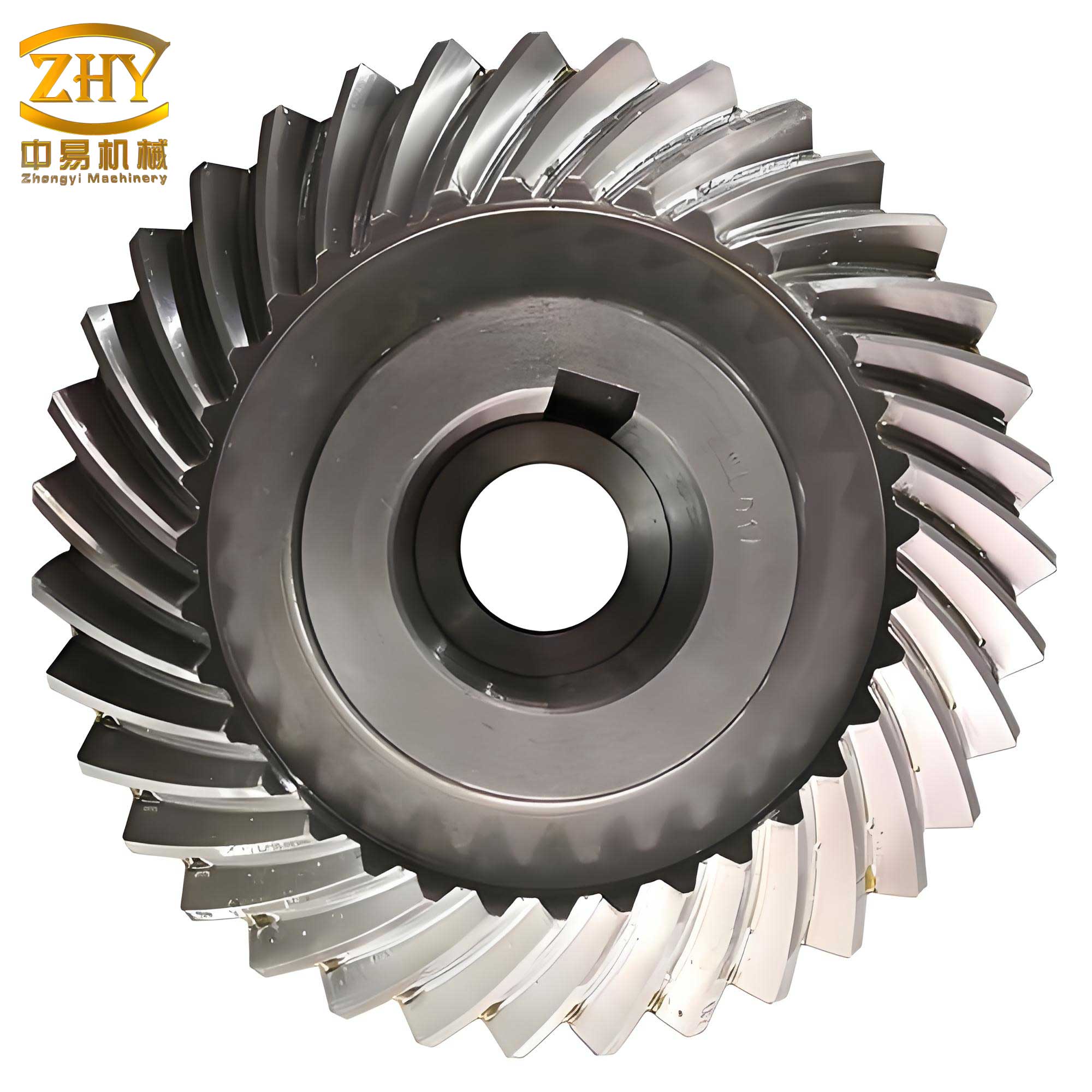
The principle of EDM成形加工 for internal spiral gears involves using an external gear-shaped tool electrode that performs a helical motion relative to the workpiece. This motion is typically facilitated by a leadscrew helical pair attached to the EDM machine. The fundamental condition for accurate replication is that the transverse tooth profile of the tool electrode matches that of the internal spiral gear workpiece, and their helical angles are equal and share the same hand. The kinematic relationship between the leadscrew parameters and the gear parameters governs the process fidelity. Evaluating the accuracy of a machined spiral gear involves several单项误差: tooth profile error (∆f_f), tooth direction error (∆F_β), pitch errors (such as base pitch deviation ∆f_pb, pitch deviation ∆f_pt, radial runout ∆F_r), and tooth thickness errors (like tooth thickness deviation ∆E_sn, average length deviation of common normal ∆E_w). Among these, the tooth direction and pitch accuracies are largely几何-related, dependent on the manufacturing and alignment precision of the leadscrew pair and the relative positioning between workpiece and electrode. Conversely, tooth profile accuracy is predominantly influenced by the tool electrode’s own precision, machining parameters, and the discharge process itself. This analysis centers on the latter, specifically how the discharge gap, as a manifestation of these parameters, affects the tooth form.
The discharge gap (δ) in EDM is a comprehensive result of electrical and non-electrical parameters. An empirical formula often used to estimate this gap under ideal, uniform电场 conditions is:
$$ δ = K_1 W^{K_2} t_p^{K_3} + K_4 + δ_m $$
Where:
- $K_1$ is a constant (approximately $1.4 \times 10^{-3}$ in kerosene).
- $W$ is the discharge energy.
- $t_p$ is the pulse duration (on-time).
- $K_2$, $K_3$ are constants related to the process.
- $K_4$ is a constant dependent on the electrode material.
- $δ_m$ represents the increase in gap due to mechanical factors.
This formula assumes a uniform电场, which is not the case in practical EDM of complex shapes like spiral gears. The actual inter-electrode电场 is non-uniform, necessitating corrections to the discharge gap model.
In EDM成形加工 of an involute internal spiral gear, the electrode pair does not constitute ideal parallel plates. The electric field strength (E) at the electrode surface relates to the inter-electrode voltage (U_0) and the local geometry. It can be expressed as:
$$ E = \alpha_e U_0 $$
Here, $α_e$ is the电场 coefficient, dependent on electrode shape and the local inter-electrode distance. For electrodes approximated as parabolic bodies of revolution, the surface电场 can be calculated using a more specific relation. Generally, the field strength intensifies with decreasing inter-electrode distance or with a smaller radius of curvature at the electrode tip. For an involute curve, the radius of curvature (ρ) varies along the profile according to its polar equation:
$$ \rho = r_b \theta $$
Where:
- $r_b$ is the base circle radius of the spiral gear.
- $θ$ is the involute展开角 (unwinding angle).
This equation indicates that the curvature radius increases linearly with the展开角. Consequently, during EDM of an involute spiral gear, the inter-electrode电场 strength changes along the tooth profile. Finite element analysis (FEA) of the电场 distribution between involute tooth surfaces reveals a non-uniform pattern. The key insight is that the electric field is strongest in regions with smaller curvature radii (near the tooth root of the spiral gear) and weaker where the curvature radius is larger (near the tooth tip).
The non-uniform电场 distribution has a direct impact on the discharge process and resultant tooth profile accuracy. According to discharge breakdown theory, breakdown occurs first where the electric field is strongest. Therefore, in EDM of an involute spiral gear, the discharge erosion is more intense at the tooth root compared to the tip. This leads to uneven material removal along the profile, causing a deviation between the actual machined tooth form and the theoretical involute. This deviation constitutes the tooth profile error. Experimental measurements confirm this phenomenon. When comparing the theoretical and actual tooth profiles of an EDM-machined internal spiral gear, it is observed that more material is eroded from the root region. The error manifests as an increase in the pressure angle and a decrease in the base circle radius relative to the design specifications.
| Error Type | Main Influencing Factors | Nature | Typical Control Method |
|---|---|---|---|
| Tooth Profile Error (∆f_f) | Tool electrode accuracy, EDM parameters, Discharge gap non-uniformity due to电场 distribution. | Electro-thermal/Process-dependent | Electrode修形, Optimized EDM parameters. |
| Tooth Direction Error (∆F_β) | Leadscrew pair accuracy, Alignment of workpiece and electrode. | Geometric/Kinematic | Precision manufacturing and assembly. |
| Pitch Errors (∆f_pt, ∆F_r, etc.) | Indexing accuracy, Machine tool stiffness, Electrode runout. | Geometric/Kinematic | High-precision motion control, Balancing. |
A quantitative analysis of the tooth profile error can be performed by decomposing the measured error. For a typical case, the total profile error ∆f_f might be decomposed into:
- Base circle error (∆r_b): Negative, indicating a smaller base circle.
- Pressure angle error (∆α): Positive, indicating a larger pressure angle.
- Form error (∆f_fα): The residual shape deviation.
This decomposition underscores that the primary effect of the non-uniform电场 in EDM of a spiral gear is a systematic shift in the gear’s fundamental geometry.
The relationship between curvature radius (ρ), discharge gap variation (∆δ), and the resulting profile error can be summarized conceptually. The effective discharge gap is not constant but is a function of the local电场 strength, which in turn depends on ρ. An illustrative relationship derived from analysis and experiment is:
$$ \Delta \delta(\rho) \approx \frac{C_1}{\rho^{n}} $$
Where $C_1$ and $n$ are constants related to process conditions. This implies that the additional erosion (or effective gap increase) is inversely related to the curvature radius. For the spiral gear’s involute, since $ρ = r_b θ$, the error is more pronounced at smaller θ (tooth root).
| Error Component | Symbol | Value (µm) | Interpretation |
|---|---|---|---|
| Total Profile Error | ∆f_f | -65 | Overall deviation from theoretical involute. |
| Base Circle Error | ∆r_b | -30 | Machined base circle is smaller. |
| Pressure Angle Error | ∆α | +15 (arc-min) | Machined pressure angle is larger. |
| Form Error | ∆f_fα | -20 | Residual shape inaccuracy. |
To counteract this inherent error source in EDM of spiral gears, a proactive approach is the modification of the tool electrode’s tooth profile. The goal is to design a non-involute,修形 profile for the external tool electrode such that during the EDM process, the inter-electrode电场 becomes uniformly distributed along the desired engagement zone. By intentionally altering the curvature radius distribution of the tool’s profile, the electric field强度 can be equalized. This修形 effectively pre-compensates for the anticipated non-uniform erosion. The design of the corrected profile requires an inverse solution based on the电场 analysis model. One method involves iteratively adjusting the tool profile until the simulated电场 distribution between the tool and the theoretical workpiece involute is uniform. The resulting tool profile for machining an internal spiral gear will be slightly different from a perfect involute, typically featuring a reduced curvature in the root region and/or an enhanced curvature near the tip relative to the standard involute.
The修形 process can be mathematically framed. Let the theoretical involute profile of the internal spiral gear be defined by $r_b$ and its equation. The desired uniform电场 strength is $E_0$. The relationship between local gap $g(s)$, voltage $U_0$, and field strength $E(s)$ is $E(s) = U_0 / g(s)$ for a simplified parallel plate analogy, but more accurately $E(s) = \alpha_e(s) U_0$, where $α_e(s)$ is a function of local geometry. To achieve $E(s) = E_0$, the local geometry (i.e., the tool profile) must be adjusted so that $α_e(s)$ becomes constant. This involves solving for the tool surface position $R_t(s)$ given the workpiece surface $R_w(s)$, where $s$ is a parameter along the profile. A simplified correction model might propose that the tool profile offset $∆R_t(s)$ is proportional to the predicted error $∆δ(ρ(s))$:
$$ R_t^{corrected}(s) = R_t^{involute}(s) – \eta \cdot \Delta \delta(\rho(s)) \cdot \hat{n}(s) $$
Where $η$ is a compensation factor (often close to 1), $∆δ(ρ(s))$ is the estimated gap variation due to non-uniform field, and $\hat{n}(s)$ is the unit normal vector to the surface. Implementing this correction requires precise modeling of the EDM process for the specific spiral gear geometry.
In conclusion, the analysis confirms that the non-uniform distribution of electric field strength along the involute tooth profile is a major contributor to tooth profile errors in the EDM of internal spiral gears. This non-uniformity arises directly from the varying curvature radius of the involute curve. The resulting uneven discharge erosion causes systematic errors, primarily an increase in pressure angle and a decrease in base circle diameter. Therefore, for high-precision applications involving spiral gears, relying solely on a perfect involute tool electrode is insufficient. The effective path to ensuring tooth profile accuracy lies in modifying the tool electrode’s tooth profile to create a condition of uniform inter-electrode electric field strength during放电. This修形 approach compensates for the process-induced distortions. Future work could focus on developing more precise quantitative models linking EDM parameters, spiral gear geometry (including helix angle effects), and the exact electric field distribution to automate the修形 design process. Additionally, experimental validation across a wider range of spiral gear modules and helix angles would further solidify this methodology. The pursuit of accuracy in manufacturing complex components like spiral gears continues to drive advancements in non-traditional machining processes like EDM.
Beyond tooth profile accuracy, other aspects of spiral gear quality in EDM warrant attention. The surface integrity, including the presence of the recast layer and micro-cracks, affects the gear’s fatigue life. Optimizing flushing conditions for the helical gap in internal spiral gear machining is crucial to avoid arcing and improve material removal uniformity. Furthermore, the wear of the tool electrode itself, especially over long machining times for large spiral gears, must be accounted for, potentially through adaptive tool path or parameter adjustment. The integration of real-time monitoring systems to measure discharge consistency and adjust parameters dynamically could enhance the process robustness for spiral gear production. As materials evolve, such as the use of advanced powdered metals for gears, EDM parameters and error compensation models will need continuous refinement to maintain the precision required for high-performance spiral gear applications in aerospace, automotive, and robotics.
The mathematical framework for电场 analysis can be extended. The general expression for electric field between two complex surfaces can be derived from Laplace’s equation, $ \nabla^2 V = 0 $, where V is the electric potential. For a region between two electrodes representing a spiral gear tooth gap, with boundary conditions $V=V_0$ on the tool and $V=0$ on the workpiece, the field $E = -\nabla V$. A simplified 2D cross-sectional analysis in the transverse plane of the spiral gear provides significant insight. In this plane, the gap distance $d(x)$ varies along the profile coordinate x. For a small gap relative to curvature radii, the field can be approximated as $E(x) \approx \frac{U_0}{d(x)} f(\kappa_t, \kappa_w)$, where $\kappa_t$ and $\kappa_w$ are the curvatures of the tool and workpiece surfaces, respectively. This reinforces that local geometry dictates field strength.
To summarize the key relationships governing tooth profile error in EDM of spiral gears, consider the following interconnected equations:
1. Involute Geometry: $$ \rho = r_b \theta, \quad x = r_b (\cos\theta + \theta \sin\theta), \quad y = r_b (\sin\theta – \theta \cos\theta) $$
2. Electric Field Strength (Simplified): $$ E(\theta) \propto \frac{U_0}{d(\theta)} \cdot \frac{1}{\sqrt{\rho(\theta)}} $$ (indicating inverse relationship with sqrt of curvature radius).
3. Discharge Gap Variation: $$ \Delta \delta(\theta) = K \cdot E(\theta)^m $$ (where K and m are process constants).
4. Resultant Profile Error: $$ \Delta y(\theta) \approx \Delta \delta(\theta) \cdot \sin \phi(\theta) $$ where $\phi(\theta)$ is the pressure angle at point $\theta$.
These formulae, while simplified, capture the essential physics linking the spiral gear’s involute shape to the machining error. For a comprehensive process design, numerical simulation combining electromagnetic, thermal, and fluid dynamics is recommended.
Finally, the advantages of EDM for internal spiral gear manufacturing remain compelling despite these error challenges. It allows for the加工 of hardened materials, complex geometries, and fine features without mechanical cutting forces. By understanding and compensating for the principal error source—the non-uniform electric field—manufacturers can harness EDM to produce high-precision internal spiral gears consistently. This is particularly valuable for prototypes, custom designs, or low-volume production runs where traditional gear hobbing or shaping of internal spiral gears is impractical or impossible. Continued research into adaptive control and intelligent tool design will further elevate EDM as a critical technology in the realm of precision gear manufacturing, especially for the demanding category of spiral gears.