
As a researcher in mechanical engineering, I have always been fascinated by the intricate dynamics of gear systems, especially spur gears, which are fundamental components in countless mechanical transmissions. In this article, I will delve into a comprehensive study on the tooth root stress characteristics of two-module spur gear pairs. Spur gears are widely used due to their simplicity and efficiency, but understanding their stress distributions is crucial for preventing failures such as tooth breakage. The focus here is on two-module spur gears, where the driving and driven gears have different modules but maintain equal normal pitch for proper meshing. This configuration offers unique advantages in design flexibility, but it also introduces complexities in stress analysis that warrant detailed investigation.
The tooth root stress is a critical factor in gear design, as it directly influences the fatigue life and reliability of spur gears. Traditional methods, like the ISO standard formulas, often calculate stress at a fixed 30° tangent angle, which may not capture the full stress distribution along the transition curve. In contrast, the broken-line section method provides a more accurate approach by considering the actual fracture path perpendicular to the transition curve, aligning better with real-world crack propagation in spur gears. This method allows for stress evaluation at any point along the transition curve, enabling a thorough analysis of stress variations. For two-module spur gears, the geometric parameters change with the modulus ratio, necessitating a tailored derivation of the transition curve equation and stress formulas. In this work, I will derive these equations based on the gear generation principle using a rack-type cutter and apply the broken-line section method to compute tooth root stress. I will then analyze the stress distribution and maximum values under different modulus ratios, supported by finite element analysis for validation. The goal is to provide insights that can enhance the design and optimization of spur gears in various applications.
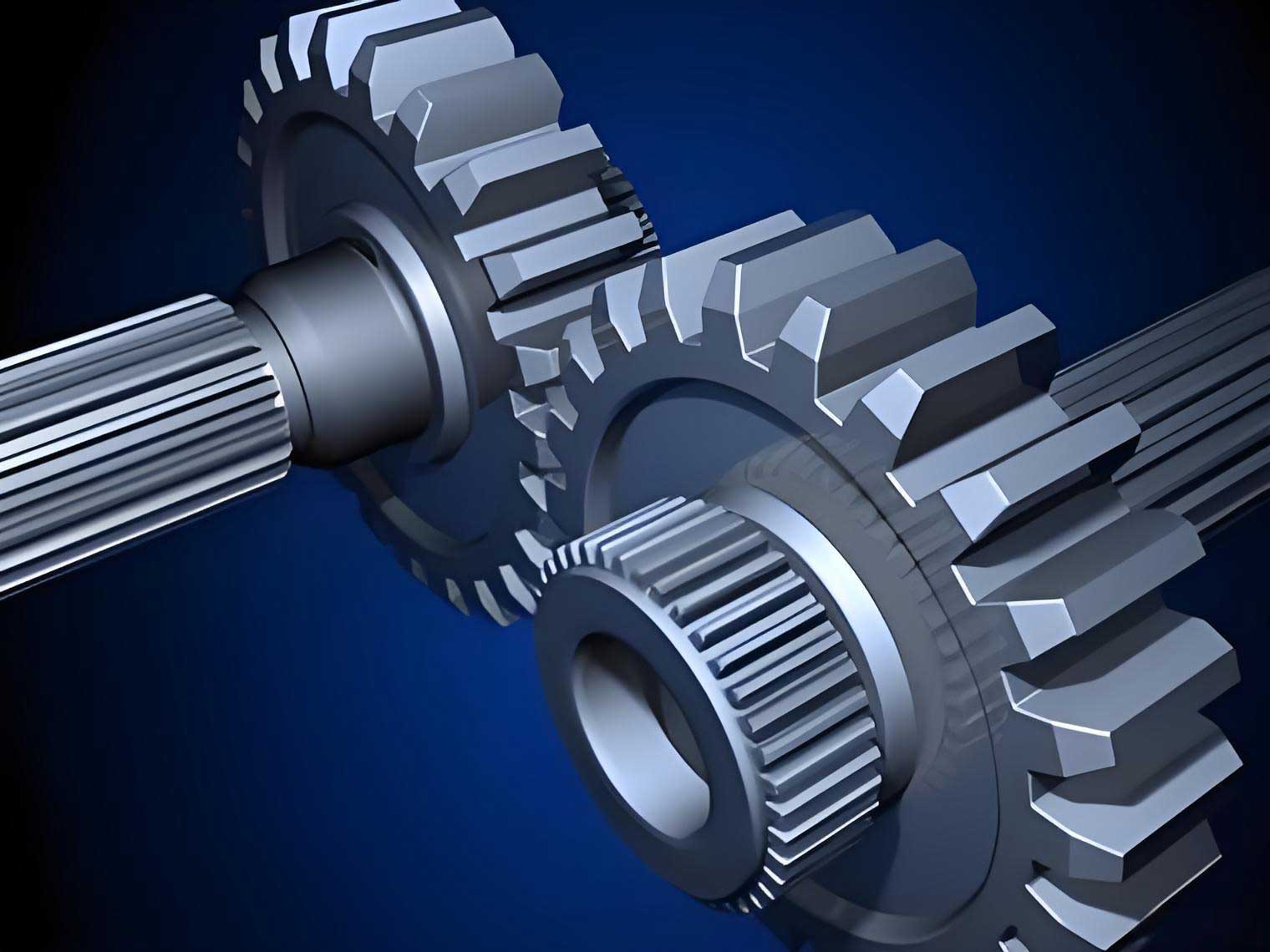
To begin, let’s consider the generation of the transition curve for spur gears. The tooth profile of involute spur gears is typically produced by a rack-type cutter through a hobbing or shaping process. In this method, the cutter and gear undergo relative rolling motion, and the envelope of the cutter’s profile forms the gear tooth. For a two-module spur gear pair, the driving gear (pinion) and driven gear have different modules, denoted as \(m_1\) and \(m_2\), respectively, with a modulus ratio \(\delta_m = m_1 / m_2\). The transition curve connects the involute profile to the root fillet, and its equation is essential for stress calculation. Based on the coordinate transformation during gear generation, the transition curve for any spur gear can be expressed in a general form. For the driving gear in a two-module pair, the coordinates \((x_p(\phi), y_p(\phi))\) of a point on the transition curve are given by:
$$ x_p(\phi) = \left( \frac{m_2 z_1 \delta_m}{2} – x_{11}^p \right) \cos \phi + \left( \frac{m_2 z_1 \delta_m}{2} \phi – y_{11}^p \right) \sin \phi $$
$$ y_p(\phi) = \left( \frac{m_2 z_1 \delta_m}{2} – x_{11}^p \right) \sin \phi – \left( \frac{m_2 z_1 \delta_m}{2} \phi – y_{11}^p \right) \cos \phi $$
Similarly, for the driven spur gear, the coordinates \((x_g(\phi), y_g(\phi))\) are:
$$ x_g(\phi) = \left( \frac{m_2 z_2}{2} – x_{11}^g \right) \cos \phi + \left( \frac{m_2 z_2}{2} \phi – y_{11}^g \right) \sin \phi $$
$$ y_g(\phi) = \left( \frac{m_2 z_2}{2} – x_{11}^g \right) \sin \phi – \left( \frac{m_2 z_2}{2} \phi – y_{11}^g \right) \cos \phi $$
In these equations, \(\phi\) is the rolling angle, \(z_1\) and \(z_2\) are the tooth numbers of the driving and driven spur gears, and \(x_{11}^p\), \(y_{11}^p\), \(x_{11}^g\), \(y_{11}^g\) are derived from cutter parameters such as addendum coefficient, clearance coefficient, and tip radius coefficient. For spur gears, these parameters depend on the module and pressure angle. Specifically, for the driving spur gear:
$$ x_{11}^p = x_c^p + \rho_0^* \delta_m m_2 \cos \gamma_1, \quad y_{11}^p = y_c^p – \rho_0^* \delta_m m_2 \sin \gamma_1 $$
$$ \gamma_1 = \arctan \left( \frac{\delta_m m_2 \phi – 2 y_c^p}{2 x_c^p} \right) $$
And for the driven spur gear:
$$ x_{11}^g = x_c^g + \rho_0^* m_2 \cos \gamma_2, \quad y_{11}^g = y_c^g – \rho_0^* m_2 \sin \gamma_2 $$
$$ \gamma_2 = \arctan \left( \frac{m_2 \phi – 2 y_c^g}{2 x_c^g} \right) $$
Here, \(\rho_0^*\) is the cutter tip radius coefficient, and \(x_c^p\), \(y_c^p\), \(x_c^g\), \(y_c^g\) are distances related to the cutter geometry. These equations form the basis for analyzing the transition curve in two-module spur gears, which is crucial for subsequent stress calculations using the broken-line section method.
The broken-line section method computes tooth root stress by considering a critical section perpendicular to the transition curve, which aligns with typical fracture patterns in spur gears. The stress formula for a gear in a two-module pair can be expressed as:
$$ \sigma_k = \frac{T_k}{b_k r_k m_k Y_{\sigma k}} $$
where \(k = 1\) for the driving spur gear and \(k = 2\) for the driven spur gear. \(T_k\) is the input torque, \(b_k\) is the face width, \(r_k\) is the pitch radius, \(m_k\) is the module, and \(Y_{\sigma k}\) is the local stress coefficient. For spur gears, \(Y_{\sigma k}\) is derived from geometric parameters and is given by:
$$ Y_{\sigma k} = \frac{2 Y_k^2 \cos \alpha_k}{m_k \left[ 2 GD_k H_k \cos \delta_k – Y_k \sin \delta_k \cos^2 \psi_k \right]} $$
In this equation, \(Y_k\) is the y-coordinate of the point on the transition curve (i.e., \(Y_1 = y_p(\phi)\) for the driving spur gear and \(Y_2 = y_g(\phi)\) for the driven spur gear), \(\alpha_k\) is the pressure angle, \(\delta_k\) is the angle between the load line and the perpendicular to the gear symmetry axis, \(\psi_k\) is the tangent angle at the transition curve point, and \(GD_k\) and \(H_k\) are factors related to gear geometry. Specifically, for spur gears:
$$ GD_k = \frac{r_{bk}}{\cos \delta_{ik}} – X_k + Y_k \tan \psi_k $$
$$ H_k = -\frac{\cos \psi_k}{2} \left[ H_0 + \frac{(\beta_k + \cos \psi_k)^2}{\beta_k^3} \ln \left( \frac{\cos \psi_k}{\cos \psi_k + \beta_k} \right) \right] $$
where \(X_k\) is the x-coordinate of the point (i.e., \(X_1 = x_p(\phi)\) for the driving spur gear and \(X_2 = x_g(\phi)\) for the driven spur gear), \(r_{bk}\) is the base radius, \(\delta_{ik}\) is the load angle, \(\beta_k = Y_k / \rho_k\) is the curvature coefficient, \(\rho_k\) is the radius of curvature at the point, and \(H_0 = (3\beta_k + 2\cos \psi_k) / (2\beta_k^2)\). By substituting the transition curve coordinates into these formulas, we can compute the tooth root stress at any point along the transition curve for two-module spur gears. This approach allows for a detailed analysis of stress distribution, which is essential for optimizing the design of spur gears.
To illustrate the application, let’s define a specific case study. Consider a two-module spur gear pair with a driving gear (pinion) of 19 teeth and a driven gear of 23 teeth. The input power is 1.64 kW, input speed is 1750 rpm, no profile shift is applied, and the face width is 16 mm. The driven spur gear has a fixed module \(m_2 = 1.25\) mm and pressure angle \(\alpha_2 = 20^\circ\), while the driving spur gear’s module \(m_1\) varies to achieve different modulus ratios \(\delta_m\). To avoid excessive thinning of the driving spur gear’s tooth tip, the modulus ratio is limited to \(\delta_m \leq 1.09\), and since \(\delta_m < 1\) would weaken the driving spur gear, we consider \(\delta_m \geq 1\). The parameters for different modulus ratios are summarized in the table below, which provides a clear overview of the geometric variations in these spur gears.
| Case No. | \(m_1\) (mm) | \(\alpha_1\) (°) | \(m_2\) (mm) | \(\alpha_2\) (°) | \(\delta_m\) |
|---|---|---|---|---|---|
| 1 | 1.250 | 20.00 | 1.25 | 20.00 | 1.00 |
| 2 | 1.275 | 22.89 | 1.02 | ||
| 3 | 1.300 | 25.37 | 1.04 | ||
| 4 | 1.325 | 27.56 | 1.06 | ||
| 5 | 1.350 | 29.53 | 1.08 |
Using these parameters, I computed the local stress coefficient \(Y_{\sigma k}\) and tooth root stress \(\sigma_k\) for both spur gears across a range of tangent angles \(\psi_k\). The results reveal interesting trends in the behavior of spur gears under different modulus ratios. For the driving spur gear, the local stress coefficient decreases initially and then increases as the tangent angle increases, with the minimum value occurring near the 30° tangent angle. This pattern is consistent across all modulus ratios, but as \(\delta_m\) increases, the entire curve of \(Y_{\sigma 1}\) shifts upward, indicating a larger effective area coefficient for the driving spur gear. Consequently, the tooth root stress for the driving spur gear shows an opposite trend: it first increases and then decreases with tangent angle, peaking near 30°. Moreover, as \(\delta_m\) increases, the stress curve for the driving spur gear shifts downward, meaning the maximum tooth root stress decreases. This is summarized in the table below for the driving spur gear’s maximum stress at different modulus ratios.
| \(\delta_m\) | Maximum Tooth Root Stress for Driving Spur Gear (MPa) | Tangent Angle at Maximum (°) |
|---|---|---|
| 1.00 | 108.0 | 30 |
| 1.02 | 102.5 | 30 |
| 1.04 | 97.0 | 30 |
| 1.06 | 91.5 | 30 |
| 1.08 | 86.0 | 30 |
For the driven spur gear, the local stress coefficient also exhibits a similar pattern of first decreasing and then increasing with tangent angle, with the minimum near 30°. However, as \(\delta_m\) increases, the curve of \(Y_{\sigma 2}\) shifts downward, indicating a smaller effective area coefficient for the driven spur gear. This leads to an increase in tooth root stress for the driven spur gear as \(\delta_m\) increases. The stress for the driven spur gear also peaks near the 30° tangent angle, but the maximum value rises with higher modulus ratios. The table below summarizes this for the driven spur gear.
| \(\delta_m\) | Maximum Tooth Root Stress for Driven Spur Gear (MPa) | Tangent Angle at Maximum (°) |
|---|---|---|
| 1.00 | 104.5 | 30 |
| 1.02 | 108.0 | 30 |
| 1.04 | 111.5 | 30 |
| 1.06 | 115.0 | 30 |
| 1.08 | 118.5 | 30 |
To provide a holistic view, the combined maximum tooth root stresses for both spur gears across modulus ratios are presented in the following table. This highlights the trade-off in stress between the driving and driven spur gears when adjusting the modulus ratio.
| \(\delta_m\) | Driving Spur Gear Max Stress (MPa) | Driven Spur Gear Max Stress (MPa) | Stress Reduction in Driving Spur Gear (%) | Stress Increase in Driven Spur Gear (%) |
|---|---|---|---|---|
| 1.00 | 108.0 | 104.5 | 0.0 | 0.0 |
| 1.02 | 102.5 | 108.0 | 5.1 | 3.3 |
| 1.04 | 97.0 | 111.5 | 10.2 | 6.7 |
| 1.06 | 91.5 | 115.0 | 15.3 | 10.0 |
| 1.08 | 86.0 | 118.5 | 20.4 | 13.4 |
From these results, it is evident that increasing the modulus ratio significantly reduces the tooth root stress in the driving spur gear, with a reduction of up to 27.8% when \(\delta_m\) increases from 1.00 to 1.08. In contrast, the driven spur gear experiences a stress increase of up to 17.7% over the same range. This trade-off is crucial for designers of spur gears, as it allows for balancing stress levels between the mating gears to enhance overall system durability. The consistency of the maximum stress occurring near the 30° tangent angle aligns with findings for standard spur gears, validating the applicability of the broken-line section method to two-module spur gears.
To validate the theoretical calculations, I conducted a finite element analysis (FEA) using a precise 3D model of the two-module spur gear pair. The transition curves were generated from the derived equations to ensure accuracy, and the gear models were trimmed to include only the meshing teeth and adjacent ones for computational efficiency. The mesh was refined near the contact regions to 0.2 mm, while the overall mesh size was 0.5 mm. For example, for \(\delta_m = 1.04\), the meshed model showed detailed stress contours. The boundary conditions included applying a torque of 8,949 N·mm to the driving spur gear and fixing the driven spur gear. The FEA results for tooth root stress distribution confirmed the theoretical trends. The maximum stresses extracted from FEA for different modulus ratios are summarized in the table below, showing good agreement with the theoretical values, thus verifying the accuracy of the broken-line section method for two-module spur gears.
| \(\delta_m\) | FEA Max Stress for Driving Spur Gear (MPa) | FEA Max Stress for Driven Spur Gear (MPa) | Theoretical Max Stress for Driving Spur Gear (MPa) | Theoretical Max Stress for Driven Spur Gear (MPa) |
|---|---|---|---|---|
| 1.00 | 107.5 | 104.0 | 108.0 | 104.5 |
| 1.02 | 102.0 | 107.5 | 102.5 | 108.0 |
| 1.04 | 96.5 | 111.0 | 97.0 | 111.5 |
| 1.06 | 91.0 | 114.5 | 91.5 | 115.0 |
| 1.08 | 85.5 | 118.0 | 86.0 | 118.5 |
The close match between FEA and theoretical results underscores the reliability of the derived formulas. Additionally, the stress distributions along the transition curves from FEA exhibited similar patterns, with peaks near the 30° tangent angle for both spur gears. This consistency further reinforces the validity of using the broken-line section method for stress analysis in two-module spur gears. The ability to predict stress accurately is vital for designing robust spur gears that can withstand operational loads without failure.
In conclusion, this study provides a comprehensive analysis of tooth root stress in two-module spur gear pairs using the broken-line section method. The key findings are: (1) For both driving and driven spur gears, the tooth root stress along the transition curve first increases and then decreases with the tangent angle, reaching a maximum near 30°. This behavior is consistent across different modulus ratios, highlighting the importance of this region in spur gear design. (2) The modulus ratio \(\delta_m\) has a significant impact on stress distribution. Increasing \(\delta_m\) reduces the local stress coefficient for the driving spur gear, leading to a decrease in its maximum tooth root stress, while for the driven spur gear, the local stress coefficient decreases, causing an increase in maximum stress. Specifically, for \(\delta_m\) from 1.00 to 1.08, the driving spur gear’s maximum stress decreases by 27.8%, and the driven spur gear’s maximum stress increases by 17.7%. This indicates that adjusting the modulus ratio can effectively optimize stress levels in spur gears, particularly for reducing stress in the driving spur gear, which is often the more critical component due to higher cyclic loading. (3) The theoretical calculations based on the derived transition curve equations and broken-line section method are validated by finite element analysis, confirming the method’s accuracy for two-module spur gears. These insights can guide engineers in designing more efficient and durable spur gear systems, especially in applications where weight reduction and performance enhancement are key. Future work could explore dynamic effects, lubrication impacts, or extended modulus ratio ranges to further optimize spur gear performance. Overall, this analysis contributes to the broader understanding of spur gears and their stress characteristics, paving the way for advanced gear design methodologies.
Throughout this discussion, the term “spur gears” has been emphasized to highlight the focus on this common yet critical type of gear. Spur gears are ubiquitous in machinery, from automotive transmissions to industrial equipment, and their reliable operation depends on accurate stress analysis. The two-module configuration offers a versatile approach to gear design, allowing for tailored performance. By leveraging the broken-line section method, designers can gain deeper insights into stress distributions, enabling the creation of spur gears that are both strong and efficient. As technology advances, such analytical tools will continue to play a vital role in optimizing mechanical systems involving spur gears.