
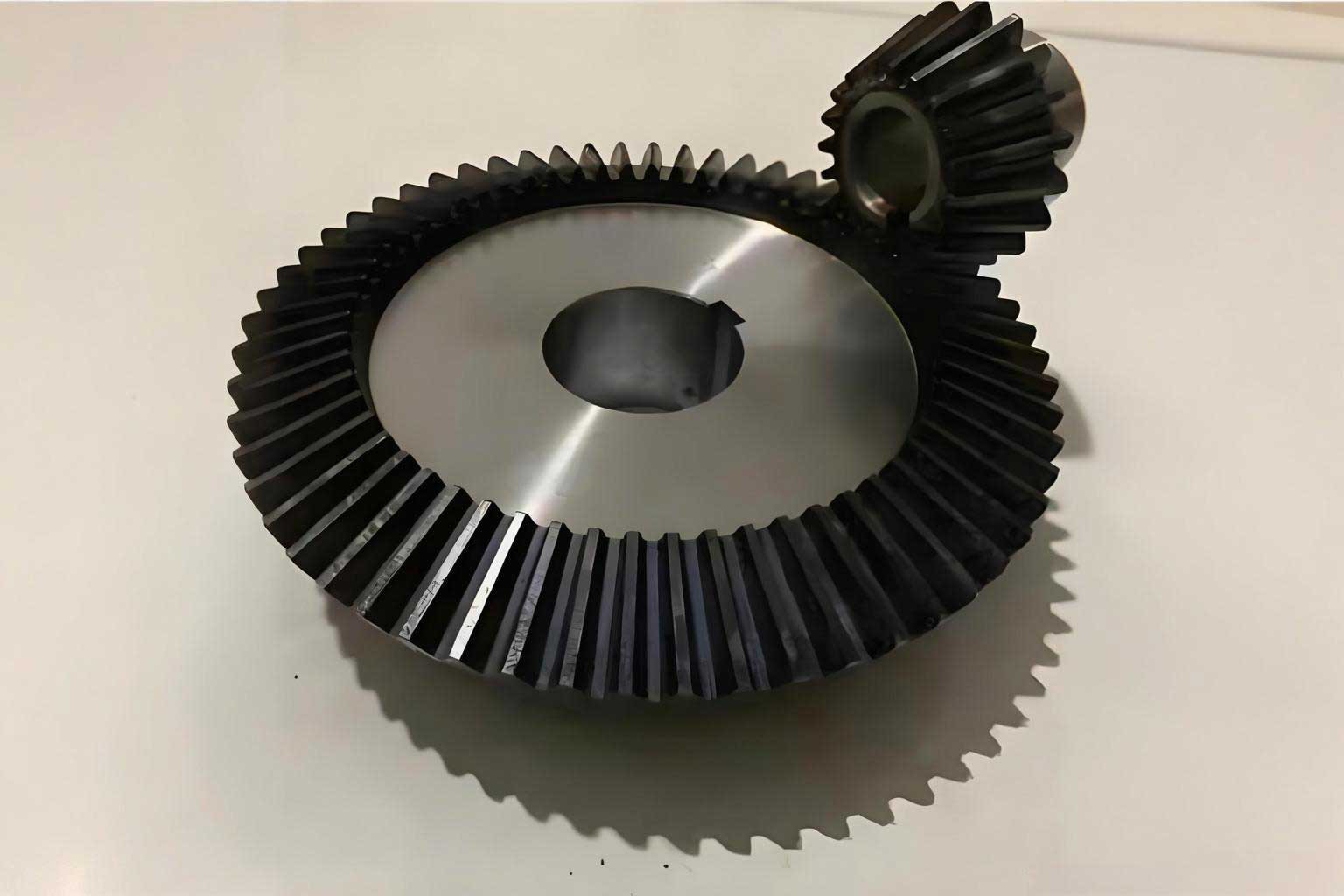
In the field of mechanical transmission, especially within aerospace applications, the selection of appropriate gear types is critical for ensuring system stability, efficiency, and longevity. Among various gear configurations, miter gears—specifically straight bevel gears and zero spiral bevel gears—are often considered interchangeable due to their similar传动 functions, yet their inherent design differences lead to distinct transmission characteristics. As an engineer focused on gear dynamics, I have conducted a comprehensive finite element analysis to compare these two types of miter gears, aiming to elucidate their performance disparities under identical loading and operational conditions. This study leverages transient simulation techniques to assess contact forces, stress distributions, and vibrational behaviors, providing insights that can guide gear selection in high-precision domains like aviation.
The foundation of this analysis lies in the development of accurate finite element models. I began by constructing a model for a pair of straight bevel gears, which are a common type of miter gears used in right-angle power transmission. The geometry was based on standard parameters, including tooth number, module, and pressure angle, to ensure realism. Using ANSYS/LS-DYNA software, I performed a transient dynamic simulation to capture the啮合 process under specified rotational speeds and torque loads. This initial step served as a validation of my methodology; by comparing the simulated contact forces with theoretical values derived from classical gear mechanics, I confirmed the model’s accuracy. The theoretical contact force, comprising tangential, axial, and radial components, can be expressed as: $$F_t = \frac{T}{r},$$ where \(F_t\) is the tangential force, \(T\) is the applied torque, and \(r\) is the pitch radius. For straight bevel gears, the axial and radial forces are calculated considering the pitch cone angles. The simulation results showed minimal errors—within 5%—across all force components, as summarized in Table 1, thereby verifying the reliability of my approach for subsequent comparisons.
| Force Component | Theoretical Value (N) | Simulated Value (N) | Error (%) |
|---|---|---|---|
| Tangential Force | 541.5 | 544.3 | 0.52 |
| Axial Force | 74.1 | 76.5 | 3.2 |
| Radial Force | 182.6 | 185.2 | 1.4 |
| Resultant Force | 576.2 | 580.0 | 0.66 |
With the methodology validated, I proceeded to develop a comparative model for zero spiral bevel gears, another variant of miter gears characterized by curved teeth with zero spiral angles. These gears are known for their smoother engagement and reduced noise, but their complex tooth geometry necessitates precise modeling. I maintained identical loading conditions—rotational speed and resistance torque—to facilitate a direct comparison with the straight bevel gears. The finite element mesh was refined to capture the intricate tooth profiles, ensuring that contact interactions were accurately represented. This comparative framework allowed me to systematically analyze transmission characteristics, focusing on contact dynamics, stress patterns, and vibrational responses.
The contact force behavior during啮合 is a primary indicator of transmission stability. For straight bevel gears, the contact force curve exhibited significant fluctuations, particularly after the initial engagement phase. In contrast, zero spiral bevel gears demonstrated a more stable contact force profile with reduced oscillations. To quantify this, I extracted the amplitude of force variations during the steady-state phase. As shown in Table 2, the fluctuation amplitude for straight bevel gears was 1,925 N, whereas for zero spiral bevel gears, it was only 95 N—a difference of over 20 times. This stark contrast highlights the superior啮合 stability of zero spiral bevel gears, which can be attributed to their gradual tooth engagement and localized contact patterns.
| Gear Type | Fluctuation Amplitude (N) |
|---|---|
| Straight Bevel Gears (Miter Gears) | 1925 |
| Zero Spiral Bevel Gears (Miter Gears) | 95 |
To further analyze the contact dynamics, I performed a Fast Fourier Transform (FFT) on the contact force curves, segmenting them into loading, transition, and steady-state phases. For straight bevel gears, the FFT revealed high-frequency components with substantial magnitudes, indicating pronounced dynamic excitations. For instance, during the steady-state phase, the peak force amplitude reached 774.4 N at a frequency of 43,625 Hz. In comparison, zero spiral bevel gears exhibited lower frequencies and amplitudes across all phases; during steady-state, the peak was merely 70.3 N at 1,949 Hz. These findings suggest that zero spiral bevel gears achieve force stabilization more rapidly and with less vibrational energy, making them advantageous for applications requiring smooth operation, such as in aerospace systems where miter gears are often deployed.
Stress distribution on tooth surfaces is another critical aspect of gear performance, as it直接影响 load-bearing capacity and fatigue life. Under ideal conditions—without installation errors—I examined the contact stress patterns via finite element simulations. For straight bevel gears, the contact斑点 spanned a broad area along the tooth height, with slight dispersion toward the toe and heel regions. This is typical for miter gears with straight teeth, where engagement occurs across multiple tooth lines simultaneously. In contrast, zero spiral bevel gears exhibited more concentrated contact斑点, localized near the large end of the tooth in the齿向 direction. This concentration results from the curved tooth profile, which promotes localized point contact, albeit with higher stress intensities at the contact zone.
To quantify stress variations, I extracted stress values along the齿向 and齿高 directions for both gear types. Along the齿向 direction, from the large end to the small end, the stress distribution for straight bevel gears was relatively uniform, whereas for zero spiral bevel gears, stresses peaked at the large end and tapered off toward the small end. This aligns with the contact斑点 observations and can be described by the Hertzian contact stress formula: $$\sigma_c = \sqrt{\frac{F}{\pi \cdot b \cdot \rho_e}},$$ where \(\sigma_c\) is the contact stress, \(F\) is the normal load, \(b\) is the contact width, and \(\rho_e\) is the equivalent radius of curvature. For miter gears, the curvature differences between straight and zero spiral teeth lead to distinct \(\rho_e\) values, influencing stress magnitudes. Along the齿高 direction, from the contact surface to the non-contact root area, maximum stresses occurred at the啮合 interface for both gears, but root stresses due to bending were also significant. The bending stress at the tooth root can be approximated using the Lewis formula: $$\sigma_b = \frac{F_t \cdot K}{b \cdot m \cdot Y},$$ where \(K\) is the load factor, \(m\) is the module, and \(Y\) is the form factor. Comparative data for maximum stresses are summarized in Table 3 and Table 4.
| Gear Type | Pinion (MPa) | Gear (MPa) |
|---|---|---|
| Straight Bevel Gears (Miter Gears) | 532 | 522 |
| Zero Spiral Bevel Gears (Miter Gears) | 756 | 536 |
| Gear Type | Pinion Tensile Stress (MPa) | Pinion Compressive Stress (MPa) | Gear Tensile Stress (MPa) | Gear Compressive Stress (MPa) |
|---|---|---|---|---|
| Straight Bevel Gears (Miter Gears) | 226 | 220 | 185 | 150 |
| Zero Spiral Bevel Gears (Miter Gears) | 174 | 187 | 147 | 235 |
From these tables, it is evident that zero spiral bevel gears experience higher contact stresses on the pinion (1.42 times that of straight bevel gears) due to their concentrated contact, but lower tensile root stresses on the pinion (0.77 times) and gear (0.79 times). However, compressive root stresses for the gear are higher in zero spiral bevel gears (1.57 times), indicating a different load distribution pattern. These stress characteristics must be considered when selecting miter gears for high-load applications, as they impact durability and failure modes.
In real-world scenarios, installation errors such as axis misalignments and axial displacements are inevitable, potentially exacerbating stress concentrations and altering啮合 behavior. To simulate this, I introduced errors into both gear models: a 0.1° reduction in shaft angle, 0.3 mm outward axial displacement for the pinion, 0.1 mm outward axial displacement for the gear, and a 0.1 mm adjustment in轴间距. Under these conditions, the contact斑点 shifted noticeably for both gear types. For straight bevel gears, the斑点 moved toward the large end, with the pinion engaging near the root and the gear near the tip, leading to偏载 and increased stress dispersion. Zero spiral bevel gears also exhibited斑点偏移 toward the large end, but the concentration remained relatively higher, suggesting better tolerance to misalignment—a valuable trait for miter gears in aerospace assemblies where precise alignment is challenging.
Stress analyses under安装误差 revealed elevated contact stresses compared to ideal conditions. As shown in Table 5 and Table 6, zero spiral bevel gears still showed higher pinion contact stresses (1.30 times), but gear contact stresses were lower (0.92 times). Root stress disparities persisted, with straight bevel gears exhibiting higher tensile stresses in both pinion and gear. These results underscore the sensitivity of straight bevel gears to installation errors, which can amplify stress imbalances and reduce transmission efficiency. In contrast, zero spiral bevel gears, with their inherent design flexibility, demonstrate more resilient stress distributions, making them suitable for applications where misalignments are probable.
| Gear Type | Pinion (MPa) | Gear (MPa) |
|---|---|---|
| Straight Bevel Gears (Miter Gears) | 635 | 756 |
| Zero Spiral Bevel Gears (Miter Gears) | 825 | 695 |
| Gear Type | Pinion Tensile Stress (MPa) | Pinion Compressive Stress (MPa) | Gear Tensile Stress (MPa) | Gear Compressive Stress (MPa) |
|---|---|---|---|---|
| Straight Bevel Gears (Miter Gears) | 251 | 241 | 290 | 351 |
| Zero Spiral Bevel Gears (Miter Gears) | 194 | 185 | 246 | 284 |
Vibrational response is a key determinant of gear system noise and reliability, particularly in aerospace contexts where minimal vibration is paramount. I focused on the axial vibration of the larger gear, as it is often the dominant mode in miter gear arrangements. By extracting axial displacement data from nodes along the gear’s径向 direction, I generated vibration profiles for both gear types. The straight bevel gear exhibited substantial axial oscillations, with a maximum displacement amplitude of 0.0897 mm and a root mean square (RMS) value of 0.0392 mm. In comparison, the zero spiral bevel gear showed significantly reduced vibrations: amplitude of 0.0353 mm and RMS of 0.0157 mm—approximately 2.5 times lower. This reduction can be attributed to the smoother tooth engagement and lower dynamic forces in zero spiral bevel gears.
To further assess vibrational severity, I computed axial acceleration by differentiating the displacement curves twice. The acceleration amplitude for straight bevel gears reached \(6.801 \times 10^7 \, \text{mm/s}^2\), whereas for zero spiral bevel gears, it was \(2.425 \times 10^7 \, \text{mm/s}^2\)—about 2.8 times lower. This disparity highlights the superior dynamic stability of zero spiral bevel gears, which translates to lower noise levels and reduced risk of resonance-induced failures. The acceleration can be linked to dynamic forces through Newton’s second law: $$a = \frac{F_{\text{dynamic}}}{m},$$ where \(a\) is acceleration and \(m\) is the effective mass. The lower accelerations in zero spiral bevel gears indicate diminished dynamic forces, reinforcing their advantage in high-speed applications like aviation transmissions where miter gears are frequently employed.
In summary, this comprehensive analysis reveals pronounced differences in transmission characteristics between straight bevel gears and zero spiral bevel gears, both falling under the category of miter gears. The contact force stability of zero spiral bevel gears is markedly superior, with fluctuation amplitudes 20 times lower than those of straight bevel gears. Stress distributions show that zero spiral bevel gears endure higher contact stresses but generally lower tensile root stresses, though compressive root stresses may be higher under certain conditions. Installation errors exacerbate these trends, with straight bevel gears being more susceptible to偏载 and stress escalation. Vibrational assessments consistently favor zero spiral bevel gears, demonstrating reduced displacements and accelerations by factors of 2.5 to 2.8.
These findings have practical implications for gear selection in aerospace and other precision industries. When啮合 stability, vibration control, and misalignment tolerance are priorities—as is often the case in aircraft auxiliary systems—zero spiral bevel gears offer distinct advantages despite their more complex manufacturing. Conversely, straight bevel gears may be suitable for applications where cost and simplicity are paramount, provided that load conditions are moderate and alignment is meticulously maintained. As an engineer, I recommend that designers evaluate these transmission characteristics holistically, considering factors such as operational environment, load spectra, and maintenance accessibility. Future work could explore优化 strategies, such as tooth profile modifications or material enhancements, to further improve the performance of both types of miter gears. Ultimately, this study contributes to a deeper understanding of gear dynamics, empowering informed decisions in the pursuit of reliable and efficient mechanical transmissions.