
In my experience with maintaining CNC gear hobbing machines, the PHOENIX 400GH model has been a reliable workhorse for gear hobbing operations, particularly in producing crown gears. This machine, which has been in service for 18 years, utilizes a GE Fanuc Series 160i-M control system and FANUC servo motors for all axes, with the X-axis employing a full-closed loop system. Despite its age, the gear hobbing machine maintains excellent precision, capable of achieving Grade 5 gear accuracy. However, we recently encountered a persistent issue with X-axis motor overheating during gear hobbing processes, which escalated from occasional alarms to frequent disruptions, severely impacting production efficiency. This article details the diagnostic and resolution process from a first-person perspective, incorporating tables and formulas to summarize key insights, while emphasizing the importance of gear hobbing machine maintenance.
The initial symptom involved intermittent 436 alarms, indicating X-axis servo motor overheating. In gear hobbing operations, the X-axis motor drives a gear mechanism that actuates a ball screw nut assembly for linear movement along sliding guides. Operators reported that these alarms initially occurred about once a month but gradually increased to several times per day, often exacerbated by warmer ambient temperatures. This pattern suggested a progressive deterioration, possibly linked to mechanical load or electrical faults in the gear hobbing machine. The randomness of the alarms made diagnosis challenging, as manual checks of motor temperature and X-axis rotation load showed no immediate abnormalities, prompting a systematic investigation.
To address this, we divided the diagnosis into mechanical and electrical aspects. Mechanically, motor overheating in a gear hobbing machine often results from elevated operational temperatures or high torque loads, leading to sustained high-current conditions. Electrically, faults could stem from temperature sensors within the motor encoder, cabling, or drive modules. We prioritized electrical checks due to their easier accessibility, replacing the motor, encoder cables, and drive module sequentially. However, the overheating persisted, indicating a deeper mechanical issue. This led us to re-examine the X-axis transmission system, focusing on lubrication and bearing conditions, which are critical in gear hobbing applications where slow, precise movements increase load variability.
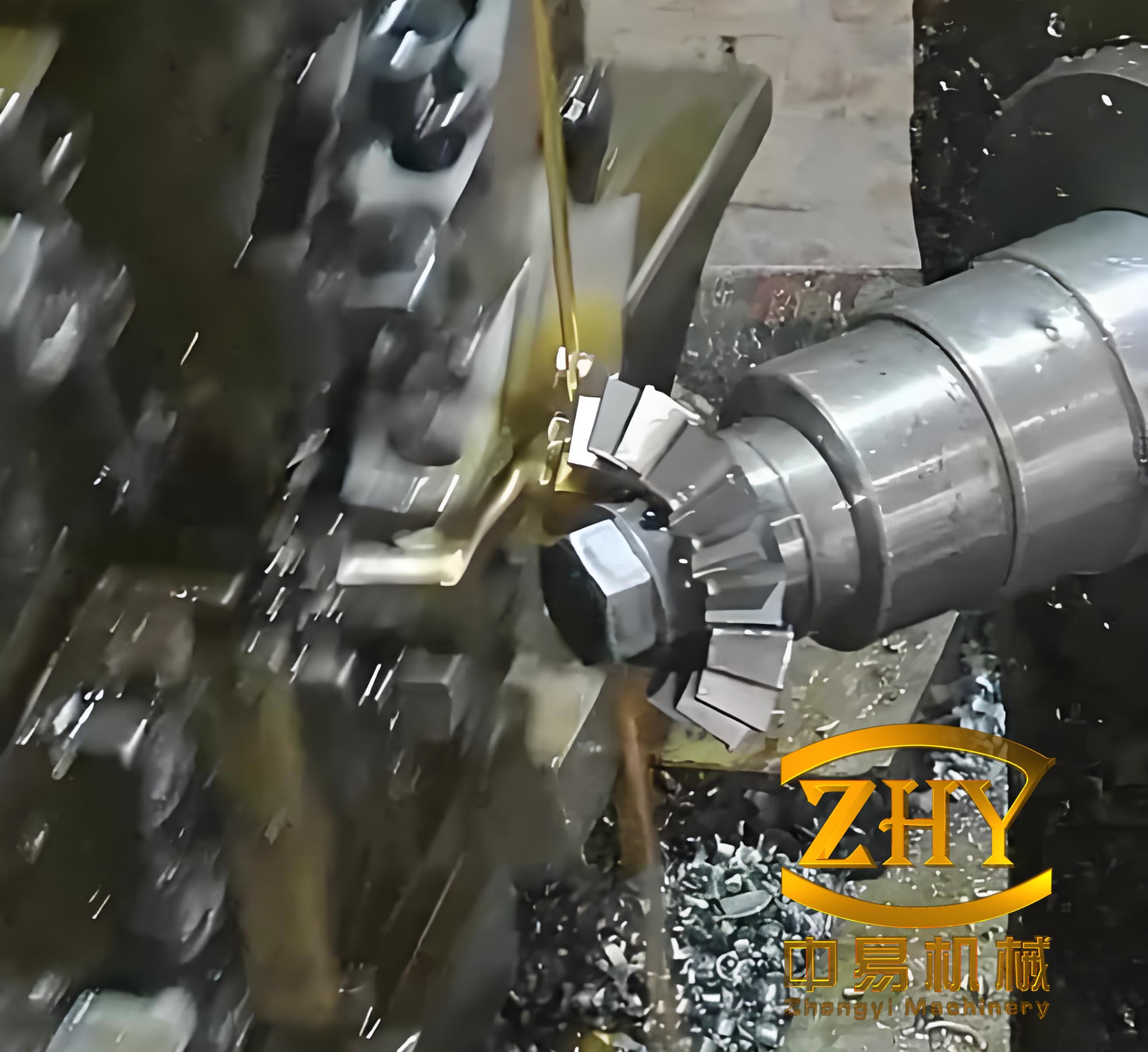
Upon disassembling the X-axis传动 system—the first such procedure in 18 years—we discovered severe lubrication deficiencies in the bearings. The bearings had minimal grease, and some retainers showed rust spots, likely due to the lack of external grease ports. This inadequate lubrication increased friction and load during the slow movements typical of gear hobbing cycles, causing random load fluctuations and subsequent motor overheating. The following table summarizes the diagnostic steps and outcomes, highlighting how mechanical factors in gear hobbing machines can mimic electrical faults:
| Step | Component Checked | Observation | Result |
|---|---|---|---|
| 1 | Electrical: Motor Temperature Sensor | No visible issues in encoder; motor replaced | Alarm persisted |
| 2 | Electrical: Cables and Drive Module | Replaced encoder cables and drive module | No change in fault frequency |
| 3 | Mechanical: Lubrication System | Forced oil lubrication to guides and screw; surfaces appeared normal | Alarm continued |
| 4 | Mechanical: Bearing Assembly | Disassembly revealed low grease and rusted retainers | Root cause identified |
The mechanical load on the X-axis motor in a gear hobbing machine can be modeled using the relationship between torque, current, and temperature. The motor temperature rise ΔT is proportional to the square of the current I and the motor resistance R, as given by: $$ΔT = k \cdot I^2 \cdot R$$ where k is a constant dependent on motor design and cooling conditions. In gear hobbing operations, the current I increases with mechanical load τ, which is influenced by friction in the transmission system. For a ball screw driven by gears, the load torque can be expressed as: $$τ = F \cdot \frac{P}{2π η} + τ_{friction}$$ where F is the axial force, P is the screw pitch, η is the efficiency, and τ_{friction} accounts for bearing and guide friction. In our case, inadequate lubrication elevated τ_{friction}, leading to higher I and ΔT, triggering overheating alarms. This formula underscores why regular maintenance is vital for gear hobbing machines to prevent such issues.
To resolve the problem, we cleaned and repacked the bearings with high-temperature grease, ensuring even distribution without overfilling. Although the original design lacked external grease ports, we implemented a scheduled manual lubrication routine every six months, tailored to the gear hobbing machine’s usage intensity. Post-repair, we monitored the X-axis performance over several weeks, noting no recurrence of overheating alarms even under continuous gear hobbing loads. The table below compares key parameters before and after the intervention, demonstrating the impact of mechanical maintenance on gear hobbing machine reliability:
| Parameter | Before Repair | After Repair |
|---|---|---|
| Motor Temperature (°C) | Frequent peaks above 80°C | Stable below 60°C |
| Alarm Frequency | Up to 3 times daily | Zero occurrences |
| X-Axis Load Current (A) | High variability, up to 120% rated | Consistent at 80-90% rated |
| Gear Hobbing Accuracy | Occasional deviations | Consistent Grade 5 |
In conclusion, this experience with the CNC gear hobbing machine taught us that seemingly electrical faults can originate from subtle mechanical oversights. The X-axis motor overheating, initially misdiagnosed as an electrical issue, was ultimately traced to bearing lubrication neglect—a common pitfall in older gear hobbing machines. By integrating regular mechanical inspections into our maintenance schedule, we have enhanced the longevity and performance of our gear hobbing equipment. This case highlights the importance of a holistic approach in troubleshooting gear hobbing machines, where teamwork and systematic analysis are essential for resolving complex industrial challenges.