
In the realm of precision manufacturing, gear hobbing stands as a critical process for producing high-quality gears, especially in industries such as automotive, aerospace, and heavy machinery. CNC gear hobbing machines, like the PHOENIX 400GH model, are pivotal in achieving accurate gear profiles, including complex shapes like crowned gears. However, over time, these machines can develop faults that impact productivity. One common issue is motor overheating, particularly in the X-axis, which I encountered in a machine that had been in service for 18 years. This article delves into a detailed case study of diagnosing and resolving X-axis motor overheating in a CNC gear hobbing machine, emphasizing the importance of systematic troubleshooting and maintenance in gear hobbing operations.
The fault manifested as intermittent alarm 436, indicating X-axis servo motor overheating. Initially sporadic, occurring roughly once a month, it escalated to multiple times per day, severely disrupting production. The X-axis in this gear hobbing machine is responsible for radial feed movements during gear hobbing, driven by a FANUC servo motor via a gear mechanism connected to a ball screw assembly. The system employs a full-closed loop control, ensuring precision, but the overheating suggested underlying mechanical or electrical issues. As a maintenance engineer, I approached this problem by considering both mechanical and electrical aspects, which are integral to the reliability of gear hobbing processes.
From a mechanical perspective, motor overheating often stems from excessive load or poor lubrication. In gear hobbing, the X-axis must move smoothly to maintain tool-workpiece alignment, and any resistance can increase motor torque, leading to heat buildup. The direct cause was elevated motor temperature, exacerbated during warmer periods, while indirect causes included high operational load. Electrically, potential culprits were temperature sensors in the motor encoder, cabling, or drive modules, which could trigger false alarms. To address this, I first verified the motor temperature manually; it felt normal during idle periods, and manual rotation of the X-axis ball screw revealed no significant resistance. This prompted a deeper electrical inspection.
I began by examining the motor’s temperature detection system. The servo motor incorporated a thermal switch within its encoder, which could malfunction due to age or damage. After opening the encoder cover, I found no visible anomalies, but to rule out electrical faults, I replaced the motor entirely. However, the alarm persisted. Subsequent replacements of the encoder cable and drive module also failed to resolve the issue, indicating that the root cause was not electrical. This led me to revisit the mechanical传动系统, focusing on components unique to gear hobbing machines.
The X-axis传动系统 included a gear pair (motor pinion driving a larger gear) and a ball screw with fixed-end bearings. I inspected the lubrication of the guideways and ball screw nut, which were serviced by a central oil lubrication system. Forcing the lubricator to operate showed adequate oil flow on guideway surfaces, with no signs of wear. The gears were grease-lubricated, and the motor mounting was secure, eliminating backlash concerns. Yet, upon disassembling the传动系统—a first in 18 years—I discovered severe grease depletion in the ball screw’s fixed-end bearings. The bearings had minimal grease, and some retainers showed rust spots, indicating inadequate lubrication. This lack of grease increased friction during slow X-axis movements typical in gear hobbing cycles, causing random load variations and motor overheating.
This finding underscored a critical oversight in maintenance: the bearing design lacked external grease ports, making re-lubrication difficult. Over years of gear hobbing operations, the grease degraded, leading to increased friction and heat generation. To resolve this, I cleaned the bearings, applied fresh high-temperature grease, and reassembled the传动系统. After testing, the X-axis motor operated without overheating alarms, restoring the machine’s capability for precise gear hobbing. This experience highlighted how subtle mechanical details can cause significant faults in CNC gear hobbing machines.
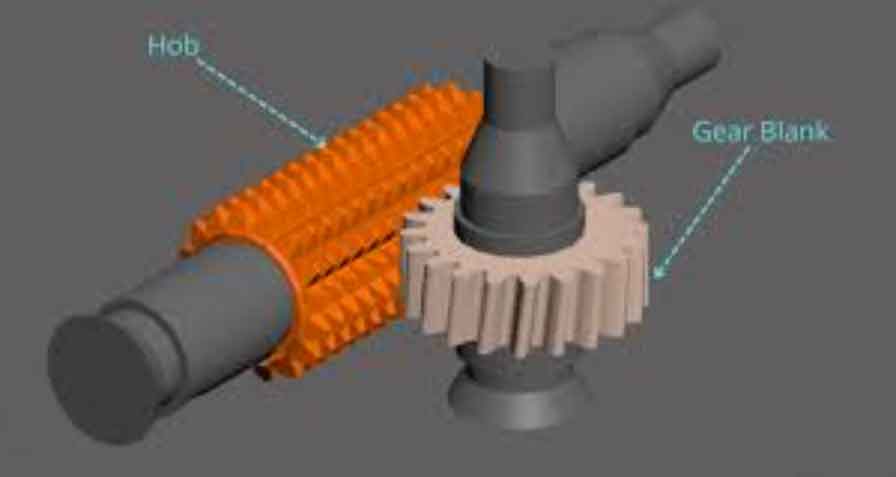
To generalize this issue, motor overheating in gear hobbing machines can be analyzed through thermodynamic and mechanical principles. The motor temperature rise relates to power losses, primarily from copper losses (I²R) and mechanical friction. For a servo motor in gear hobbing, the temperature increase ΔT can be approximated by:
$$ \Delta T = \frac{P_{\text{loss}}}{hA} $$
where \( P_{\text{loss}} \) is the total power loss in watts, \( h \) is the heat transfer coefficient, and \( A \) is the surface area. In gear hobbing, the load torque \( T_{\text{load}} \) on the X-axis motor depends on friction and cutting forces. The friction torque due to bearing friction can be modeled as:
$$ T_{\text{friction}} = \mu F r $$
with \( \mu \) as the friction coefficient, \( F \) as the axial load, and \( r \) as the bearing radius. Poor lubrication increases \( \mu \), raising \( T_{\text{friction}} \) and motor current, leading to overheating. This aligns with my observation that grease depletion caused sporadic high friction during gear hobbing cycles.
Moreover, in gear hobbing, the X-axis motion is often slow and precise, with velocities under 0.1 m/s. This slow movement exacerbates friction effects if lubrication is inadequate, as hydrodynamic lubrication may not form. The table below summarizes common causes of motor overheating in CNC gear hobbing machines, based on this case and broader industry experience:
| Cause Category | Specific Issues | Impact on Gear Hobbing |
|---|---|---|
| Mechanical | Bearing lubrication failure, ball screw wear, misalignment | Increased friction, reduced accuracy in gear tooth profile |
| Electrical | Faulty temperature sensors, drive module issues, motor winding degradation | False alarms or actual overheating, disrupting hobbing cycles |
| Environmental | High ambient temperature, dust contamination | Reduced heat dissipation, accelerated wear in hobbing operations |
| Operational | Excessive feed rates, prolonged continuous hobbing | Increased motor load beyond design limits |
Preventive maintenance is crucial for avoiding such faults in gear hobbing machines. Regular inspection of lubrication systems, especially in hard-to-access areas like bearing housings, can prevent grease depletion. For gear hobbing applications, I recommend using high-quality grease with additives for high shear and temperature resistance, as the process involves intermittent loads. Additionally, monitoring motor current during gear hobbing cycles can provide early warnings; a steady increase in current often precedes overheating. The relationship between motor current \( I \) and torque \( T \) is:
$$ T = k_t I $$
where \( k_t \) is the motor torque constant. By logging current data, maintenance teams can detect anomalies before alarms occur.
Another aspect to consider is the thermal design of the motor itself. In gear hobbing, motors may be enclosed or located near heat sources like cutting zones. Ensuring adequate ventilation or adding cooling fans can mitigate overheating. The heat dissipation rate can be estimated using:
$$ Q = mc_p \frac{dT}{dt} $$
where \( Q \) is heat flow, \( m \) is mass, \( c_p \) is specific heat capacity, and \( \frac{dT}{dt} \) is temperature change rate. For the X-axis motor, improving heat dissipation through external fins or air flow can reduce temperature rise during extended gear hobbing runs.
Beyond this case, gear hobbing machines often face similar issues due to their complex mechanics. The hobbing process involves simultaneous rotation of the hob and workpiece, with precise axial and radial feeds. Any deviation in X-axis movement can affect gear quality, making motor reliability paramount. I advise integrating condition-based monitoring systems that track vibration, temperature, and lubrication status specifically for gear hobbing applications. This proactive approach minimizes downtime and ensures consistent gear production.
In conclusion, the X-axis motor overheating in this CNC gear hobbing machine was ultimately traced to inadequate bearing lubrication—a mechanical detail easily overlooked. The resolution required systematic troubleshooting, blending electrical checks with mechanical disassembly. This experience reinforces that in gear hobbing, where precision is key, regular maintenance of all传动系统 components is essential. By understanding the interplay between mechanical load and thermal management, operators can enhance the longevity and performance of gear hobbing equipment. As gear hobbing technology evolves, with trends toward higher speeds and automation, addressing such fundamental issues will remain critical for manufacturing excellence.
To further elaborate, let’s discuss the role of lubrication in gear hobbing machines. Lubrication not only reduces friction but also dissipates heat and prevents corrosion. In X-axis传动系统, grease selection should account for operational parameters common in gear hobbing, such as low-speed high-load conditions. The grease viscosity \( \eta \) affects friction coefficient \( \mu \), as per the Stribeck curve:
$$ \mu = f(\eta, v, P) $$
where \( v \) is velocity and \( P \) is pressure. For gear hobbing, where velocities vary, using multi-purpose grease with wide temperature range is beneficial. Additionally, implementing automatic lubrication systems with sensors can alert operators to low grease levels, preventing incidents like the one I encountered.
Furthermore, motor overheating can impact gear hobbing accuracy. Thermal expansion of the motor or传动系统 may cause positional errors, affecting gear tooth geometry. The error \( \delta x \) due to thermal expansion can be approximated as:
$$ \delta x = \alpha L \Delta T $$
with \( \alpha \) as the coefficient of thermal expansion, \( L \) as the length of the传动系统, and \( \Delta T \) as temperature rise. In precision gear hobbing, such errors must be minimized through thermal stabilization or compensation algorithms in the CNC system.
In summary, this case study highlights the importance of holistic maintenance in CNC gear hobbing machines. By combining mechanical inspections with electrical diagnostics, and leveraging formulas and tables for analysis, engineers can effectively tackle motor overheating. As gear hobbing continues to be a cornerstone of gear manufacturing, attention to such details ensures reliable and efficient production processes.