
In the field of mechanical transmissions, helical gears are widely used due to their smooth operation and high load-carrying capacity. However, internal excitations such as stiffness variation and error excitation are major sources of vibration and noise in gear systems. Understanding the mesh stiffness of helical gears is crucial for dynamic analysis and design optimization. This article presents an improved analytical model for calculating the mesh stiffness of helical gear pairs, considering axial deformation and tooth profile modification. The model is based on an enhanced method for determining the three-dimensional meshing line length and position, coupled with a stiffness-error interaction approach. By using this model, the mesh stiffness can be accurately and efficiently computed, providing insights into the effects of different profile modification parameters on gear performance. The helical gear, with its angled teeth, exhibits complex spatial behavior, making its analysis more challenging than that of spur gears.
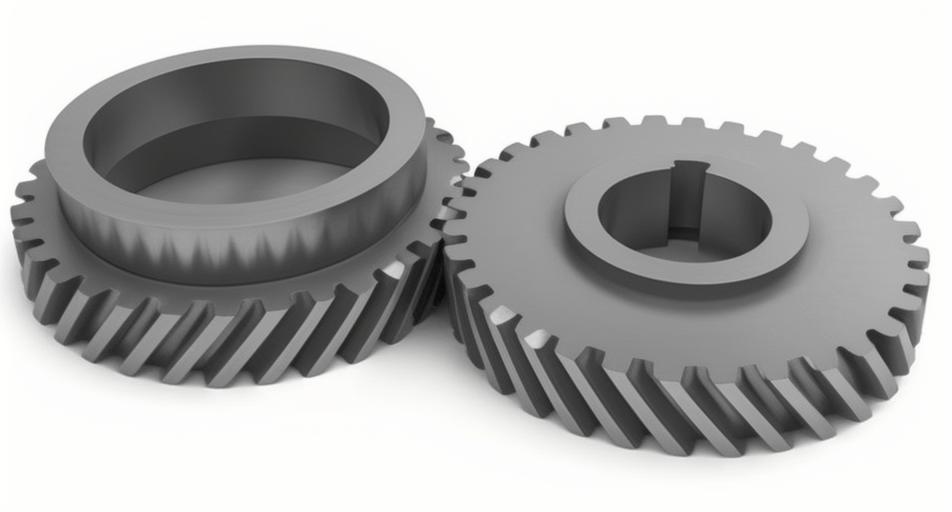
The mesh stiffness of helical gears is a key parameter in gear dynamics, influencing vibration, noise, and transmission error. Traditional methods for calculating mesh stiffness include material mechanics approaches, finite element methods, and approximate substitution techniques. For spur gears, material mechanics methods are commonly used due to their efficiency and accuracy. However, for helical gears, the three-dimensional nature of tooth contact requires more sophisticated models. Previous studies have often neglected axial deformation or relied on time-consuming finite element simulations. In this work, I develop an analytical model that addresses these limitations by incorporating axial deformation and tooth profile modifications, enabling rapid and precise stiffness calculations for helical gear pairs.
The tooth error in helical gears is a three-dimensional spatial problem, which differs from spur gears. When tooth profile modification is applied, such as tip relief, the mesh stiffness calculation becomes even more complex. Existing models for helical gear mesh stiffness often use simplified assumptions, like ignoring axial forces or approximating the meshing line length variation. These approximations can lead to significant errors, especially for helical gears with large helix angles. Therefore, there is a need for a comprehensive analytical model that accounts for the full spatial geometry of helical gear engagement, including the effects of profile modifications. This article aims to fill that gap by proposing a novel method based on force and deformation decomposition, coupled with stiffness-error relationships.
Before delving into the model details, it is essential to understand the geometry of helical gear meshing. The meshing surface of a helical gear is an involute helicoid, generated by the spiral motion of an involute curve along the axial direction. For a left-handed helical gear, the involute curve rotates around the z-axis with a helical motion. The spatial coordinates of any point on the involute helicoid can be expressed as follows. Let \( r_b \) be the base circle radius, \( \alpha_E \) the pressure angle at point E, and \( \theta_E \) the involute angle. The coordinates of a point on the original involute curve are given by:
$$ x_E = r_b \sin(\omega_A + \theta_E + \alpha_E) + r_b (\theta_E + \alpha_E) \cos(\omega_A + \theta_E + \alpha_E) $$
$$ y_E = r_b \cos(\omega_A + \theta_E + \alpha_E) – r_b (\theta_E + \alpha_E) \sin(\omega_A + \theta_E + \alpha_E) $$
$$ z_E = 0 $$
Here, \( \omega_A \) is the angle between the reference line and the x-axis. After a helical motion with parameter \( \sigma \) and lead parameter \( p = p_z / (2\pi) \), where \( p_z \) is the lead, the coordinates become:
$$ x_{E’} = x_E \cos \sigma – y_E \sin \sigma $$
$$ y_{E’} = x_E \sin \sigma + y_E \cos \sigma $$
$$ z_{E’} = z_E + p \sigma $$
This formulation allows us to describe the three-dimensional meshing line of helical gears. The meshing line is the locus of contact points between gear teeth during engagement. For helical gears, this line varies in length and position along the tooth width. An improved algorithm is developed to compute the meshing line length and position efficiently, avoiding the need to solve complex equations. The key idea is to discretize the gear tooth along the width into thin slices and use the involute properties to determine the contact points.
In the transverse plane, the meshing process of helical gears is similar to spur gears, but with an additional axial component. The start and end points of meshing on the transverse plane are denoted as \( B_2 \) and \( B_1 \), respectively. The rotation angles and pressure angles at these points can be derived from geometric relationships. By dividing the meshing line into N segments, the rotation position \( \omega_E \) and meshing position parameter \( \tan(\alpha_E) \) for each segment can be calculated without solving simultaneous equations. The formulas are:
$$ \tan(\alpha_E) = \frac{N_1 B_2 + \frac{E}{N} B_2 B_1}{N_1 O_1} $$
$$ \omega_E = \varphi_1 + \alpha_{B_2} – \tan(\alpha_E) $$
Here, \( \varphi_1 \) is a phase angle, and \( \alpha_{B_2} \) is the pressure angle at point \( B_2 \). This approach significantly speeds up the computation compared to previous methods that required solving equations for each rotation step.
The meshing line length \( L_i \) at a given rotation position i is then computed by summing the distances between consecutive contact points in three-dimensional space:
$$ L_i = \sum \sqrt{ (x_e – x_{e-1})^2 + (y_e – y_{e-1})^2 + (z_e – z_{e-1})^2 } $$
This meshing line length varies during the engagement cycle, affecting the mesh stiffness. For helical gears, the contact ratio is higher than for spur gears due to the angled teeth, leading to smoother transitions but more complex stiffness variations.
To compute the mesh stiffness of helical gear pairs, I use a slicing method where the gear is divided into M thin slices along the tooth width. Each slice is treated as a spur gear with a specific meshing position and width. The stiffness of each slice is calculated using material mechanics formulas that include bending, shear, radial compression, Hertzian contact, and fillet foundation deformations. However, traditional methods ignore the axial deformation caused by the axial component of the mesh force. In helical gears, the normal force \( F_n \) can be decomposed into axial force \( F_z \) and transverse force \( F_t’ \). The deformation along the normal direction \( \delta_n \) is related to the deformations along the axial and transverse directions. If \( k_t’ \) is the stiffness considering only the transverse force, then the actual mesh stiffness \( k_n \) including axial deformation is given by:
$$ \frac{1}{k_n} = \frac{1}{k_t’} \cdot \frac{1}{\cos^2 \beta} $$
where \( \beta \) is the helix angle. This correction is crucial for helical gears with large helix angles, where axial deformation becomes significant.
When tooth profile modification is applied, such as tip relief, the tooth errors introduce additional complexities. The error \( E_j \) for each slice j affects the contact condition. At any rotation position, the total mesh stiffness \( K_i \) of the helical gear pair is calculated by considering the coupling between stiffness and error. Assuming n slices are in contact, the formula is:
$$ K_i = \frac{F \cdot \sum_{j=1}^{n} k_j}{F + \sum_{j=1}^{n} k_j \cdot (E_j – E_{\text{min}})} $$
Here, F is the normal load, \( k_j \) is the stiffness of slice j, \( E_j \) is the total error of slice j (sum of errors on both gears), and \( E_{\text{min}} \) is the minimum error among the contacting slices. This model accounts for the nonlinear interaction between stiffness and error, allowing for accurate stiffness calculations under modified tooth profiles.
The calculation process for the total mesh stiffness of helical gears is summarized in the following flowchart description. First, the gear parameters and rotation position are input. Then, the meshing line length and position are determined using the improved algorithm. Next, the gear is sliced, and the stiffness of each slice is computed with axial deformation correction. Finally, the total stiffness is obtained by summing the slice stiffnesses with error coupling. This method is computationally efficient, enabling rapid analysis of helical gear pairs under various conditions.
To validate the model, I compare the results with existing methods. Consider a helical gear pair with the following parameters:
| Parameter | Symbol | Value |
|---|---|---|
| Number of teeth (pinion) | \( z_1 \) | 37 |
| Number of teeth (gear) | \( z_2 \) | 62 |
| Normal module | \( m_n \) | 2.5 mm |
| Normal pressure angle | \( \alpha_n \) | 20° |
| Helix angle | \( \beta \) | Variable |
| Face width | B | 34 mm |
The load per unit width is set to 300 N/mm. The average mesh stiffness \( K_a \) is computed for different helix angles using the proposed model, finite element method, and an industry standard (HB method). The results are shown in the table below.
| Helix Angle \( \beta \) (°) | HB Method \( K_a \times 10^8 \) N/m | Finite Element Method \( K_a \times 10^8 \) N/m | Proposed Model \( K_a \times 10^8 \) N/m |
|---|---|---|---|
| 5 | 7.64725 | 7.67822 | 7.63120 |
| 10 | 7.70821 | 7.93975 | 8.03972 |
| 15 | 7.76907 | 8.00326 | 8.15699 |
| 20 | 7.77468 | 8.19087 | 7.90677 |
| 25 | 7.66901 | 7.94475 | 8.15867 |
The proposed model shows good agreement with other methods, with errors within 8%. Moreover, the computation time is significantly reduced compared to finite element analysis, making it suitable for dynamic simulations. The effect of axial deformation is illustrated by comparing the average mesh stiffness with and without axial correction. For helix angles below 15°, the difference is less than 10%, but for larger angles, axial deformation becomes more important, and ignoring it can lead to errors exceeding 10%.
The variation of mesh stiffness and meshing line length over one engagement cycle is studied for different helix angles. The total mesh stiffness \( K_\gamma \) and meshing line length L are plotted against dimensionless time T, where T is the ratio of elapsed time to the meshing period. For helix angles of 5°, 15°, and 25°, the stiffness curves exhibit different patterns. In some cases, the stiffness in multi-tooth contact regions is lower than in single-tooth regions, which contrasts with spur gear behavior. This phenomenon is attributed to the spatial distribution of contact lines in helical gears. The relationship between single-tooth mesh stiffness \( K_s \) and single-tooth meshing line length l is also analyzed. As the helix angle increases, the variation of \( K_s \) becomes more similar to that of l, indicating that for large helix angles, the meshing line length can approximate stiffness variation with reasonable accuracy.
Tooth profile modification is commonly used to reduce vibration and noise. For helical gears, tip relief is applied to both pinion and gear. The maximum relief amount \( C_{a_{\text{max}}} \) and length \( L_{a_{\text{max}}} \) are often determined by standards such as ISO/DIS-1983:
$$ C_{a_{\text{max}}} = 0.02 m_t $$
$$ L_{a_{\text{max}}} = 0.06 m_t $$
where \( m_t \) is the transverse module. In this study, the relief length is fixed at \( L_a = 0.5 \) mm, and the relief amount \( C_a \) is varied from 5 μm to 25 μm. The mesh stiffness is computed for helix angles of 5°, 15°, and 25° under a torque of 500 Nm. The results show that as \( C_a \) increases, the mesh stiffness generally decreases, and the stiffness curves become smoother at tooth engagement transitions. However, excessive relief can cause sharp changes in stiffness, counteracting the benefits. For a helix angle of 15°, a relief amount of 20 μm provides the smoothest stiffness curve. For helix angles of 5° and 25°, the optimal relief amount depends on the meshing conditions, highlighting the need for careful design.
The effect of relief length \( L_a \) is also investigated by setting \( C_a = 20 \) μm and varying \( L_a \) from 0.3 mm to 1.1 mm. As \( L_a \) increases, the mesh stiffness decreases, and the curves become smoother. For helix angles of 15° and 25°, longer relief lengths reduce stiffness in multi-tooth regions but increase it in single-tooth regions. This behavior is influenced by the condition \( (\omega_{B_2} – \omega_{B_1}) \) relative to \( b/p \), where b is the face width and p is the lead parameter. When \( (\omega_{B_2} – \omega_{B_1}) > b/p \), the meshing line exhibits constant length segments, leading to stiffness variations that differ from meshing line length changes. When \( (\omega_{B_2} – \omega_{B_1}) < b/p \), the meshing line length and stiffness are more aligned. Thus, the proposed model captures these subtleties, enabling accurate stiffness prediction for various helical gear geometries.
Under higher torque conditions, such as 3000 Nm, the mesh stiffness shows different trends with relief length. For a helix angle of 25°, the stiffness decreases with increasing \( L_a \), but the rate of decrease diminishes. At \( L_a = 0.5 \) mm, the stiffness curve has smooth transitions between contact regions. This indicates that the optimal relief parameters depend on operating conditions, and the model can help identify them efficiently.
The helical gear mesh stiffness model presented here offers several advantages. It accounts for three-dimensional geometry, axial deformation, and tooth profile modifications in an analytical framework. The improved meshing line algorithm eliminates the need for equation solving, speeding up computations. The stiffness-error coupling allows for realistic simulation of modified gears. Validation against finite element and standard methods confirms its accuracy. Furthermore, the model can be integrated into dynamic system simulations to predict vibration and noise, aiding in the design of quiet and reliable gear transmissions.
In conclusion, helical gears are complex components that require detailed analysis for optimal performance. The mesh stiffness is a critical factor influencing their dynamic behavior. This article develops an analytical model for helical gear mesh stiffness that considers axial deformation and tooth profile modification. By using an efficient meshing line calculation and stiffness-error coupling, the model provides fast and accurate results. It reveals that axial deformation becomes significant for large helix angles, and tooth profile modifications can smooth stiffness variations but must be carefully designed. The model serves as a valuable tool for engineers to optimize helical gear designs, reducing vibration and improving transmission quality. Future work may extend the model to include other types of modifications, such as lead crowning, or to analyze dynamic responses in full gear systems.
Throughout this discussion, the term helical gear has been emphasized to underscore the focus on this specific gear type. The helical gear’s unique geometry poses challenges but also offers benefits like high contact ratios and smooth operation. Understanding its mesh stiffness through advanced analytical models is key to harnessing these benefits in practical applications. The formulas and tables provided here summarize the core aspects of the model, enabling readers to apply it in their own work. As gear technology advances, such models will play an increasingly important role in achieving efficient and quiet mechanical systems.