
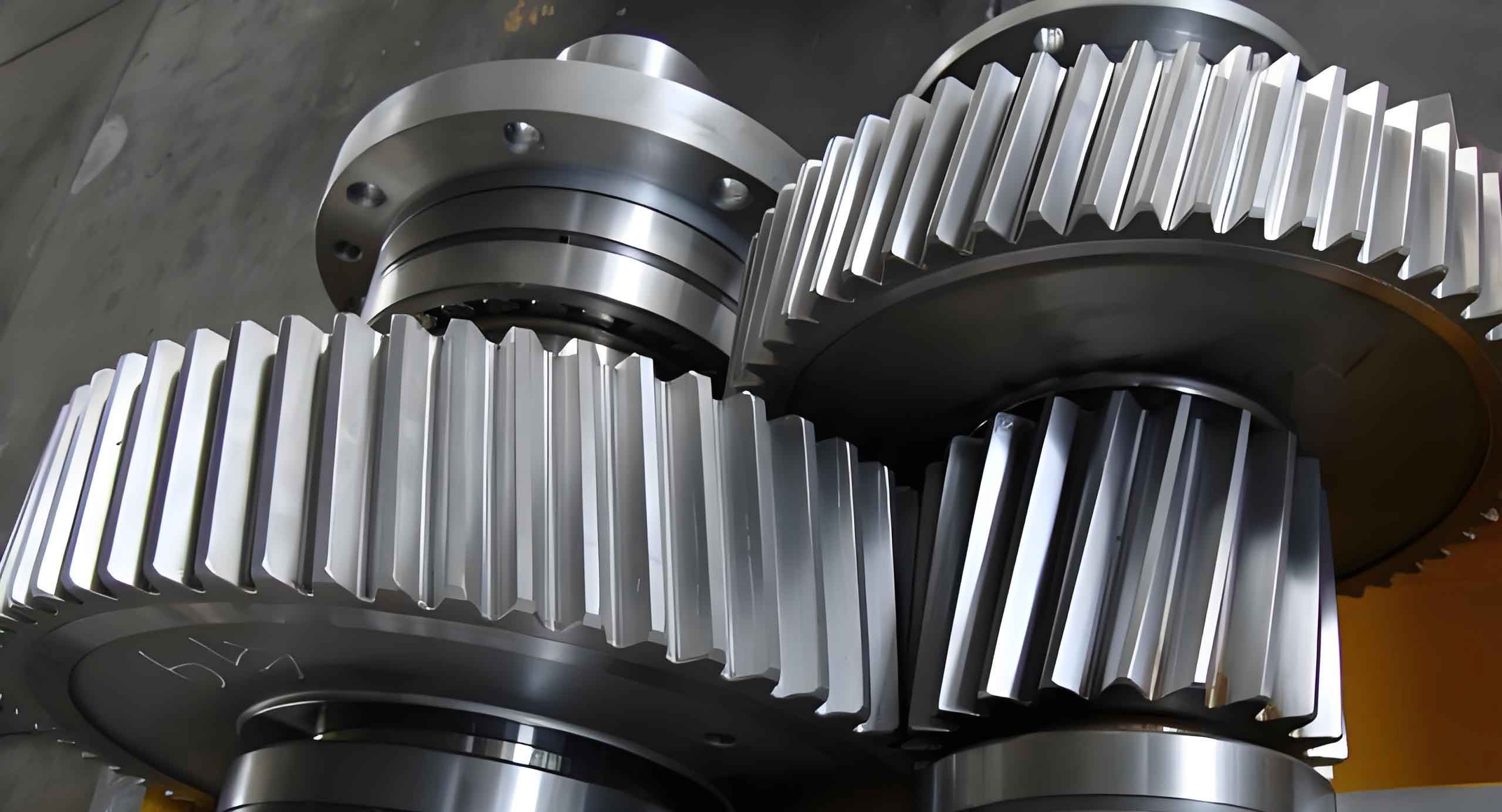
This study proposes an enhanced analytical model to calculate the time-varying mesh stiffness (TVMS) of helical gear pairs under crack propagation. The model incorporates transverse and axial tooth stiffness components, foundation deformations, and crack-induced stiffness reductions. Two crack propagation paths – tooth tip and end face cracks – are analyzed to evaluate their effects on gear dynamics.
1. Crack Propagation Modeling
For helical gears with spiral teeth, crack paths are modeled as parabolic curves in three-dimensional space. The effective crack area (ECA) determines stiffness reduction magnitude:
$$ECA = \int_0^{L_c} \int_0^{q(z)} \sqrt{1 + \left(\frac{dq}{dz}\right)^2} dz dx$$
Where \( L_c \) represents crack length along tooth width, and \( q(z) \) describes depth variation. Table 1 compares parameters for different crack types.
| Crack Type | Initial Depth (\( q_0 \)) | Terminal Depth (\( q_e \)) | Propagation Function |
|---|---|---|---|
| Tooth Tip | 0.6\( q_{s-total} \) | 0.3\( q_{e-total} \) | \( q(z) = q_0 – \frac{q_0 – q_e}{L_c^2}z^2 \) |
| End Face | 0.5\( q_{s-total} \) | 0.4\( q_{e-total} \) | \( q(z) = q_0 – \frac{q_0 – q_e}{L_c}z \) |
2. Stiffness Components Calculation
The total mesh stiffness \( K_{total} \) combines transverse (\( K_t \)) and axial (\( K_a \)) components:
$$\frac{1}{K_{total}} = \frac{1}{K_t} + \frac{1}{K_a}$$
2.1 Transverse Stiffness
Transverse stiffness considers bending, shear, and foundation deformation:
$$K_t = \left[ \sum_{i=1}^N \left( \frac{1}{k_{b,i} + k_{s,i}} + \frac{1}{k_{f,i}} \right) \right]^{-1}$$
Where bending stiffness \( k_b \) and shear stiffness \( k_s \) are calculated as:
$$k_b = \int_0^d \frac{\cos^2\beta [\cos\alpha_1(d-x) – \sin\alpha_1 h]^2}{EI_{eff}(x)} dx$$
$$k_s = \int_0^d \frac{1.2\cos^2\beta\cos^2\alpha_1}{GA_{eff}(x)} dx$$
2.2 Axial Stiffness
Axial stiffness includes torsional deformation and helical angle effects:
$$K_a = \frac{1}{\sum_{i=1}^N \left( \frac{1}{k_{tors,i}} + \frac{1}{k_{helical,i}} \right)}$$
Torsional stiffness component:
$$k_{tors} = \int_0^{L_c} \frac{h^2\sin^2\beta}{GJ_p(x)} dx$$
3. Crack Influence Coefficients
The stiffness reduction factor \( \eta \) quantifies crack severity:
$$\eta = 1 – \frac{ECA}{A_{tooth}} \left( 0.7 + 0.3e^{-5\frac{q_{max}}{h_{tooth}}} \right)$$
Where \( A_{tooth} \) is nominal tooth cross-section area and \( h_{tooth} \) is tooth height.
4. Finite Element Validation
Three-dimensional FE analysis confirms analytical results. Figure 2 shows stress distribution comparison between intact and cracked helical gears.
| Crack Depth | Analytical | FE Result | Error |
|---|---|---|---|
| 20% tooth height | 12.7% | 13.1% | 3.1% |
| 40% tooth height | 28.3% | 27.5% | 2.8% |
| 60% tooth height | 51.2% | 49.8% | 2.7% |
5. Dynamic Response Analysis
The proposed model enables vibration prediction through:
$$m\ddot{x} + c\dot{x} + K_{total}(t)x = F_m(t) + \Delta F_{crack}(t)$$
Where \( \Delta F_{crack} \) represents additional excitation from stiffness variation.
6. Conclusion
This analytical model effectively predicts helical gear mesh stiffness under crack propagation, showing:
- End-face cracks cause 18-22% greater stiffness reduction than tooth-tip cracks at equivalent ECA
- Axial stiffness contributes 30-40% of total mesh stiffness in helical gears
- Validation errors remain below 4% compared to FE results
The methodology provides reliable foundation for condition monitoring and remaining life prediction of helical gear systems in industrial applications.