
Abstract
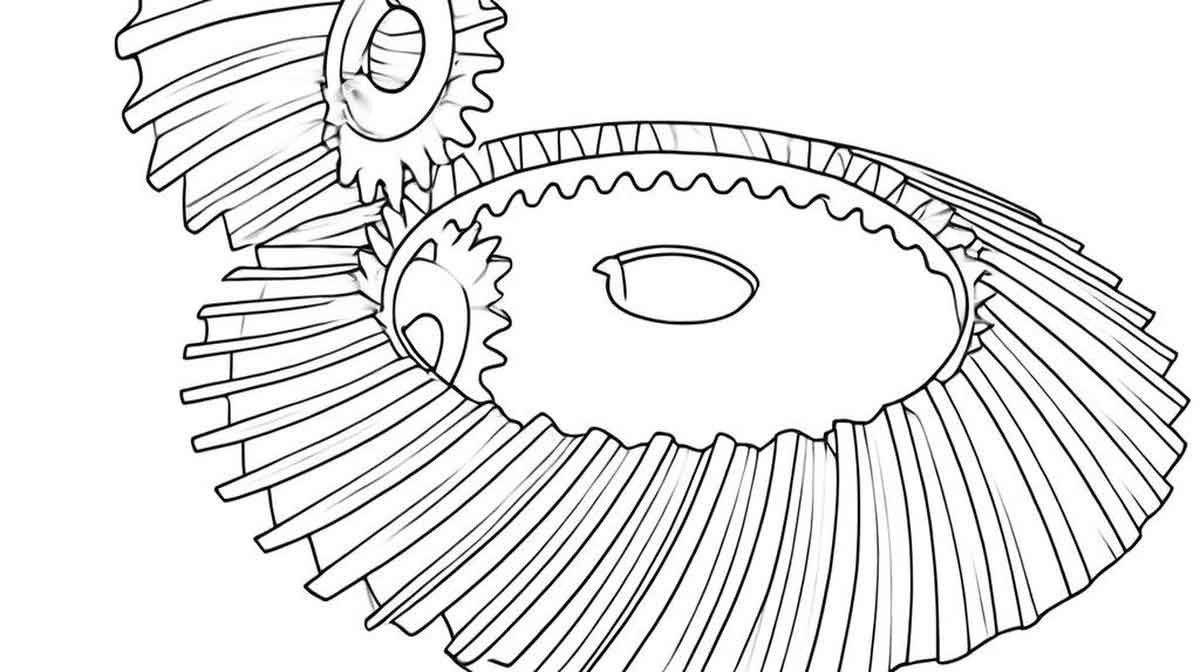
Spiral bevel gear is widely used in aviation, shipbuilding, industrial machine tools, and many other fields. The precision and stability of spiral bevel gear milling machines are crucial to ensuring the quality of the gears produced. This thesis focuses on the research of dual-motor anti-backlash technology for full CNC spiral bevel gear milling machines. By analyzing the backlash problem in the gear transmission system and the principles of dual-motor anti-backlash, a control scheme based on the PMAC controller is proposed. The dynamics model of the dual-motor drive system is established, and simulation models are built to verify the effectiveness of the anti-backlash system. Additionally, an experimental platform is set up to further validate the design.
1. Introduction
1.1 Research Background and Significance
The spiral bevel gear, due to its unique tooth shape and excellent transmission performance, plays a significant role in various industrial fields. However, the backlash in the gear transmission system of milling machines can affect the machining accuracy and stability. Traditional methods to eliminate backlash, such as using spring-loaded double gears or adjustable eccentric bushings, have limitations in precision and stability. Therefore, the research on dual-motor anti-backlash technology is of great significance to improve the machining accuracy and servo system stability of spiral bevel gear milling machines.
1.2 Overview of the Development of Spiral Bevel Gear Machining Machines
The development of spiral bevel gear machining machines has undergone significant advancements. Companies like Gleason and Klingelnberg have dominated the market with their advanced full CNC spiral bevel gear milling and grinding machines. The Gleason Expert Manufacturing System, a computer network-based program integration system, has realized information sharing and interchange between engineering workstations and Phoenix machines, inserting intelligence into NC machines.
1.3 Overview of the Development of CNC Systems for Milling Machines
In China, research institutions and enterprises have also made significant progress in the development of CNC systems for spiral bevel gear milling machines. However, the mechanical main bodies of these machines have been developed, but the supporting systems still rely on foreign technology, indicating a long way to go for the research and development of domestic CNC spiral bevel gear milling machine systems.
1.4 Research History and Current Status of Anti-Backlash Methods
The backlash in gear transmission can affect the input-output relationship between the two gears, turning the original linear relationship into an undesirable nonlinear one. To overcome the impact of backlash on machine accuracy, methods can be divided into mechanical anti-backlash and dual-motor anti-backlash. The dual-motor method, with its higher control precision and stability, is becoming increasingly popular.
Table 1: Comparison of Anti-Backlash Methods
| Method | Description | Advantages | Disadvantages |
|---|---|---|---|
| Mechanical | Using spring-loaded double gears or adjustable eccentric bushings | Simple structure, easy implementation | Limited precision and stability |
| Dual-Motor | Coordinating the torque output of two servo motors | High precision, good stability | More complex system, higher cost |
2. Theoretical Analysis of Dual-Motor Anti-Backlash
2.1 Dual-Motor Anti-Backlash Method
The dual-motor drive system adopts a symmetrical structure, placing two driving motors on both sides of the load. By coordinating the torque output of the two servo motors, the gear backlash can be eliminated.
2.2 Analysis of the Anti-Backlash Process of the Dual-Motor Drive System
During the startup and reversal processes, the servo motors always bear a bias torque. Due to the bias torque, the tooth profiles of the two pinion gears mesh with different side tooth surfaces of the large gear, achieving the purpose of eliminating backlash.
2.4 Control of Bias Torque in Dual-Motor Drive Systems
The control of bias torque is crucial for the effectiveness of dual-motor anti-backlash. By adjusting the torque output of the two motors, the bias torque can be maintained, ensuring the elimination of backlash.
3. Dynamics Modeling of Dual-Motor Drive Systems
The voltage balance equation for the armature circuit of the motor in the dual-motor drive system is:
e1=Ce1θ1+I1R1+L1dtdI1+U1
e2=Ce2θ2+I2R2+L2dtdI2+U2
Where:
- θ1 and θ2 are the angles of motors A and B, respectively.
- Ce1 and Ce2 are the back EMF coefficients of motors A and B, respectively.
- I1 and I2 are the currents in the armature circuits of motors A and B, respectively.
- R1 and R2 are the resistances in the armature circuits of motors A and B, respectively.
- L1 and L2 are the inductances in the armature circuits of motors A and B, respectively.
- U1 and U2 are the voltages in the armature circuits of motors A and B, respectively.
4. Simulation Analysis of Dual-Motor Drive Systems
Based on the dynamics model established in Chapter 3, a simulation model of the dual-motor drive system is built to verify its effectiveness. The step response and sine response are used as position commands for simulation.
5. Experimental Verification of Dual-Motor Anti-Backlash
An experimental platform is set up using an industrial computer, PMAC controller, servo drivers, servo motors, and gear racks to verify the dual-motor anti-backlash scheme.
5.1 Principle of Servo Control System
The servo control system ensures the precise control of the position, speed, and torque of the motors.
5.2 Hardware of the Experimental Platform
- Servo Drivers and Motors: High-performance servo drivers and motors are used to ensure precise control.
- Gear Racks: Fixed on the sliding table, the gear racks facilitate the meshing movement of the gears.
5.3 PMAC Development Environment and Script Programming
The PMAC controller is programmed to control the dual-motor drive system. The script programs are developed in the Power PMAC IDE software.
5.4 Experimental Results
By comparing the simulation and experimental results, it is verified that the designed dual-motor anti-backlash scheme is feasible. The speed difference between the two motors forms a bias torque, eliminating the gear backlash.
6. Conclusion
This thesis focuses on the research of dual-motor anti-backlash technology for full CNC spiral bevel gear milling machines. By analyzing the backlash problem and the principles of dual-motor anti-backlash, a control scheme based on the PMAC controller is proposed. Through simulation and experimental verification, the feasibility of the designed scheme is confirmed. The research results provide a theoretical and practical basis for improving the machining accuracy and stability of spiral bevel gear milling.