
In modern mechanical transmission systems, particularly those operating under high-speed and heavy-load conditions, the helical gear is widely favored due to its smooth engagement, reduced stiffness fluctuations, and superior load distribution compared to spur gears. Accurate stress analysis is fundamental to gear design, and finite element analysis (FEA) has become a standard tool for simulating the meshing behavior of helical gears. However, a significant hurdle in performing such simulations within the ANSYS environment is the difficulty in creating precise three-dimensional solid models of meshing helical gear pairs. Importing models from external CAD software often leads to feature loss or geometric inaccuracies, compromising the reliability of subsequent analyses. To address this, we present a comprehensive, parameterized modeling methodology using the ANSYS Parametric Design Language (APDL) to efficiently generate accurate helical gear meshing models for various engagement phases.
The core of our approach lies in a bottom-up construction process: starting from the fundamental tooth profile curve equations, we generate the gear’s cross-sectional face, which is then swept along the base helix to form the solid, multi-tooth three-dimensional model. This method ensures geometric fidelity and integrates seamlessly with ANSYS for further FEA. The modeling workflow is divided into two primary stages: first, creating the individual helical gear solid model at a predefined reference position; second, orchestrating the precise spatial arrangement of the driver and driven gears to simulate their meshing engagement at any desired point within the meshing cycle.
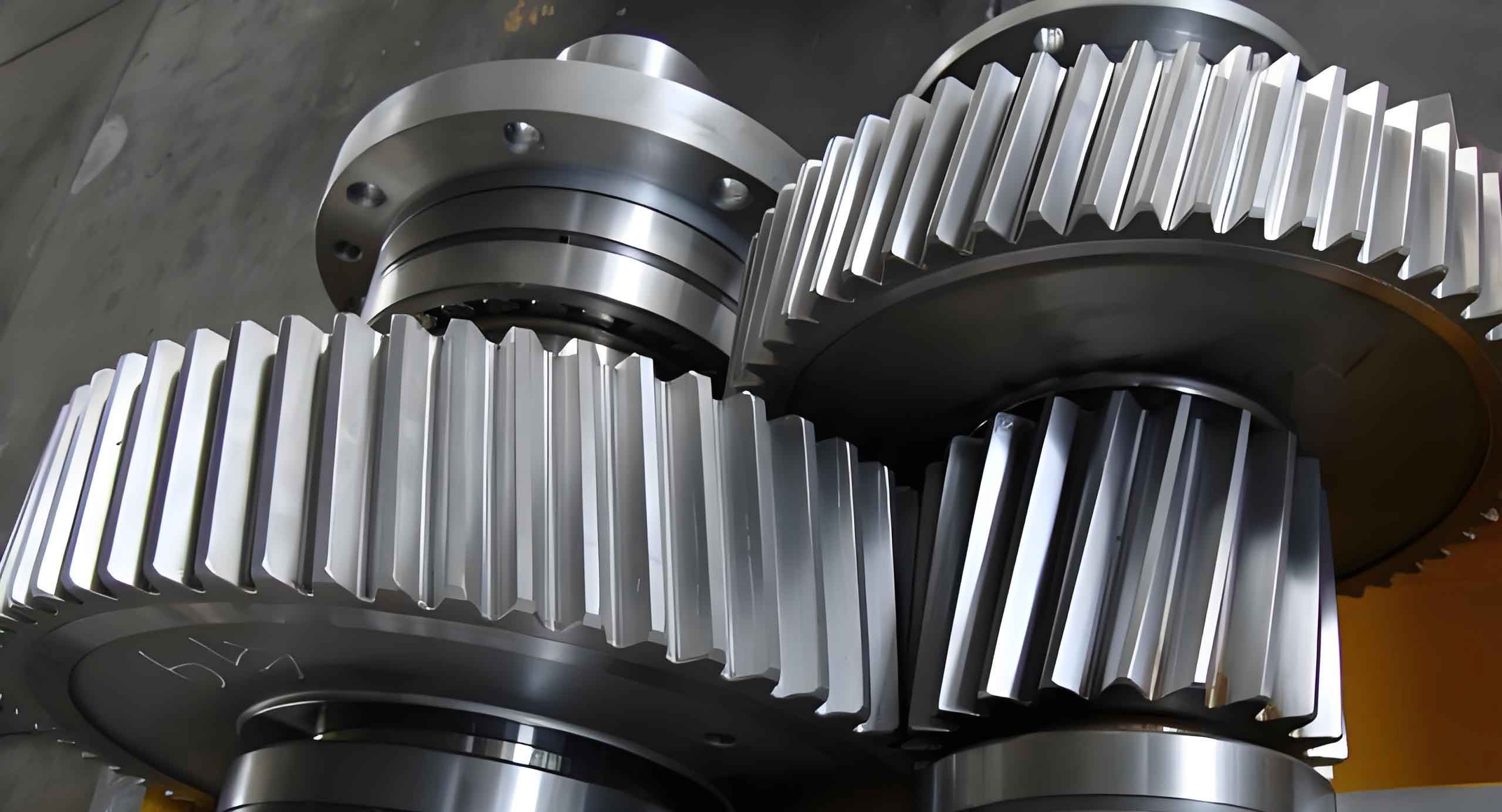
The generation of an accurate tooth profile is the foundation. For a standard involute helical gear manufactured with a rack-type cutter, the active profile consists of two distinct segments: the involute segment and the root fillet transition curve. The coordinates of any point on the involute segment in the transverse plane are derived from the fundamental definition of the involute. In a Cartesian coordinate system with its origin at the gear center, for a point P on the involute, its coordinates are given by:
$$ x = r_p \sin \Phi $$
$$ y = r_p \cos \Phi $$
where the radial distance \( r_p \) and the polar angle \( \Phi \) are functions of the transverse pressure angle \( \alpha_{pt} \) at point P:
$$ r_p = \frac{r_b}{\cos \alpha_{pt}} $$
$$ \Phi = \varphi + \text{inv} \alpha_t – \text{inv} \alpha_{pt} $$
Here, \( r_b \) is the base circle radius, \( \alpha_t \) is the standard transverse pressure angle, \( \varphi \) is the half-tooth-thick angle, and the involute function is defined as \( \text{inv} \alpha = \tan \alpha – \alpha \). The start and end of the active involute profile are defined by the form diameter and the tip diameter, corresponding to specific pressure angles \( \alpha_{ft} \) and \( \alpha_{qt} \), respectively. Within APDL, we define an array of points by varying \( \alpha_{pt} \) over the interval \( [\alpha_{ft}, \alpha_{qt}] \) using a *DO loop and subsequently create the involute curve segment with the BSPLIN command.
The root fillet profile, generated by the tip of the hob cutter, requires a more complex kinematic derivation. Considering the relative motion between the gear blank and the rack-type cutter, the coordinates of a point I on the fillet curve in the fixed gear coordinate system are:
$$ x = (x_1 – r \omega) \cos \omega + (y_1 + r) \sin \omega $$
$$ y = (y_1 + r) \cos \omega + (r \omega – x_1) \sin \omega $$
$$ \omega = (x_1 – y_1 \cot \theta) / r $$
The parameters \( (x_1, y_1) \) are the coordinates of point I in the coordinate system attached to the cutter, and \( \theta \) is the angle parameter defining the cutter’s profile during generation. Their detailed expressions are:
$$ x_1 = R_0 \frac{\tan \gamma}{\sqrt{\cos^4 \beta + \cos^2 \beta \tan^2 \gamma}} + C_{tx} $$
$$ y_1 = C_{ty} – R_0 \frac{\cos \beta}{\sqrt{\cos^2 \beta + \tan^2 \gamma}} $$
$$ \gamma = \theta + \frac{\pi}{2} $$
$$ C_{tx} = \frac{(x_n m_n \tan \alpha_n + \pi m_n / 4)}{\cos \beta} + \left[ h_{a0} – R_0 (1 – \sin \alpha_n) \right] \tan \alpha_t + \frac{R_0 \cos \alpha_n}{\cos \beta} $$
$$ C_{ty} = R_0 – h_{a0} $$
In these equations, \( \beta \) is the helix angle at the reference circle, \( \alpha_n \) is the normal pressure angle, \( x_n \) is the normal profile shift coefficient, \( m_n \) is the normal module, \( R_0 \) is the cutter tip radius, \( h_{a0} \) is the addendum height of the basic rack cutter (\( h_{a0} = h_{ap0} m_n – x_n m_n \)), and \( h_{ap0} \) is the cutter addendum coefficient. By varying \( \theta \) over an appropriate range, the fillet curve points are calculated and plotted in APDL. After generating both the involute and fillet segments, they are combined, mirrored, and connected with tip and root arcs to form a closed, single-tooth profile curve in the transverse cross-section.
To optimize computational efficiency in subsequent FEA, we model only the maximum number of teeth that can be in simultaneous contact, determined by the total contact ratio \( \varepsilon_{\gamma} \) of the helical gear pair. The total contact ratio is the sum of the transverse contact ratio \( \varepsilon_{\alpha} \) and the face contact ratio \( \varepsilon_{\beta} \). For a helical gear, it is given by:
$$ \varepsilon_{\gamma} = \varepsilon_{\alpha} + \varepsilon_{\beta} = \frac{g_{\alpha}}{p_{et}} + \frac{b \tan \beta_b}{p_{et}} $$
Here, \( g_{\alpha} \) is the length of path of contact in the transverse plane, \( p_{et} \) is the transverse base pitch (\( p_{et} = \pi m_t \cos \alpha_t \), with \( m_t \) as the transverse module), \( b \) is the face width, and \( \beta_b \) is the base helix angle (\( \sin \beta_b = \sin \beta \cos \alpha_n \)). The integer number of teeth to model is \( \lceil \varepsilon_{\gamma} \rceil + 1 \). For instance, if \( \varepsilon_{\gamma} = 2.75 \), up to three or four tooth pairs may be in contact, so we model four teeth to be safe. The single-tooth profile is rotated and copied circumferentially using the LGEN command in a cylindrical coordinate system to create the multi-tooth cross-sectional area.
The final step in creating the helical gear solid model is the extrusion of this cross-section along the helical path. The key is defining the base helix line. In a cylindrical coordinate system (R, θ, Z), a point on the base helix at the front face (Z=0) has coordinates \( (r_b, 90^\circ, 0) \). A corresponding point at the rear face (Z=-b) has coordinates \( (r_b, 90^\circ + \text{rota} \cdot \eta, -b) \), where \( \eta = b \tan \beta_b / r_b \) and ‘rota’ is a handedness parameter (1 for left-hand, -1 for right-hand helical gear). Connecting these two points with the L command creates the base helix line. The VDRAG command is then used to sweep the transverse cross-sectional area along this helix, generating the three-dimensional, multi-tooth solid model of the helical gear.
| Parameter Symbol | Description | Governing Equation/Relation |
|---|---|---|
| \( m_n \) | Normal Module | Basic size parameter |
| \( z \) | Number of Teeth | – |
| \( \beta \) | Helix Angle at Ref. Circle | – |
| \( \alpha_n \) | Normal Pressure Angle | Standard value (e.g., 20°) |
| \( x_n \) | Normal Profile Shift Coefficient | For tooth thickness adjustment |
| \( r_b \) | Base Circle Radius | \( r_b = \frac{m_n z \cos \alpha_t}{2 \cos \beta} \) |
| \( \beta_b \) | Base Helix Angle | \( \sin \beta_b = \sin \beta \cos \alpha_n \) |
| \( p_{et} \) | Transverse Base Pitch | \( p_{et} = \pi m_t \cos \alpha_t = \frac{\pi m_n \cos \alpha_t}{\cos \beta} \) |
| \( \varepsilon_{\gamma} \) | Total Contact Ratio | \( \varepsilon_{\gamma} = \varepsilon_{\alpha} + \frac{b \tan \beta_b}{p_{et}} \) |
With the solid models of the driver and driven helical gears created at their respective reference positions, the next challenge is to position them accurately to represent a specific meshing state. The engagement of a helical gear pair is characterized by a periodically changing pattern of contact lines across the tooth faces. We define an initial meshing position corresponding to the moment when the total length of all contact lines is at a minimum. This position offers a well-defined starting point for analysis and is derived from geometric considerations in the transverse plane.
Consider the transverse cross-section of the gear pair. The line of action AE has a length \( g_{\alpha} \). Point C is the pitch point. Point A is the start of active profile (SAP) or entry point, and point E is the end of active profile (EAP) or exit point. Let point D be located on the line of action at a distance equal to one transverse base pitch \( p_{et} \) from point A (i.e., AD = \( p_{et} \)). When the theoretical contact point for a reference tooth pair is at D, the total contact length is minimized. To rotate the gears from their reference (unmeshed) position to this initial meshing position, we calculate the required rotation angles \( \Psi_1 \) and \( \Psi_2 \) for the driver and driven gears, respectively.
From the geometry, the rotation angles are:
$$ \Psi_1 = – (90^\circ – \nu_1) $$
$$ \Psi_2 = 90^\circ – \nu_2 $$
The angles \( \nu_1 \) and \( \nu_2 \) are determined by the pressure angles at points D1 and D2, which are the points on the driver and driven gear tooth profiles that coincide with the contact point D in the transverse plane:
$$ \nu_1 = \alpha_{Dt1} – \alpha_{wt} – \zeta_1 $$
$$ \nu_2 = \alpha_{wt} – \alpha_{Dt2} + \zeta_2 $$
Here, \( \alpha_{wt} \) is the operating transverse pressure angle (\( \cos \alpha_{wt} = \frac{a}{a_w} \cos \alpha_t \), with \( a \) as the standard center distance and \( a_w \) as the operating center distance). The angles \( \zeta_1 \) and \( \zeta_2 \) account for the tooth thickness:
$$ \zeta_1 = \varphi_1 + \text{inv} \alpha_t – \text{inv} \alpha_{Dt1} $$
$$ \zeta_2 = \varphi_2 + \text{inv} \alpha_t – \text{inv} \alpha_{Dt2} $$
The pressure angles \( \alpha_{Dt1} \) and \( \alpha_{Dt2} \) depend on the radial distances \( r_{D1} \) and \( r_{D2} \) of points D1 and D2:
$$ \alpha_{Dt1} = \arccos\left( \frac{r_{b1}}{r_{D1}} \right), \quad \alpha_{Dt2} = \arccos\left( \frac{r_{b2}}{r_{D2}} \right) $$
$$ r_{D1} = \sqrt{T_{1D}^2 + r_{b1}^2}, \quad r_{D2} = \sqrt{T_{2D}^2 + r_{b2}^2} $$
The parameters \( T_{1D} \) and \( T_{2D} \) are lengths along the line of action from the base circles to point D:
$$ T_{1D} = \sqrt{r_{a1}^2 – r_{b1}^2} + p_{et} – g_{\alpha} $$
$$ T_{2D} = \sqrt{r_{a2}^2 – r_{b2}^2} – p_{et} $$
where \( r_{a1} \) and \( r_{a2} \) are the tip radii. Using these formulas, the APDL code calculates \( \Psi_1 \) and \( \Psi_2 \) and applies the rotations in the cylindrical coordinate system to assemble the initial meshing model of the helical gear pair.
To capture any arbitrary meshing position within one cycle of contact line distribution variation, we introduce a meshing phase coefficient, denoted as \( n_p \). This cycle corresponds to the movement of the contact point along the path of contact by one transverse base pitch \( p_{et} \). We define \( n_p \) to vary from 0 to 10, where \( n_p = 0 \) corresponds to the initial meshing position (contact point at D, minimum total contact length), and \( n_p = 10 \) corresponds to the contact point having moved one full \( p_{et} \) to the next equivalent position. The incremental rotation angles for the two gears from the initial meshing position are:
$$ \delta_1 = \frac{n_p \kappa_1}{10} $$
$$ \delta_2 = – \frac{n_p \kappa_1 z_1}{10 z_2} $$
where \( \kappa_1 = p_{et} / r_{b1} \) is the angular rotation (in radians) of the driver gear corresponding to a contact point shift of \( p_{et} \). By applying these additional rotations based on a user-specified \( n_p \), the model can represent the helical gear pair at any precise instant during the meshing cycle, enabling the study of load sharing and stress variation over time.
| Parameter | Symbol | Description | Equation/Range |
|---|---|---|---|
| Meshing Phase Coefficient | \( n_p \) | Controls the relative position within a contact line cycle | \( n_p \in [0, 10] \) |
| Driver Base Rotation | \( \kappa_1 \) | Angular shift per base pitch of contact travel | \( \kappa_1 = p_{et} / r_{b1} \) (rad) |
| Driver Phase Increment | \( \delta_1 \) | Additional rotation from initial position | \( \delta_1 = n_p \kappa_1 / 10 \) |
| Driven Phase Increment | \( \delta_2 \) | Additional rotation from initial position | \( \delta_2 = – \delta_1 \cdot (z_1 / z_2) \) |
| Total Driver Rotation | \( \Theta_1 \) | From reference to arbitrary mesh position | \( \Theta_1 = \Psi_1 + \delta_1 \) |
| Total Driven Rotation | \( \Theta_2 \) | From reference to arbitrary mesh position | \( \Theta_2 = \Psi_2 + \delta_2 \) |
To demonstrate the applicability and accuracy of this APDL-based helical gear modeling method, we present a numerical example. The parameters for the driver and driven helical gears are listed in the table below. These parameters are input into a custom APDL macro with a user-friendly interface, which automates the entire modeling process.
| Parameter | Gear 1 (Driver) | Gear 2 (Driven) |
|---|---|---|
| Normal Module, \( m_n \) (mm) | 4.5 | 4.5 |
| Number of Teeth, \( z \) | 17 | 69 |
| Helix Angle, \( \beta \) (degrees) | 12 (Left-Hand, rota=-1) | 12 (Right-Hand, rota=1) |
| Normal Pressure Angle, \( \alpha_n \) (degrees) | 20 | 20 |
| Face Width, \( b \) (mm) | 80 | 80 |
| Profile Shift Coefficient, \( x_n \) | 0.3100 | 0.1923 |
| Addendum Coefficient, \( h_{ap} \) | 1.0 | 1.0 |
| Operating Center Distance, \( a_w \) (mm) | 195.0 (calculated) | |
Using this data, the macro generates the solid models. For instance, setting the meshing phase coefficient \( n_p = 0 \) yields the model at the initial meshing position with minimum total contact length. Setting \( n_p = 5 \) represents an intermediate meshing state where the contact point has traversed half a base pitch from the initial position. The geometric accuracy is visually verifiable by examining the contact pattern in the transverse plane.
To validate the model’s suitability for stress analysis, a finite element analysis was conducted on the \( n_p = 0 \) model. The model was discretized using SOLID185 elements, an 8-node brick element suitable for 3-D modeling. Boundary conditions were applied: the inner surface of the driven gear was fully constrained, while the inner surface of the driver gear was constrained except for the rotational degree of freedom about its axis. A torque of 1260 N·m was applied to the driver gear’s nodes as an equivalent circumferential force. The contact between the gear teeth was modeled using the augmented Lagrangian method with a normal penalty stiffness factor of 1.5 and a penetration tolerance factor of 0.1, neglecting friction.
The resulting contact stress distribution was analyzed. For the \( n_p = 0 \) position, the theoretical maximum contact stress calculated per ISO 6336-1:2006 standard is approximately 427.5 MPa. The FEA results showed maximum contact stresses in the range of 400 MPa located near the root and tip regions of the two engaged tooth pairs, which aligns well with the theoretical prediction. This agreement confirms that the geometrically accurate helical gear meshing model produced by our APDL method reliably represents the physical engagement conditions, ensuring credible simulation outcomes.
The contact stress \( \sigma_H \) according to ISO standard is calculated as:
$$ \sigma_H = Z_{B,D} Z_H Z_E Z_{\varepsilon} Z_{\beta} \sqrt{\frac{F_t}{b d_1} \frac{u+1}{u}} $$
Where \( Z_{B,D} \) is the single pair tooth contact factor, \( Z_H \) is the zone factor, \( Z_E \) is the elasticity factor, \( Z_{\varepsilon} \) is the contact ratio factor, \( Z_{\beta} \) is the helix angle factor, \( F_t \) is the nominal tangential load, \( d_1 \) is the reference diameter of the pinion, and \( u \) is the gear ratio. The close correlation between the FEA results and this formula underscores the model’s precision.
In conclusion, the parametric modeling methodology based on ANSYS APDL presented here effectively solves the challenge of creating precise helical gear meshing models within the ANSYS environment. By deriving the tooth geometry from fundamental equations and implementing a systematic procedure for positioning the gears based on meshing phase kinematics, this approach guarantees geometric accuracy. The ability to control the meshing phase via a single coefficient allows for easy simulation of the gear pair at any point in its engagement cycle, facilitating detailed studies of time-varying contact patterns, load sharing, and stress distributions. The numerical validation confirms that the generated models yield physically realistic stress results, making this method a robust and efficient tool for the design and analysis of helical gear transmissions. Future work could extend this framework to include profile modifications, such as tip and root relief, to further enhance the realism of the simulation for dynamic analysis.