
As a manufacturer deeply involved in the drivetrain industry, our pursuit of optimal materials for critical components is continuous. The spiral bevel gear is the cornerstone of a heavy-duty truck’s drive axle, operating under extreme loads. In our domestic market, where overloading is frequently encountered, the operational conditions for this gear pair are exceptionally severe. Therefore, the steel used for manufacturing heavy-duty spiral bevel gears must satisfy a stringent set of requirements to ensure reliability and longevity under such punishing service.
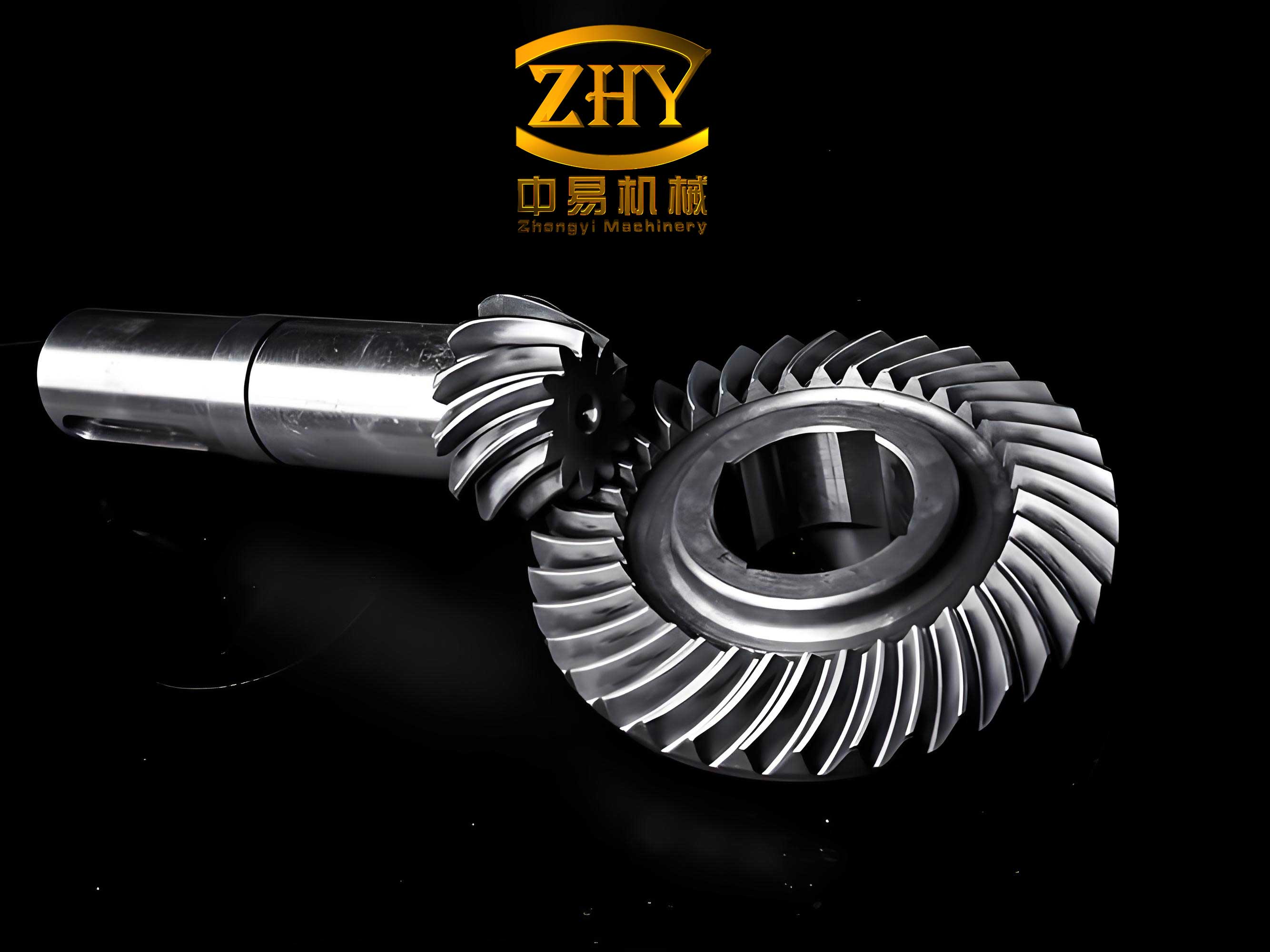
The evolution of material selection for domestic heavy-duty truck spiral bevel gears has progressed through several stages: from 20CrMnTi (or 20MnVB), to the more controlled-hardenability grade 20CrMnTiH, and then to alloys like 22CrMoH, 20CrNiMoH, and 20CrNi3. Each of these materials presented specific drawbacks when applied to the most demanding spiral bevel gear applications. The 20CrMnTiH series often fell short in achieving the necessary combination of strength and toughness. While 22CrMoH meets the technical demands, its molybdenum content renders it expensive. The nickel-bearing steels, 20CrNiMoH and 20CrNi3, not only command a higher price due to the nickel but also introduce complexities in heat treatment process control. The industry has long awaited a cost-effective, high-performance steel that aligns with domestic resource availability. The successful development of 17Cr2Mn2TiH steel appears to address these gaps, offering a favorable composition (rich in titanium, chromium, and manganese, but lean in nickel and molybdenum), excellent hardenability (leading to high core hardness), and a more attractive price point. This prompted our company, beginning in 2007, to initiate a comprehensive technical feasibility study on applying this new steel grade to the production of heavy-duty drive axle spiral bevel gears.
Material Requirements for Heavy-Duty Spiral Bevel Gears
The successful performance of a spiral bevel gear in a heavy-duty axle is predicated on the steel’s ability to withstand multidimensional stresses. The core requirements can be summarized as follows:
- Superior Mechanical Properties: High tensile strength, yield strength, and good ductility to resist bending and contact fatigue.
- Excellent Carburizing and Quenching Response: The ability to develop a deep, hard, and wear-resistant case with a tough, high-strength core after carburizing heat treatment.
- High Impact Toughness: To absorb shock loads from rough terrain and sudden torque changes without catastrophic failure.
- Adequate Core Hardness: Sufficient hardness in the gear’s core after heat treatment to support the hard case and prevent subsurface yielding. This is directly related to the steel’s hardenability.
- Predictable Thermal Deformation Behavior: Minimal and consistent distortion during heat treatment to maintain precise gear geometry and reduce costly finishing operations.
Chemical Composition Analysis of 17Cr2Mn2TiH
A fundamental analysis begins with the chemical composition. The table below compares the nominal compositions of 17Cr2Mn2TiH with other commonly used steels for heavy-duty spiral bevel gears.
| Steel Grade | C | Cr | Mn | Ti | Mo | Ni |
|---|---|---|---|---|---|---|
| 17Cr2Mn2TiH | 0.16-0.20 | 1.30-1.65 | 1.20-1.50 | 0.04-0.10 | – | – |
| 22CrMoH | 0.19-0.25 | 0.85-1.25 | 0.55-0.90 | – | 0.35-0.45 | – |
| 20CrMnTiH | 0.18-0.24 | 1.00-1.35 | 0.80-1.15 | 0.04-0.10 | – | – |
| 20CrNiMoH | 0.19-0.25 | 0.85-1.25 | 0.60-1.00 | – | 0.30-0.40 | 0.40-0.70 |
| 20CrNi3 | 0.17-0.23 | 0.60-0.90 | 0.30-0.60 | – | – | 2.75-3.15 |
Compared to the traditional 20CrMnTi, the 17Cr2Mn2TiH formulation increases the chromium and manganese content while slightly lowering the carbon content. This strategic adjustment is key to its performance. Chromium is a strong carbide-forming element. It shifts the Continuous Cooling Transformation (CCT) diagram to the right, increasing the stability of undercooled austenite and thereby enhancing hardenability. The formation of fine chromium carbides also inhibits austenite grain growth and contributes to precipitation strengthening, improving both strength and toughness. Manganese is a potent austenite stabilizer that significantly increases hardenability and solid solution strengthening. However, high manganese can promote grain growth and increase the detrimental effects of inclusions. By lowering the carbon content and raising the manganese content (increasing the Mn/C ratio), the positive hardenability effect dominates. The retained titanium content plays a dual role: it forms stable carbonitrides (Ti(C,N)) that pin grain boundaries, providing a potent grain refinement effect, and it can form titanium sulfides which are less detrimental to plasticity than manganese sulfides, mitigating the potential negative effects of the higher manganese.
The strengthening mechanisms can be conceptually related to composition. The increase in yield strength from grain refinement (Hall-Petch relationship) and solid solution strengthening can be expressed as contributions to the overall strength:
$$\Delta \sigma_{y} = \Delta \sigma_{ss} + k_{y}d^{-1/2}$$
where $\Delta \sigma_{y}$ is the increase in yield strength, $\Delta \sigma_{ss}$ is the solid solution strengthening contribution from Cr and Mn, $k_{y}$ is the strengthening coefficient, and $d$ is the average grain diameter. Titanium’s role in reducing $d$ is crucial.
While molybdenum and nickel are highly effective in international alloys for improving hardenability and toughness, their cost is a significant factor. Molybdenum contributes to deep hardenability and improves tempering resistance. Nickel enhances toughness by lowering the ductile-to-brittle transition temperature and promoting a more homogeneous microstructure. The design philosophy behind 17Cr2Mn2TiH is to achieve a comparable performance profile through the optimized synergy of C, Cr, Mn, and Ti, offering a cost-effective alternative for manufacturing critical spiral bevel gears.
Physical and Mechanical Property Comparison
To objectively evaluate 17Cr2Mn2TiH, we conducted comparative testing on multiple steel grades and diameters. Samples were prepared and subjected to standard mechanical and physical tests. Key results are summarized below.
| Property / Steel Grade (Diameter) | 17Cr2Mn2TiH (100mm) | 17Cr2Mn2TiH (160mm) | 22CrMoH3 (100mm) | 20CrMnTiH3 (100mm) | 20CrNiMoH (100mm) | 20CrNi3 (100mm) |
|---|---|---|---|---|---|---|
| Rp0.2 (MPa) | 1315.0 | 1210.0 | 1125.0 | 1237.5 | 1407.5 | 997.5 |
| Rm (MPa) | 1420.0 | 1335.0 | 1212.5 | 1382.5 | 1550.0 | 1127.5 |
| A (%) | 12.75 | 12.00 | 13.75 | 14.50 | 13.75 | 14.63 |
| Z (%) | 54.00 | 56.38 | 58.88 | 57.13 | 52.25 | 61.88 |
| Aku2 (J) | 85.50 | 118.00 | 79.00 | 77.00 | 57.00 | 140.75 |
| J9 (HRC) | 44.38 | 39.13 | 45.85 | 38.43 | 44.50 | 39.80 |
| J15 (HRC) | 40.13 | 36.15 | 40.00 | 32.90 | 39.73 | 36.20 |
The analysis of this data reveals several important points regarding the suitability of 17Cr2Mn2TiH for spiral bevel gears. First, the 0.2% proof strength (Rp0.2) and tensile strength (Rm) of 17Cr2Mn2TiH are competitive, being second only to 20CrNiMoH among the compared grades (excluding the anomalous 20CrNi3 data, which suffered from excessive retained austenite). This indicates a strong load-bearing capacity for the spiral bevel gear tooth. The ductility metrics (elongation A and reduction of area Z) are broadly similar across all grades, suggesting no significant compromise in this area. Most notably, the impact absorption energy (Aku2) of 17Cr2Mn2TiH is the highest among the non-nickel grades and even surpasses the higher-alloyed 20CrNiMoH. This superior toughness is a critical asset for a spiral bevel gear facing shock loads. Crucially, the hardenability, as indicated by the J15 value (hardness at 15mm from the quenched end in a Jominy test), is excellent for 17Cr2Mn2TiH. High hardenability ensures that the core of a thick-section spiral bevel gear, especially the pinion, achieves sufficient hardness after quenching, providing essential support for the carburized case. This property is paramount for the functional integrity of the gear.
The hardenability can be estimated using ideal critical diameter formulas based on composition. A simplified Grossmann approach considers multiplying factors for each alloying element. For 17Cr2Mn2TiH, the high Cr and Mn factors contribute significantly to a large ideal critical diameter ($D_I$), which correlates with the good Jominy performance:
$$D_I = D_{I(base)} \times f_{Cr} \times f_{Mn} \times …$$
This translates directly to the ability to through-harden larger sections, a key requirement for the robust core of a heavy-duty spiral bevel gear.
Rig and Field Trial Validation
Theoretical and laboratory property analysis must be validated under simulated and real-world conditions. We manufactured several spiral bevel gear sets for common heavy-duty axle models (e.g., EQ153, CA457, STEYR series) using 17Cr2Mn2TiH steel for the pinions (the more critically stressed member in a spiral bevel gear set). These were subjected to rigorous rig testing at certified institutions and field trials in demanding operating environments.
| Test Site | Test Product (Spiral Bevel Gear Set) | Test Conditions | Result (Cycles to Failure) | Failure Mode | Conclusion |
|---|---|---|---|---|---|
| Site A | Model EQ153-6/41 | Output Torque: 30,000 Nm Input Speed: 200 rpm |
326,000 | Tooth fracture (Pinion & Gear) | Met or exceeded the target durability cycle count specified for the respective application, validating the performance of the spiral bevel gear made from the new material. |
| Site B | Model EQ153-6/39 | Output Torque: 30,000 Nm Input Speed: 246 rpm |
342,000 | Tooth fracture | |
| Site A | Model CA457-6/38 | Output Torque: 36,000 Nm Input Speed: 200 rpm |
486,000 & 498,000 | Tooth fracture |
The rig tests demonstrated that spiral bevel gears manufactured from 17Cr2Mn2TiH steel could reliably meet and, in some cases (like the CA457 test under higher torque), significantly exceed the target durability life cycles. The failure modes were typical bending fatigue failures under extreme load, indicating proper material performance rather than premature failure due to material deficiencies.
Concurrently, field trials were conducted by placing gears in service with fleet operators in mountainous and mining regions known for severe overloading conditions—precisely the environment that challenges a spiral bevel gear the most. Over two dozen gear sets were monitored. The vast majority performed satisfactorily over the monitoring period. A small number of early failures were investigated and attributed to external factors such as improper assembly (re-use of worn bearings leading to incorrect pinion positioning) and case depth being at the lower specification limit, rather than an inherent flaw in the 17Cr2Mn2TiH material itself. This underscores that the performance of a spiral bevel gear is a system-dependent property, where material, heat treatment, and assembly precision all play vital roles.
Key Application Considerations for 17Cr2Mn2TiH
Adopting a new material requires process adaptations. Based on our manufacturing experience, successful application of 17Cr2Mn2TiH for spiral bevel gears necessitates attention to two key thermal processing steps:
- Normalizing after Forging: The post-forging normalizing cycle may require adjustment compared to traditional steels. The goal is to refine the grain structure and achieve a uniform, fine-pearlitic microstructure that ensures good machinability and prepares the material for subsequent carburizing. The precise temperature and cooling rate must be optimized for this specific composition to prevent banding or excessive grain growth.
- Carburizing and Heat Treatment: The carburizing response and hardenability of 17Cr2Mn2TiH are excellent. However, the heat treatment parameters (carburizing temperature, time, carbon potential, quenching medium, and tempering temperature) must be fine-tuned to control case depth, surface carbon content, core hardness, and most importantly, to avoid undesirable microstructural constituents like excessive retained austenite or non-martensitic transformation products. The formula for case depth diffusion is governed by Fick’s law, and the high alloy content affects the diffusivity of carbon:
$$d \propto \sqrt{D(T) \cdot t}$$
where $d$ is case depth, $D$ is the temperature-dependent diffusion coefficient (influenced by alloying elements), and $t$ is time. Process control is essential to leverage the material’s potential fully and ensure every spiral bevel gear meets the stringent metallurgical specifications.
Conclusion
The comprehensive evaluation of 17Cr2Mn2TiH steel, from compositional analysis and mechanical property testing to rigorous rig and field validation, confirms its technical feasibility and performance suitability for manufacturing heavy-duty spiral bevel gears. Its balanced composition provides an excellent combination of high hardenability (ensuring robust core properties in thick sections), superior impact toughness (for shock load resistance), and competitive strength—all at a favorable cost structure. While process parameters in forging and heat treatment require specific optimization, the material’s machinability and processability are on par with conventional grades. For the critical application of spiral bevel gears in heavy-duty axles, 17Cr2Mn2TiH emerges as a viable, high-performance, and cost-effective alternative to more expensive nickel and molybdenum-alloyed steels, effectively meeting the demanding requirements of modern, heavily loaded drivetrains.