
In the field of heat treatment for automotive components, the pursuit of enhanced performance, durability, and efficiency has always been a driving force. Over the past two decades, rare earth (RE) chemical heat treatment processes have emerged as a transformative technology, offering significant improvements in carburizing kinetics and material properties. My involvement in this domain has focused on the application of RE carburizing technology specifically for helical bevel gears used in heavy-duty trucks. This article details our journey from laboratory research to industrial-scale implementation, highlighting the technical breakthroughs, experimental results, and economic benefits achieved. The helical bevel gear, a critical component in vehicle drivetrains, demands exceptional wear resistance, fatigue strength, and dimensional stability. Traditional carburizing methods often fall short in optimizing these properties while minimizing energy consumption and emissions. Our work addresses these challenges by integrating RE elements into the carburizing process, leveraging their catalytic and micro-alloying effects to revolutionize gear performance.
The core innovation lies in the ability of RE elements to accelerate carbon diffusion and refine microstructure. When introduced into the carburizing atmosphere, RE atoms permeate the steel surface, where they serve as nucleation sites for carbide precipitation and grain refinement. This dual action not only shortens processing times but also yields a superior渗层 characterized by ultra-fine martensite, dispersed carbides, and reduced non-martensitic phases. For helical bevel gears, this translates to higher surface hardness, improved contact fatigue resistance, and extended service life. Our project aimed to transition this technology from batch-type furnaces to continuous carburizing lines, a move that required overcoming technical hurdles such as RE agent clogging and process parameter optimization. Through systematic experimentation and equipment modifications, we successfully achieved industrialization, marking a milestone in sustainable manufacturing for the automotive sector.
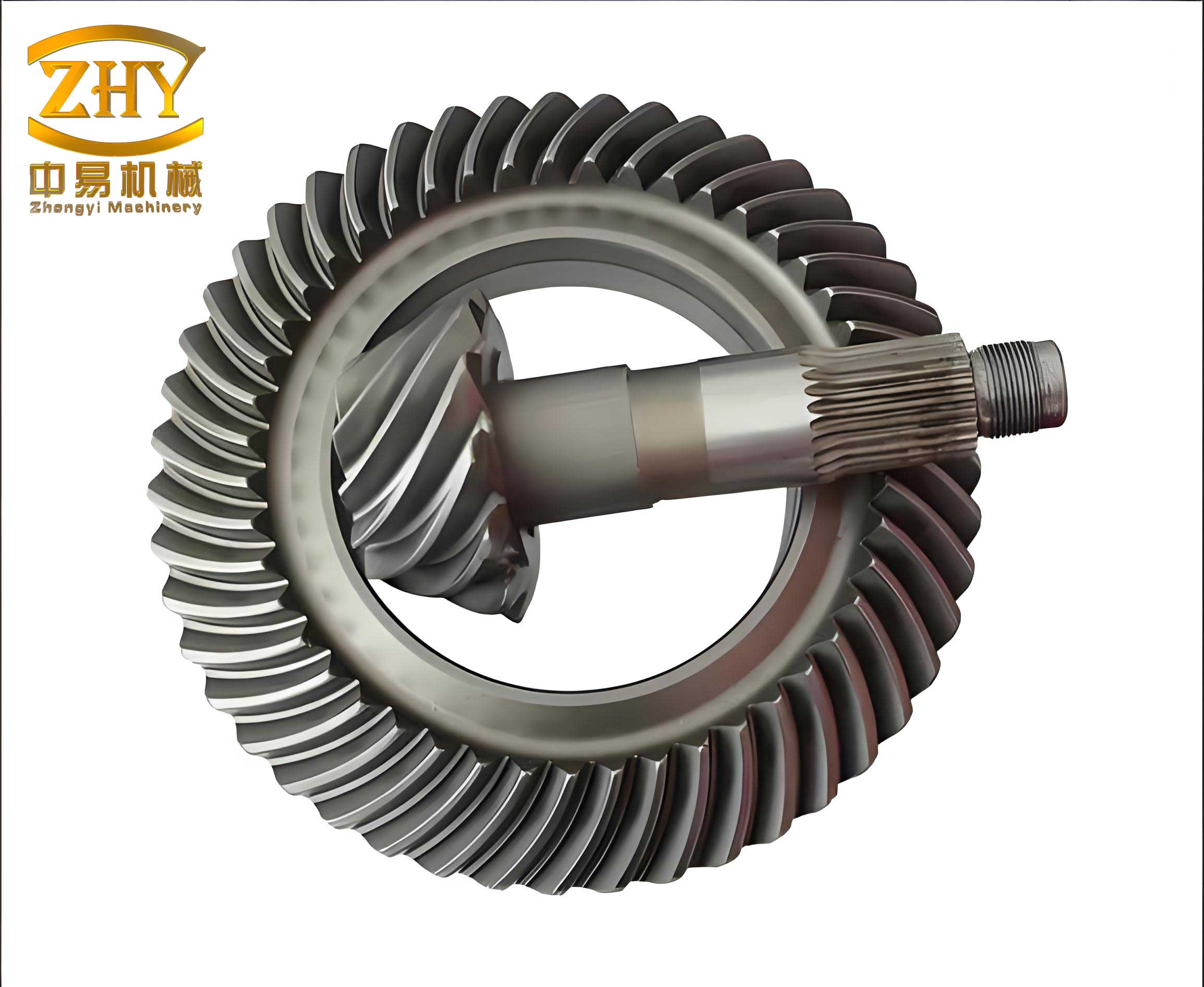
To contextualize our work, it is essential to understand the technical specifications of the helical bevel gears under consideration. These gears are integral to the rear axles of heavy-duty trucks, where they transmit torque under high loads and harsh conditions. The material of choice is 20CrMnTiH steel, a chromium-manganese-titanium alloy steel with guaranteed hardenability, conforming to GB/T 5216-2004 standards. Key requirements include an oxygen content below 20 ppm and a hardenability band of J9 = 36–42 HRC. The gear design mandates an effective carburized case depth of 1.70–2.10 mm after quenching, with surface hardness ranging from 58 to 63 HRC and core hardness between 35 and 40 HRC. Microstructurally, the carbides must be rated 1–5级, martensite and retained austenite at 1–5级, and non-martensitic layer depth limited to ≤20 μm, as per QC/T 262-1999 standards. These stringent criteria ensure reliable operation, but achieving them consistently with minimal energy input has been a persistent challenge in conventional carburizing.
Our approach centered on adapting RE carburizing for a dual-row continuous gas carburizing automated production line, designated as the LS15 type. This furnace features multiple zones for preheating, carburizing, diffusion, and quenching, allowing for precise control over temperature and atmosphere. The standard process involves cleaning, pre-treatment, preheating, carburizing, diffusion, pre-cooling, quenching, cleaning, tempering, and shot blasting. However, to incorporate RE elements, we devised a RE-nitrogen-methanol process, where RE-infused methanol is injected alongside conventional carriers. The primary obstacle was the tendency of RE agents to clog injection pipes due to coking, which we resolved through patented modifications. These included water-cooled anti-coking drip pipes and a programmable gas flushing system, ensuring stable flow rates across all zones. Additionally, we redesigned the medium flow distribution plates to maintain consistency, critical for reproducible results in helical bevel gear production.
The RE carburizing process parameters were meticulously optimized to balance accelerated carburizing with microstructural perfection. Unlike conventional methods that use a lower carbon potential during diffusion, our strategy employs a high carbon potential (Cp = 1.20%–1.40% C) in the carburizing zones, followed by controlled precipitation of carbides in the diffusion zone. This approach capitalizes on RE’s ability to enhance carbon transfer coefficient (β) and diffusion coefficient (D), as described by Fick’s laws. The kinetics can be expressed as:
$$ \frac{\partial C}{\partial t} = D \frac{\partial^2 C}{\partial x^2} $$
where \( C \) is carbon concentration, \( t \) is time, \( x \) is depth, and \( D \) is the diffusion coefficient. With RE addition, \( D \) increases significantly due to accelerated atomic mobility, reducing the time required to achieve target case depths. We reconfigured the furnace zones: Zone 2 (pre-carburizing) and Zone 3 (main carburizing) were designated as strong carburizing zones I and II, respectively, while Zones 4 and 5 served as microstructure control zones for diffusion and pre-cooling. This zoning allows independent management of carburizing rate and layer quality, a key advantage for helical bevel gears requiring both deep cases and fine microstructures.
The table below summarizes the optimized RE carburizing parameters, highlighting the temperatures, carbon potentials, and medium flow rates for each zone:
| Zone | Temperature (°C) | Carbon Potential (Cp % C) | Propane (m³/h) | Nitrogen (m³/h) | Methanol (ml/min) | RE-Methanol (ml/min) |
|---|---|---|---|---|---|---|
| Heating (1) | 840–800 | – | 0 | 2–3 | 0 | 0 |
| Strong Carburizing I (2) | 900–920 | 1.015–1.025 | 0.3–0.6 | 2–3 | 10–20 | 15–30 |
| Strong Carburizing II (3) | 920–930 | 1.20–1.40 | 0.3–0.6 | 2–3 | 20–30 | 15–30 |
| Diffusion (4) | 880–910 | 1.10–1.15 | 0.10–0.20 | 2–3 | 10–20 | 10–25 |
| Pre-cooling (5) | 840–850 | 0.90–1.10 | 0 | 3–4 | 0 | 0 |
The push cycle, or production rhythm, was reduced from 38 minutes per tray to 30 minutes, representing a 21% increase in carburizing speed. This reduction directly translates to higher throughput and lower energy consumption per gear. For helical bevel gears, this means shorter furnace residence times, which also mitigates thermal distortion—a common issue in gear heat treatment. The enhanced kinetics can be quantified by the effective diffusion coefficient \( D_{\text{eff}} \), which incorporates RE’s catalytic effect:
$$ D_{\text{eff}} = D_0 \exp\left(-\frac{Q}{RT}\right) \cdot \eta_{\text{RE}} $$
where \( D_0 \) is the pre-exponential factor, \( Q \) is activation energy, \( R \) is gas constant, \( T \) is temperature, and \( \eta_{\text{RE}} \) is the enhancement factor due to RE, typically ranging from 1.2 to 1.5 based on our measurements. This formula underscores how RE elements lower energy barriers for carbon diffusion, enabling faster case depth attainment without raising temperatures.
One of the most striking outcomes of RE carburizing is the improvement in surface hardness for helical bevel gears. In conventional processes, surface hardness often exhibits a “drop” phenomenon due to non-martensitic layers, but RE carburizing elevates hardness by promoting carbide precipitation and reducing oxidation. We conducted extensive hardness testing on gear shafts, comparing standard and RE-carburized samples. The results are tabulated below:
| Sample Set | Hardness Measurements (HRC) – 10 Points | Average Hardness (HRC) |
|---|---|---|
| Standard Carburizing | 60, 59.5, 58.5, 59, 58.5, 61, 59, 60.5, 61.5, 59.5 | 59.7 |
| RE Carburizing | 62.5, 61.5, 62, 59.5, 60, 64, 60, 61.5, 63, 62 | 61.6 |
The average increase of 1.9 HRC may seem modest, but it significantly enhances wear resistance and contact fatigue life. More importantly, hardness distribution curves reveal a distinct profile: in RE-carburized helical bevel gears, hardness peaks at 64 HRC in the subsurface region (500–1100 μm), compared to 59 HRC in conventional gears. This peak aligns with the Hertzian stress distribution in meshing gears, offering superior load-bearing capacity. The hardness as a function of depth \( x \) can be modeled as:
$$ H(x) = H_{\text{surface}} – \alpha x + \beta \exp(-\gamma x) $$
where \( H_{\text{surface}} \) is the surface hardness, and \( \alpha, \beta, \gamma \) are constants influenced by RE addition. The exponential term accounts for the subsurface peak, which we attribute to fine carbide dispersion.
Microstructural analysis further elucidates the benefits. Traditional carburized gears exhibit coarse martensite with intermittent carbides, whereas RE-carburized helical bevel gears showcase a signature microstructure: ultra-fine lath martensite, minimal retained austenite, and finely dispersed granular carbides. This structure results from RE-induced carbide nucleation and austenite recrystallization during diffusion. The carbide volume fraction \( V_c \) can be estimated using:
$$ V_c = \frac{\pi}{6} \sum d_i^3 n_i $$
where \( d_i \) is carbide diameter and \( n_i \) is number density, both increased by RE. This refinement impedes crack initiation and propagation, boosting fatigue resistance. For helical bevel gears, this means delayed pitting and spalling under cyclic loads.
Non-martensitic layers, often caused by internal oxidation, are a critical quality metric. Conventional processes typically yield depths of 20–35 μm, exceeding the ≤20 μm standard. RE carburizing suppresses internal oxidation because RE atoms preferentially bond with oxygen, forming stable oxides like RE₂O₃, thus protecting alloy elements like chromium and manganese. Our measurements consistently show non-martensitic depths below 20 μm, complying with international norms. The reduction in oxidation depth \( \delta \) follows an exponential decay with RE concentration \( C_{\text{RE}} \):
$$ \delta = \delta_0 \exp(-k C_{\text{RE}}) $$
where \( \delta_0 \) is the baseline depth and \( k \) is a constant. This equation highlights how trace RE additions (tens of ppm) yield disproportional benefits.
Economic and environmental impacts are equally compelling. By shortening the push cycle, we increased production capacity by 21%, which reduces per-unit energy and material consumption. The table below contrasts unit consumptions before and after RE implementation:
| Parameter | Standard Process | RE Carburizing Process |
|---|---|---|
| Electricity (kWh/kg) | 2.04 | 1.73 |
| Propane (kg/kg) | 0.0065 | 0.0058 |
| Methanol (kg/kg) | 0.038 | 0.033 |
| RE Agent (L/kg) | 0 | 0.0004 |
Cost analysis reveals significant savings. Although RE agent adds expense (approximately 280 USD per liter), the overall reduction in energy and carrier gas usage lowers heat treatment cost per gear from 40.5 USD to 33.73 USD, a 16.7% decrease. Annually, for a production volume of 80,000 helical bevel gear sets (2000 tons), this translates to savings of 794,100 USD in materials and energy, minus RE costs, netting 567,300 USD. Furthermore, the increased output generates additional revenue—around 880,000 USD in annual产值—with a net profit boost of 630,000 USD. These figures underscore the financial viability of RE carburizing for helical bevel gears.
Environmental benefits align with global “energy saving and emission reduction” goals. The shorter process time cuts CO₂ emissions by over 15% per kilogram of product. For our scale, this means an annual reduction of 630 tons of CO₂ and 650,000 kWh in energy consumption. RE agents are used in minimal quantities (daily consumption of 2.5 L, with RE solute around 450 g), and any residual oxides are harmless, mixed with furnace soot without ecological impact. Thus, RE carburizing offers a green manufacturing pathway for helical bevel gear production.
Quality consistency is paramount in mass production. We monitored key parameters over a 10-day period, as shown below:
| Date | Case Depth (mm) | Carbide Rating | Martensite Rating | Retained Austenite Rating | Core Ferrite Rating | Shaft Hardness (HRC) |
|---|---|---|---|---|---|---|
| Day 1 | 1.98 | 2 | 3 | 3 | 1 | 61.5 |
| Day 2 | 1.95 | 3 | 4 | 3 | 1 | 62 |
| Day 3 | 1.93 | 2 | 2 | 2 | 1 | 60.5 |
| Day 4 | 1.92 | 2 | 3 | 3 | 1 | 63 |
| Day 5 | 1.95 | 3 | 4 | 4 | 1 | 62 |
| Day 6 | 2.00 | 2 | 1 | 2 | 1 | 62 |
| Day 7 | 1.98 | 3 | 3 | 3 | 1 | 60 |
| Day 8 | 1.94 | 2 | 2 | 2 | 1 | 61.5 |
| Day 9 | 1.96 | 4 | 4 | 4 | 1 | 63 |
| Day 10 | 1.93 | 2 | 3 | 2 | 1 | 62.5 |
The data indicate stable case depths (1.92–2.00 mm) and consistent microstructure ratings, affirming process robustness. Moreover, distortion control improved: for driven helical bevel gears, one-press quenching qualification rate rose from 91% to 97%, and for drive gears, shaft runout acceptance increased from 45% to 60%. This is attributed to reduced thermal exposure, as described by the thermal stress model:
$$ \sigma_{\text{thermal}} = E \alpha \Delta T $$
where \( E \) is Young’s modulus, \( \alpha \) is thermal expansion coefficient, and \( \Delta T \) is temperature gradient. Shorter cycles minimize \( \Delta T \), lowering residual stresses.
Looking ahead, the success of RE carburizing for helical bevel gears opens avenues for broader adoption. Potential extensions include other gear types, such as spur or planetary gears, and adaptation to vacuum carburizing for further emission cuts. The micro-alloying effects of RE could also be harnessed for nitriding or carbonitriding processes, enhancing surface properties of different components. Our ongoing research explores optimizing RE compositions for varied steel grades, potentially unlocking new performance frontiers.
In conclusion, the industrialization of rare earth carburizing technology for helical bevel gears represents a significant advancement in heat treatment. By integrating RE elements into continuous furnace operations, we achieved a 21% boost in productivity, a 16.7% reduction in unit cost, and superior gear quality characterized by enhanced hardness, refined microstructure, and reduced distortion. The environmental benefits, including lower CO₂ emissions and energy use, align with sustainable manufacturing imperatives. This technology not only elevates the performance and longevity of helical bevel gears but also sets a precedent for innovation in the automotive sector. As we continue to refine and expand this approach, the future holds promise for even greater efficiencies and applications, solidifying RE carburizing as a cornerstone of modern gear manufacturing.