
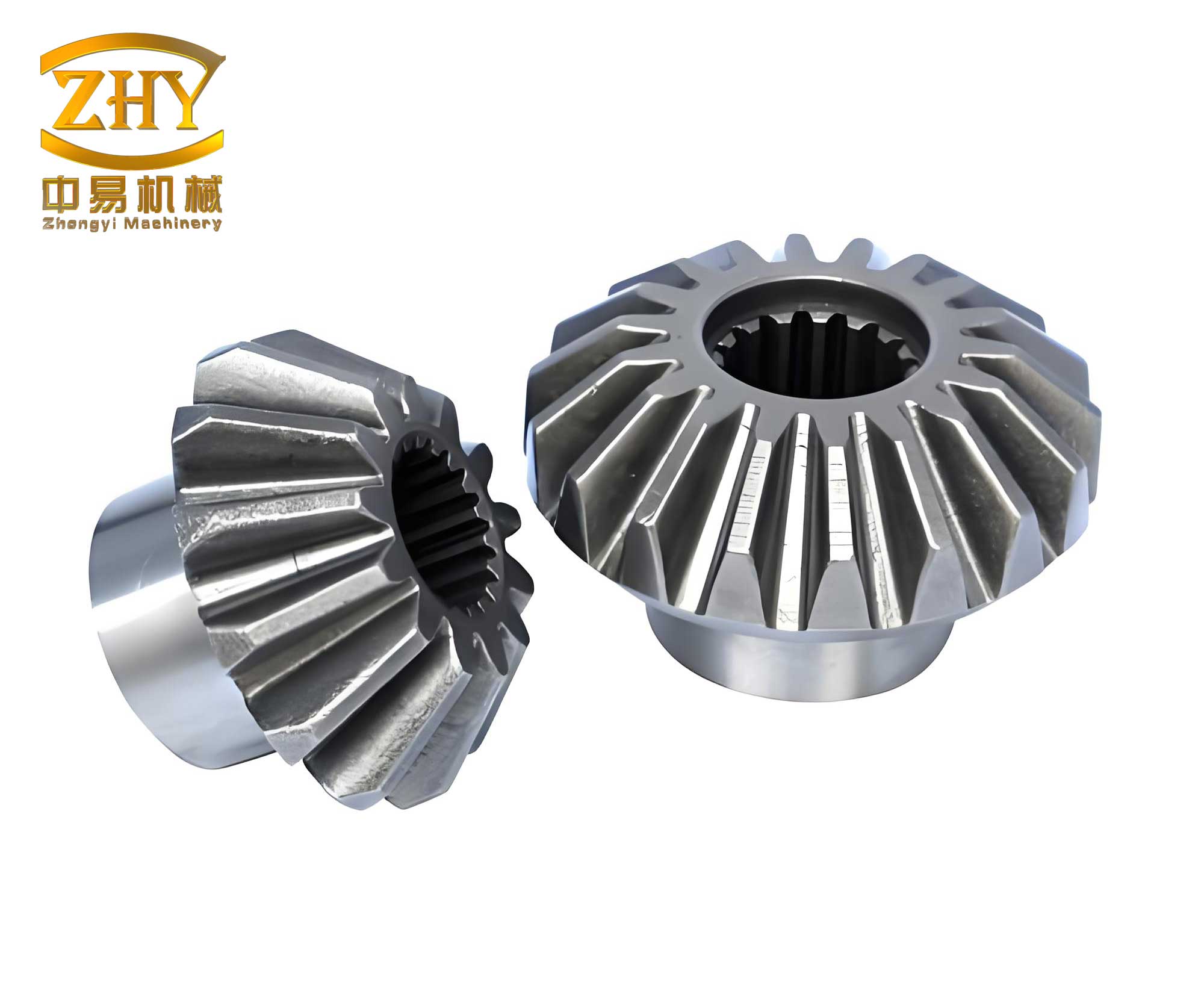
In modern automotive drivetrains, the differential assembly stands as a critical component, enabling smooth cornering by managing speed differences between wheels. Central to its function is the precise meshing of bevel gears. These gears operate under an overhung support structure, where their axial positioning accuracy is paramount for optimal contact pattern, noise performance, and longevity. This axial location is primarily defined by a machined counterbore feature inside the gear’s bore.
The challenge with inspecting this bevel gear counterbore lies in its geometry. The specified depth (H) is measured from a theoretical sharp corner (the intersection of the angled face and the cylindrical pilot diameter) to the gear’s back face. Similarly, the angle (α) of the conical seat is internal and not directly accessible. While advanced metrology equipment like contour projectors or coordinate measuring machines (CMMs) can measure these features, they are unsuitable for high-volume production environments due to their cost, environmental sensitivity, and low measurement throughput. The absence of simple, robust shop-floor gauges creates a quality control blind spot, risking undetected process drift and potential batch scrap.
This article details the design and application of functional gauges based on the fundamental “Go/No-Go” (or “Pass/Not Pass”) principle, commonly used for inspecting hole sizes with plain plug gauges. The core logic is elegantly simple: a “Go” gauge member, sized to the maximum material condition (MMC) of the feature, must freely assemble. A “No-Go” gauge member, sized to the least material condition (LMC), must not assemble. Translating this principle to the complex bevel gear counterbore allows for rapid, reliable, and operator-friendly inspection of both depth and angle.
1. Fundamental Geometry and the Inspection Challenge
The critical features of a bevel gear bore are illustrated in the schematic below. The primary locating diameter is D1, typically held to a tight tolerance (e.g., ±0.015 mm). Inside this bore, the counterbore consists of a pilot diameter D2 (often with a wider tolerance) and a conical seat with a specified angle α and a depth H measured from the sharp corner to the gear’s back face.
The inspection objectives are:
- Verify that the counterbore depth H is within its specified tolerance ±δ.
- Verify that the counterbore angle α is within its specified tolerance ±θ.
Direct measurement of H is impossible with standard tools due to the virtual sharp corner. Measuring α precisely on the shop floor is equally challenging. Our solution involves designing two distinct Go/No-Go gauges that transform these complex measurements into simple assembly checks.
2. Go/No-Go Gauge for Counterbore Depth (H)
The depth H has a tolerance: Hmin = H – δ and Hmax = H + δ. The gauge concept is to create two gauge ends that physically interact with the sharp corner. The gauge uses the high-precision bore diameter D1 as its primary datum for alignment.
2.1 Gauge Design Principle and Geometry
The depth gauge is a single tool with two functional ends: a “Go” (T) end and a “No-Go” (Z) end. Both ends feature a central pilot that engages the gear bore D1 and a conical tip that aims to contact the counterbore’s sharp corner.
The key design parameters are summarized in the following table:
| Gauge Feature | Design Rule & Purpose | Mathematical Expression |
|---|---|---|
| Pilot Diameter (for D1) | Designed for a slight clearance fit with the minimum bore diameter (D1min). Ensures easy insertion and coaxial alignment without being a tight slip fit. | $$ D_{gauge\_pilot} = D1_{min} – (0.02 \text{ to } 0.04) \, mm $$ |
| Tip Cone Diameter | Designed larger than the maximum bore diameter (D1max). Forces the gauge tip to contact the angled counterbore surface, not the bore wall. The tip is a sharp point. | $$ D_{gauge\_tip} = D1_{max} + (0.18 \text{ to } 0.20) \, mm $$ |
| Go (T) End Height | Represents the maximum allowable material condition for depth. If the depth is too shallow (H too small), this gauge will not seat. Its height is calculated from Hmin with a radial offset correction. | $$ L_T = H_{min} – \Delta_{correction} $$ |
| No-Go (Z) End Height | Represents the minimum allowable material condition for depth. If the depth is too deep (H too large), this gauge will seat. Its height is calculated from Hmax with the same correction. | $$ L_Z = H_{max} – \Delta_{correction} $$ |
2.2 Radial Offset Correction
Because the gauge tip diameter is larger than the bore, its point of contact with the counterbore cone is radially offset from the theoretical sharp corner. This offset must be accounted for in the height calculation. As shown in the diagram, the gauge contacts at point f, while the design corner is at point e. The radial difference bf is half the diameter difference:
$$ bf = \frac{D_{gauge\_tip} – D1}{2} \approx 0.1 \, mm $$
In the right triangle △bef, the axial distance be (which must be subtracted from the nominal depth) is:
$$ be = \frac{bf}{\tan(\alpha)} = \frac{0.1}{\tan(\alpha)} \, mm $$
Therefore, the correction factor Δcorrection = be. The final gauge heights are:
$$ L_T = H – \delta – \frac{0.1}{\tan(\alpha)} $$
$$ L_Z = H + \delta – \frac{0.1}{\tan(\alpha)} $$
The variation in angle α (±θ) has a negligible effect on this correction for typical tolerances (e.g., ±1°) and can be ignored in the gauge design, using the nominal α value.
2.3 Inspection Procedure for Bevel Gear Depth
- Go Check: Insert the Go (T) end of the gauge into the bevel gear bore. The gauge must fully seat, meaning its reference shoulder makes complete, flush contact with the gear’s back face. This indicates the actual depth is not less than Hmin.
- No-Go Check: Insert the No-Go (Z) end of the gauge into the same bevel gear bore. The gauge must not seat fully. There should be a visible, uniform gap (light visible) between the gauge’s reference shoulder and the gear’s back face. This indicates the actual depth is not greater than Hmax.
Acceptance Criteria: The bevel gear counterbore depth is acceptable only if it passes both checks: Go end passes, No-Go end does not pass.
3. Go/No-Go Gauge for Counterbore Angle (α)
Inspecting the angle α directly is complex. However, with the depth H verified as correct, the angle tolerance ±θ translates directly into a variation of the effective vertical height of the counterbore’s pilot diameter D2. When the angle is at its minimum (αmin), the conical seat is steeper, making the “effective height” Hα_min of the pilot wall shorter. When the angle is at its maximum (αmax), the seat is shallower, making the effective height Hα_max longer.
We design a second gauge to check this effective height, thereby indirectly inspecting the angle. This gauge is only valid if the depth H has already been confirmed as within tolerance.
3.1 Gauge Design Principle and Geometry
The angle gauge also has Go (T) and No-Go (Z) ends. It uses the same bore diameter D1 for piloting and alignment. However, its tip diameter is now designed to fit within the counterbore’s pilot diameter D2. The tip is still a sharp point to contact the angled surface.
The key design parameters are as follows:
| Gauge Feature | Design Rule & Purpose | Mathematical Expression |
|---|---|---|
| Pilot Diameter (for D1) | Identical to the depth gauge. Ensures consistent alignment. | $$ D_{gauge\_pilot} = D1_{min} – (0.02 \text{ to } 0.04) \, mm $$ |
| Tip Cone Diameter | Designed for a slight clearance with the minimum pilot diameter D2min. Allows the gauge to enter the counterbore freely without binding on D2. | $$ D_{gauge\_tip\_angle} = D2_{min} – (0.02 \text{ to } 0.04) \, mm $$ |
| Go (T) End Height for Angle | Represents the maximum allowable effective height (corresponding to αmax). Must be shorter than this worst-case height to pass. Its height is based on Hα_max but must also account for the depth tolerance (±δ). | $$ L_{T\alpha} = H_{\alpha\_max} + \delta $$ |
| No-Go (Z) End Height for Angle | Represents the minimum allowable effective height (corresponding to αmin). Must be longer than this worst-case height to not pass. Its height is based on Hα_min and accounts for depth tolerance. | $$ L_{Z\alpha} = H_{\alpha\_min} – \delta $$ |
3.2 Calculating Effective Heights and Gauge Dimensions
The effective heights Hα_min and Hα_max are derived from the basic geometry of the counterbore. The axial distance from the sharp corner to a point on the cone at the gauge tip’s radius must be calculated for both angle limits. The geometry is defined by the nominal and extreme angles, the nominal D2, and the gauge tip radius.
Let Rtip be the radius of the gauge tip (Dgauge_tip_angle/2). The axial distance from the theoretical corner to the contact point for a given angle α is:
$$ H_{\alpha} = \frac{ (D2/2) – R_{tip} }{\tan(\alpha)} $$
We calculate this for αmin and αmax:
$$ H_{\alpha\_min} = \frac{ (D2/2) – R_{tip} }{\tan(\alpha – \theta)} $$
$$ H_{\alpha\_max} = \frac{ (D2/2) – R_{tip} }{\tan(\alpha + \theta)} $$
Because the depth H itself has a tolerance ±δ, the actual position of the sharp corner along the axis can vary. To ensure the angle gauge is robust to this depth variation, we add the full depth tolerance to the Go end calculation and subtract it from the No-Go end calculation. This creates a safety margin.
$$ L_{T\alpha} = H_{\alpha\_max} + \delta $$
$$ L_{Z\alpha} = H_{\alpha\_min} – \delta $$
Note that the tolerance on diameter D2 does not significantly affect this measurement because the gauge tip is designed to clear even the smallest D2, and the calculation uses the nominal D2 value. The critical relationship is between the axial height and the angle.
3.3 Inspection Procedure for Bevel Gear Angle
Prerequisite: The bevel gear must first pass the depth (H) inspection.
- Go Check for Angle: Insert the Go (T) end of the angle gauge. It must fully seat (shoulder flush with back face). This indicates the effective height is not less than the value for αmax, meaning the actual angle is not steeper than αmax.
- No-Go Check for Angle: Insert the No-Go (Z) end of the angle gauge. It must not seat fully (uniform gap at shoulder). This indicates the effective height is not greater than the value for αmin, meaning the actual angle is not shallower than αmin.
Acceptance Criteria: The bevel gear counterbore angle is acceptable only if it passes both checks after passing the depth check: Angle Go end passes, Angle No-Go end does not pass.
4. Practical Advantages and Implementation
The application of the Go/No-Go principle to bevel gear counterbore inspection offers significant manufacturing advantages:
- Speed and Efficiency: Inspection takes seconds, enabling 100% in-process verification on the production line without slowing down the cycle.
- Simplicity and Reliability: The gauges require no skilled interpretation or electronic setup. The result is a binary pass/fail, eliminating operator judgment errors.
- Robustness: Made from hardened tool steel, these gauges are durable and suitable for the shop-floor environment, unlike sensitive optical or CMM probes.
- Proactive Quality Control: Immediate feedback allows machine operators to detect tool wear or machine drift early and make corrective adjustments before producing non-conforming parts.
- Cost-Effectiveness: The gauges are inexpensive to manufacture compared to automated measuring systems and prevent costly batch scrap events.
The design methodology is not limited to automotive bevel gears. It can be effectively applied to any component featuring an internal conical seat or counterbore where direct dimension measurement is impractical for production control. The core innovation lies in transforming a two-dimensional geometric tolerance (depth and angle) into two independent, one-dimensional functional tests using mechanically intelligent gauge design.
5. Summary
Ensuring the precision of a bevel gear‘s internal counterbore is non-negotiable for the performance of a differential assembly. By adapting the timeless Go/No-Go gauge principle, we can solve the elusive problem of measuring the depth to a virtual sharp corner and the internal cone angle. The solution involves two dedicated gauges: one that translates depth tolerance into an axial gauge length with radial offset compensation, and another that translates angle tolerance into a different axial gauge length by considering the effective height of the counterbore’s pilot wall. This approach provides a robust, fast, and foolproof method for shop-floor inspection, closing a critical quality assurance loop in the high-volume manufacturing of precision bevel gears. Implementing such gauges empowers production teams with the tools needed for real-time quality assurance, directly contributing to manufacturing excellence and product reliability in automotive drivetrains.