
In the manufacturing of straight bevel gears, rough cutting is a critical preparatory step that significantly influences the efficiency and quality of subsequent finishing operations, such as gear planing. As an engineer focused on gear production optimization, I have extensively studied the design of milling cutters used for rough cutting straight bevel gears. Traditional methods often rely on graphical techniques to approximate the tooth profile, but these approaches are prone to inaccuracies, leading to uneven finishing allowances or even insufficient material left at the tooth ends. To address this, I have developed and implemented a novel analytical method for designing the arc tooth profile of rough milling cutters. This method ensures consistent and optimal finishing allowances across both the large and small ends of the straight bevel gear, enhancing tool life and process reliability. Throughout this discussion, I will emphasize the importance of precise cutter design for straight bevel gears, a component widely used in differentials, transmissions, and other mechanical systems requiring efficient power transmission between intersecting shafts.
The design of a rough milling cutter for straight bevel gears encompasses several key parameters: tool geometry, material selection, and cutting conditions. Proper selection of these parameters is fundamental to achieving high productivity and extended tool life. For the cutter geometry, the rake angle and relief angles are paramount. Based on practical experience and machining principles, I recommend the following ranges for a cutter used on straight bevel gears. The side rake angle is typically set between $$8^\circ$$ and $$12^\circ$$. The side relief angle should be in the range of $$4^\circ$$ to $$6^\circ$$. The end relief angle, crucial for preventing rubbing, is commonly set from $$10^\circ$$ to $$12^\circ$$. Through optimization, I have found that a rake angle of $$10^\circ$$ generally yields the best balance between cutting force and chip evacuation. The side relief angle should preferably be $$5^\circ$$; it is critical to avoid using any value less than $$4^\circ$$ to prevent excessive friction and rapid tool wear. The cutter material is typically high-speed steel (HSS) or advanced grades like M42 for improved performance when machining carbon steels.
| Tool Angle Parameter | Recommended Range | Optimal Value |
|---|---|---|
| Side Rake Angle (γ_s) | $$8^\circ – 12^\circ$$ | $$10^\circ$$ |
| Side Relief Angle (α_s) | $$4^\circ – 6^\circ$$ | $$5^\circ$$ |
| End Relief Angle (α_e) | $$10^\circ – 12^\circ$$ | $$11^\circ$$ |
| Cutter Material | High-Speed Steel (e.g., M2, M42) | |
The selection of cutting parameters is equally vital, as it directly determines production efficiency and part quality. For the rough milling operation on straight bevel gears, the key parameters are cutting speed, feed per tooth, and rotational speeds of both the cutter and the workpiece. The following formulas provide a systematic approach to selecting these parameters for a straight bevel gear milling setup:
$$ v_c = \frac{\pi D n_t}{1000} \quad \text{(m/min)} $$
$$ f_z = \frac{v_f}{z n_t} \quad \text{(mm/tooth)} $$
$$ n_w = \frac{v_f}{\pi d_w} \quad \text{(rev/min)} $$
Where:
$$ v_c $$ = Cutting speed (m/min)
$$ D $$ = Diameter of the cutter tip circle (mm)
$$ n_t $$ = Rotational speed of the milling cutter (rev/min)
$$ f_z $$ = Feed per tooth (mm/tooth)
$$ z $$ = Number of cutter blades on the arbor (typically 1)
$$ v_f $$ = Feed velocity (mm/min)
$$ n_w $$ = Rotational speed of the workpiece (straight bevel gear blank) (rev/min)
$$ d_w $$ = Major diameter of the workpiece (mm)
For a cutter material of high-speed steel and a workpiece material of carbon steel, the cutting speed $$ v_c $$ can be selected between 30 to 50 m/min. In a typical setup using a standard lathe adapted for milling, with a single cutter blade ($$z=1$$) and a minimum workpiece speed of $$n_w = 20$$ rev/min, one can calculate the required cutter speed. For instance, with a cutter tip diameter $$D = 150$$ mm and aiming for $$v_c = 40$$ m/min, the cutter rotational speed $$n_t$$ is calculated as:
$$ n_t = \frac{1000 v_c}{\pi D} = \frac{1000 \times 40}{\pi \times 150} \approx 84.9 \text{ rev/min} $$
The feed per tooth $$f_z$$ is chosen based on the desired surface finish and tool load, typically ranging from 0.05 to 0.15 mm/tooth for roughing straight bevel gears. Proper cooling, often using compressed air, is essential to maintain low cutting temperatures and prolong tool life.
| Cutting Parameter | Symbol | Typical Range/Value |
|---|---|---|
| Cutting Speed | $$v_c$$ | 30 – 50 m/min (for HSS vs. Carbon Steel) |
| Feed per Tooth | $$f_z$$ | 0.05 – 0.15 mm/tooth |
| Cutter Rotational Speed | $$n_t$$ | 80 – 120 rev/min (example) |
| Number of Cutter Blades | $$z$$ | 1 |
| Workpiece Rotational Speed | $$n_w$$ | 15 – 30 rev/min |
The core challenge in designing a rough milling cutter for straight bevel gears lies in defining its tooth profile. The tooth profile of a straight bevel gear varies continuously from the large end to the small end due to the conical geometry. The module and circular pitch are larger at the big end than at the small end, and the curvature of the involute tooth profile differs at each cross-section along the tooth length. The primary goal of rough cutting is to remove the bulk of material while leaving a uniform and adequate finishing allowance for the subsequent planing operation. The desired allowance is typically 0.5 to 1.0 mm on each side of the tooth at the pitch circle.
Traditionally, the tooth profile for a rough milling cutter used on straight bevel gears is designed using a graphical method. This involves drawing the tooth profiles at both the large and small ends of the straight bevel gear based on its geometric parameters. The designer then attempts to find a single curve that closely approximates both end profiles, aiming to ensure the finishing allowance is roughly equal at both ends. However, this method is inherently iterative and subjective. The reliance on manual drawing introduces significant errors, often resulting in non-uniform allowances. In practice, this can manifest as excessive material at one end and insufficient at the other, or even a complete lack of finishing stock at the tooth tip or root on one end. Such inconsistencies adversely affect the planing tool’s life and the final quality of the straight bevel gear.
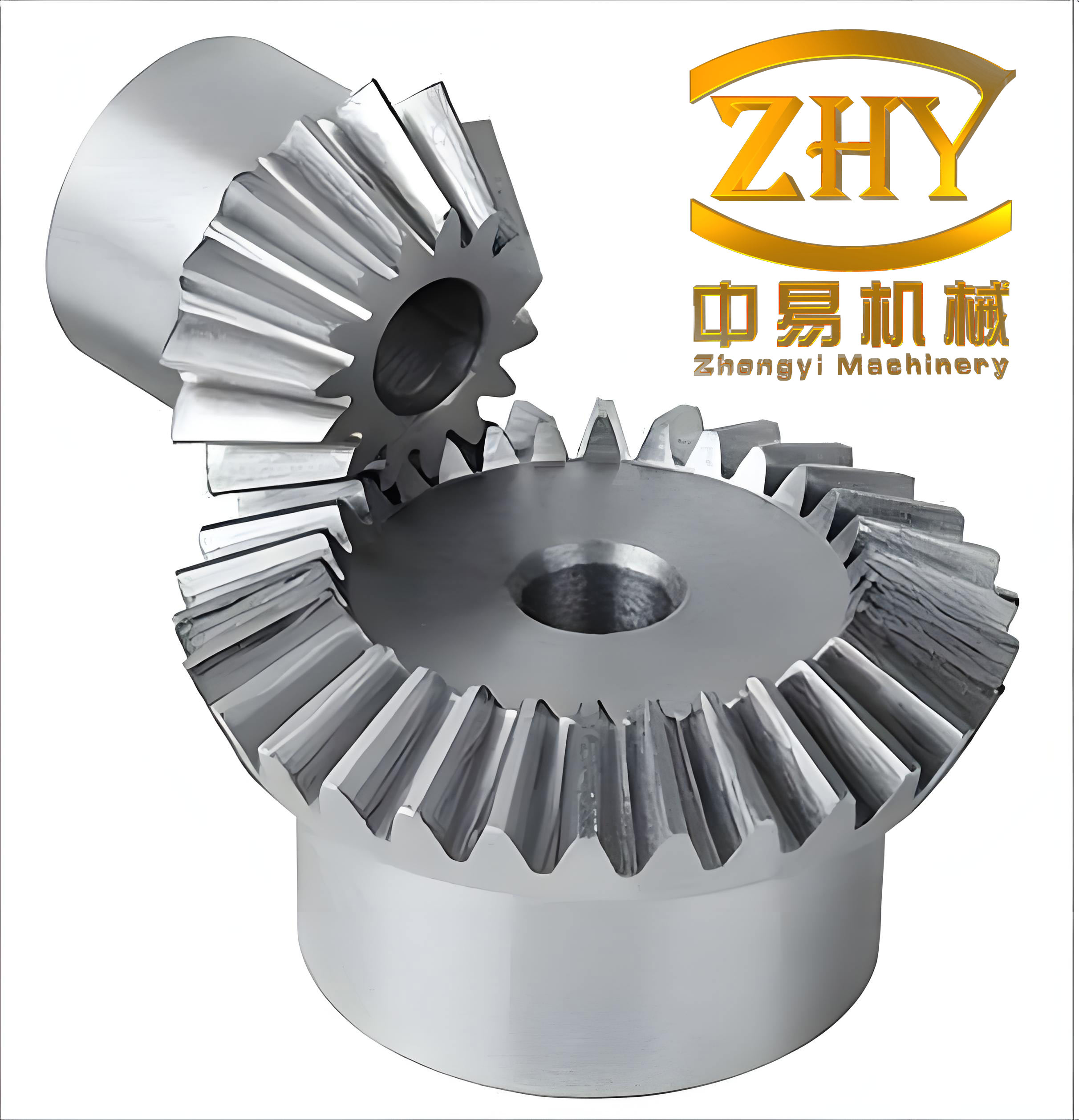
To overcome these limitations, I have formulated a new, principled method for designing the tooth profile of a rough milling cutter as a circular arc. This method is analytical, reducing dependency on graphical approximation and improving accuracy and consistency for machining straight bevel gears. The fundamental principle is to replace the complex involute profiles at the large and small ends with circular arcs that best fit key points on those profiles. A final “common tangent arc” is then constructed to serve as the cutter’s tooth profile, ensuring it smoothly bridges the requirements of both ends.
Let me elaborate on the geometric derivation. Consider a straight bevel gear defined by its parameters: number of teeth ($$Z$$), module at the large end ($$m$$), pitch cone angle ($$\delta$$), face cone angle ($$\delta_a$$), addendum angle ($$\theta_a$$), total tooth height at large end ($$h$$), and pressure angle at the pitch circle ($$\alpha$$). For both the large end (subscript $$L$$) and the small end (subscript $$S$$), we identify the tooth profile curve in a transverse section. We select three critical points on each profile: the intersection with the addendum circle (tooth tip), the intersection with the pitch circle, and the intersection with the dedendum circle (or the base circle if it is larger than the dedendum circle). These three points for each end uniquely define a circle that approximates the local involute profile.
Let the coordinates of these three points for the large end be $$(x_{L1}, y_{L1})$$, $$(x_{L2}, y_{L2})$$, and $$(x_{L3}, y_{L3})$$. Similarly, for the small end, the points are $$(x_{S1}, y_{S1})$$, $$(x_{S2}, y_{S2})$$, and $$(x_{S3}, y_{S3})$$. These coordinates are derived from the standard gear geometry equations for a straight bevel gear. For example, the radius to the addendum circle at the large end is $$r_{aL} = \frac{mZ}{2\cos\delta} + m$$ (considering addendum), and its coordinate on the profile involves the pressure angle and roll angle. The detailed coordinate calculations are based on the involute function and the cone geometry.
For a set of three points $$(x_1, y_1)$$, $$(x_2, y_2)$$, $$(x_3, y_3)$$, the radius $$R$$ and center coordinates $$(a, b)$$ of the circle passing through them can be found by solving the following system derived from the general circle equation $$(x – a)^2 + (y – b)^2 = R^2$$:
$$ (x_1 – a)^2 + (y_1 – b)^2 = (x_2 – a)^2 + (y_2 – b)^2 $$
$$ (x_1 – a)^2 + (y_1 – b)^2 = (x_3 – a)^2 + (y_3 – b)^2 $$
Solving these yields:
$$ a = \frac{(y_1 – y_3)(x_1^2 – x_2^2 + y_1^2 – y_2^2) – (y_1 – y_2)(x_1^2 – x_3^2 + y_1^2 – y_3^2)}{2[(x_1 – x_2)(y_1 – y_3) – (x_1 – x_3)(y_1 – y_2)]} $$
$$ b = \frac{(x_1 – x_3)(x_1^2 – x_2^2 + y_1^2 – y_2^2) – (x_1 – x_2)(x_1^2 – x_3^2 + y_1^2 – y_3^2)}{2[(y_1 – y_2)(x_1 – x_3) – (y_1 – y_3)(x_1 – x_2)]} $$
$$ R = \sqrt{(x_1 – a)^2 + (y_1 – b)^2} $$
Applying this to the large end points gives the circle parameters $$(a_L, b_L, R_L)$$, and for the small end, we get $$(a_S, b_S, R_S)$$. These two circles approximate the tooth profiles at the respective ends of the straight bevel gear.
The next step is to find a final arc that will serve as the actual tooth profile of the rough milling cutter. This arc is defined as the circle that is tangent to both the large-end circle and the small-end circle at a specific reference point, typically near the addendum region. The condition is that this common tangent circle (the cutter profile) touches both circles externally at points that correspond to the tooth tip region, ensuring the finishing allowance is controlled from the top. Let the desired cutter profile circle have center $$(a_c, b_c)$$ and radius $$R_c$$. The tangency conditions with the two approximated circles are:
$$ \sqrt{(a_c – a_L)^2 + (b_c – b_L)^2} = |R_c – R_L| \quad \text{(for external tangency)} $$
$$ \sqrt{(a_c – a_S)^2 + (b_c – b_S)^2} = |R_c – R_S| $$
Furthermore, to ensure the cutter profile provides the correct finishing allowance, it must pass through a control point derived from the target allowance at the pitch circle. This adds a third condition. Solving these three equations simultaneously yields the optimal $$(a_c, b_c, R_c)$$. In practice, to simplify and optimize the design for straight bevel gears, I incorporate an additional step: checking and optimizing the tooth tip width of the generated profile. The tooth tip width of the rough-cut gear should be slightly less than the finished gear’s tip width by an amount equal to twice the finishing allowance. Therefore, the design process becomes an optimization problem where $$(a_c, b_c, R_c)$$ are adjusted to satisfy the tangency conditions while ensuring the calculated tip width $$W_t$$ meets the requirement:
$$ W_t = 2 \cdot \left( R_c \cdot \sin(\phi_t) \right) \approx W_{t,\text{finished}} – 2 \cdot \Delta $$
where $$\phi_t$$ is the half angle subtended by the tip arc, and $$\Delta$$ is the desired finishing allowance (e.g., 0.75 mm).
Given the complexity of these calculations, I have developed a computer program that automates this design process for straight bevel gears. The program takes as input the key parameters of the straight bevel gear:
| Input Parameter for Straight Bevel Gear | Symbol |
|---|---|
| Number of Teeth | $$Z$$ |
| Module at Large End | $$m$$ |
| Pitch Cone Angle | $$\delta$$ |
| Face Cone Angle | $$\delta_a$$ |
| Addendum Angle | $$\theta_a$$ |
| Total Tooth Height at Large End | $$h$$ |
| Pressure Angle | $$\alpha$$ |
| Shaft Angle | $$\Sigma$$ (usually 90°) |
The program performs the following steps algorithmically:
- Calculate the gear geometry at both the large and small ends, including pitch radii, addendum radii, dedendum radii, and base radii.
- Compute the coordinates of the three key points (tip, pitch, root) on the tooth profile in a transverse plane for both ends.
- Determine the circles $$(a_L, b_L, R_L)$$ and $$(a_S, b_S, R_S)$$ that pass through these points.
- Set up the optimization routine to find the cutter arc $$(a_c, b_c, R_c)$$ that satisfies the external tangency conditions with both circles and produces a tip width consistent with the target finishing allowance.
- Output the optimal parameters for the rough milling cutter’s arc tooth profile.
An example output from the program for a typical straight bevel gear might look like this:
| Output Parameter for Cutter Arc Profile | Symbol | Calculated Value (Example) |
|---|---|---|
| Center X-coordinate | $$a_c$$ | 24.37 mm |
| Center Y-coordinate | $$b_c$$ | -8.15 mm |
| Arc Radius | $$R_c$$ | 32.68 mm |
| Estimated Tip Width (Rough) | $$W_t$$ | 4.12 mm |
| Target Finishing Allowance | $$\Delta$$ | 0.75 mm per side |
This method offers significant advantages over the traditional graphical approach for designing rough milling cutters for straight bevel gears. First, it is analytical and repeatable, eliminating human drawing errors. Second, it guarantees a mathematically defined optimal profile that ensures uniform finishing allowances at both the large and small ends of the straight bevel gear. This uniformity protects the finishing planing tool from uneven loads, thereby extending its service life. Third, the process is efficient; once the program is set up, new cutter designs for different straight bevel gear specifications can be generated in seconds, facilitating rapid prototyping and production planning.
The integration of this advanced cutter design with appropriate machining techniques, such as the fly milling or rotary cutting setup described earlier, creates a highly effective roughing process for straight bevel gears. The milling setup itself offers several benefits: a relatively simple structure that is easy to install and maintain; high cutting speeds that reduce the number of passes required; slow axial feed that allows for easy retraction and chip clearance; intermittent cutting action that provides natural cooling periods for the tool, further enhanced by compressed air cooling; and the ability to achieve a surface roughness better than Ra 12.5 μm, which is adequate for a roughing operation. All these factors contribute to a reduction in overall power consumption compared to high-speed thread cutting methods, making it an economical choice for batch production of straight bevel gears.
In conclusion, the design of the tooth profile for rough milling cutters used on straight bevel gears is a critical factor in the overall manufacturing chain. The traditional graphical method, while useful, falls short in precision and consistency. The novel arc tooth profile design method I have presented, based on geometric derivation and computational optimization, provides a robust solution. By inputting the fundamental parameters of the straight bevel gear, engineers can now reliably generate an optimal cutter profile that ensures precise and uniform material allowance for the finishing process. This advancement not only improves the quality and consistency of the machined straight bevel gears but also enhances tool life and production efficiency. As manufacturing continues to evolve towards greater automation and precision, such analytical design methodologies will become indispensable for producing high-performance components like straight bevel gears.