
As an engineer specializing in automotive component testing, I have been involved in the design and implementation of an automated testing and adjustment system for rack and pinion gears, which are critical in vehicle steering mechanisms. The rack and pinion gear system is widely used in modern cars due to its compact design and efficient torque transmission. However, ensuring its performance within specified tolerances for torque and backlash has traditionally relied on manual or semi-automated methods, leading to inefficiencies and inaccuracies. This paper, from my first-person perspective, details the development of a fully automated test bench that integrates industrial computing, programmable logic controllers (PLCs), and precision sensors to enhance testing accuracy and productivity for rack and pinion gears. The system automatically conducts load run-in, no-load and load tests, analyzes results, and adjusts substandard units, with statistical process control capabilities. Throughout this discussion, I will emphasize the design principles, control strategies, and key technologies, while incorporating tables and formulas to summarize concepts. The term “rack and pinion gear” will be frequently referenced to highlight its centrality in this application.
The core challenge in testing rack and pinion gears lies in measuring the rotational torque of the pinion gear under both loaded and unloaded conditions, as well as the backlash between the rack and pinion. The system must also adjust the tightening plug that controls meshing tightness to bring parameters within allowable limits. Traditional approaches often result in inconsistent outcomes, prompting the need for an automated solution. My design philosophy centered on creating a modular, multi-component platform where a central industrial computer coordinates with a PLC, sensors, and actuators to perform synchronized control. This not only improves repeatability but also allows for real-time data analysis and adaptive adjustments. In the following sections, I will dissect the system architecture, hardware composition, software design, and testing methodologies, with a focus on how each element contributes to the precise evaluation of rack and pinion gear performance.
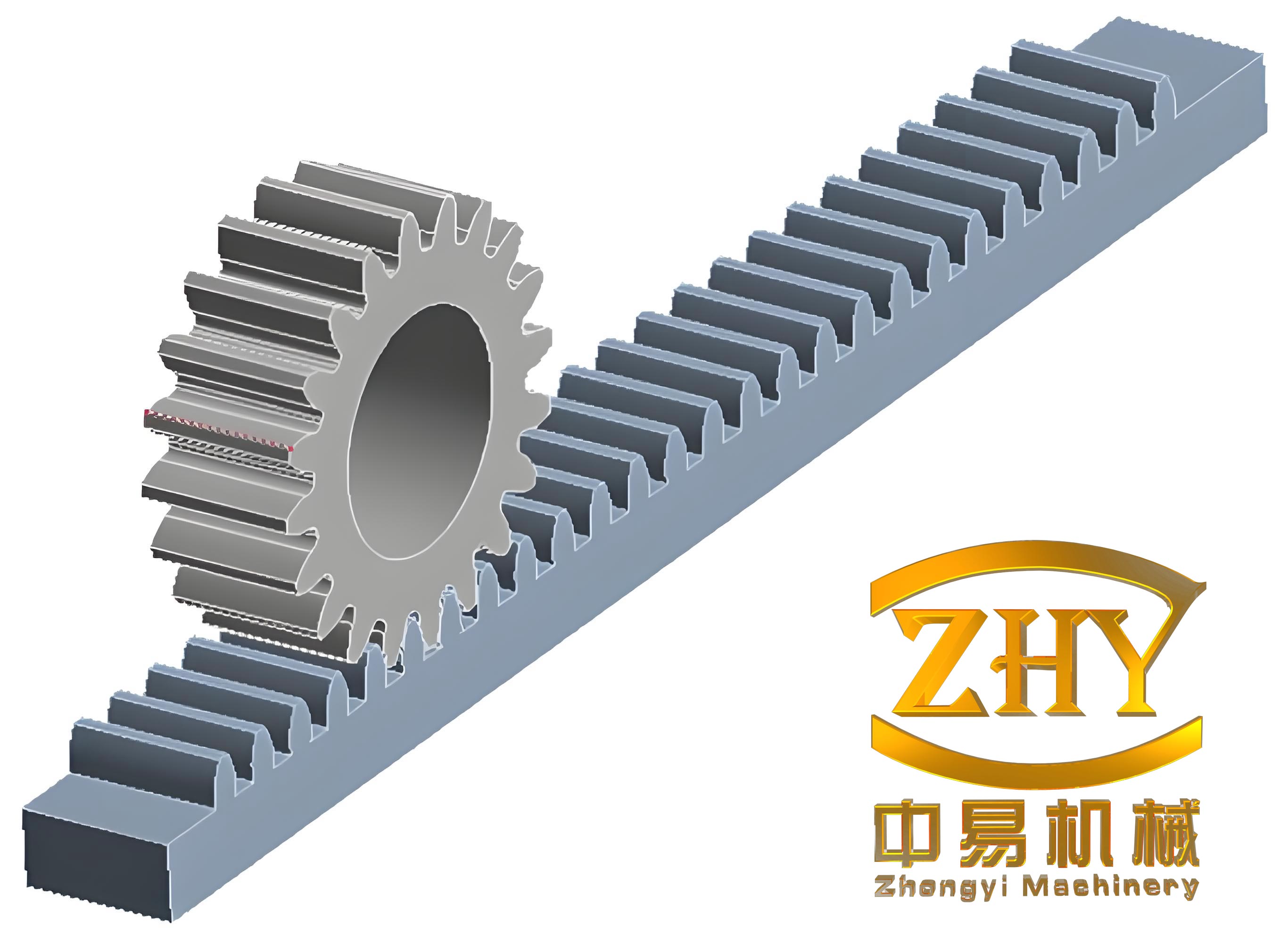
The overall system structure, as I conceived it, comprises an industrial PC (IPC) as the upper-level controller, a Siemens S7-200 PLC for logic and sequence control, sensors for torque and displacement measurement, pneumatic actuators for clamping and positioning, and stepper motors for precise motion control. The rack and pinion gear unit under test is mounted on a fixture that allows for automated loading and adjustment. A schematic of the test bench illustrates the integration of these components, but for brevity, I will describe them in detail through tables and formulas. The control hierarchy ensures that the IPC handles data acquisition, processing, and high-level decision-making, while the PLC manages real-time I/O operations and safety interlocks. This division of labor leverages the strengths of each device: the IPC’s computational power for complex algorithms and the PLC’s reliability for industrial automation tasks.
To provide a clear overview, Table 1 summarizes the key hardware components used in the system, emphasizing their roles in testing the rack and pinion gear.
| Component | Model/Specification | Function | Role in Rack and Pinion Gear Testing |
|---|---|---|---|
| Industrial PC | IPC with A/D, PIO, and driver cards | Data acquisition, signal processing, control signal generation | Coordinates overall test flow, analyzes torque and backlash data for the rack and pinion gear |
| PLC | Siemens S7-200 | Logic control, timing, pulse output | Manages pneumatic cylinder sequences and monitors safety for rack and pinion gear positioning |
| Torque Sensor | HBM, range -20 to +20 N·m | Measures pinion gear rotational torque | Critical for assessing rack and pinion gear meshing tightness under various loads |
| Displacement Sensor | Inductive type, resolution 0.001 mm | Measures backlash between rack and pinion | Ensures precise backlash evaluation in the rack and pinion gear assembly |
| Stepper Motors | Five-phase with drivers | Precise positioning of rack and adjustment of tightening plug | Controls rack movement and plug rotation to optimize rack and pinion gear performance |
| Pneumatic Valves & Cylinders | Various, with proximity switches | Clamping, loading, and fixture actuation | Automates handling and loading of rack and pinion gear units during testing |
The control principle hinges on seamless communication between the IPC and PLC. In automatic mode, the IPC sends configuration data to the PLC, which then executes a sequence of actions—such as clamping the rack and pinion gear, applying load, and initiating measurements. The PLC monitors proximity switches to confirm actuator positions and triggers alarms if timeouts occur. Meanwhile, the IPC samples analog signals from torque and displacement sensors, processes them in real-time, and displays results. If a rack and pinion gear unit fails to meet specifications, the system can automatically adjust the tightening plug via stepper motor control and retest, up to six times. This closed-loop adjustment is a key innovation, reducing manual intervention and ensuring consistent quality for rack and pinion gear products.
In terms of mathematical modeling, the torque measurement for the rack and pinion gear can be described using a linear relationship between sensor output voltage and actual torque. The torque sensor typically provides a voltage signal proportional to the applied torque. Let \( T \) represent the torque in N·m, and \( V \) the sensor output in volts. The calibration formula is:
$$ T = k \cdot V + T_0 $$
where \( k \) is the sensitivity coefficient (in N·m/V) and \( T_0 \) is the zero offset (in N·m). For the HBM sensor used, \( k \) is determined through calibration, ensuring accurate readings for the rack and pinion gear under test. Similarly, the backlash measurement involves converting displacement sensor output to physical gap. The inductive sensor output \( D \) in volts relates to the backlash \( B \) in mm as:
$$ B = \alpha \cdot D + B_0 $$
where \( \alpha \) is the conversion factor (in mm/V) and \( B_0 \) is the baseline offset. Given the high resolution required for rack and pinion gear backlash, typically around 0.001 mm, this linear model is validated during system calibration.
One of the critical testing techniques I developed is the meshing position localization for the rack and pinion gear. Since tests must be conducted within a specific range of the rack’s total travel, precisely identifying the mid-point is essential. The method involves driving the stepper motor to rotate the pinion gear while monitoring both the pulse count and torque. When the torque exceeds a threshold, it indicates contact with one end of the rack. By repeating this in the opposite direction, the full travel pulse count \( N_{\text{total}} \) is obtained. The mid-point pulse count \( N_{\text{mid}} \) is then:
$$ N_{\text{mid}} = \frac{N_{\text{total}}}{2} $$
This allows the system to position the rack and pinion gear at the center for consistent testing. To account for stepper motor startup jitter, which can distort torque readings, I implemented a soft-start algorithm. The motor begins at a low speed, accelerates gradually to the target velocity, and starts sampling only after a pre-defined pulse offset \( N_{\text{offset}} \) from the test position. This eliminates transient effects, ensuring that the measured torque reflects the true rack and pinion gear meshing characteristics. The velocity profile can be modeled as a ramp function:
$$ \omega(t) = \begin{cases}
\omega_{\text{start}} + \beta t & \text{for } 0 \leq t \leq t_{\text{accel}} \\
\omega_{\text{target}} & \text{for } t > t_{\text{accel}}
\end{cases} $$
where \( \omega(t) \) is the angular velocity in pulses per second, \( \omega_{\text{start}} \) is the initial low velocity, \( \beta \) is the acceleration rate, and \( t_{\text{accel}} \) is the acceleration time. This approach stabilizes the rack and pinion gear interaction during testing.
The software architecture, which I programmed using Visual C++, is modular to enhance flexibility and maintainability. The main modules include self-test, parameter setup, test execution, adjustment, and statistical process control (SPC). Each module can be configured independently, allowing users to customize test sequences for different rack and pinion gear models. For instance, the test execution module is subdivided into sub-modules for no-load torque, loaded torque, and backlash measurement, which can be combined as needed. Table 2 outlines the software modules and their functions related to rack and pinion gear testing.
| Module | Function | Relevance to Rack and Pinion Gear |
|---|---|---|
| Self-Test | Verifies I/O boards, A/D converter, stepper motors, and PLC communication | Ensures all components are operational before testing rack and pinion gear units |
| Parameter Setup | Allows input of torque and backlash tolerances, test sequences | Customizes criteria for specific rack and pinion gear specifications |
| Test Execution | Runs automated tests, including load run-in, torque, and backlash measurements | Directly evaluates rack and pinion gear performance metrics |
| Adjustment | Controls stepper motor to tighten or loosen the plug based on test results | Optimizes rack and pinion gear meshing to achieve合格 parameters |
| SPC | Analyzes historical data, generates control charts, computes process capability indices | Monitors long-term trends in rack and pinion gear manufacturing quality |
The PLC program, written in ladder logic, complements the IPC software by managing real-time control tasks. I structured it into five modules: state judgment, automatic test, manual test, timer, and output control. The state judgment module checks initial conditions, such as fixture readiness, before allowing tests on the rack and pinion gear. The automatic test module follows a step-by-step sequence, using register variables to track progress and coordinate with IPC commands. For example, after clamping the rack and pinion gear, the PLC waits for a pulse from the IPC to start the stepper motor for positioning. If an error occurs, such as a cylinder not reaching its proximity switch, the module jumps to an alarm routine. The timer module handles delays and timeout alerts, while the output control module drives pneumatic valves and indicators based on the current mode. This modular PLC design ensures robust operation, crucial for handling the repetitive nature of rack and pinion gear testing.
In the testing phase, the system evaluates the rack and pinion gear by first conducting a mid-range torque test. The pinion gear is rotated within a specified segment of the rack travel, and the torque curve is compared against a tolerance band. If the curve falls outside, the adjustment module activates the stepper motor to rotate the tightening plug, altering the meshing tightness. The adjustment amount \( \Delta \theta \) in degrees is calculated based on the torque deviation \( \Delta T \) from the target:
$$ \Delta \theta = \gamma \cdot \Delta T $$
where \( \gamma \) is an empirical coefficient derived from the rack and pinion gear design. After adjustment, the test is repeated, up to six iterations, until the torque curve conforms. This process is automated, reducing human error. Following successful mid-range testing, a full-travel no-load torque test is performed to ensure consistency across the entire rack and pinion gear engagement. The results are displayed graphically, but for summary, Table 3 presents sample data from a test run on a rack and pinion gear unit, showing torque values at key positions.
| Rack Position (mm) | Measured Torque (N·m) | Upper Tolerance (N·m) | Lower Tolerance (N·m) | Status |
|---|---|---|---|---|
| -50 | 1.2 | 2.0 | 0.5 | Pass |
| -25 | 1.5 | 2.0 | 0.5 | Pass |
| 0 (Mid) | 1.8 | 2.0 | 0.5 | Pass |
| 25 | 1.6 | 2.0 | 0.5 | Pass |
| 50 | 1.3 | 2.0 | 0.5 | Pass |
For backlash measurement, the system moves the rack slightly while monitoring displacement sensor output. The backlash \( B \) is computed as the difference between positions when the pinion gear reverses direction. A typical specification for rack and pinion gear backlash is below 0.1 mm. The measurement process can be modeled as:
$$ B = | x_{\text{forward}} – x_{\text{reverse}} | $$
where \( x_{\text{forward}} \) and \( x_{\text{reverse}} \) are the rack positions recorded at the point of torque reversal. This ensures accurate quantification of play in the rack and pinion gear assembly.
The system also incorporates statistical process control (SPC) to monitor production quality over time. Using historical data from multiple rack and pinion gear units, control charts such as X-bar and R charts are generated. The process capability index \( C_p \) is calculated as:
$$ C_p = \frac{USL – LSL}{6\sigma} $$
where \( USL \) and \( LSL \) are the upper and lower specification limits for torque or backlash, and \( \sigma \) is the standard deviation of the measured data. A \( C_p \) value greater than 1.33 indicates a capable process for manufacturing rack and pinion gears. This SPC module helps identify trends and prevent defects, enhancing overall reliability.
In terms of performance, the system has demonstrated high accuracy and efficiency in testing rack and pinion gears. Based on my experience, the torque measurement uncertainty is within ±0.1 N·m, and backlash resolution is 0.001 mm. The automated adjustment success rate—where substandard rack and pinion gear units are brought within tolerance—exceeds 90%, significantly reducing scrap rates. Moreover, the test cycle time per unit is under 3 minutes, a substantial improvement over manual methods. These outcomes validate the design approach, particularly the multi-component coordination and modular software architecture.
To further illustrate the system’s capabilities, I will delve into the mathematical foundations of the control algorithms. The stepper motor control for positioning the rack involves converting angular displacement to linear rack movement. Given the pinion gear pitch radius \( r_p \) (in mm) and the rack pitch \( p \) (in mm/revolution), the linear displacement \( \Delta L \) per motor step can be expressed as:
$$ \Delta L = \frac{p \cdot \theta_{\text{step}}}{360} $$
where \( \theta_{\text{step}} \) is the step angle in degrees. For precise positioning in rack and pinion gear testing, microstepping is often employed to increase resolution. The total pulses \( N \) required to move the rack a distance \( L \) is:
$$ N = \frac{L}{\Delta L} \cdot m $$
where \( m \) is the microstepping factor. This equation ensures accurate targeting of test positions for the rack and pinion gear.
Another key aspect is the loading mechanism, which simulates real-world conditions on the rack and pinion gear. The load is applied via a pneumatic cylinder, and the force \( F \) is regulated by pressure control. The relationship between cylinder pressure \( P \) (in bar) and force is:
$$ F = P \cdot A \cdot \eta $$
where \( A \) is the piston area (in cm²) and \( \eta \) is the efficiency factor. This load translates to an additional torque on the pinion gear, which is factored into the loaded torque test. The combined torque \( T_{\text{loaded}} \) can be modeled as:
$$ T_{\text{loaded}} = T_{\text{no-load}} + \frac{F \cdot r_p}{\mu} $$
where \( \mu \) is the friction coefficient in the rack and pinion gear system. This allows for comprehensive performance assessment.
In conclusion, the automated testing and adjustment system I designed represents a significant advancement in quality assurance for automotive rack and pinion gears. By integrating IPC, PLC, sensors, and actuators, it achieves high precision, efficiency, and adaptability. The modular software and hardware design facilitate easy maintenance and customization for different rack and pinion gear variants. The use of mathematical models and SPC further enhances its robustness. From my perspective, this system not only meets immediate testing needs but also serves as a blueprint for complex performance test platforms in other industries. The success in improving production throughput and consistency underscores the value of automation in manufacturing critical components like rack and pinion gears.
Looking ahead, potential enhancements could include integrating machine learning for predictive adjustment or expanding the system to test other steering components. However, the current implementation has proven reliable in operational environments, with over six months of stable run-time. The principles discussed—such as coordinated control, precise positioning, and data-driven adjustment—are widely applicable, making this a reference case for engineers working on similar automated test systems. Ultimately, the focus on the rack and pinion gear as the central element has driven innovations that benefit the entire automotive supply chain.