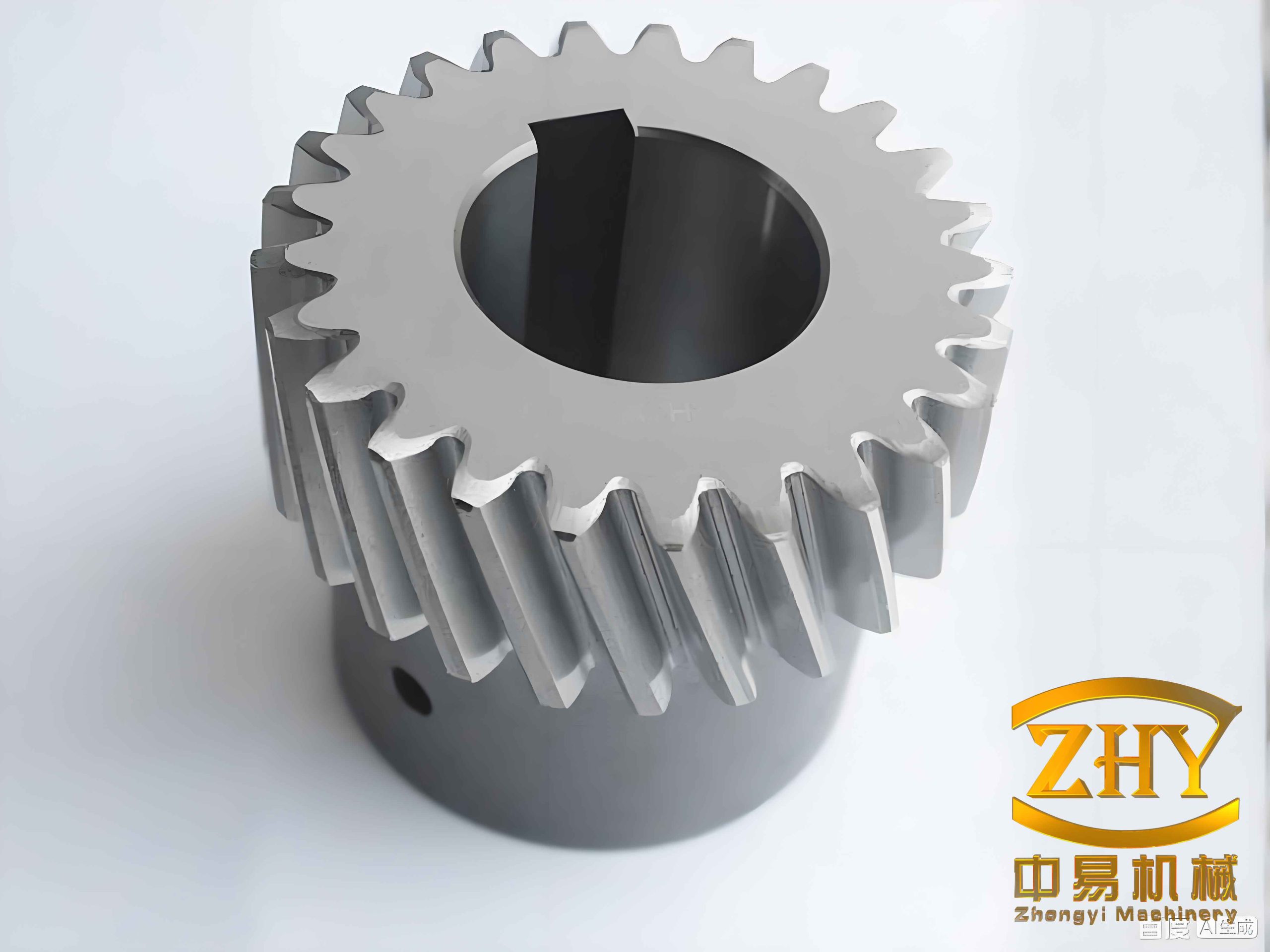
In the assembly line of automotive steering gears, the meshing assembly between a helical gear and a rack presents a significant challenge for automation. The process must ensure that the helical gear is inserted smoothly without any collision or damage to the tooth surfaces, while maintaining precise final positions. Manual assembly suffers from low efficiency, high labor intensity, and inconsistent quality. Therefore, developing a reliable automatic assembly process is critical for high‑volume production. This paper describes the systematic approach I used to design and optimize the automatic assembly process for a helical gear and rack in an electric power steering gear. The key aspects include rack tooth face positioning, synchronization of the gear and rack starting positions, synchronous insertion kinematics, guiding mechanisms, and displacement‑force monitoring. The methodology and results provide a reference for similar gear‑rack assembly automation.
1. Process Background
In the transmission assembly of automotive steering gears, the meshing of a helical gear with a rack is notoriously difficult to automate. The helical gear must be inserted vertically while the rack moves horizontally, and the two motions must be precisely synchronized to avoid interference. Any misalignment can cause tooth collision, bearing damage, or excessive assembly force, leading to rejects. Traditional manual assembly cannot meet the requirements of mass production in terms of speed, consistency, and product quality. To overcome these challenges, I developed an automatic assembly process that leverages servo‑controlled axes and sensor feedback. The process achieves a high repeatability and a low defect rate, which is essential for cost‑effective manufacturing.
2. Rack Tooth Face Positioning
Before the helical gear can engage with the rack, the rack must be oriented at a specific circumferential angle so that the tooth spaces align properly with the gear teeth. The rack tooth faces are planar, while the back of the rack is a cylindrical surface, giving a radial difference of more than 3 mm. I used two contact‑type displacement sensors to detect this difference. The rack is rotated by a servo motor through more than one full revolution (e.g., 370°), and the sensors record the displacement profile. A minimum point (valley) in the sensor signal corresponds to a tooth face position. The rack is then rotated to bring this valley to a target angular position. To create clearance for the helical gear sensor unit to enter, I rotate the rack an additional 5° from the valley. This ensures that the tooth space above the rack is open for the helical gear’s initial insertion.
The detection principle is summarized in Figure 3 (conceptual). The two displacement sensors A and B are placed at fixed angular positions. As the rack rotates, the sensors output a current signal proportional to the distance. The valleys occur when the sensor tip contacts the tooth face. By identifying the valley position, the controller determines the rack’s angular orientation and corrects it.
| Parameter | Value | Description |
|---|---|---|
| Rotation range for detection | 370° | Ensure full coverage of one tooth pitch |
| Additional rotation for clearance | 5° | Create space for helical gear insertion |
| Sensor type | Contact potentiometric displacement sensor | Provides current output, immune to voltage fluctuations |
3. Synchronous Assembly Starting Position
The correct starting position is essential to prevent tooth‑on‑tooth interference. The rack tooth pitch is 5.96885 mm parallel to the tooth direction. After converting to the horizontal plane, the effective pitch is 6 mm (due to the helix angle). The helical gear must begin insertion with its tooth tip already inside a rack tooth space. I calculate the distance from the helical gear end face to the bearing seat, denoted \(L_1\), and the corresponding rack retraction distance \(L_2\). The relationship between \(L_1\) and \(L_2\) depends on the geometry of the helical gear and rack. In practice, the rack is moved backward (to the right) by multiple horizontal pitches so that when the helical gear descends, the meshing starts at the correct relative position.
For a right‑inclined rack (Figure 8), the kinematics give:
$$ L_2 = \frac{L_1 \, \sin(\alpha + \beta)}{\sin(90^\circ – \beta)} $$
which simplifies to:
$$ \frac{L_1}{L_2} = \frac{\cos \beta}{\sin(\alpha + \beta)} $$
For a left‑inclined rack (Figure 9):
$$ L_2 = L_1 \sin \alpha – L_1 \cos \alpha \tan \gamma $$
or
$$ \frac{L_1}{L_2} = \frac{1}{\sin \alpha – \cos \alpha \tan \gamma} $$
where \(\alpha\) is the angle between the helical gear axis and vertical, \(\beta\) is the right inclination angle of the rack, and \(\gamma\) is the left inclination angle. These equations ensure that the contact point moves without interference during the synchronous motion.
4. Synchronous Meshing Assembly Process
During assembly, the helical gear descends vertically (Z direction) while the rack moves horizontally (X direction). No motion occurs in the Y direction. I model the contact point as a particle with displacement vector:
$$ \Delta \mathbf{r} = \Delta x \, \mathbf{i} + \Delta z \, \mathbf{k} $$
where \(\Delta x\) is the horizontal rack motion and \(\Delta z\) is the vertical gear motion. The relationship between \(\Delta x\) and \(\Delta z\) is governed by the helix angle and the rack inclination.
For a right‑inclined rack (combination 1), the displacement ratio is given by the earlier formula. For a left‑inclined rack (combination 2), a different formula applies. In modern steering gears, some racks have a gradually varying helix angle (Figure 12) to reduce backlash. This introduces a local tooth thickening (0.1 mm per side) near the middle of the tooth profile. To accommodate this, I adopted a passive compliance strategy: the helical gear shaft is held with a reduced clamping force (20–50 N) using a pneumatic gripper. During assembly, the rack pushes the helical gear slightly in rotation, allowing it to self‑align with the varying tooth geometry. The measured assembly force drops from >500 N (causing 1–2% rejects) to below 200 N, and the reject rate reduces to less than 0.3%.
| Approach | Maximum Assembly Force (N) | Reject Rate |
|---|---|---|
| Rigid gripping | 500–600 | ~2% |
| Compliant gripping (20–50 N) | 100–150 | <0.3% |
5. Key Guiding Mechanism
The helical gear shaft must be inserted into a needle bearing (clearance fit H7/g6) and a deep‑groove ball bearing (transition fit). To ensure smooth entry despite cumulative tolerances, I designed a guiding support mechanism (Figure 16). This mechanism contacts the end of the helical gear shaft, providing secondary centering and axial guidance during the press‑in operation. The support is slightly retracted as the shaft progresses, but its initial contact reduces the risk of shaft‑bearing edge collision. The guiding mechanism compensates for misalignments originating from upstream positioning errors, thus lowering the required precision of the assembly robot and reducing overall cost.
6. Displacement and Force Control
Force monitoring is critical to detect tooth interference or bearing misalignment. I use a pressure sensor in line with the vertical servo axis to record the assembly force in real time. The permissible force threshold is set based on the calculated press‑in force for the bearings. For the deep‑groove ball bearing (inner diameter 17 mm, shaft diameter 16.986–16.994 mm), the maximum interference is 0.002 mm. The press‑in force is calculated by:
$$ P_{f max} = \frac{\delta}{d_f} \left( \frac{C_a}{E_a} + \frac{C_i}{E_i} \right) $$
$$ F = P_{f max} \, \pi \, d_f \, l_f \, \mu $$
where:
- \(\delta\) = maximum interference (0.002 mm)
- \(d_f\) = joint diameter (17 mm)
- \(l_f\) = bearing length (13 mm)
- \(E_a = E_i = 200\) GPa (steel modulus)
- \(C_a = 2.214\), \(C_i = 0.7\) (diameter ratios and Poisson’s ratio = 0.3)
- \(\mu = 0.1\) (friction coefficient, steel‑steel without lubrication)
Substituting values gives \(P_{f max} = 8.075\) MPa and \(F = 560\) N. Therefore, I set the force alarm threshold to 600 N during assembly. If the force exceeds this limit, the machine stops and signals an error. The actual force profile is displayed on the HMI (Figure 18).
| Bearing Type | Inner Diameter (mm) | Shaft Diameter (mm) | Maximum Interference (mm) | Press‑In Force (N) |
|---|---|---|---|---|
| Deep‑groove ball bearing | 17 | 16.986 – 16.994 | 0.002 | 560 |
| Needle roller bearing | 26 | 25.991 – 26.000 | Clearance fit | Negligible |
7. Conclusion
Through systematic analysis of the helical gear‑rack assembly process, I established a robust automatic process that includes rack tooth face positioning, synchronous starting point calculation, compliant gripping for variable tooth geometry, guiding support, and force‑displacement monitoring. The process has been implemented in a production line for electric power steering gears, achieving a reject rate below 0.3% and consistent quality. The kinematic formulas and control logic presented here can be directly adapted to other helical gear‑rack assemblies, providing a standardized framework for automation engineers.