
As an engineer specializing in automotive transmission systems, I have extensively studied the critical role of differential assemblies in pure electric passenger vehicles. The differential is a core component that directly impacts vehicle efficiency, noise levels, and overall driving comfort. In this article, I will analyze the structure of differentials, compare them with commercial vehicle counterparts, and delve into the assembly processes and axial clearance control methods. A particular focus will be on automated solutions for mass production, emphasizing the importance of the gear shaft in ensuring precision and reliability.
The differential in pure electric passenger vehicles is designed for compactness and high performance. Power is transmitted from the electric motor through a reducer to the differential housing, which drives the half shaft gears. During non-differential conditions, the planetary gear shaft and planetary gears act as a single unit, rotating the half shaft gears to propel the left and right wheels. In differential scenarios, relative motion occurs between the planetary gears and half shaft gears, adhering to the fundamental equation: left half shaft speed + right half shaft speed = 2 × planetary carrier speed. This balance is maintained during straight-line driving but shifts during turns, where the inner wheel slows down and the outer wheel accelerates. The precision of components, especially the gear shaft, is paramount to minimize noise and vibration.
In contrast, commercial vehicle differentials share a similar basic structure but differ significantly due to higher load requirements. They typically feature a split housing design, which enhances assemblability and allows for direct measurement of gear backlash. Commercial vehicles often employ four planetary gears arranged in a cross-shaped gear shaft configuration, forming a stable pitch circle plane that reduces impact during operation. Pure electric passenger vehicles, however, use an integral housing with two planetary gears, leading to greater摆动 and higher impact forces. This necessitates higher part accuracy, particularly in the gear shaft and related components, to maintain performance under dynamic conditions.
The assembly process for pure electric passenger vehicle differentials is optimized for high-volume production lines. It begins with installing the half shaft gears and their pads, followed by the planetary gears and pads, and then the planetary gear shaft. A critical step is the measurement of half shaft gear axial clearance, which must be checked at both ends with a tolerance of ±0.02 mm. Manual methods, common in prototype or small-batch production, are slow and prone to inaccuracies due to human error. For instance, operators must manually rotate the gears and apply pressure, leading to inconsistent results. This highlights the need for automated systems that can reliably control axial clearance, a key factor in ensuring proper gear mesh and reducing NVH (Noise, Vibration, and Harshness) issues.
Axial clearance in this context refers to the distance between the half shaft gear’s position at the top of the differential housing and its lowest point of contact with the planetary gears. When the half shaft gear is fully seated against the housing, the clearance is minimized. Controlling this clearance indirectly regulates the normal backlash between the half shaft and planetary gears, as direct measurement of backlash is impractical in integral housings. The relationship between axial clearance and gear performance can be expressed mathematically. For example, the theoretical axial clearance ΔL is derived from positional measurements during assembly, and it must fall within specified limits to ensure optimal contact patterns and load distribution.
To address the challenges of mass production, I have developed an automated control system for axial clearance. This system utilizes detection shafts equipped with expanding sleeves that engage the half shaft gear splines. The differential is fixed on a test bench, and the detection shafts rotate at 20–30 r/min while moving axially. Initially, the half shaft gear is pulled toward the housing until contact is made, recording position M1. Then, the shaft moves toward the planetary gears until resistance is encountered, with continuous data acquisition to capture the maximum value M2. The actual axial clearance is calculated as ΔL = |M2 – M1|. To account for manufacturing tolerances and gear tooth variations, the detection shaft must rotate a minimum number of turns, given by the formula: $$N_{\text{min}} = \frac{Z_1 Z_2}{2}$$ where Z1 is the number of teeth on the half shaft gear and Z2 is the number of teeth on the planetary gear. This ensures comprehensive data collection across multiple meshing positions.
Data processing involves converting theoretical gear backlash to axial clearance. For straight bevel gears, factors like tooth flank modification and heat treatment distortions complicate theoretical calculations. In practice, I use a method where gears are mounted on a rolling tester at theoretical installation distances. The half shaft gear is moved to eliminate backlash, recording position Li1, and then adjusted to the designed backlash, recording Li2. The theoretical axial clearance is ΔLi = |Li2 – Li1|. This empirical approach accounts for real-world variations and ensures that the measured clearance Ln satisfies the condition Ln_min < ΔLi < Ln_max. Below is a table summarizing key parameters for axial clearance control in differential assemblies:
| Parameter | Symbol | Typical Value | Description |
|---|---|---|---|
| Half Shaft Gear Teeth | Z1 | 10–15 | Number of teeth on half shaft gear |
| Planetary Gear Teeth | Z2 | 8–12 | Number of teeth on planetary gear |
| Minimum Rotation Turns | N_min | 40–90 | Calculated as Z1 * Z2 / 2 |
| Axial Clearance Range | ΔL | 0.05–0.20 mm | Allowable axial clearance |
| Gear Shaft Tolerance | — | ±0.02 mm | Precision requirement for gear shaft |
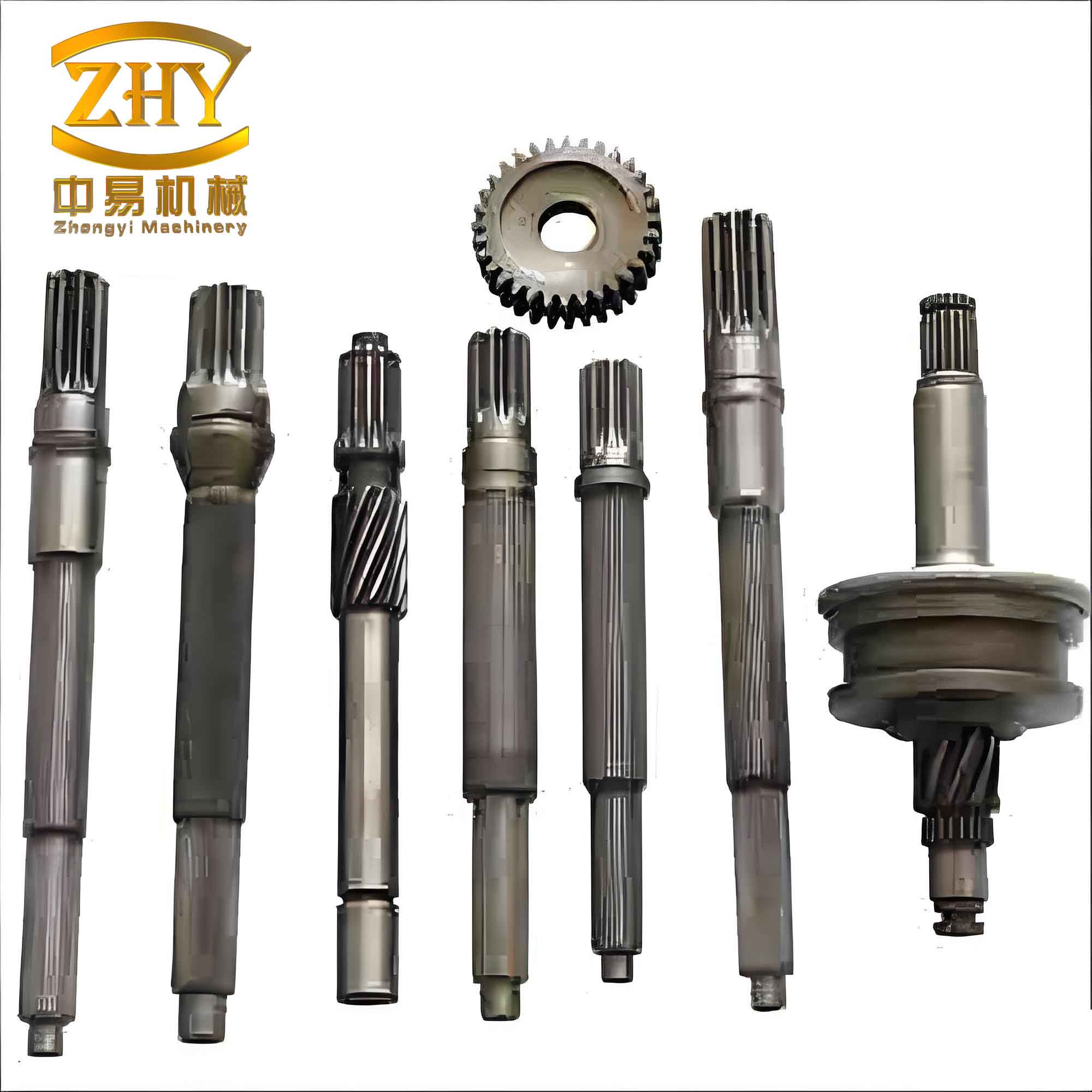
The gear shaft plays a pivotal role in this system, as its alignment and integrity directly affect the axial clearance. In automated lines, the detection shaft must be robust to handle repeated operations. The expanding sleeves, labeled D and E in the system, secure the half shaft gears during testing, ensuring consistent measurements. This automation not only speeds up production but also reduces variability, with studies showing a significant improvement in measurement accuracy compared to manual methods. For instance, the standard deviation of axial clearance readings can be reduced by over 50% with automated controls, highlighting the importance of precision in the gear shaft design.
Furthermore, the interaction between the gear shaft and other components necessitates careful consideration of material properties and thermal expansion. In electric vehicles, operating temperatures can fluctuate, affecting clearances. Thus, the design must incorporate factors like coefficient of thermal expansion, which can be modeled using the equation: $$ \Delta L_{\text{thermal}} = \alpha \cdot L \cdot \Delta T $$ where α is the thermal expansion coefficient, L is the initial length, and ΔT is the temperature change. This ensures that axial clearance remains within specifications under various conditions.
In conclusion, the automatic control of axial clearance in pure electric passenger vehicle differentials is essential for achieving high-quality, reliable transmissions. By leveraging automated detection systems and precise data processing, manufacturers can maintain tight tolerances on the gear shaft and related parts, ultimately enhancing vehicle performance and customer satisfaction. The integration of such systems into mass production lines represents a significant advancement in automotive manufacturing, paving the way for quieter and more efficient electric vehicles.