
The reliable and efficient transmission of motion and power between intersecting or offset shafts is a fundamental requirement in modern machinery. Among the various solutions, bevel gears, particularly spiral and hypoid types, are indispensable due to their ability to transmit power smoothly and with high load capacity at varying shaft angles. The performance of these bevel gears is critically dependent on the integrity of their hardened tooth surfaces.
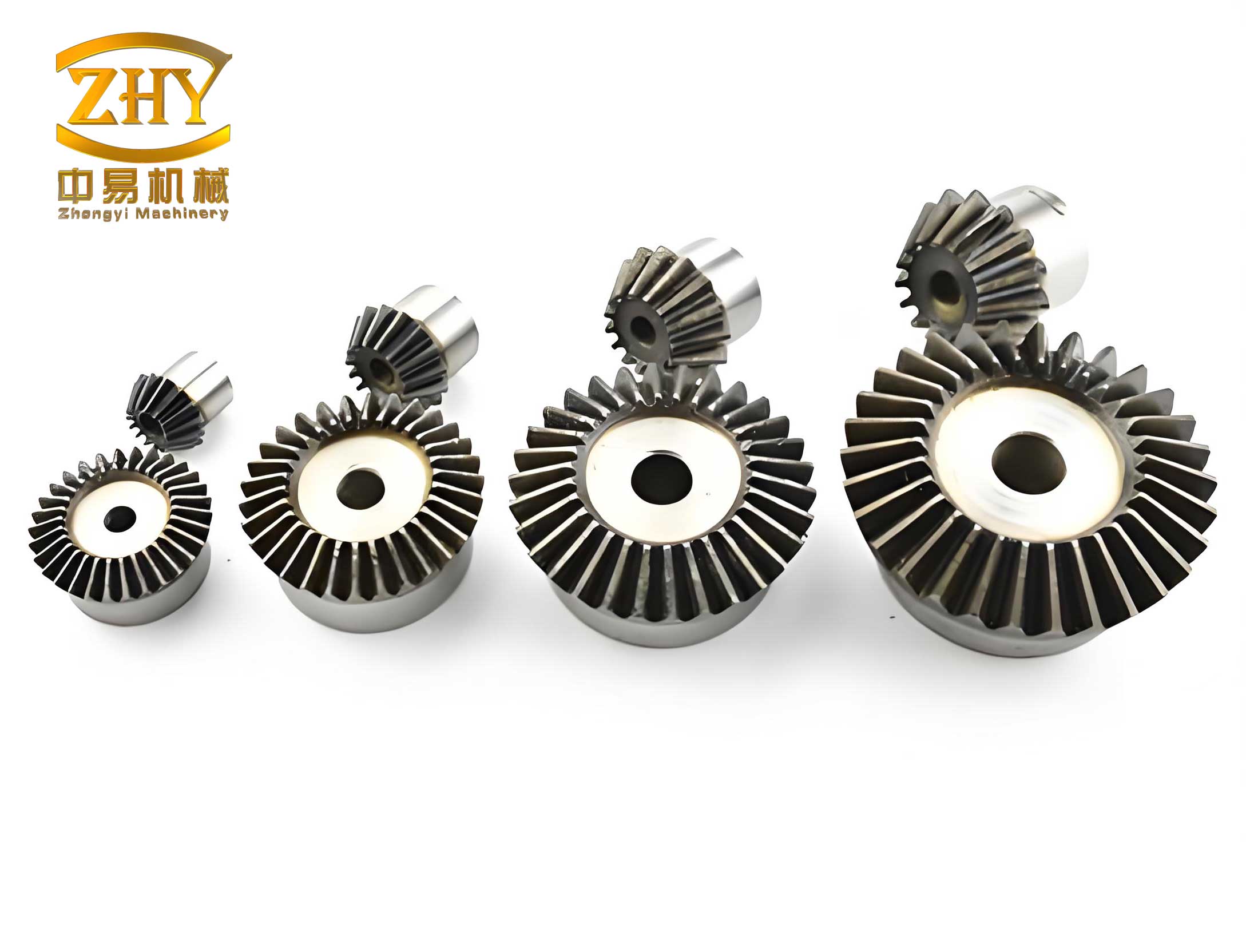
High-performance bevel gears are typically case-hardened and subsequently ground to achieve the required geometric accuracy and surface finish. However, the grinding process itself can induce detrimental thermal damage known as grinding burn. This phenomenon occurs when excessive heat generated at the grinding wheel-tooth interface alters the metallurgical structure of the surface layer. It can lead to undesirable effects such as untempered martensite (re-hardening), overtempering (softening), and the introduction of significant tensile residual stresses. These changes severely compromise the fatigue life, wear resistance, and overall reliability of the bevel gear. Traditional methods for assessing grinding burn, like acid etching or micro-hardness testing, are destructive, offline, and unsuitable for 100% inspection in production. This creates a pressing need for a non-destructive, automated inspection technique that can be integrated into the quality control process for bevel gears. This article details the design and development of an automated detection system, based on the Magnetic Barkhausen Noise (MBN) method, specifically engineered to be mounted on a standard bevel gear testing machine. The system enables rapid, repeatable, and non-destructive evaluation of grinding burn across the entire tooth flank of a bevel gear.
The Foundation: Bevel Gear Testing Machine Architecture
The automated detection system is designed as a modular add-on for a standard bevel gear testing machine. Understanding the host machine’s kinematics is crucial for the design. A typical machine for testing orthogonal bevel gears provides five degrees of freedom (DOF):
- Two Rotary Axes (A and C): These spindles hold and rotate the driving (pinion) and driven (gear) bevel gears, respectively, simulating their meshing action.
- Three Linear Axes (X, Y, Z): These axes provide the translational adjustments necessary to set the correct mounting distance (pinion and gear offsets) and the hypoid offset (E). The axes are typically aligned with the machine’s coordinate system, with the origin at the theoretical intersection of the gear and pinion axes when the offset is zero.
The core principle of our integration is to utilize these existing machine axes to manipulate the detection probe relative to the stationary bevel gear under test. The detection module is mounted on one spindle’s fixture, while the bevel gear to be inspected is mounted on the opposite spindle. By coordinating the movements of three linear axes (X, Y, Z) and one rotary axis (either A or C, depending on which gear is being inspected), a four-axis motion path can be generated to guide the sensor along the complex curved surface of the bevel gear tooth. This approach negates the need for a dedicated, expensive robotic arm, leveraging the precision and software control of the existing tester.
The Sensing Principle: Magnetic Barkhausen Noise (MBN)
The detection system is fundamentally based on the Magnetic Barkhausen Noise (MBN) effect, a non-destructive electromagnetic technique highly sensitive to microstructural and stress states in ferromagnetic materials like gear steels. When an alternating magnetic field is applied to a ferromagnetic material, the magnetic domains realign. This realignment does not occur smoothly but in abrupt jumps as domain walls overcome pinning sites (dislocations, precipitates, grain boundaries). These discrete, stochastic jumps induce voltage pulses in a nearby pickup coil, generating a noise-like signal—the Barkhausen noise.
The intensity and characteristics of the MBN signal are profoundly influenced by the material’s near-surface condition:
- Hardness/Microstructure: Grinding burn alters the near-surface microstructure. Re-hardened zones (untempered martensite) have high hardness and high stress, typically showing lower MBN activity. Overtempered (softened) zones show higher MBN activity.
- Residual Stresses: Tensile residual stresses, often induced by abusive grinding, generally increase MBN activity, while compressive stresses decrease it.
By analyzing parameters of the MBN signal (e.g., root mean square (RMS) value, peak value, signal energy), a quantitative assessment of the grinding burn severity can be made. The penetration depth of the measurement is controlled by the frequency and amplitude of the magnetizing field, allowing for subsurface analysis.
The key to obtaining a high-quality, repeatable MBN signal is consistent and optimal coupling between the sensor’s magnetic yoke/pole pieces and the bevel gear tooth surface. Any variation in lift-off, angle, or contact area significantly affects the magnetic circuit and, consequently, the measured signal. Therefore, the mechanical design of the probe holder and the motion path planning are critical to maintaining this optimal contact throughout the scan of the curved bevel gear tooth flank.
System Design and Components
The automatic detection device comprises three main subsystems: the mechanical probe assembly, the MBN instrumentation electronics, and the control/analysis software.
1. MBN Instrumentation Module
To ensure robustness and reliability in an industrial testing environment, a commercial MBN system was selected (e.g., Stresstech Rollscan 350). Its core components are:
- MBN Main Unit: Generates the programmable, low-frequency (e.g., 10 Hz – 1 kHz) alternating magnetizing current and conditions the raw signal from the sensor.
- MBN Sensor (Probe): Contains the magnetizing yoke and the pickup coil. For bevel gears, probes with different shoe geometries are used:
- Flat Shoe: Suitable for straight bevel gears or regions with low curvature.
- Curved/Arcuate Shoe: Essential for conformal contact with the highly curved flanks of spiral and hypoid bevel gears.
- Data Acquisition Card: A high-resolution, high-speed DAQ card (e.g., 24-bit, 100+ kS/s) is installed in the host industrial PC to digitize the analog MBN signal output from the main unit.
| Parameter | Specification/Value |
|---|---|
| Magnetization Waveform | Triangular, Sine |
| Magnetization Frequency Range | 10 Hz – 250 Hz |
| Magnetization Voltage Range | 0 – 16 V |
| Signal Filter Bands | e.g., 10-70 kHz, 70-200 kHz, 200-450 kHz |
| DAq Card Sampling Rate | > 100 kS/s (per Shannon’s theorem) |
| DAq Card Resolution | 24-bit |
2. Mechanical Probe Assembly Design
The mechanical assembly serves as the critical interface between the MBN sensor and the bevel gear testing machine’s motion system. Its primary functions are:
1. To rigidly mount the assembly to the machine’s spindle fixture.
2. To orient the MBN sensor correctly relative to the bevel gear tooth surface.
3. To provide passive compliance to ensure continuous, conformal contact between the sensor shoe and the complex, moving bevel gear tooth geometry during the 4-axis scan.
The assembly, constructed primarily from aluminum alloy for lightweight rigidity, features several key modules:
- Mounting Base: Interfaces directly with the standard bevel gear fixture on the testing machine spindle.
- Orientation Module: Incorporates a manual rotary stage (or an automated one) to initially set the probe’s entry angle relative to the bevel gear’s root cone. This ensures the probe approaches the tooth slot perpendicular to the root line, preventing collisions.
- Flexure (Compliance) Module: This is a crucial component. It consists of a cross-spring flexure or a similar mechanism that allows the probe holder to pivot slightly about two axes. This passive compliance accommodates minor deviations between the programmed 4-axis path and the actual bevel gear tooth geometry, maintaining constant contact force and alignment without requiring active control from the machine axes. A pre-load spring defines the nominal contact force.
- Probe Holder: The final stage that clamps the specific MBN sensor (flat or curved shoe).
- Alignment Aids: A bubble level and a proximity sensor are integrated. The level is used for the initial manual leveling of the assembly. The proximity sensor aids in automatically finding the tooth slot before starting a scan, ensuring repeatable scan start positions.
| Feature | Description / Purpose |
|---|---|
| Primary Material | Aluminum Alloy (e.g., 2A11) for reduced weight |
| Mounting Base Material | Steel (e.g., 45#) for rigidity and wear resistance |
| Compliance Mechanism | Cross-spring flexure (or leaf spring) providing 2-DOF pivot |
| Max Compliance Angle | ±15-20 degrees |
| Nominal Contact Force | Adjustable via pre-load spring, typically 5-15 N |
| Alignment Features | Bubble level, inductive proximity sensor |
3. Control and Analysis Software
A dedicated software suite, running on the industrial PC, integrates all system functions:
- Machine Communication: Interfaces with the bevel gear testing machine’s motion controller (e.g., via Ethernet) to send trajectory commands and receive axis positions.
- Path Planning & Kinematics: The core algorithm calculates the 4-axis (X, Y, Z, C or A) motion trajectory required to scan a specified bevel gear tooth. This requires a precise mathematical model of the bevel gear tooth flank.
- Instrument Control: Sets the parameters (frequency, voltage, gain, filter) on the MBN main unit and triggers data acquisition synchronized with motion.
- Data Acquisition & Processing: Captures the MBN signal stream from the DAQ card, segments it according to position, and extracts relevant features (RMS, peak, count, etc.).
- Visualization & Evaluation: Presents the MBN feature values as 2D color maps overlaid on the tooth flank model or as line graphs. Compares results against thresholds to classify the bevel gear tooth as acceptable or burned.
Mathematical Foundation for Path Planning
Automating the scan requires precise calculation of the sensor’s position and orientation at every point along the bevel gear tooth’s curved path. A coordinate system is defined with its origin at the bevel gear’s pitch cone apex, the Z-axis along the bevel gear’s axis of rotation, and the X-axis parallel to the mounting axis of the detection assembly.
The first step is to define the geometry of the spiral bevel gear tooth. The tooth flank can be modeled based on the generating principle. The tooth line (path along the face width) for a spiral bevel gear generated by a face-milling cutter can be described as a spherical curve. A parametric representation is used. Let \( \mathbf{L}(t) = [X(t), Y(t), Z(t)] \) denote the tooth line coordinates, where \( t \) is a parameter varying from the heel to the toe of the bevel gear. This is derived from the machine settings: mean cone distance \( R_m \), cutter radius \( r_c \), mean spiral angle \( \beta \), and other generation parameters.
For a point \( \mathbf{P} = (x, y, z) \) on the tooth line \( \mathbf{L}(t) \), we need to find the machine axis coordinates \( (S_x, S_y, S_z, S_c) \) that place the MBN sensor in optimal contact. The optimal contact condition is defined as: the sensor’s shoe surface is tangent to the bevel gear tooth flank at \( \mathbf{P} \), and its center line is aligned with the local tooth profile direction.
The solution involves a sequence of coordinate transformations:
- Rotation to Horizontal Tangent: Find the angle \( \alpha_q \) to rotate the bevel gear around its axis (C or A) such that the tangent vector to the tooth line at \( \mathbf{P} \) becomes horizontal (parallel to the XZ-plane of the machine). This angle is calculated from the projection of the tooth line. After this rotation, the transformed point is \( \mathbf{P}_1 = \mathbf{P} \cdot \mathbf{M}_1 \), where \( \mathbf{M}_1 \) is the rotation matrix about the Z-axis by \( \alpha_q \). Thus, \( S_c = \alpha_q \).
- Probe Orientation (Flexure Angle): Calculate the required pivot angle \( \alpha_r \) for the compliance module. This angle aligns the sensor shoe to be normal to the surface normal at \( \mathbf{P}_1 \). It is derived from the components of the surface normal vector \( \mathbf{n} = (a, b, c) \) at \( \mathbf{P}_1 \), which is obtained from the bevel gear tooth surface equation \( \mathbf{S}(u,v) \).
- Linear Axis Positions: Finally, calculate the linear axis coordinates to position the pivot point of the assembly such that the sensor contacts point \( \mathbf{P}_1 \). This is a geometric transformation involving the fixed mechanical dimensions of the assembly \( (L_1, L_2, A_1, A_2) \), the orientation module angle \( \alpha_s \), and the flexure angle \( \alpha_r \).
The general form of the solution for the linear axes is:
$$
\begin{aligned}
S_x &= x_1 + A_1 \sin\alpha_s \cos\alpha_r + L_2 \cos\alpha_s + L_1 \\
S_y &= y_1 – A_1 \sin\alpha_s – A_2 \\
S_z &= -z_1 + A_1 \cos\alpha_s \cos\alpha_r – L_2 \sin\alpha_s + \Delta z \\
\end{aligned}
$$
where \( (x_1, y_1, z_1) \) are the coordinates of \( \mathbf{P}_1 \), and \( \Delta z \) is the distance from the bevel gear’s pitch cone apex to its mounting face. By evaluating these equations for a series of points \( \mathbf{P} \) along the tooth line \( \mathbf{L}(t) \), the complete 4-axis trajectory \( (S_x(t), S_y(t), S_z(t), S_c(t)) \) is generated. This path ensures the MBN sensor maintains the desired contact state throughout the scan of the complex bevel gear tooth surface.
Experimental Implementation and Results
The system was implemented and tested on a laboratory-grade bevel gear geometry and performance tester. The tester’s specifications and the sample hypoid bevel gear parameters are summarized below.
| Category | Parameter | Value |
|---|---|---|
| Test Machine | X-axis Travel | 200 mm |
| Y-axis Travel | 160 mm | |
| Z-axis Travel | 200 mm | |
| Spindle Fixture Compatibility | Standard bevel gear arbors | |
| Sample Hypoid Gear (Driven) | Number of Teeth | 41 |
| Module | 4.161 mm | |
| Hypoid Offset | 30 mm | |
| Mean Spiral Angle | 22° 39′ | |
| Hand of Spiral | Right | |
| Material | Case-hardened Steel |
The MBN inspection module was mounted on the drive-side (pinion) fixture. A curved-shoe MBN sensor was selected for the hypoid bevel gear’s concave flank. The bevel gear under test was mounted on the driven-side spindle. The software planned the scan path for a single tooth flank based on the bevel gear’s nominal design data.
Repeatability Test: To evaluate the system’s mechanical and measurement stability, the same tooth flank of the sample bevel gear was scanned automatically 18 consecutive times without remounting. For each scan, standard MBN signal features—Mean value, RMS value, and Peak value—were extracted from the raw signal over the entire scan duration. The results are presented below.
| Scan # | Mean (mV) | RMS (mV) | Peak (mV) | Scan # | Mean (mV) | RMS (mV) | Peak (mV) |
|---|---|---|---|---|---|---|---|
| 1 | 1.229 | 0.554 | 4.829 | 10 | 1.247 | 0.566 | 4.821 |
| 2 | 1.249 | 0.551 | 4.835 | 11 | 1.292 | 0.557 | 4.800 |
| 3 | 1.255 | 0.570 | 4.668 | 12 | 1.287 | 0.576 | 4.694 |
| 4 | 1.283 | 0.550 | 4.665 | 13 | 1.263 | 0.577 | 4.780 |
| 5 | 1.259 | 0.550 | 4.698 | 14 | 1.237 | 0.556 | 4.818 |
| 6 | 1.264 | 0.574 | 4.676 | 15 | 1.262 | 0.564 | 4.728 |
| 7 | 1.226 | 0.555 | 4.727 | 16 | 1.240 | 0.557 | 4.800 |
| 8 | 1.233 | 0.577 | 4.673 | 17 | 1.247 | 0.558 | 4.822 |
| 9 | 1.240 | 0.558 | 4.710 | 18 | 1.271 | 0.558 | 4.669 |
The statistical analysis of the repeatability data shows a high degree of consistency. The maximum relative variation (defined as (Max-Min)/Average * 100%) for the Mean value was approximately 2.9%, for the RMS value was 2.5%, and for the Peak value was 1.9%. These low variations demonstrate that the integrated system—comprising the precise path planning, the compliant mechanical design, and the stable MBN instrumentation—can achieve highly repeatable measurements on the complex surface of a hypoid bevel gear. This level of repeatability is essential for reliable quality control, allowing for the establishment of meaningful pass/fail thresholds for grinding burn on bevel gears.
Conclusion
The development of an automated, non-destructive grinding burn detection system for bevel gears, designed as an integrated module for standard bevel gear testing machines, addresses a significant gap in quality assurance for high-performance gear manufacturing. By leveraging the existing precision motion platform of the bevel gear tester, the system provides a cost-effective and space-efficient alternative to dedicated robotic inspection cells. The core of the system’s success lies in the synergistic combination of the sensitive MBN measurement technique with a meticulously designed mechanical assembly featuring passive compliance. This compliance is crucial for maintaining optimal sensor-tooth contact on the demanding geometry of spiral and hypoid bevel gears during a simplified four-axis scan. The mathematical framework for path planning, based on precise bevel gear geometry, enables fully automated inspection of the entire tooth flank. Experimental validation confirmed excellent measurement repeatability, a fundamental requirement for implementation in a production environment. This system enhances the capability of bevel gear testers, transforming them from purely geometric and transmission error analyzers into comprehensive tools for assessing surface integrity. It paves the way for 100% inspection of critical bevel gears in automotive, aerospace, and other demanding applications, ultimately contributing to improved product reliability and safety.