
In mechanical transmission systems, the tooth surface of a straight bevel gear is a complex spatial surface, where meshing performance is highly sensitive to micron-level design modifications or machining errors. Therefore, establishing a precise three-dimensional finite element model is crucial for accurately analyzing tooth contact behavior and stress distribution. Traditional methods often rely on free meshing in commercial software, which can produce distorted or degenerate elements, leading to reduced computational efficiency and accuracy. This study focuses on developing an automated method for generating high-quality mapping meshes for straight bevel gears, utilizing principles from gear shaping and mathematical modeling to ensure precision.
Finite element meshing generally falls into two categories: free meshing and mapping meshing. Free meshing, typically automated by finite element software, often results in irregular or degenerated elements that require further refinement. This approach tends to generate a large number of elements, increasing computational time without guaranteeing accuracy. In contrast, mapping meshing produces structured, regular grids, which are initially generated on surfaces and then extended to volumes. This method yields high-quality elements, minimizes畸变, and enhances computational precision. For straight bevel gears, achieving high-fidelity finite element models necessitates accurate node placement based on precise geometric representations, followed by the construction of well-defined elements like hexahedral eight-node units.
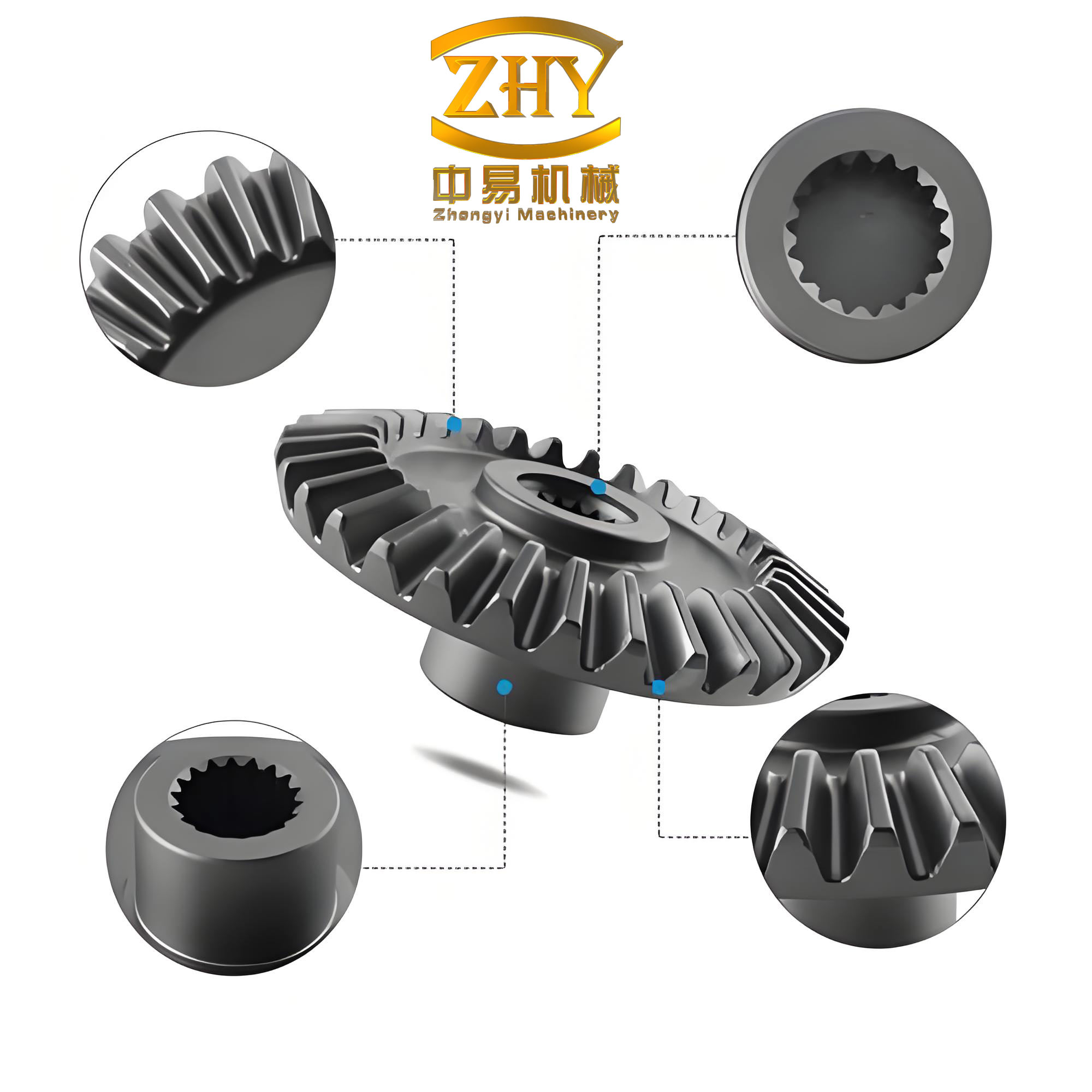
The conventional approach involves creating a 3D model in CAD software and then applying automatic free meshing in finite element tools. However, this leads to low node accuracy and poor mesh quality, making it unsuitable for detailed gear analysis. To address this, our research employs a mathematical model derived from gear shaping principles to calculate exact tooth surface coordinates. By dividing a rotational projection plane and mapping it onto the tooth surface, we construct hexahedral elements that form the basis of an accurate finite element model. This model is universally compatible with various finite element analysis software, facilitating reliable stress and performance evaluations.
Mathematical Foundation for Tooth Surface Modeling
The tooth surface of a straight bevel gear is generated using a gear shaping process, which simplifies the complex spherical involute geometry into a producible form. The shaping tool’s cutting edge is represented as a straight line in the coordinate system $S_c$, where the generating surface lies in the plane $x_cO_cz_c$. A point $p$ on this surface is defined by parameters $l$ (coordinate along $x_c$) and $d$ (coordinate along $z_c$). The position vector $\mathbf{r}_c$ and normal vector $\mathbf{n}_c$ in $S_c$ are given by:
$$ \mathbf{r}_c(l, d) = [l, 0, d, 1]^T $$
$$ \mathbf{n}_c(l, d) = [0, 1, 0]^T $$
In the gear cutting coordinate system, the relationship between the cradle (shaping tool) and the workpiece (straight bevel gear) is critical. The cradle rotates with angular velocity $\omega_g$ about its axis, while the workpiece rotates with angular velocity $\omega_1$. The roll ratio $I_f$, which governs the relative motion, is defined as:
$$ I_f = \frac{\omega_g}{\omega_1} = \frac{\phi_g}{\phi_1} = \frac{\cos \theta}{\sin \delta} $$
where $\theta$ is the root angle of the gear and $\delta$ is the pitch cone angle. By solving the engagement equation between the generating surface and the gear tooth surface, the precise tooth profile can be derived. This forms the basis for calculating node coordinates in the finite element model.
Mapping Mesh Node Generation
To generate the finite element mesh, we first establish a rotational projection coordinate system centered at the pitch cone apex of the straight bevel gear. In this system, the horizontal axis corresponds to the gear’s rotation axis $x$, and the vertical axis represents the radial distance $\sqrt{y^2 + z^2}$. The tooth surface is discretized into grid points $M_{ij}$ for $i = 1$ to $n$ and $j = 1$ to $m$, with coordinates $(L_{ij}, R_{ij})$ in the projection plane. The mapping relationship between the projection plane and the actual tooth surface is described by the equations:
$$ \sqrt{y^2(l_{ij}, d_{ij}) + z^2(l_{ij}, d_{ij})} = R_{ij} $$
$$ x(l_{ij}, d_{ij}) = L_{ij} $$
Solving this system of nonlinear equations yields the precise 3D coordinates of the tooth surface nodes. This approach ensures that the nodes accurately represent the gear geometry, which is essential for high-quality mesh generation. The following table summarizes the key parameters used in the node calculation process for a typical straight bevel gear:
| Parameter | Symbol | Value | Description |
|---|---|---|---|
| Number of Nodes Along Tooth Height | $n$ | 20 | Defines resolution in the radial direction |
| Number of Nodes Along Tooth Length | $m$ | 15 | Defines resolution in the axial direction |
| Pitch Cone Angle | $\delta$ | 30° | Angle of the pitch cone |
| Root Angle | $\theta$ | 5° | Angle of the root cone |
| Roll Ratio | $I_f$ | 1.732 | Ratio of cradle to workpiece angular velocity |
For each grid point $M_{ij}$, the coordinates $(x, y, z)$ are computed iteratively, ensuring that the node distribution conforms to the tooth surface curvature. This method allows for controlled mesh density, balancing computational efficiency and accuracy. The node generation process is automated, enabling the creation of models for various straight bevel gear configurations.
Finite Element Mesh Generation
Once the tooth surface nodes are defined, the next step is to generate the finite element mesh. This involves creating nodes on both tooth surfaces, interpolating internal nodes, and defining the base nodes to form a complete gear model. The element of choice is the SOLID45 hexahedral eight-node element, which is well-suited for modeling complex geometries like straight bevel gears due to its ability to capture stress gradients accurately.
Tooth Surface and Internal Node Generation
The tooth surface nodes are calculated based on the mapping method described earlier. For a single tooth, nodes are generated on both the drive and coast sides. The internal nodes are then created by linear interpolation between corresponding nodes on the two surfaces, considering the number of nodes in the tooth thickness direction. This ensures a smooth transition through the gear body, which is vital for stress analysis. The coordinates of internal nodes are determined using:
$$ \mathbf{r}_{\text{internal}} = (1 – \alpha) \mathbf{r}_{\text{drive}} + \alpha \mathbf{r}_{\text{coast}} $$
where $\alpha$ is a parameter ranging from 0 to 1, representing the position along the tooth thickness. This interpolation maintains geometric consistency and avoids discontinuities in the mesh.
Base Node Generation and Element Formation
The base nodes, located at the gear root and adjacent regions, are computed based on the gear’s geometric relationships. Nodes on the tooth root plane and adjacent slot planes are defined, and internal base nodes are interpolated linearly. This forms a solid foundation for the mesh, ensuring that boundary conditions are properly applied during analysis. The elements are then assembled by connecting nodes in a predefined order, as illustrated for a typical hexahedral element with nodes numbered from 1 to 8. The element connectivity follows a consistent pattern to maintain mesh integrity.
The overall finite element model includes multiple teeth to account for interaction effects. For instance, a three-tooth model is often used to simulate realistic loading conditions while minimizing computational cost. The mesh quality is assessed based on element aspect ratios and Jacobian determinants, ensuring that the model is suitable for finite element analysis. The following table outlines the mesh statistics for a sample straight bevel gear model:
| Component | Number of Nodes | Number of Elements | Element Type |
|---|---|---|---|
| Single Tooth Surface | 300 | 280 | Hexahedral |
| Internal Tooth Body | 600 | 520 | Hexahedral |
| Gear Base | 400 | 350 | Hexahedral |
| Three-Tooth Assembly | 3900 | 3450 | SOLID45 |
The automated mesh generation process ensures that the model is both accurate and efficient, with elements tailored to the straight bevel gear’s geometry. This approach eliminates the need for manual adjustments, reducing the potential for errors and saving time in model preparation.
Stress Analysis Using Finite Element Model
To validate the finite element model, stress analysis is performed by importing the mesh data into ANSYS. The analysis focuses on bending stresses at the tooth root, which are critical for assessing gear strength and durability. The constraints and loading conditions are applied to simulate real-world operating scenarios.
Boundary Conditions and Loading
For the stress analysis, a three-tooth model is used to approximate the engagement conditions while keeping computational demands manageable. The base surfaces, symmetric planes, and bottom face of the gear are fully constrained, restricting all six degrees of freedom to simulate a fixed support. The material properties are defined with an elastic modulus of 0.21 GPa and a Poisson’s ratio of 0.3, typical for gear materials.
Loading is applied at the tooth tip to represent the worst-case scenario for bending stress, as the maximum bending moment occurs near the highest point of single tooth contact. The normal force $F_n$ and tangential force $F_t$ are related by the pressure angle at the tip $\alpha_a$:
$$ F_n = \frac{F_t}{\cos \alpha_a} $$
In this analysis, a tangential force $F_t = 1000\, \text{N}$ is applied, and the resulting stresses are evaluated using the von Mises criterion to assess yielding potential. The applied load distribution ensures that the stress concentration at the tooth root is accurately captured.
Results and Validation
The finite element analysis reveals the stress distribution across the straight bevel gear tooth. The maximum von Mises stress is observed at the tooth root, with a value of approximately 41.807 MPa. This result aligns closely with calculations from empirical formulas, such as the Lewis equation for bending stress, which predicts similar values for the given loading conditions. The stress contour plot shows higher stresses at the loaded tooth tip and root, consistent with theoretical expectations for straight bevel gears.
The comparison between finite element results and empirical methods validates the accuracy of the mapping mesh approach. The table below summarizes the stress analysis results and comparison with theoretical values:
| Method | Maximum Bending Stress (MPa) | Remarks |
|---|---|---|
| Finite Element Analysis (FEA) | 41.807 | Von Mises stress at tooth root |
| Empirical Formula | 40.5 | Based on Lewis equation adaptation |
| Deviation | 3.2% | Within acceptable engineering limits |
The close agreement demonstrates that the mapping mesh method produces reliable results for straight bevel gear analysis. This approach not only enhances accuracy but also provides insights into stress concentrations that may not be evident from analytical methods alone.
Conclusions
The development of an automated finite element mapping mesh generation method for straight bevel gears represents a significant advancement in gear analysis. By leveraging precise mathematical models from gear shaping processes, we achieve high node accuracy and element quality, which are essential for reliable stress evaluations. The use of hexahedral eight-node elements ensures that the model is computationally efficient and universally applicable across different finite element software platforms.
Stress analysis results confirm that the finite element model accurately predicts bending stresses, with deviations from empirical formulas within acceptable limits. This method eliminates the drawbacks of free meshing, such as distorted elements and low precision, making it ideal for detailed studies on straight bevel gear performance. Future work could extend this approach to dynamic analyses or incorporate material nonlinearities to further enhance model fidelity.
In summary, the automated mapping mesh generation for straight bevel gears provides a robust foundation for optimizing gear design and ensuring durability in mechanical transmissions. By integrating precise geometry with high-quality meshing, we enable more accurate simulations that support innovation in gear technology.