
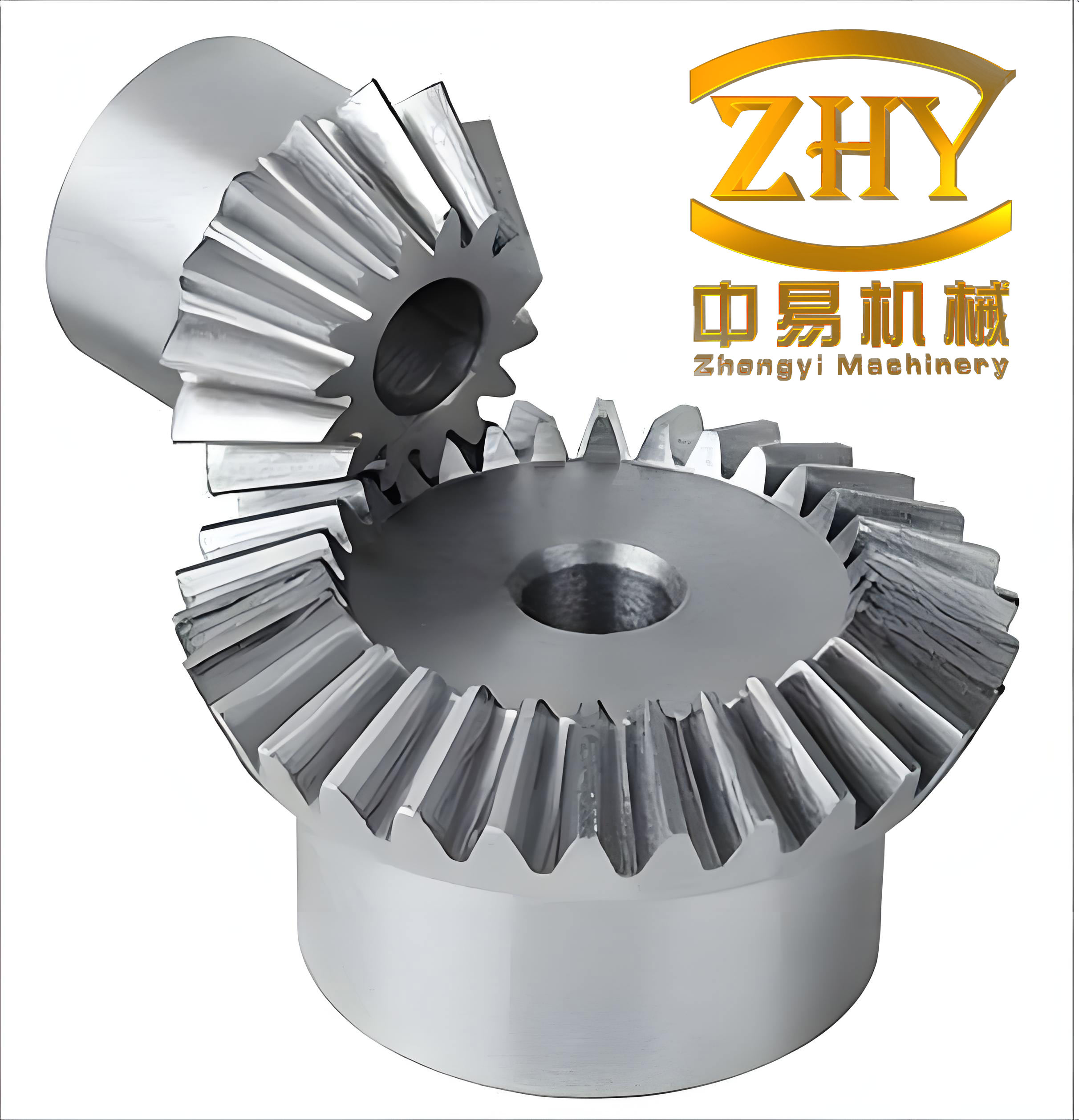
In modern mechanical transmission systems, the performance of straight bevel gears is critical due to their role in transmitting motion and power between intersecting shafts. The tooth surface of a straight bevel gear is a complex spatial surface, and its meshing performance is highly sensitive to micron-level design modifications or manufacturing errors. Even slight deviations in the tooth surface can significantly alter the contact pattern, load distribution, and overall efficiency. Therefore, establishing an accurate three-dimensional finite element model is essential for precisely analyzing the meshing behavior and stress characteristics of straight bevel gears. Traditional approaches often rely on free meshing techniques available in commercial finite element software, which can lead to distorted or degenerated elements, reduced computational accuracy, and increased solution time. In contrast, mapped meshing offers a structured grid that ensures high-quality elements and superior computational precision. This paper presents a comprehensive methodology for the automatic generation of mapped finite element meshes for straight bevel gears, based on precise mathematical modeling of the tooth surface derived from gear shaping principles. The approach involves calculating high-precision nodal coordinates, mapping them from a rotational projection plane to the tooth surface, and constructing hexahedral eight-node elements. The resulting finite element model is validated through stress analysis, demonstrating its applicability and reliability.
The tooth surface of a straight bevel gear is typically generated using a gear shaping process, which mimics the theoretical generation of a spherical involute. However, due to the complexity of exact spherical involutes, practical manufacturing employs a刨齿展成法 (gear shaping generative method). To derive the mathematical model of the tooth surface, we consider the coordinate systems involved in the cutting process. The generating surface coordinate system \( S_c \) is defined, where the tool edge is represented as a straight line. Let \( l \) and \( d \) be parameters denoting the coordinates along the \( x_c \) and \( z_c \) axes, respectively. The position vector \( \mathbf{r}_c \) and normal vector \( \mathbf{n}_c \) of the generating surface in \( S_c \) are given by:
$$ \mathbf{r}_c(l, d) = [l, 0, d, 1]^T $$
$$ \mathbf{n}_c(l, d) = [0, 1, 0]^T $$
The cutting process involves multiple coordinate transformations. The relationship between the generating surface and the workpiece coordinate system \( S_1 \) is established through intermediate systems, including the摇台 (cradle) system \( S_g \) and the machine system \( S_m \). The cradle rotates with an angular velocity \( \omega_g \), and the workpiece rotates with \( \omega_1 \). The roll ratio \( I_f \) is defined as:
$$ I_f = \frac{\omega_g}{\omega_1} = \frac{\phi_g}{\phi_1} = \frac{\cos \theta}{\sin \delta} $$
where \( \theta \) is the root angle of the gear and \( \delta \) is the pitch cone angle. By solving the engagement equation between the generating surface and the workpiece, the tooth surface equation in \( S_1 \) is obtained. This equation provides the foundational basis for calculating precise nodal coordinates on the tooth surface of the straight bevel gear.
To generate the mapped mesh, we first define a rotational projection plane. The origin of this plane coincides with the pitch cone apex of the gear. The horizontal axis represents the gear’s rotational axis \( x \), and the vertical axis is the radial distance \( R = \sqrt{y^2 + z^2} \). Any point \( M_{ij} \) on the tooth surface, where \( i = 1 \) to \( n \) and \( j = 1 \) to \( m \) denote the grid indices along the tooth height and length directions, respectively, has coordinates \( (L_{ij}, R_{ij}) \) in this projection plane. The corresponding spatial coordinates \( (x, y, z) \) in \( S_1 \) satisfy the mapping relations:
$$ \sqrt{y^2(l_{ij}, d_{ij}) + z^2(l_{ij}, d_{ij})} = R_{ij} $$
$$ x(l_{ij}, d_{ij}) = L_{ij} $$
These nonlinear equations are solved iteratively to compute the exact coordinates of each node on the tooth surface. This process ensures high precision in node placement, which is crucial for accurate finite element analysis of straight bevel gears.
The finite element mesh generation involves several steps. First, the nodal points on both sides of a single tooth are calculated based on the mapping from the rotational projection plane. The number of nodes in the tooth height and length directions can be adjusted to control mesh density. For instance, a typical configuration might use \( n = 20 \) and \( m = 30 \), resulting in 600 nodes per tooth surface. The coordinates are stored in a matrix for further processing. Next, internal nodes within the tooth volume are generated using linear interpolation between corresponding nodes on the two tooth surfaces. The number of layers in the tooth thickness direction, say \( k = 10 \), determines the resolution through the volume. The base nodes of the gear tooth are computed considering the geometric relations of the straight bevel gear, including points on the tooth root fillet and adjacent slot surfaces. Linear interpolation is again employed to generate nodes within the base region.
For element formation, an eight-node hexahedral element (e.g., SOLID45 in ANSYS) is selected due to its ability to accurately represent curved geometries while maintaining computational efficiency. The element has nodes numbered from 1 to 8, as illustrated below. The connectivity of nodes to form elements is established by traversing the grid indices. For example, an element connecting nodes \( (i,j,k) \), \( (i+1,j,k) \), \( (i+1,j+1,k) \), \( (i,j+1,k) \), and their counterparts in the \( k+1 \) layer. This results in a structured mesh that minimizes element distortion.
The following table summarizes the parameters used in the mesh generation for a typical straight bevel gear:
| Parameter | Symbol | Value | Description |
|---|---|---|---|
| Number of nodes along tooth height | \( n \) | 20 | Controls resolution in the radial direction |
| Number of nodes along tooth length | \( m \) | 30 | Controls resolution in the circumferential direction |
| Number of layers in tooth thickness | \( k \) | 10 | Determines volume mesh density |
| Pitch cone angle | \( \delta \) | 20° | Defines the gear geometry |
| Pressure angle | \( \alpha \) | 20° | Influences tooth profile |
The automatic generation algorithm produces a full finite element model of the straight bevel gear, including multiple teeth and the gear body. For computational efficiency, a model with three teeth is often used in stress analysis, as it captures the essential meshing behavior while reducing model size. The mesh quality is evaluated based on element aspect ratios and Jacobian determinants, ensuring that the mapped mesh avoids degenerate elements.
For stress analysis, the finite element model is imported into ANSYS. The material properties are defined: elastic modulus \( E = 0.21 \) GPa and Poisson’s ratio \( \nu = 0.3 \). Boundary conditions are applied to simulate realistic constraints. The base surfaces of the gear and the symmetric planes are fixed in all six degrees of freedom. This represents the gear mounted on a shaft, with no translation or rotation allowed at the base.
Loading conditions are applied to simulate the worst-case scenario for bending stress. The maximum bending stress typically occurs when the load is applied at the highest point of single tooth contact. For simplicity, the load is applied at the tooth tip, along the direction of the normal pressure angle. The normal force \( F_n \) is related to the tangential force \( F_t \) by:
$$ F_n = \frac{F_t}{\cos \alpha_a} $$
where \( \alpha_a \) is the normal pressure angle at the tooth tip. In this analysis, a tangential force \( F_t = 1000 \) N is applied. The stress distribution is computed using the von Mises criterion, which is suitable for ductile materials like steel.
The results show that the maximum equivalent stress occurs at the tooth root, with a value of approximately 41.807 MPa. This is consistent with empirical calculations based on the equivalent spur gear method, which yields a bending stress of around 40 MPa. The slight discrepancy may be due to mesh refinement and boundary conditions. The stress contour plot illustrates high stress concentrations at the fillet region, validating the model’s ability to capture critical areas. The table below compares the finite element results with empirical values:
| Method | Tooth Root Bending Stress (MPa) | Notes |
|---|---|---|
| Finite Element Analysis | 41.807 | Maximum von Mises stress |
| Empirical Formula | 40.0 | Based on equivalent spur gear |
The developed methodology for straight bevel gear finite element mesh generation offers several advantages. First, the use of precise mathematical models ensures accurate representation of the tooth surface, which is vital for analyzing meshing performance. Second, the mapped grid approach produces high-quality hexahedral elements, reducing the need for manual correction and improving computational efficiency. Third, the automated process can be adapted to various gear geometries by adjusting parameters such as the pitch cone angle and pressure angle. This makes it suitable for iterative design and optimization of straight bevel gears.
In conclusion, the accurate finite element modeling of straight bevel gears is crucial for reliable stress and contact analysis. The proposed method leverages gear shaping principles to derive exact tooth surface equations, employs mapping techniques to generate structured meshes, and utilizes hexahedral elements for robust finite element analysis. The stress results align well with empirical data, confirming the model’s validity. Future work may extend this approach to spiral bevel gears or incorporate dynamic loading conditions for more comprehensive performance evaluation. The ability to automatically generate high-quality meshes for straight bevel gears will facilitate advanced simulations in gear design and manufacturing.
The mathematical foundation of the tooth surface generation involves solving the engagement conditions between the generating tool and the workpiece. The coordinate transformation from the generating surface \( S_c \) to the workpiece \( S_1 \) can be expressed as a series of homogeneous transformations. Let \( \mathbf{T}_{c1} \) be the transformation matrix from \( S_c \) to \( S_1 \). Then, the tooth surface in \( S_1 \) is given by:
$$ \mathbf{r}_1(l, d, \phi_g) = \mathbf{T}_{c1} \cdot \mathbf{r}_c(l, d) $$
where \( \phi_g \) is the cradle angle. The engagement equation is derived from the condition that the relative velocity between the tool and the workpiece is perpendicular to the common normal. This can be written as:
$$ \mathbf{n}_1 \cdot \mathbf{v}_{1c} = 0 $$
where \( \mathbf{n}_1 \) is the normal vector in \( S_1 \) and \( \mathbf{v}_{1c} \) is the relative velocity. Solving this equation along with the coordinate transformations yields the parameters \( l \), \( d \), and \( \phi_g \) for points on the tooth surface. This system of equations is nonlinear and requires numerical methods, such as Newton-Raphson iteration, for solution.
For the mapped mesh generation, the rotational projection plane is discretized into a grid. The coordinates \( (L_{ij}, R_{ij}) \) are chosen based on uniform or graded distributions. For example, along the tooth height, the nodes may be spaced linearly from the root to the tip, while along the tooth length, a sinusoidal distribution might be used to concentrate nodes near the ends where curvature is high. The mapping equations are solved for each grid point, resulting in a set of spatial coordinates \( (x_{ij}, y_{ij}, z_{ij}) \).
The internal node generation uses trilinear interpolation. Consider two corresponding nodes on the left and right tooth surfaces: \( \mathbf{P}_L(i,j) \) and \( \mathbf{P}_R(i,j) \). The internal nodes along the thickness direction are computed as:
$$ \mathbf{P}(i,j,k) = \mathbf{P}_L(i,j) + \frac{k}{K} \left( \mathbf{P}_R(i,j) – \mathbf{P}_L(i,j) \right) $$
where \( k = 0 \) to \( K \), and \( K \) is the number of layers. This ensures a smooth transition through the tooth volume.
The base nodes are generated by extrapolating the tooth surface nodes to the gear body. The tooth root fillet is modeled as a circular arc, with nodes placed along the arc based on the same mapping principle. The adjacent slot surfaces are defined using geometric relations from the gear design parameters.
In the finite element model, each hexahedral element is defined by eight nodes. The connectivity is stored in an element table, and the node coordinates are stored in a coordinate table. The model can be exported in formats such as NASTRAN or ANSYS input files for analysis. The following table shows a snippet of the node coordinates for a straight bevel gear:
| Node ID | X (mm) | Y (mm) | Z (mm) |
|---|---|---|---|
| 1 | 10.000 | 0.000 | 0.000 |
| 2 | 10.050 | 0.500 | 0.100 |
| 3 | 10.100 | 1.000 | 0.200 |
| … | … | … | … |
For the stress analysis, the applied load is distributed over the nodes at the tooth tip. The force components in the global coordinate system are calculated based on the pressure angle. In ANSYS, the solution is obtained using the static analysis module. The post-processing reveals the stress distribution, with maximum values at the tooth root, as expected for bending-dominated loading.
The validation against empirical formulas involves calculating the bending stress using the Lewis equation modified for bevel gears. The equivalent spur gear parameters are derived from the bevel gear geometry at the mean cone distance. The bending stress \( \sigma_f \) is given by:
$$ \sigma_f = \frac{F_t}{b m_n Y} K_v K_o K_m $$
where \( b \) is the face width, \( m_n \) is the normal module, \( Y \) is the form factor, and \( K_v \), \( K_o \), \( K_m \) are velocity, overload, and mounting factors, respectively. For the example gear, this yields approximately 40 MPa, which is close to the finite element result of 41.807 MPa.
The methodology presented here provides a robust framework for finite element analysis of straight bevel gears. The automated mesh generation reduces manual effort and ensures consistency. The use of mapped grids enhances solution accuracy and convergence in nonlinear analyses, such as contact problems. Future enhancements could include adaptive meshing for localized refinement and integration with optimization algorithms for gear design.
In summary, the accurate modeling of straight bevel gears through finite element analysis is essential for predicting performance and ensuring reliability. The approach described in this paper, based on precise tooth surface generation and mapped meshing, offers a significant improvement over traditional methods. The stress analysis results demonstrate the model’s capability to capture critical stress concentrations, making it a valuable tool for engineers in the design and analysis of straight bevel gears.