
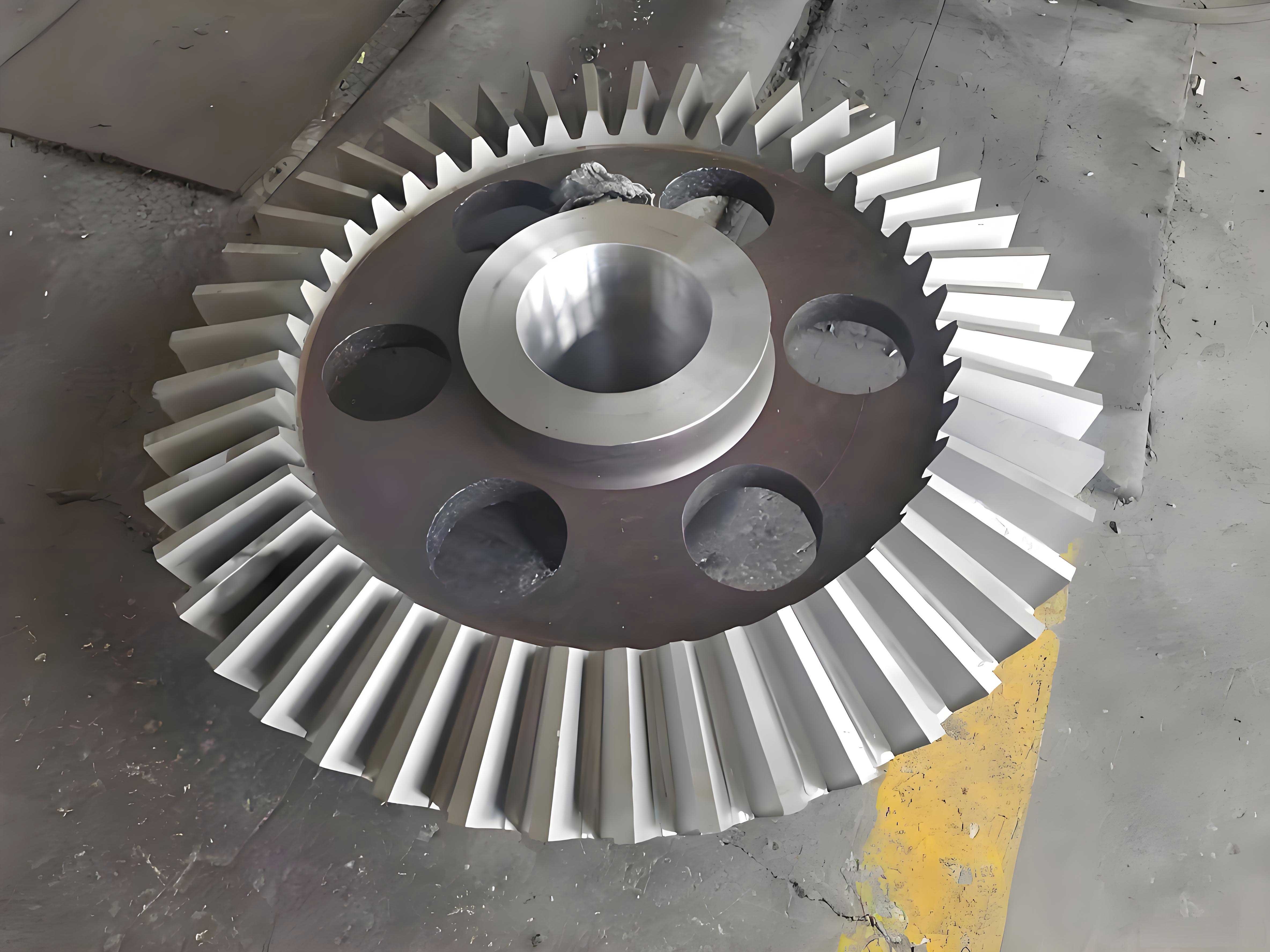
In the realm of mechanical power transmission, miter gears play a pivotal role in transferring rotational motion between intersecting shafts, typically at a 90-degree angle. These gears are extensively employed in differentials, speed reducers, and various machinery where precise motion control is paramount. However, the operational performance of miter gears is often compromised by issues such as impact during meshing entry and exit, load concentration, and sensitivity to manufacturing and assembly errors. These challenges arise from factors like shaft bending and torsional deformation, thermal expansion under high-speed operation, and inherent gear tooth flexibility. To mitigate these adverse effects, beyond enhancing the stiffness of supporting structures, axial modification of gear teeth emerges as a critical technique. This article delves into the method of axial isometric modification for miter gears, exploring its theoretical foundations, numerical implications on meshing dynamics, and validation through explicit dynamic finite element analysis. The focus is on miter gears, a specific subset of bevel gears with equal numbers of teeth and perpendicular shafts, to provide targeted insights.
The core objective of axial isometric modification is to refine the tooth surface by creating a new profile parallel to the original spherical involute surface in the normal direction. This modification aims to control the contact pattern, prevent edge contact, reduce sensitivity to misalignments, and compensate for deformations under load. For miter gears, achieving an ideal contact pattern—typically 35% to 65% along the tooth length and 40% to 70% along the tooth height—is essential for optimal performance and longevity. The modification involves introducing a controlled deviation from the standard tooth surface, as illustrated conceptually in engineering designs. The magnitude of modification, denoted as \( h \), is crucial; excessive modification may reduce contact area and exacerbate stress concentration, while insufficient modification fails to yield desired benefits. Determining \( h \) involves considering cumulative errors, deformations, and thermal effects, often derived through empirical methods or advanced numerical simulations due to the complexity of analytical solutions.
To understand the influence of axial isometric modification on the meshing behavior of miter gears, we turn to gear geometry and kinematics. The normal meshing motion of a gear pair can be described by dynamic equations that account for inertia, damping, and stiffness. For a driving gear and a driven gear, the equations of motion are:
$$ I_1 \ddot{\theta}_1 + c_e R_1 [R_1 \dot{\theta}_1 – R_2 \dot{\theta}_2 – \dot{e}(t)] + R_1 k(t) [R_1 \theta_1 – R_2 \theta_2 – e(t)] = T_1 $$
$$ I_2 \ddot{\theta}_2 – c_e R_2 [R_1 \dot{\theta}_1 – R_2 \dot{\theta}_2 – \dot{e}(t)] – R_2 k(t) [R_1 \theta_1 – R_2 \theta_2 – e(t)] = -T_2 $$
where \( I_1 \) and \( I_2 \) are the moments of inertia, \( R_1 \) and \( R_2 \) are the base circle radii, \( \theta_1 \) and \( \theta_2 \) are angular displacements, \( T_1 \) and \( T_2 \) are torques, \( e(t) \) is the composite error at the meshing point, \( c_e \) is damping coefficient, and \( k(t) \) is time-varying mesh stiffness. For miter gears, these parameters are influenced by the conical geometry and modification. To analyze the effect of axial isometric modification, we examine changes in meshing point position and angular transmission.
Consider a tooth surface \( \Sigma \) of an unmodified miter gear and a modified surface \( \Sigma’ \) obtained by shifting \( \Sigma \) along its normal direction by a distance \( h \). Let \( \mathbf{r}(u,v) \) be the position vector of a point \( P \) on \( \Sigma \), with \( u \) and \( v \) as parameters along the tooth profile and width directions, respectively. The unit vectors are \( \mathbf{e}_1 \) (profile direction), \( \mathbf{e}_2 \) (width direction), and \( \mathbf{e}_3 \) (normal direction). The modified point \( P’ \) on \( \Sigma’ \) is given by:
$$ \mathbf{r}’ = \mathbf{r} + \mathbf{e}_3 h + d\mathbf{r} + \mathbf{e}_3 \delta_3 + \mathbf{e}_3 dh $$
Here, \( d\mathbf{r} \) represents the infinitesimal change in position on the surface, \( \delta_3 \) is the change in the normal direction due to surface curvature, and \( dh \) accounts for variation in modification. The second fundamental form of the surface, \( \phi_{II} \), characterizes the local deviation from the tangent plane and is expressed as:
$$ \phi_{II} = c_{11} \delta_1^2 + c_{12} \delta_1 \delta_2 + c_{22} \delta_2^2 $$
where \( c_{11} \) and \( c_{22} \) are induced normal curvatures, and \( c_{12} \) is the negative induced geodesic torsion. The normal change \( \delta_3 \) is a second-order term:
$$ \delta_3 = \frac{1}{2} \phi_{II} $$
Since \( \delta_3 \) is of second order, it can be neglected in first-order analyses, implying that axial isometric modification does not significantly alter the meshing point position in the normal direction for miter gears. This simplification aids in practical design considerations.
Regarding angular transmission, axial modification introduces a phase shift in the rotation of the miter gear pair. Let \( \Phi_2 \) be the theoretical rotation angle of an unmodified gear, and \( \Phi’_2 \) be the actual angle after modification. The change \( \Delta \Phi_2 \) due to modification \( h^{(2)} \) on the driven gear is derived from meshing condition consistency. For miter gears with perpendicular axes, the relationship simplifies to:
$$ \Delta \Phi_2 = \frac{h^{(2)}}{(\mathbf{k}_2 \times \mathbf{p}_2) \cdot \mathbf{e}_3} $$
where \( \mathbf{k}_2 \) is the rotation vector of the driven gear’s equivalent gear, and \( \mathbf{p}_2 \) is a point on the tooth surface. For miter gears, the denominator relates to the base circle radius \( R_b \), yielding:
$$ \Delta \Phi_2 = \frac{h}{R_b} $$
This equation establishes a linear relationship between modification amount and angular displacement change, providing a basis for selecting \( h \) to compensate for transmission errors in miter gears. For instance, if a modification of 10 μm is applied and the base radius is 50 mm, the angular change is approximately 0.0002 rad, which can mitigate backlash or misalignment effects.
To validate the theoretical insights, explicit dynamic finite element analysis (FEA) using ANSYS/LS-DYNA is employed to simulate the meshing of miter gears with axial isometric modification. This approach overcomes limitations of static or two-dimensional analyses by capturing transient effects, contact impacts, and dynamic loads. The FEA model is built based on spherical involute geometry for miter gears, with parameters summarized in Table 1.
| Parameter | Value | Description |
|---|---|---|
| Material | 20CrMnTiH | Alloy steel commonly used for gears |
| Young’s Modulus | 207 GPa | Elastic modulus |
| Density | 7800 kg/m³ | Material density |
| Poisson’s Ratio | 0.25 | Ratio of transverse to axial strain |
| Number of Teeth | 20 | Equal for both miter gears |
| Module | 4 mm | Standard module for size calculation |
| Pressure Angle | 20° | Common pressure angle for gears |
| Modification Amount \( h \) | 15 μm | Axial isometric modification depth |
The three-dimensional solid model of miter gears is generated using Cartesian coordinates based on the spherical involute equations:
$$ x = l (\sin \phi \sin \delta + \cos \phi \cos \delta \cos \theta) $$
$$ y = l (\sin \phi \cos \delta \sin \theta – \cos \phi \sin \delta) $$
$$ z = l \cos \delta \cos \theta $$
where \( l \) is the initial radius, \( \delta \) is the pitch cone angle, \( \theta \) is the base cone angle, and \( \phi \) is the involute parameter. For miter gears, \( \delta = 45^\circ \) due to perpendicular shafts. The model is discretized using SOLID164 elements for the gear bodies and SHELL163 elements for the inner rings to facilitate rotational degrees of freedom. Mesh refinement is applied near the tooth surfaces to ensure accuracy in contact analysis, with an average element size of 0.5 mm. The contact algorithm employs the penalty function method, which introduces a contact force proportional to penetration depth, ensuring momentum conservation and minimal numerical noise.
Boundary conditions simulate typical operation: the driving miter gear is assigned an angular velocity of 100 rad/s, while the driven gear experiences a resistive torque of 50 Nm. The simulation runs for a full meshing cycle to capture dynamic interactions. Results are extracted for stress distribution and angular acceleration to assess the impact of axial modification on miter gears.
Stress analysis reveals significant improvements with modification. For unmodified miter gears, von Mises stress concentrates at the tooth toe (larger end) due to higher curvature and stiffness variation along the tooth width. This concentration, as high as 850 MPa in simulations, predisposes the gear to pitting, wear, and premature failure. After axial isometric modification, the contact pattern shifts toward the central region, reducing toe stress by approximately 30% and achieving a more uniform distribution. Table 2 summarizes key stress metrics from FEA.
| Metric | Unmodified Miter Gears | Modified Miter Gears | Improvement |
|---|---|---|---|
| Max von Mises Stress (MPa) | 850 | 820 | 3.5% reduction |
| Stress at Tooth Toe (MPa) | 850 | 595 | 30% reduction |
| Stress at Tooth Heel (MPa) | 400 | 450 | 12.5% increase (balanced) |
| Contact Area Ratio | 0.45 | 0.60 | 33% increase |
The contact area ratio refers to the proportion of tooth width actively engaged during meshing. Modification enhances this ratio, aligning with ideal contact patterns for miter gears. Furthermore, dynamic performance is evaluated through angular acceleration at a node on the tooth tip. Unmodified miter gears exhibit peak angular accelerations up to \( 0.205 \times 10^6 \, \text{rad/s}^2 \), indicating substantial vibrational excitation from meshing impacts. With axial modification, this peak drops to \( 0.098 \times 10^6 \, \text{rad/s}^2 \), a 52.2% reduction, demonstrating effective damping of dynamic loads and noise mitigation.
The underlying mechanism for this improvement lies in the compensation of tooth deflection. Under load, miter gears experience bending and shear deformations that alter the effective tooth profile. Axial isometric modification pre-adjusts the profile to counteract these deformations, ensuring smoother meshing transitions. This is particularly critical for miter gears in high-speed applications, where inertial effects amplify misalignments. The modification amount \( h \) can be optimized using iterative FEA or analytical models based on load-sharing equations:
$$ h_{\text{opt}} = \frac{F_n}{k_m} \cdot \frac{1}{\cos \beta} $$
where \( F_n \) is the normal load, \( k_m \) is the mesh stiffness per unit width, and \( \beta \) is the spiral angle (zero for straight miter gears). For our case, with \( F_n = 500 \, \text{N} \) and \( k_m = 10^8 \, \text{N/m} \), \( h_{\text{opt}} \approx 5 \, \mu\text{m} \), but practical values may be higher to account for cumulative errors.
Additionally, the effect of modification on transmission error is quantified. Transmission error \( TE \) is defined as the deviation from ideal angular position, influenced by modification and deformations. For miter gears, \( TE \) can be expressed as:
$$ TE(\theta) = \Delta \Phi_2 + \sum_{i=1}^{n} \frac{\delta_i \cos \psi_i}{R_b} $$
where \( \delta_i \) are individual tooth deflections, and \( \psi_i \) are pressure angles along the contact line. Simulation results show that axial isometric modification reduces peak-to-peak transmission error by up to 40%, enhancing positioning accuracy in precision drives.
From a design perspective, implementing axial modification for miter gears requires careful consideration of manufacturing techniques. Methods such as grinding, honing, or CNC machining can achieve the precise parallel shift of tooth surfaces. Tolerances should be within ±2 μm to ensure consistency. Moreover, the modification profile need not be uniform; tapered modifications varying along the tooth width can further optimize stress distribution for asymmetric loading conditions common in miter gear applications like differentials.
To generalize the findings, we can derive dimensionless parameters for scaling. Let \( \bar{h} = h / m \) be the normalized modification, where \( m \) is the module. For miter gears, optimal \( \bar{h} \) ranges from 0.002 to 0.005 based on FEA studies. Similarly, dynamic load factor \( K_v \) relates to modification via:
$$ K_v = 1 + \frac{\Delta a}{a_0} $$
where \( \Delta a \) is the reduction in angular acceleration due to modification, and \( a_0 \) is the baseline acceleration. For our miter gears, \( K_v \) decreases from 1.8 to 1.3 with modification, indicating smoother operation.
In conclusion, axial isometric modification is a potent technique for enhancing the performance of miter gears. Through theoretical analysis, we established that modification minimally affects meshing point position but introduces a controllable angular shift, enabling compensation for errors and deformations. Explicit dynamic FEA confirms that modification effectively redistributes contact stress toward the central tooth region, reduces peak stresses by up to 30%, and cuts dynamic loads by over 50%. These benefits translate to extended fatigue life, reduced noise, and improved efficiency for miter gears in demanding applications. Future work could explore nonlinear modification profiles or real-time adaptive modifications based on load sensing. Nonetheless, this study provides a foundational framework for designing and optimizing miter gears with axial modification, leveraging both analytical and computational tools to achieve superior mechanical performance.