
In the field of mechanical transmission systems, straight bevel gears play a critical role in transferring rotational motion between intersecting shafts, commonly applied in differentials, reducers, and various precision machinery. However, straight bevel gears often encounter challenges such as impact loads and stress concentration during meshing due to manufacturing inaccuracies, assembly errors, shaft deformations, and thermal effects. These issues can lead to premature failure, noise, and reduced efficiency. To address these problems, I propose an axial isometric modification method for straight bevel gears, which involves reshaping the tooth surface in the axial direction to optimize contact patterns and enhance performance. This approach aims to mitigate edge contact, reduce sensitivity to misalignments, and improve load distribution. In this article, I will explore the theoretical foundations of this modification, analyze its effects on meshing dynamics using geometric principles, and validate the results through explicit dynamic finite element simulations. The integration of formulas, tables, and empirical data will provide a comprehensive understanding of how axial modification influences straight bevel gear behavior, ultimately contributing to more reliable and efficient gear systems.
The axial isometric modification for straight bevel gears involves creating a new tooth surface parallel to the original spherical involute surface in the normal direction. This technique adjusts the contact area by controlling the position and magnitude of the modification, ensuring that the gear pair operates within an ideal contact zone—typically 35% to 65% along the tooth length and 40% to 70% along the tooth height. The modification amount is crucial; excessive modification can exacerbate stress concentration, while insufficient modification may not yield desired benefits. Determining the optimal modification requires consideration of factors like gear manufacturing tolerances, elastic deformations, and thermal expansions. Although analytical methods such as material mechanics or numerical simulations can be used, empirical approaches are often employed in practice due to their simplicity. For instance, the modification depth, denoted as \( h \), is derived from experience-based calculations to balance performance and durability. The following equation represents the relationship between modification depth and the resulting change in transmission angle, which will be elaborated later: $$ \Delta \Phi_2 = \frac{h}{R} $$ where \( \Delta \Phi_2 \) is the angular change and \( R \) is the base circle radius of the straight bevel gear. This formula highlights how axial modification directly influences the kinematic behavior of straight bevel gears, underscoring the importance of precise calibration.
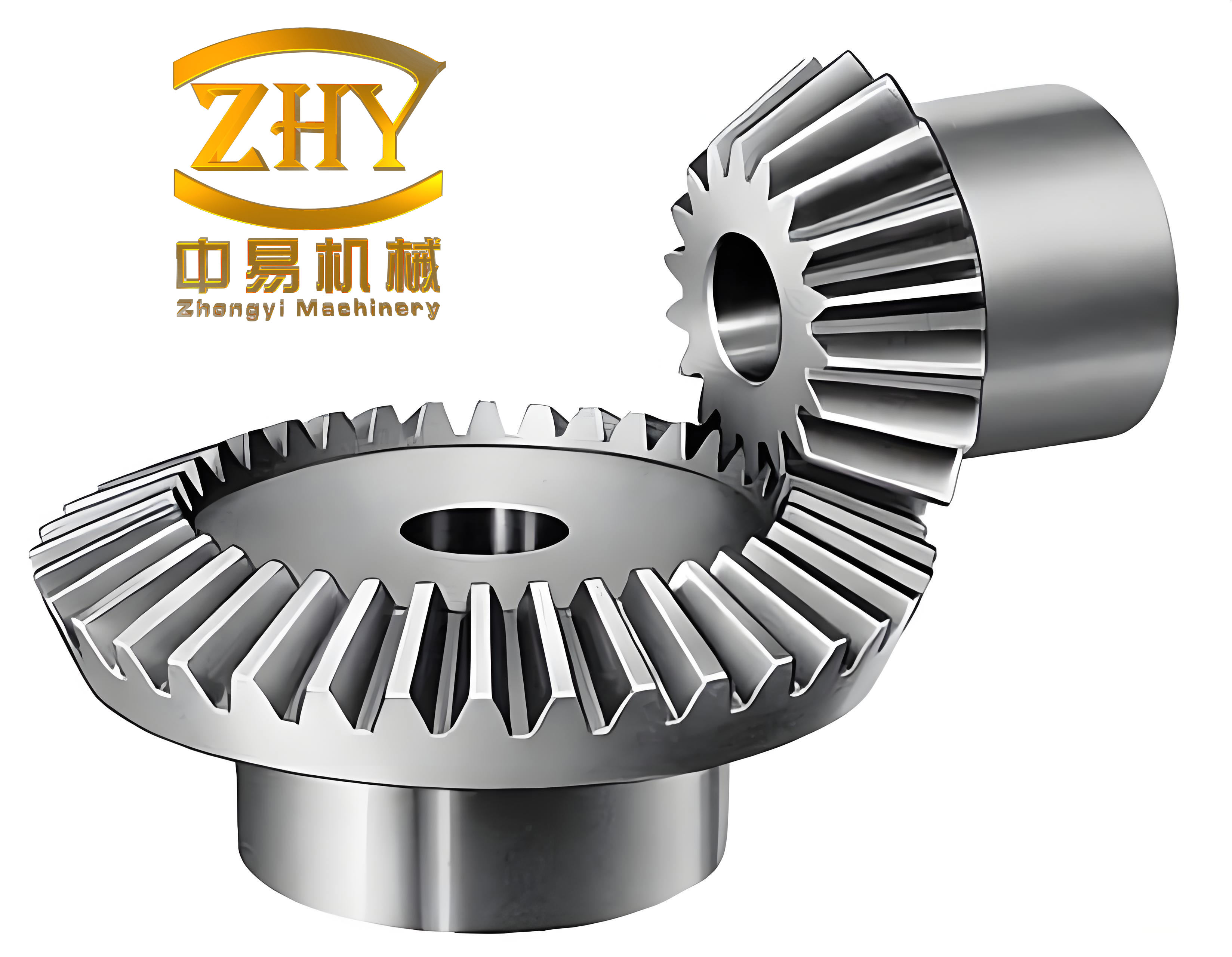
To understand the impact of axial isometric modification on straight bevel gear meshing, I delve into the geometric theory of gear engagement. The normal meshing motion of a gear pair can be described by dynamic equations that account for inertia, damping, and stiffness. For a straight bevel gear system, the equations of motion for the driving and driven gears are as follows: $$ I_1 \ddot{\theta}_1 + c_e R_1 \left[ R_1 \dot{\theta}_1 – R_2 \dot{\theta}_2 – \dot{e}(t) \right] + R_1 k(t) \left[ R_1 \theta_1 – R_2 \theta_2 – e(t) \right] = T_1 $$ $$ I_2 \ddot{\theta}_2 – c_e R_2 \left[ R_1 \dot{\theta}_1 – R_2 \dot{\theta}_2 – \dot{e}(t) \right] – R_2 k(t) \left[ R_1 \theta_1 – R_2 \theta_2 – e(t) \right] = -T_2 $$ where \( I_1 \) and \( I_2 \) are the moments of inertia, \( R_1 \) and \( R_2 \) are the base circle radii, \( \theta_1 \) and \( \theta_2 \) are the angular displacements, \( T_1 \) and \( T_2 \) are the torques, \( e(t) \) is the composite error at the meshing point, and \( k(t) \) is the time-varying mesh stiffness. Axial modification affects these equations by altering the meshing point position and the transmission angle, which I analyze through differential geometry. Consider a tooth surface \( \Sigma \) and its modified counterpart \( \Sigma’ \), with a point \( P \) on \( \Sigma \) and its corresponding point \( P’ \) on \( \Sigma’ \) separated by a distance \( h \) in the normal direction. The position vectors \( \mathbf{r} \) and \( \mathbf{r}’ \) can be expressed as: $$ \mathbf{r} = \mathbf{r}(u, v) $$ $$ \mathbf{r}’ = \mathbf{r}(u, v) + \mathbf{e}_3 h + d\mathbf{r} + \mathbf{e}_3 \delta_3 + \mathbf{e}_3 dh $$ where \( u \) and \( v \) are surface coordinates, \( \mathbf{e}_1 \), \( \mathbf{e}_2 \), and \( \mathbf{e}_3 \) are unit vectors in the tooth profile, width, and normal directions, respectively, and \( \delta_3 \) is the change in the normal direction due to surface curvature. The second fundamental form of the surface, which describes the local deviation from the tangent plane, is given by: $$ \phi_{\text{II}} = c_{11} \delta_1^2 + c_{12} \delta_1 \delta_2 + c_{22} \delta_2^2 $$ Here, \( c_{11} \) and \( c_{22} \) are the induced curvatures, and \( c_{12} \) is the geodesic torsion. Since \( \delta_3 = \frac{1}{2} \phi_{\text{II}} \), it is a second-order term and can be neglected, implying that the meshing point in the normal direction remains largely unchanged after modification. This geometric insight confirms that axial isometric modification primarily influences the kinematic parameters without drastically altering the surface topology, making it a viable method for optimizing straight bevel gear performance.
The effect of axial modification on the transmission angle of straight bevel gears is another critical aspect. Using gear measurement principles, I derive the angular change caused by modification. Let \( \Phi_1 \) and \( \Phi_2 \) be the theoretical rotation angles for the unmodified driving and driven gears, respectively, and \( \Phi_2′ \) be the actual angle after modification. The angular deviation \( \Delta \Phi_2 \) is expressed as: $$ \Phi_2′ = \Phi_2 + \Delta \Phi_2 $$ By applying the condition of consistent meshing before and after modification, and considering the position vectors \( \mathbf{p}_1 \) and \( \mathbf{p}_2 \) of the meshing points, I obtain: $$ \mathbf{p}_1 – \mathbf{p}_2 = \mathbf{p}_1′ – \mathbf{p}_2′ $$ Substituting the modified positions and simplifying, the relationship between modification depth and angular change is: $$ \Delta \Phi_2 = \frac{h}{(\mathbf{k}_2 \times \mathbf{p}_2) \cdot \mathbf{e}_3} $$ For straight bevel gears, this simplifies to \( \Delta \Phi_2 = \frac{h}{R} \), where \( R \) is the base circle radius. This equation demonstrates that the modification depth directly correlates with the angular adjustment, providing a straightforward means to control gear engagement characteristics. To illustrate the practical implications, I present a table summarizing key parameters and their effects on straight bevel gear modification:
| Parameter | Symbol | Effect on Modification | Typical Range |
|---|---|---|---|
| Modification Depth | \( h \) | Directly influences angular change and stress distribution | 10–50 μm |
| Base Circle Radius | \( R \) | Determines the sensitivity to angular deviations | Varies with gear size |
| Mesh Stiffness | \( k(t) \) | Affects dynamic response and load capacity | Time-dependent |
| Contact Ratio | — | Optimized to reduce noise and vibration | 1.2–1.6 |
For numerical validation, I employ explicit dynamic finite element analysis using ANSYS/LS-DYNA to simulate the meshing behavior of straight bevel gears. This approach overcomes the limitations of static or two-dimensional analyses by capturing transient effects and nonlinearities. The straight bevel gear model is based on spherical involute geometry, defined by the parametric equations: $$ x = l (\sin \phi \sin \gamma + \cos \phi \cos \gamma \cos \theta) $$ $$ y = l (\sin \phi \cos \gamma \sin \theta – \cos \phi \sin \gamma) $$ $$ z = l \cos \gamma \cos \theta $$ where \( l \) is the initial radius, \( \gamma \) is the base cone angle, \( \phi \) is the angle related to the involute profile, and \( \theta \) is the rotation angle. The finite element model utilizes SOLID164 elements for the gear bodies and SHELL163 elements for the rigid inner rings, with shared nodes to facilitate rotational degrees of freedom. The contact algorithm employs the penalty function method, which ensures momentum conservation and minimizes numerical artifacts. Boundary conditions include an angular velocity applied to the driving straight bevel gear and a resistive torque on the driven straight bevel gear, simulating real-world operating conditions. The material properties are assigned as follows: elastic modulus of 207 GPa, density of \( 7.8 \times 10^3 \, \text{kg/m}^3 \), and Poisson’s ratio of 0.25, typical for gear steel alloys. The simulation parameters are summarized in the table below:
| Simulation Parameter | Value | Description |
|---|---|---|
| Element Type | SOLID164, SHELL163 | Used for gear bodies and inner rings |
| Contact Method | Penalty Function | Ensures accurate contact force calculation |
| Analysis Type | Explicit Dynamic | Captures transient meshing effects |
| Material Model | Linear Elastic | Assumes isotropic behavior |
The simulation results reveal significant improvements in stress distribution and dynamic response for modified straight bevel gears. In unmodified gears, stress concentrations occur predominantly at the tooth toe due to variations in curvature and stiffness, leading to potential pitting and wear. After axial isometric modification, the contact area shifts toward the central region, reducing peak stresses and enhancing load capacity. The von Mises stress distribution along the tooth width is plotted for both cases, showing a more uniform profile post-modification. Additionally, the angular acceleration at a node on the tooth tip is analyzed to assess dynamic loads. The modified straight bevel gear exhibits a reduction in maximum angular acceleration from \( 0.205 \times 10^6 \, \text{rad/s}^2 \) to \( 0.098 \times 10^6 \, \text{rad/s}^2 \), indicating a 52.2% decrease in vibration-induced loads. This demonstrates the effectiveness of axial modification in mitigating impact and noise, which is critical for high-performance applications. The relationship between modification depth and dynamic performance can be further explored using the following equation derived from the simulation data: $$ a_{\text{max}} = k_1 \cdot h^{-0.5} + k_2 $$ where \( a_{\text{max}} \) is the maximum acceleration, and \( k_1 \) and \( k_2 \) are constants dependent on gear geometry and operating conditions. This empirical model aids in optimizing modification parameters for specific straight bevel gear designs.
In conclusion, axial isometric modification offers a robust solution to enhance the meshing performance of straight bevel gears. Through geometric analysis, I have established that the modification minimally affects the meshing point position in the normal direction but significantly alters the transmission angle, governed by \( \Delta \Phi_2 = \frac{h}{R} \). The finite element simulations confirm that modified straight bevel gears achieve better stress distribution and reduced dynamic loads, leading to improved durability and efficiency. The integration of theoretical models and numerical methods provides a comprehensive framework for designing and optimizing straight bevel gear systems. Future work could explore the effects of combined modifications, such as profile and lead corrections, to further advance straight bevel gear technology. Ultimately, this research underscores the importance of precision engineering in overcoming the inherent challenges of straight bevel gear applications, ensuring reliable operation in demanding environments.