
In the field of gear engineering, precise measurement of tooth thickness and pressure angle is crucial for ensuring the performance and longevity of miter gears. As a practitioner specializing in gear design and metrology, I have extensively explored the ball measurement method as a reliable technique for these parameters. This method, which involves using steel balls to contact the tooth flanks, offers high accuracy and repeatability, especially for straight bevel gears like miter gears. In this article, I will delve into the theoretical foundations, computational procedures, and practical applications of this method, aiming to provide a comprehensive guide for engineers and technicians. Throughout, I will emphasize the relevance to miter gears, as these gears are commonly used in right-angle drives where precise tooth geometry is essential for smooth operation and minimal backlash.
The ball measurement method for miter gears relies on geometric relationships between the gear teeth and the steel balls placed in the tooth spaces. By measuring the position of the ball centers relative to a reference surface, such as the mounting base or cone apex, one can derive the arc tooth thickness at the pitch circle and the pressure angle. This approach is particularly advantageous for miter gears due to their conical shape, which complicates direct measurement with traditional tools. I will start by outlining the basic parameters and symbols used in the calculations. For a miter gear, key parameters include the number of teeth (z), pitch cone angle (δ), pitch cone distance (R), and pressure angle (α). The steel ball diameter is denoted as d, and the contact point between the ball and tooth flank is characterized by its cone angle (δ_meas) and cone distance (R_meas). The radial and axial dimensions from the ball center to the reference are labeled as X and Y, respectively.
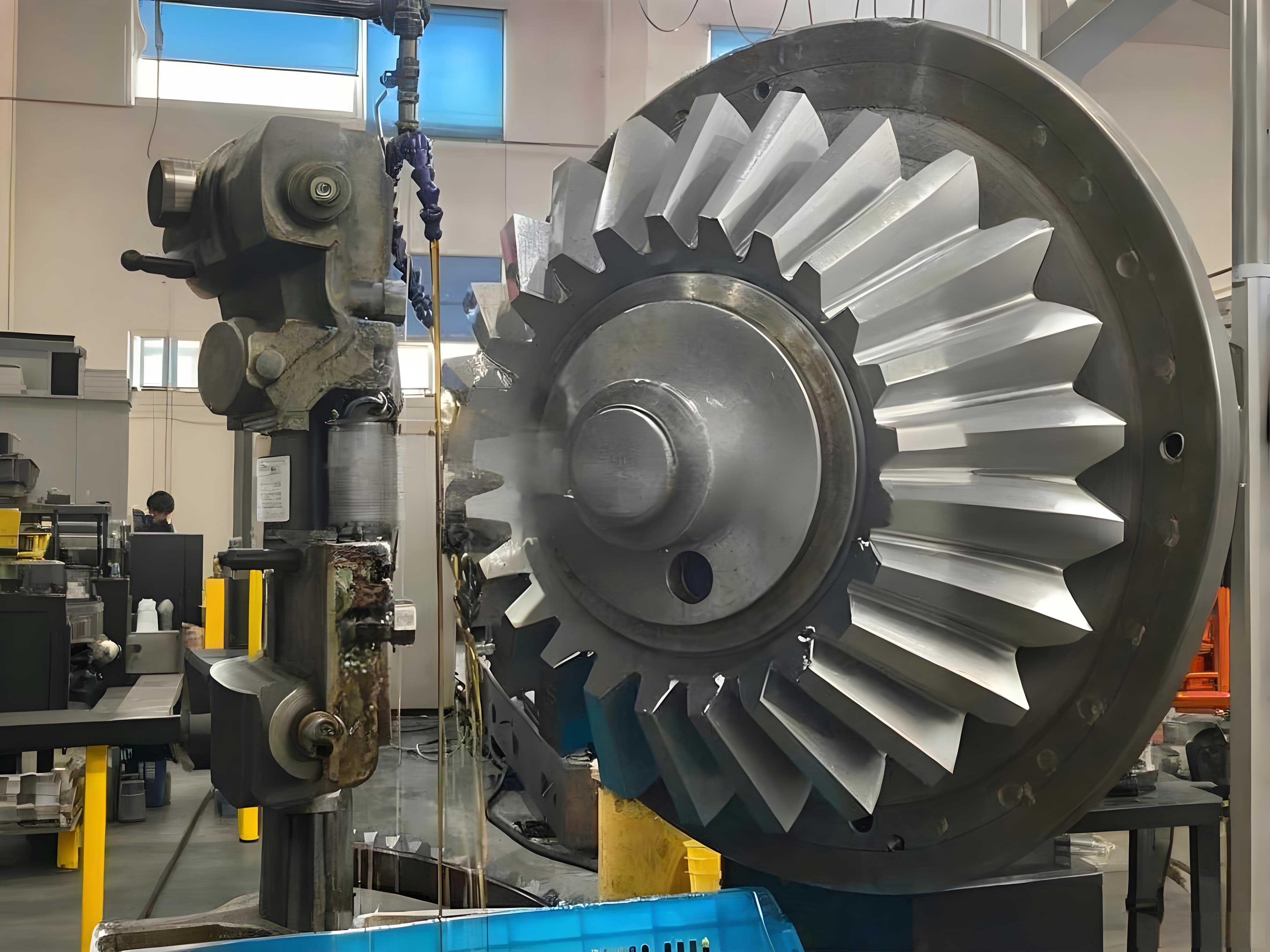
To establish the foundational formulas, I consider the geometry of the miter gear tooth space. The ball contacts the tooth flank at a point where the normal to the surface passes through the ball center. This leads to a set of equations that relate the ball position to the tooth thickness. Let s be the arc tooth thickness at the pitch circle, and let φ be the half-angle subtended by the tooth thickness at the cone apex. For a miter gear, φ can be expressed as: $$φ = \frac{s}{2R \sin δ}$$ where δ is the pitch cone angle. The cone angle at the ball contact point, δ_meas, is derived from the base cone angle δ_b, which is related to the pressure angle α: $$δ_b = \arctan(\tan δ \cos α)$$ For miter gears, since the shaft angle is typically 90°, the pitch cone angle is 45° for equal tooth numbers, but variations exist. The ball contact cone angle is given by: $$δ_{meas} = δ_b + \arcsin\left(\frac{d}{2R_{meas} \sin φ}\right)$$ This equation forms the basis for many calculations in the ball measurement method for miter gears.
In practical applications, several scenarios arise depending on what parameters are known and what needs to be determined. I have summarized these scenarios in Table 1, which provides a quick reference for engineers working with miter gears. The table lists the given parameters, the target variables, and the key formulas involved. This systematic approach helps streamline the measurement process for miter gears, ensuring accuracy and efficiency.
| Scenario | Given Parameters | Target Variables | Key Formulas |
|---|---|---|---|
| 1 | Tooth thickness s, ball diameter d | Cone angle δ_meas and distance R_meas at contact point | $$δ_{meas} = δ_b + \arcsin\left(\frac{d}{2R_{meas} \sin φ}\right)$$ $$R_{meas} = R \cdot \frac{\sin δ}{\sin δ_{meas}}$$ |
| 2 | Tooth thickness s, δ_meas and R_meas | Ball diameter d | $$d = 2R_{meas} \sin φ \sin(δ_{meas} – δ_b)$$ |
| 3 | Tooth thickness s, ball diameter d, δ_meas | Radial and axial dimensions X and Y | $$X = R_{meas} \sin δ_{meas} – \frac{d}{2} \cos(δ_{meas} – φ)$$ $$Y = R_{meas} \cos δ_{meas} – \frac{d}{2} \sin(δ_{meas} – φ)$$ |
| 4 | Tooth thickness s, ball diameter d, R_meas | Radial and axial dimensions X and Y | Iterative solution for δ_meas, then use formulas from Scenario 3 |
Now, I will elaborate on each scenario with detailed derivations and examples focused on miter gears. Starting with Scenario 1, where the tooth thickness s and ball diameter d are known, the goal is to find the cone angle δ_meas and cone distance R_meas at the contact point. For a miter gear, the pitch cone angle δ is often 45°, but it can vary based on design. The half-angle φ is computed as: $$φ = \frac{s}{2R \sin δ}$$ Then, using the base cone angle δ_b, which depends on the pressure angle α, we have: $$δ_b = \arctan(\tan δ \cos α)$$ The contact cone angle is derived from: $$δ_{meas} = δ_b + \arcsin\left(\frac{d}{2R_{meas} \sin φ}\right)$$ However, R_meas is initially unknown, so an iterative approach may be needed. Alternatively, if we assume R_meas ≈ R, we can approximate δ_meas and refine it. For miter gears, due to their symmetry, this process is often simplified. The cone distance R_meas is then: $$R_{meas} = R \cdot \frac{\sin δ}{\sin δ_{meas}}$$ This relationship ensures that the ball contact point lies on the tooth flank of the miter gear.
In Scenario 2, given the tooth thickness s and the contact point parameters δ_meas and R_meas, we aim to determine the ball diameter d. This is useful when selecting an appropriate ball size for measurement. From the geometry, the ball diameter is expressed as: $$d = 2R_{meas} \sin φ \sin(δ_{meas} – δ_b)$$ Here, φ is calculated from s as before. For miter gears, with δ = 45°, this formula can be simplified, but I recommend using the general form to account for any deviations. An example calculation for a miter gear with s = 5 mm, R = 50 mm, δ = 45°, α = 20°, and given δ_meas = 47°, R_meas = 52 mm, yields φ ≈ 0.05 rad, δ_b ≈ 42.5°, and d ≈ 4.2 mm. This demonstrates how the ball size adapts to the miter gear geometry.
Scenario 3 involves computing the radial and axial dimensions X and Y when the tooth thickness s, ball diameter d, and contact cone angle δ_meas are known. These dimensions are critical for setting up measurement tools for miter gears. The formulas are: $$X = R_{meas} \sin δ_{meas} – \frac{d}{2} \cos(δ_{meas} – φ)$$ $$Y = R_{meas} \cos δ_{meas} – \frac{d}{2} \sin(δ_{meas} – φ)$$ where R_meas is derived from R_meas = R · sin δ / sin δ_meas. For instance, consider a miter gear with s = 6 mm, d = 5 mm, δ_meas = 48°, and R = 60 mm. First, compute φ = s/(2R sin δ) ≈ 0.06 rad. Then, find R_meas ≈ 60 · sin 45° / sin 48° ≈ 56.5 mm. Plugging into the formulas, X ≈ 56.5 sin 48° – 2.5 cos(48° – 0.06) ≈ 42.1 mm, and Y ≈ 56.5 cos 48° – 2.5 sin(48° – 0.06) ≈ 37.8 mm. These values guide the placement of measurement instruments for the miter gear.
Scenario 4 is more complex, as it requires an iterative solution when R_meas is given instead of δ_meas. This often occurs in practice for miter gears when the contact point is specified by distance rather than angle. The iterative formula is: $$δ_{meas}^{(k+1)} = δ_b + \arcsin\left(\frac{d}{2R_{meas} \sin φ}\right)$$ where k is the iteration index. Starting with an initial guess δ_meas^(0) = δ, the process converges monotonically. For miter gears, convergence is typically fast due to the smooth geometry. Once δ_meas is obtained, X and Y are calculated as in Scenario 3. This iterative approach ensures accuracy in measuring miter gear tooth thickness, even when direct angle measurement is challenging.
Beyond these core calculations, several practical issues must be addressed when applying the ball measurement method to miter gears. One key aspect is the measurement tooling. I have designed a simple tool, as illustrated in the inserted image, that uses the mounting base of the miter gear as a reference. This tool allows for precise positioning of steel balls and measurement of dimensions like X and Y. For miter gears with a small end face, that face can serve as a measurement baseline if its runout is minimal. This is particularly useful for compact miter gear assemblies. Additionally, when the miter gear teeth are crowned along the length, the ball contact point should be at the midpoint of the tooth face, where the crown is highest. This ensures that the measured tooth thickness correlates with the operational backlash after assembly, which is more meaningful for crowned miter gears than measuring at the large end.
Another important application of the ball measurement method for miter gears is determining the pressure angle α. This is valuable in reverse engineering or quality control of miter gears. The procedure involves using two sets of steel balls with different diameters, d1 and d2, to obtain two sets of measurements (X1, Y1) and (X2, Y2). From these, we can derive the base cone angle δ_b and then the pressure angle α. The fundamental equation is: $$δ_b = \arctan\left(\frac{\sqrt{X1^2 + Y1^2} – \sqrt{X2^2 + Y2^2}}{R_{meas1} – R_{meas2}}\right)$$ but this requires knowing R_meas1 and R_meas2. Alternatively, an iterative formula based on the geometry of the miter gear is used: $$δ_b^{(k+1)} = \arctan\left(\tan δ \cos α^{(k)}\right)$$ where α is updated from: $$\alpha = \arccos\left(\frac{\tan δ_b}{\tan δ}\right)$$ For miter gears with δ = 45°, this simplifies to α = arccos(tan δ_b). In practice, I recommend using two balls with significantly different diameters to maximize the difference in contact points, improving measurement accuracy for the miter gear. Table 2 summarizes the steps for pressure angle determination, highlighting formulas and considerations specific to miter gears.
| Step | Description | Formulas and Notes for Miter Gears |
|---|---|---|
| 1 | Measure with ball diameter d1, record X1, Y1 | Compute R_meas1 = √(X1² + Y1²), assume initial α |
| 2 | Measure with ball diameter d2, record X2, Y2 | Compute R_meas2 = √(X2² + Y2²) |
| 3 | Iterate to find δ_b | Use $$δ_b^{(k+1)} = \arctan\left(\frac{d1 – d2}{2(R_{meas1} \sin φ_1 – R_{meas2} \sin φ_2)}\right)$$ where φ_i depends on s |
| 4 | Calculate pressure angle α | $$\alpha = \arccos\left(\frac{\tan δ_b}{\tan δ}\right)$$ For miter gears, round to standard values (e.g., 20°, 14.5°) |
| 5 | Verify with gear standards | Consider tooth profile system of the miter gear |
To illustrate, consider a miter gear with z = 20, mating gear z_mate = 20 (so δ = 45°), and measured values: for d1 = 4 mm, X1 = 40 mm, Y1 = 35 mm; for d2 = 6 mm, X2 = 38 mm, Y2 = 33 mm. Assuming s = 5 mm, we compute φ1 and φ2, then iterate to find δ_b ≈ 42°. Then α = arccos(tan 42° / tan 45°) ≈ arccos(0.9) ≈ 25.8°, which may be rounded to 25° or 26° based on the miter gear’s design. This process underscores the versatility of the ball measurement method for miter gears.
When implementing this method for miter gears, several precautions enhance accuracy. First, ensure that the difference between contact cone angles for the two ball sets is large, as this reduces error amplification. For miter gears, a difference of at least 5° is advisable. Second, if using the same ball diameter but measuring at different tooth positions, confirm that the positions are symmetrically placed on the miter gear tooth flank. Third, for crowned miter gears, position the balls near the tooth center to capture the effective thickness. Fourth, always calibrate the measurement tool against known standards, especially for critical miter gear applications like aerospace or automotive differentials. These steps help maintain the reliability of the ball measurement method for miter gears.
In conclusion, the ball measurement method offers a robust and precise approach for determining tooth thickness and pressure angle in miter gears. Through geometric formulas, iterative solutions, and practical tools, engineers can achieve high accuracy even for complex conical geometries. I have presented detailed scenarios, formulas, and tables to guide users in applying this method to miter gears. Key advantages include adaptability to crowned teeth, ability to measure pressure angle indirectly, and minimal reliance on specialized equipment. For miter gears, which often operate in high-precision right-angle drives, this method is invaluable for quality assurance and performance optimization. Future work could explore automated measurement systems for miter gears, integrating digital sensors with the ball technique to further enhance efficiency. By mastering this method, professionals can ensure that miter gears meet stringent tolerances and contribute to smoother mechanical systems.
Throughout this article, I have emphasized the importance of miter gears in various applications, and the ball measurement method proves to be a key tool in their metrology. Whether for design validation, manufacturing control, or field maintenance, understanding these principles empowers engineers to tackle challenges in gear engineering. I encourage practitioners to experiment with the formulas and tables provided, adapting them to specific miter gear configurations for optimal results. With continued innovation, the ball measurement method will remain a cornerstone in the precision assessment of miter gears.