
Strain wave gearing, a revolutionary transmission technology, operates on the principle of controlled elastic deformation of a flexible component. This stands in stark contrast to conventional gear mechanisms. The unique working principle of the strain wave gear bestows it with superior advantages, including exceptional positional accuracy, a high number of teeth in simultaneous contact, compact design, high load-bearing capacity, and excellent coaxiality.
The predominant design in widespread use is the cup-shaped flexspline. Its deformation analysis has traditionally relied on equivalent ring theory or constant-thickness shell theory. These methods have been instrumental in studying stress and deformation under various wave generator actions, including electromagnetic fields and the classical cam-based generator. More advanced studies have incorporated the influence of tooth loads by coupling shell and beam finite element models or by imposing geometric constraints and equilibrium conditions to deduce the true deformation of the neutral layer. With the advent of powerful computational tools, three-dimensional elastic contact analysis using solid models has become feasible, providing detailed stress distribution in the toothed rim and the cup body. For analytical simplicity, the toothed flexspline is often simplified to an equivalent constant-thickness shell to study its behavior under transmission loads.
As the drive for miniaturization intensifies, short axial-length flexsplines are increasingly favored. However, reducing the axial dimension of a standard cup-shaped strain wave gear often leads to pronounced taper deformation and a sharp increase in axial displacement at the toothed rim. This deviation from ideal engagement geometry causes misalignment in tooth contact, severely compromising the meshing strength and transmission stiffness. To counteract this detrimental effect and eliminate taper deformation, the bell-shaped flexspline design has emerged as a critical area of research.
The fundamental premise of the bell-shaped strain wave gear is to achieve planar deformation of the tooth rim—where points on the rim move parallel to themselves, maintaining alignment with the gear’s axis. This ensures pure radial engagement between the tooth profiles. The inherent structure of the bell-shaped flexspline is designed to absorb a portion of the rim’s deformation into its contoured shell, resulting in minimal deformation at the cup bottom where it connects to the output shaft. This allows for a simple flange connection and contributes to a more compact overall assembly. Crucially, the planar engagement characteristic leads to a uniform load distribution along the tooth face, significantly enhancing the gear’s load-carrying capacity.
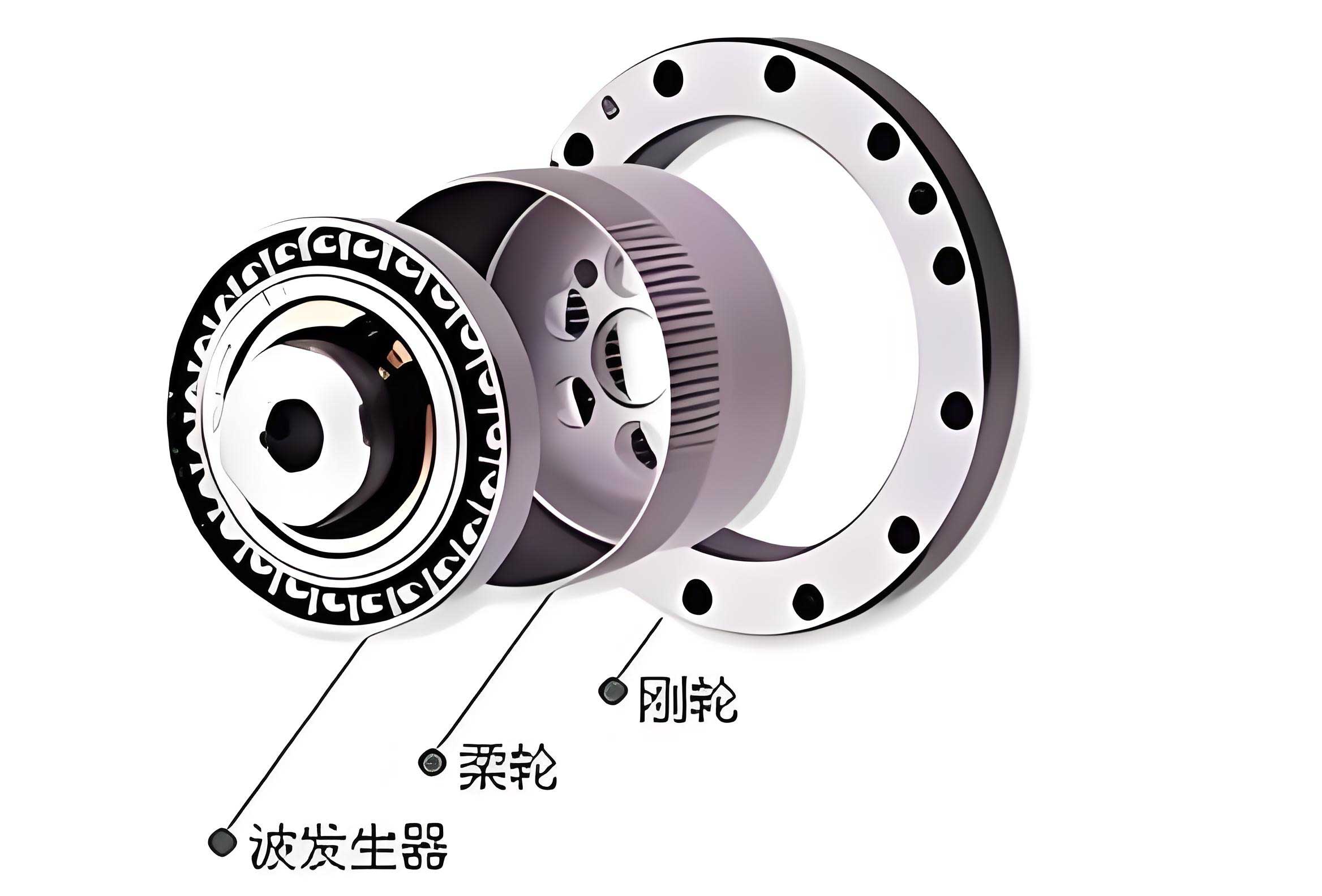
Geometric Structure of the Bell-Shaped Flexspline
The undeformed geometry of a bell-shaped flexspline is characterized by distinct zones, as illustrated in the schematic. The central functional component is the toothed rim, modeled as a cylindrical shell with a mid-surface radius \( r_m \) and an axial width \( b \). This cylindrical section transitions smoothly into the bell-shaped shell. The contour of this shell’s mid-surface is defined by a circular arc of radius \( R \) and central angle \( \theta \), which is revolved around the gear’s axis. The length of this shell section is denoted as \( L \). The bell-shaped shell connects to a circular diaphragm (or cup bottom) with radius \( R_1 \), which is rigidly attached to a flange of radius \( R_2 \) for connection to the output shaft.
| Parameter | Symbol | Description |
|---|---|---|
| Tooth Rim Mid-Surface Radius | \( r_m \) | Radius of the cylindrical toothed section. |
| Bell Curve Radius | \( R \) | Radius of the circular arc defining the shell contour. |
| Bell Curve Central Angle | \( \theta \) | The angular span of the defining circular arc. |
| Shell Length | \( L \) | Axial length of the bell-shaped shell section. |
| Cup Bottom (Diaphragm) Radius | \( R_1 \) | Radius at the connection between the shell and the cup bottom. |
Condition for Planar Deformation in a Strain Wave Gear
The goal is to derive a mathematical condition that ensures the tooth rim of the strain wave gear undergoes purely radial, planar deformation without axial displacement or tilt. We approach this by modeling the flexspline as a composite shell: the tooth rim as a cylindrical shell and the bell-shaped section as a shell of revolution. From the geometric equations of thin-shell theory in an orthogonal curvilinear coordinate system \((\alpha, \beta, \gamma)\), the mid-surface strains are given by:
$$
\begin{aligned}
\varepsilon_{1} &= \frac{1}{A} \frac{\partial u}{\partial \alpha} + \frac{1}{AB}\frac{\partial A}{\partial \beta} v + \kappa_1 w \\
\varepsilon_{2} &= \frac{1}{B} \frac{\partial v}{\partial \beta} + \frac{1}{AB}\frac{\partial B}{\partial \alpha} u + \kappa_2 w \\
\varepsilon_{12} &= \frac{A}{B} \frac{\partial}{\partial \beta} \left( \frac{u}{A} \right) + \frac{B}{A} \frac{\partial}{\partial \alpha} \left( \frac{v}{B} \right)
\end{aligned}
$$
Where \( \alpha \) and \( \beta \) are the axial and circumferential coordinates, respectively; \( A \) and \( B \) are the Lamé coefficients; \( u, v, w \) are the axial, circumferential, and radial displacements; \( \kappa_1, \kappa_2 \) are the curvatures.
For the cylindrical tooth rim, we set \( \alpha = z \) (axial coordinate), \( \beta = s \) (circumferential arc length). The parameters become: \( A=1 \), \( B = r_m \), \( \kappa_1 = 0 \), \( \kappa_2 = 1/r_m \). The condition for planar deformation is that the axial displacement \( u \) is zero across the rim. Applying \( u=0 \) to the strain-displacement relations simplifies them to:
$$
\begin{aligned}
\frac{\partial u}{\partial \alpha} &= 0 \\
\frac{1}{r_m} \frac{\partial v}{\partial \beta} + \frac{1}{r_m} w &= 0 \\
\frac{\partial v}{\partial \alpha} &= 0
\end{aligned}
$$
The third equation (\( \partial v / \partial \alpha = 0 \)) indicates that the circumferential displacement \( v \) is constant along the axial direction of the rim. The second equation shows that the radial displacement \( w \) is proportional to the circumferential derivative of \( v \). More importantly, examining the curvature changes \( \chi_1, \chi_2, \chi_{12} \) (which relate to bending and twisting) under the condition \( u=0 \) reveals that the axial curvature \( \chi_1 \) and the twist \( \chi_{12} \) of the cylindrical surface become zero. This confirms that the tooth rim deforms as a plane, moving parallel to itself without tilting. Therefore, the fundamental geometric condition for planar engagement in a bell-shaped strain wave gear is that the axial displacement at the connection between the cylindrical tooth rim and the bell-shaped shell must be zero:
$$
u_{\text{at connection}} = 0
$$
Finite Element Methodology and Iterative Solution for Geometric Conditions
While shell theory provides the necessary condition (\(u=0\)), it cannot directly yield the specific geometric relationship between the bell curve radius \(R\), its angle \(\theta\), and the rim radius \(r_m\) that satisfies this condition. To solve this, a parametric finite element model was developed. The model uses shell elements (SHELL181 in ANSYS) to represent the flexspline. Key fixed parameters were set: cup bottom radius \( R_1 = 80 \text{ mm} \), maximum imposed radial deformation \( w_0 = 0.25 \text{ mm} \), rim thickness \( \delta = 0.02 r_m \), and shell thickness \( \delta_2 = \delta / 1.5 \). The primary design variables are the radius ratio \( t = r_m / R \) and the bell curve central angle \( \theta \).
The core of the analysis is an iterative algorithm designed to find pairs \((t, \theta)\) that minimize the axial displacement at the rim-shell junction. The process is outlined below:
- Initialization: Define start values and step sizes for \( t \) and \( \theta \), and a tolerance \( \epsilon \) for the maximum allowable axial displacement.
- Model Build & Solve: For a given \((t, \theta)\), calculate \( r_m \) and \( L \) from geometric relations, build the FEA model, apply the radial deformation \( w_0 \) via contact elements simulating the wave generator, and solve.
- Check Condition: Extract the maximum axial displacement \( u_{max} \) at the rim-shell junction. If \( u_{max} \le \epsilon \), record the \((t, \theta)\) pair.
- Iterate: Increment \( \theta \) within a practical range (e.g., 0° to 90°). Once the range is covered, increment \( t \) and reset \( \theta \), repeating the process until a full design space is explored.
- Optimal Selection: From all valid pairs, select the one corresponding to the absolute minimum \( u_{max} \).
This systematic search was performed computationally. The resulting optimal relationship between the radius ratio \( t \) and the bell curve angle \( \theta \) was found and fitted with a fifth-order polynomial spline for accurate representation in design:
$$
\theta = \mathbf{C}^T \mathbf{T}_1
$$
where
$$
\mathbf{C} = \begin{bmatrix} 8.22527 \\ 101.42802 \\ -134.32174 \\ 149.66555 \\ -87.58647 \\ 21.21395 \end{bmatrix}, \quad \mathbf{T}_1 = \begin{bmatrix} 1 \\ t \\ t^2 \\ t^3 \\ t^4 \\ t^5 \end{bmatrix}
$$
The geometric relationship between the cup bottom and the rim is:
$$
\frac{R_1}{r_m} = 1 + \frac{1 – \cos \theta}{t}
$$
By analyzing Eq. (6) with the fitted \(\theta(t)\) from Eq. (5), a minimum for \( R_1/r_m \) is found at \( t \approx 0.1541 \), corresponding to \( \theta \approx 21.16^\circ \). This point represents the most material-efficient design for a given rim radius. Furthermore, parametric studies confirmed that this derived geometric condition \( \theta(t) \) is independent of the specific values chosen for \( R_1 \) and \( w_0 \), demonstrating its general validity for designing a planar-engagement strain wave gear.
| Radius Ratio \( t = r_m/R \) | Optimal Bell Angle \( \theta \) (degrees) | Remarks |
|---|---|---|
| 0.10 | 18.5 | Near the efficient design point. |
| 0.25 | 29.8 | Typical design range. |
| 0.33 | 31.7 | Example from analysis (see deformation plot). |
| 0.50 | 45.2 | Larger ratio, steeper bell contour. |
| 0.75 | 68.1 | Approaching maximum practical angle. |
Cup Bottom Stress Analysis in the Strain Wave Gear
Achieving planar engagement is only one criterion; the cup bottom must also withstand stresses without fatigue failure. The cup bottom is modeled as a circular thin plate. Its deformation is governed by the equations for axisymmetric bending and stretching, simplified by the observation that radial in-plane displacement is negligible compared to bending:
$$
\begin{aligned}
\frac{d^2 u_2}{dr^2} + \frac{1}{r} \frac{du_2}{dr} – \frac{u_2}{r^2} &= 0 \\
\frac{d^3 w_2}{dr^3} + \frac{1}{r} \frac{d^2 w_2}{dr^2} – \frac{1}{r^2} \frac{dw_2}{dr} &= 0
\end{aligned}
$$
Where \( u_2 \) and \( w_2 \) are the in-plane radial and out-of-plane (axial) displacements of the cup bottom plate, and \( r \) is the radial coordinate from the center.
The general solutions are:
$$
\begin{aligned}
u_2 &= C_1 r + \frac{C_2}{r} \\
w_2 &= C_3 \ln r + C_4 + C_5 r^2
\end{aligned}
$$
The constants \( C_1 \) through \( C_5 \) are determined from boundary conditions. The connection to the output shaft at radius \( r = C R_1 \) (where \( C \) is the ratio of shaft radius to cup radius) provides two conditions: zero axial displacement and zero slope (\( w_2 = 0, dw_2/dr = 0 \)). The most critical boundary condition comes from the junction with the bell shell at \( r = R_1 \). The axial displacement here, \( w_2(R_1) \), is not zero but is coupled to the rim’s radial deformation \( w_1 \). Finite element analysis of the optimized geometries was used to establish this relationship empirically. The displacement ratio \( u_1 = w_2(R_1) / w_1 \) was found to be independent of circumferential position and well-described as a function of the radius ratio \( t \):
$$
u_1(t) = 0.10387 + 0.92051t – 0.5122t^2 + 0.21205t^3 + 0.03423t^4
$$
Applying these three boundary conditions allows solving for \( C_3, C_4, C_5 \). The primary stress in the cup bottom arises from bending. Ignoring the small in-plane stress, the radial bending stress \( \sigma_r \) at any point \( r \) in the cup bottom can be derived as:
$$
\sigma_r = \frac{2h E u_1(t) w_1 (R_1^2 C^2 + r^2)}{ \left( 2C^2 \ln \frac{1}{C} + C^2 – 1 \right) r^2 R_1^2 }
$$
Where \( h \) is half the cup bottom thickness, \( E \) is Young’s modulus, and \( C = R_{shaft} / R_1 \). This equation reveals the profound influence of the output shaft size. Analysis shows that when the shaft radius exceeds approximately \( 0.65 R_1 \) (i.e., \( C > 0.65 \)), the denominator term \( (2C^2 \ln(1/C) + C^2 – 1) \) approaches zero, causing the bending stress \( \sigma_r \) to increase exponentially. This defines a critical design rule for the bell-shaped strain wave gear: to prevent excessive stress concentration and potential fatigue failure at the cup bottom, the output shaft radius should generally be less than 65% of the cup bottom radius.
| Shaft Ratio \( C = R_{shaft}/R_1 \) | Stress Multiplier Trend \( \propto 1/(2C^2 \ln(1/C)+C^2-1) \) | Design Implication |
|---|---|---|
| 0.3 | Low, stable | Safe, low stress. |
| 0.5 | Moderate increase | Acceptable for many applications. |
| 0.65 | Sharp increase begins | Critical threshold. Design limit. |
| 0.8 | Very high | Dangerous, high risk of failure. |
| 0.9 | Extremely high | Prohibitive. |
Conclusion
This comprehensive analysis establishes a rigorous foundation for the design of bell-shaped strain wave gears that achieve planar tooth engagement. The key findings are:
- The fundamental condition for planar deformation of the tooth rim in a strain wave gear is the elimination of axial displacement at the junction between the cylindrical rim and the contoured shell (\(u=0\)).
- The optimal geometric relationship between the bell-shaped contour (defined by radius ratio \( t = r_m/R \) and central angle \( \theta \)) required to satisfy this condition has been determined numerically and expressed as a fitted polynomial \( \theta(t) \). This relationship is universal for the design of such gears.
- The deformation coupling between the shell and the cup bottom has been quantified, yielding an empirical formula for the displacement ratio \( u_1(t) \). This bridges the shell deformation analysis with the plate theory model of the cup bottom.
- A theoretical method for calculating cup bottom stress has been developed. It reveals a critical design constraint: to avoid exponentially increasing bending stresses, the radius of the output shaft connected to the cup bottom should not exceed 65% of the cup bottom’s radius (\( C < 0.65 \)).
These results provide designers with precise tools and clear rules to develop compact, high-performance bell-shaped strain wave gears that combine the benefits of planar meshing for strength and stiffness with reliable, low-stress connections at the drive output.