
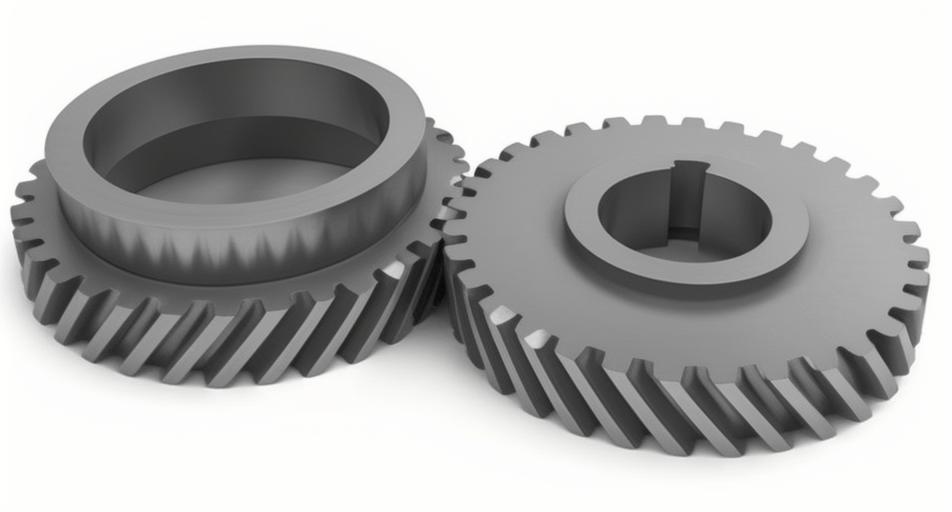
This study investigates the bending fatigue life prediction and displacement coefficient optimization of helical gears in subway vehicle transmissions. A comprehensive methodology combining finite element analysis (FEA), transient dynamics simulation, and fatigue testing was developed to improve the reliability and maintenance strategies of urban rail transit systems.
1. Dynamic Analysis of Helical Gears Under Operational Conditions
The transient dynamics of helical gears were analyzed using ABAQUS software with parameters from actual subway gearboxes. Four operational conditions were defined based on traction motor characteristics:
| Condition | Speed Range (km/h) | Torque (N·m) | Angular Velocity (rad/s) |
|---|---|---|---|
| I | 0-40 | 20,161 | 71.42 |
| II | 40-50 | 18,270 | 128.55 |
| III | 50-60 | 13,466 | 157.11 |
| IV | 60-80 | 8,400 | 204.72 |
Key findings from FEA simulations revealed:
$$ \sigma_{\text{max}} = 603.375\,\text{MPa}\ (\text{Condition I}) $$
$$ \sigma_{\text{min}} = 185.659\,\text{MPa}\ (\text{Condition IV}) $$
Two-tooth engagement states showed 15% higher root stress than three-tooth engagements, with Conditions I and II contributing most to fatigue damage accumulation.
2. Energy-Based Fatigue Life Prediction Model
A novel prediction model combining Miner’s rule and energy accumulation was developed through single-tooth bending fatigue tests:
| Stress Level (MPa) | Experimental Life (×10⁴ cycles) | Predicted Life (×10⁴ cycles) |
|---|---|---|
| 510.00 | 890.06 | 537.67 |
| 572.50 | 92.11 | 50.30 |
| 635.00 | 11.60 | 7.30 |
The energy accumulation curve was formulated as:
$$ E = C_1n^2 + C_2n + C_3 $$
Where coefficients vary with stress levels:
$$ C_1 = 1.134 \times 10^{-3}\sigma^{1.488} $$
$$ C_2 = -0.535\sigma + 10.613 $$
$$ C_3 = 0.122\sigma^2 – 146.33\sigma + 43942.74 $$
3. Displacement Coefficient Optimization
Seven displacement coefficient combinations were analyzed using FE-Safe for 18CrNiMo7-6 steel helical gears:
| Pinion x₁ | Gear x₂ | Root Stress (MPa) | Fatigue Life (cycles) |
|---|---|---|---|
| 0.35 | -0.65 | 649.0/785.8 | 4.02×10⁶/4.48×10⁵ |
| 0.55 | 0.55 | 590.3/618.3 | 1.00×10⁷/7.03×10⁶ |
| 0.65 | 1.15 | 662.5/508.8 | 3.18×10⁶/1.00×10⁷ |
The optimal solution (x₁=0.559, x₂=0.603) achieved:
$$ \sigma_{\text{eq}} = 601\,\text{MPa} $$
$$ L_{10} = 8.20 \times 10^6\,\text{cycles}\ (3.29\times\text{baseline}) $$
4. Transmission Quality Validation
Optimized helical gears demonstrated improved meshing performance:
$$ \varepsilon_\gamma = \varepsilon_\alpha + \varepsilon_\beta = 1.399 + 1.036 = 2.435 $$
Key advantages include:
- Consistent contact line length variation ≤3%
- Noise reduction through optimized pressure angle distribution
- Balanced sliding ratios (η₁/η₂ = 0.97)
Conclusion
This research establishes a systematic approach for helical gear optimization in subway applications. The displacement coefficient adjustment method improves fatigue life by 229% while maintaining transmission stability. Future work will extend this methodology to multi-stage gearboxes and different material combinations.