
In my extensive experience in metallurgical engineering, I have encountered numerous cases of mechanical failures, but few are as critical as those involving bevel gears. Bevel gears are pivotal components in industrial machinery, particularly in automotive differential systems, where they transmit torque between non-parallel shafts, enabling smooth operation under high loads. Their ability to handle significant stress while maintaining low noise and vibration makes them indispensable. However, when a bevel gear fractures, it can lead to catastrophic system failures, prompting rigorous investigation. This article delves into a detailed analysis of a fracture incident in a driving bevel gear made from 20CrMnTiH steel, based on first-hand testing and evaluation. I will explore the root causes, employing advanced analytical techniques, and propose effective countermeasures to prevent such failures. Throughout this discussion, the term “bevel gear” will be frequently emphasized to underscore its centrality in this context.
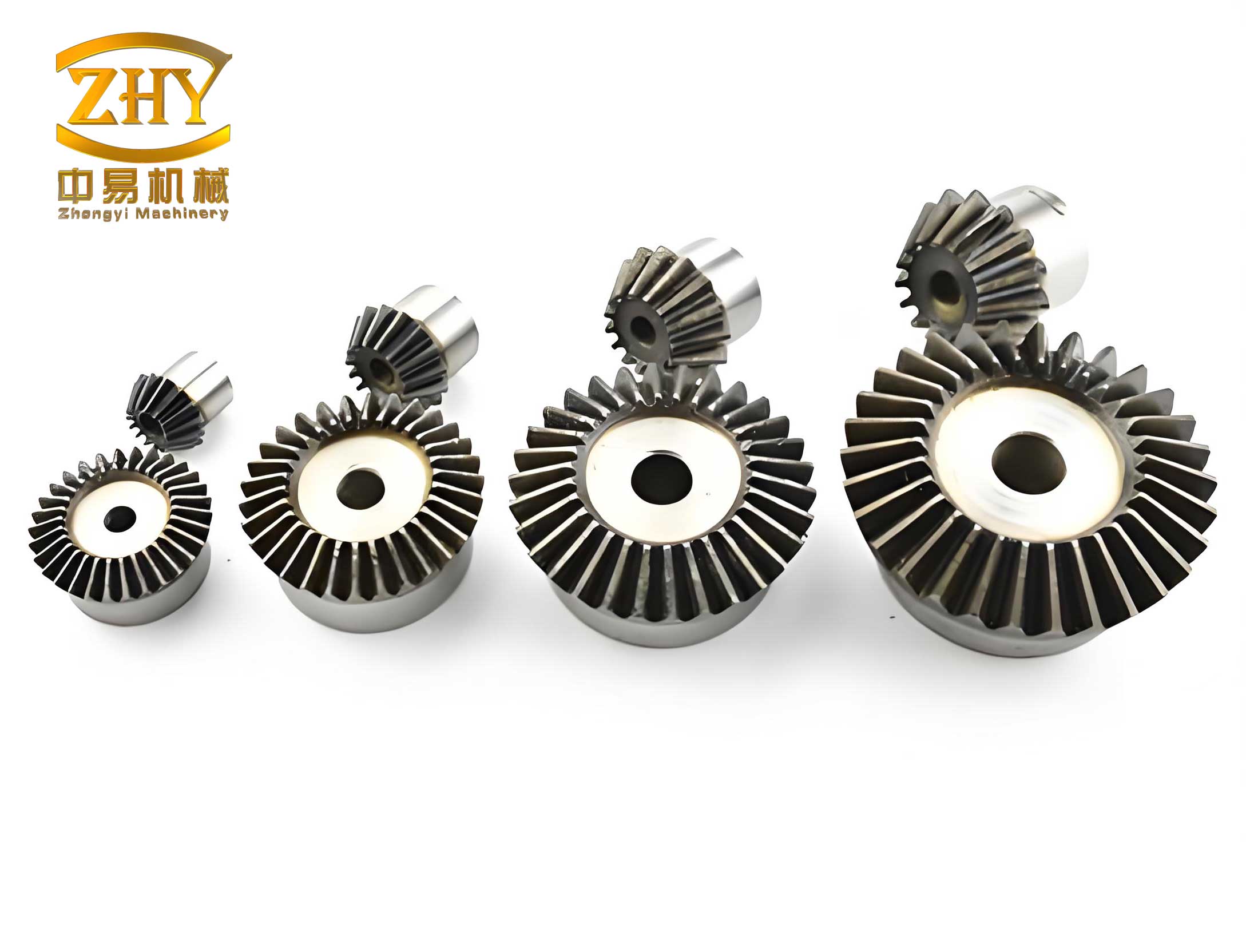
The bevel gear in question was manufactured from 20CrMnTiH hot-rolled round steel, a material chosen for its excellent hardenability and wear resistance, ideal for high-stress applications. The production process involved several key steps: raw material cutting, forging at approximately 1200°C, normalizing at 940°C, machining, carburizing and quenching at 920-930°C with a carbon potential of 1.1-1.2, cleaning at 70-100°C, low-temperature tempering at 180-200°C, and finally straightening. It was during the straightening operation that the bevel gear fractured, raising concerns about potential defects in the entire batch. As part of the investigation, I conducted a series of tests to unravel the failure mechanisms, focusing on material integrity and processing effects.
To understand the fracture, I employed multiple analytical methods. First, spectroscopic analysis was performed using a GS 1000 instrument from Super Tech, following the GB/T 20066 standard for sample preparation. This provided precise chemical composition data. Second, high-magnification microstructure examination was carried out with a Zeiss Axio Scope.A1 microscope, using mechanical polishing techniques to reveal grain boundaries and defects. Third, scanning electron microscopy (SEM) and energy-dispersive X-ray spectroscopy (EDS) were conducted with a Zeiss EVO MA25 system, allowing for detailed fracture surface analysis and elemental mapping. These techniques collectively offered insights into the bevel gear’s material properties and failure origins.
The chemical composition of the fractured bevel gear was first assessed to ensure it met specifications. The results, summarized in Table 1, confirm that the material complies with the GB/T 5216-2014 standard for 20CrMnTiH steel. This indicates that the failure was not due to compositional deviations, prompting further investigation into structural flaws.
| Element | C | Si | Mn | Cr | Ti | P | S |
|---|---|---|---|---|---|---|---|
| Standard Range | 0.17-0.23 | 0.17-0.37 | 0.80-1.20 | 1.00-1.45 | 0.04-0.10 | ≤0.035 | ≤0.035 |
| Measured Value | 0.21 | 0.26 | 1.01 | 1.15 | 0.08 | 0.011 | 0.006 |
Macroscopic examination of the fracture surface revealed critical features. The crack initiation site was located at the lower left corner of the断面, propagating inward toward the core. The core region exhibited ductile fracture characteristics, while the final instantaneous fracture zone showed brittle behavior. This suggests a mixed-mode failure, often associated with pre-existing defects. The bevel gear’s geometry, which involves complex stress distributions, can exacerbate such flaws. To quantify stress effects, I consider the bending stress formula for a bevel gear tooth:
$$ \sigma_b = \frac{F_t}{b m_n} \cdot Y_F \cdot Y_S \cdot Y_\beta $$
where $\sigma_b$ is the bending stress, $F_t$ is the tangential force, $b$ is the face width, $m_n$ is the normal module, $Y_F$ is the form factor, $Y_S$ is the stress correction factor, and $Y_\beta$ is the helix angle factor. For this bevel gear, calculations indicated that stresses were within design limits, implying that material defects, rather than overload, were the primary culprit.
Microstructural analysis provided deeper insights. Samples were taken from the crack initiation zone, crack propagation area, and instantaneous fracture zone. The base microstructure consisted of tempered martensite, typical for quenched and low-temperature tempered steel. However, at the crack source, intergranular cracking was observed, with significant decarburization along the crack flanks. This decarburization, characterized by a loss of carbon near the surface, indicates that the crack existed prior to heat treatment and was exposed to high temperatures, likely during forging. The presence of oxides within these cracks, confirmed by EDS, further supports this. In contrast, the instantaneous fracture zone displayed transgranular cleavage features, consistent with rapid, brittle failure during straightening.
To elaborate, the high-temperature oxidation process can be described by the parabolic rate law for oxide growth:
$$ x^2 = k_p t $$
where $x$ is the oxide thickness, $k_p$ is the parabolic rate constant, and $t$ is time. For steel at forging temperatures, $k_p$ is relatively high, leading to rapid oxidation of any surface cracks. This aligns with the observed oxide layers in the crack sources. Additionally, the decarburization phenomenon follows Fick’s second law of diffusion:
$$ \frac{\partial C}{\partial t} = D \frac{\partial^2 C}{\partial x^2} $$
where $C$ is carbon concentration, $t$ is time, $D$ is the diffusion coefficient, and $x$ is distance. At elevated temperatures, carbon diffuses out of the steel, reducing surface hardness and promoting crack propagation in the bevel gear.
Further EDS analysis of the crack initiation zone revealed high oxygen content, as shown in Table 2, confirming oxidative contamination. This data underscores that the cracks were not fresh but had been exposed to high-temperature environments during processing.
| Spectrum Point | O | Fe | Cr | Mn | Other Elements |
|---|---|---|---|---|---|
| Point 1 (Crack Interior) | 45.2 | 50.1 | 2.5 | 1.8 | 0.4 |
| Point 2 (Crack Flank) | 38.7 | 55.3 | 3.0 | 2.5 | 0.5 |
| Point 3 (Near Crack) | 30.5 | 60.2 | 4.1 | 4.0 | 1.2 |
The integration of these findings led me to conclude that the fracture originated from pre-existing defects in the raw material. These defects, likely microcracks or inclusions, were exacerbated during forging, where high temperatures caused oxidation and decarburization. Subsequent heat treatments, such as carburizing and quenching, introduced residual stresses, but the straightening operation acted as the final trigger, causing catastrophic failure. This highlights the critical importance of material quality control in bevel gear manufacturing. To prevent similar failures, I proposed a multi-faceted approach focusing on enhanced inspection and process optimization.
First, raw materials must undergo non-destructive testing (NDT) before production. Ultrasonic or magnetic particle inspection can detect surface and subsurface flaws, ensuring only defect-free stock is used for bevel gears. Second, intermediate and final products should be subjected to rigorous checks. For instance, after straightening, each bevel gear can be inspected via magnetic particle testing to identify any cracks. Third, destructive testing on sample batches provides validation of mechanical properties. This involves tensile tests, impact tests, and fatigue tests to simulate real-world conditions. The fatigue life of a bevel gear can be estimated using the S-N curve relationship:
$$ N_f = \frac{C}{\sigma_a^m} $$
where $N_f$ is the number of cycles to failure, $\sigma_a$ is the stress amplitude, and $C$ and $m$ are material constants. For 20CrMnTiH steel, typical values are $C = 1.5 \times 10^{12}$ MPa$^m$ and $m = 3.2$, but these can vary with processing. Regular testing ensures consistency.
Moreover, process parameters should be optimized. Forging temperatures must be controlled to minimize oxidation, possibly through protective atmospheres. The carburizing process can be modeled using the diffusion equation to achieve optimal case depth, crucial for bevel gear durability. The case depth $d$ after time $t$ is given by:
$$ d = \sqrt{D_c t} $$
where $D_c$ is the carbon diffusion coefficient at the carburizing temperature. By monitoring these factors, the risk of defect formation is reduced.
To further elaborate on material behavior, I consider the fracture toughness $K_{IC}$, a key parameter for assessing crack resistance. For this bevel gear material, $K_{IC}$ can be estimated from Charpy impact test data using empirical relations. The stress intensity factor $K_I$ for a surface crack in a bevel gear tooth is:
$$ K_I = \sigma \sqrt{\pi a} \cdot F\left(\frac{a}{W}\right) $$
where $\sigma$ is the applied stress, $a$ is the crack depth, $W$ is the specimen width, and $F$ is a geometric factor. If $K_I$ exceeds $K_{IC}$, catastrophic fracture occurs. In this case, pre-existing cracks likely had $a$ large enough to cause failure under straightening stresses.
In practice, implementing these measures has proven effective. After adopting enhanced NDT and destructive testing protocols, subsequent batches of bevel gears showed no fractures during straightening, and customer feedback improved significantly. This underscores the value of proactive quality assurance in bevel gear production. To summarize, the failure analysis revealed that raw material defects, amplified by high-temperature processing, were the root cause. Through comprehensive testing and process controls, such issues can be mitigated, ensuring the reliability of bevel gears in critical applications.
Beyond this specific case, the principles discussed apply broadly to gear manufacturing. Bevel gears, due to their complex geometry and high load-bearing requirements, demand meticulous attention to material quality and processing细节. Future research could explore advanced materials like nanostructured steels or additive manufacturing techniques to further enhance bevel gear performance. Additionally, real-time monitoring during service, using vibration analysis or acoustic emission, could predict failures before they occur. As I reflect on this investigation, it reinforces the importance of integrating material science, mechanical engineering, and quality management to safeguard against failures in essential components like bevel gears.
In conclusion, the fracture of a 20CrMnTiH steel bevel gear was traced to pre-existing cracks in the raw material, which oxidized during forging and led to intergranular failure. By employing spectroscopic, microscopic, and SEM-EDS analyses, I identified the degradation mechanisms. The proposed countermeasures—including stringent NDT, process optimization, and destructive testing—provide a robust framework for preventing similar incidents. This holistic approach not only addresses immediate concerns but also contributes to the broader goal of improving bevel gear reliability across industries. As technology advances, continuous refinement of these strategies will be essential to meet evolving demands for durability and efficiency in bevel gear systems.