
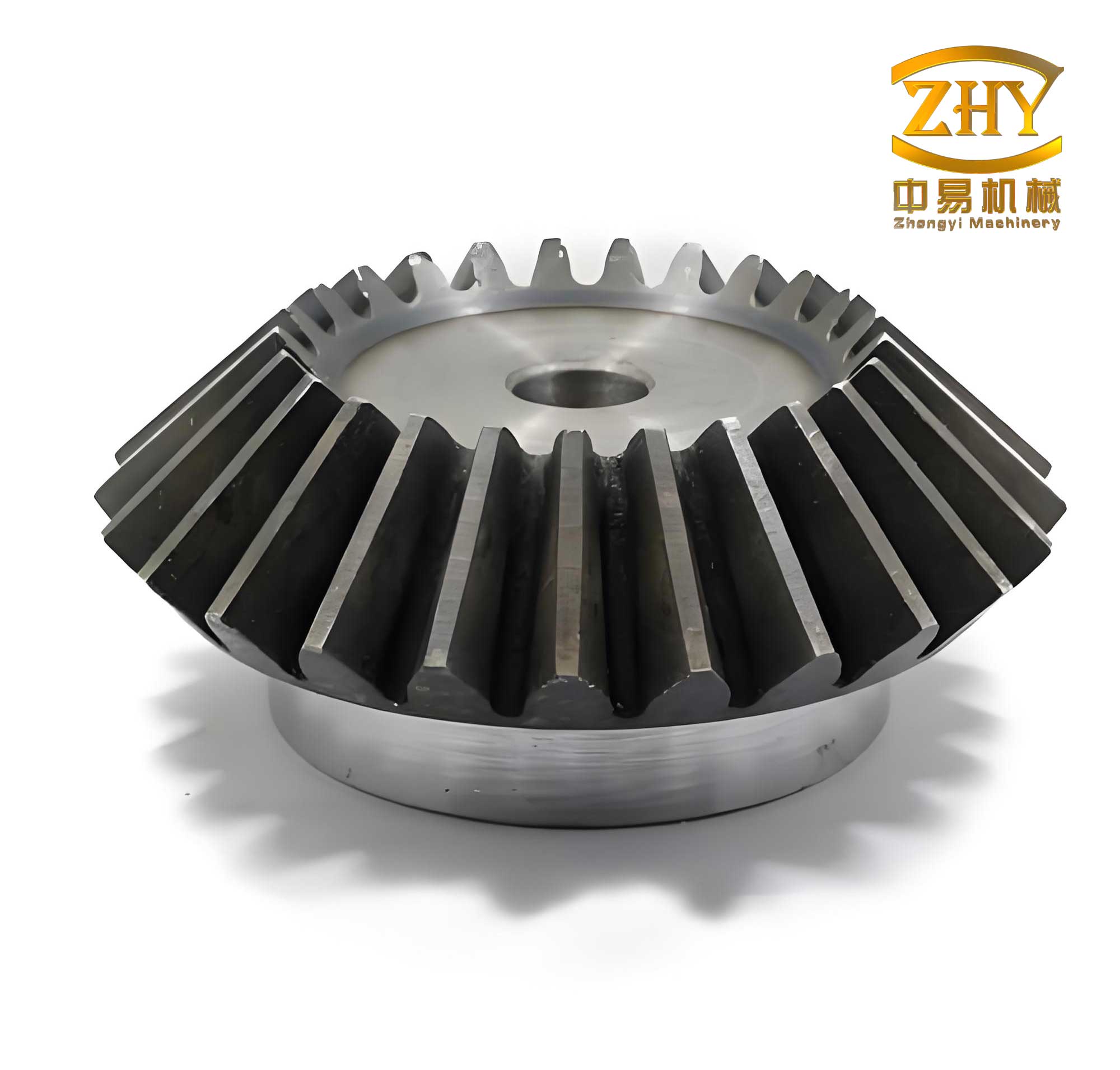
In my experience as a mechanical engineer working on aircraft transmission systems, I have encountered significant challenges in ensuring the precise operation of bevel gears within closed reducers. Bevel gears are critical components in aircraft减速转向器 (deceleration steering gears), where they transmit power at right angles while承受 varying loads. The mesh gap, or backlash, between bevel gears directly impacts the lifespan,转向 accuracy, and safety of the aircraft. However, detecting and adjusting this gap in enclosed assemblies has traditionally been inefficient and subjective, relying on complex measurements and operator expertise. This led me to design a novel detection device and method specifically for closed aircraft减速转向器 bevel gear pairs, aiming to improve efficiency, accuracy, and reliability.
The primary issue lies in the closed nature of the减速转向器. Once assembled, the bevel gears are not directly accessible, making traditional inspection methods like contact pattern checks or direct侧隙 measurements impractical. Standard gear inspection involves multiple parameters such as contact斑点, normal侧隙, mounting distance deviation, axial deviation, and shaft angle deviation, which require extensive calculations and are prone to human error. For bevel gears in aviation, where tolerances are tight (e.g., a mesh gap of 0.05–0.10 mm), a more scientific approach is needed. My goal was to create a device that simulates operating conditions, provides direct readouts, and guides precise adjustments, thereby ensuring 100% first-pass qualification rates.
The core of my design is a detection apparatus that integrates定位, clamping, measurement, and support components into a cohesive system. This device leverages the inherent features of the减速转向器, such as its花键 shafts and箱体 mounting points, to secure the assembly during testing. Key to its functionality is a measurement unit that attaches to the large bevel gear shaft, applying controlled forces via counterweights to simulate rotational motion. The resulting displacement is transferred through a measuring rod to a dial indicator, providing a direct reading of the bevel gear mesh gap. Below is a summary of the main components and their functions, presented in a table for clarity.
| Component Group | Key Parts | Function |
|---|---|---|
| Positioning & Clamping | Spline shaft, clamps, screws, nuts, washers,定位凸台 | Secures the减速转向器箱体 and small bevel gear shaft to the fixture base, preventing movement during testing. |
| Measurement Unit | Spline sleeve, counterweights,钢丝绳, measuring rod, dial indicator | Attaches to the large bevel gear shaft, applies rotational force via counterweights, and translates gear movement into a measurable displacement on the dial indicator. |
| Support Structure | Fixture base (L-shaped夹具体), dial indicator支架, support blocks | Provides a stable platform for mounting all components and the减速转向器 assembly. |
The design emphasizes several innovative features. First, the spline sleeve is split to allow easy attachment to the large bevel gear shaft, and it includes a dedicated measurement reference surface. This surface contacts the measuring rod, ensuring consistent readings. Second, counterweights are suspended from screws on either side of the sleeve, enabling bidirectional rotation (clockwise and counterclockwise) of the bevel gears under a controlled, repeatable force. This eliminates the variability introduced by manual force application, a common pitfall in traditional methods. Third, the entire system is modular, allowing for quick setup and teardown, which enhances efficiency in production environments. The use of bevel gears in this context is paramount, as the device specifically targets the meshing characteristics of these angular传动 elements.
To understand the detection principle, consider the mechanics of bevel gear meshing. The mesh gap \( j \) between two bevel gears can be defined as the angular backlash converted to a linear displacement at the pitch circle. For a pair of bevel gears, the relationship between axial adjustment and mesh gap变化 is critical. In my device, when a counterweight applies a torque \( T \) to the large bevel gear shaft, it causes rotation through an angle \( \theta \), which is constrained by the mesh with the small bevel gear. The displacement \( d \) measured at the spline sleeve’s reference surface relates directly to the angular backlash. Assuming small angles, this can be expressed as:
$$ d = r \cdot \theta $$
where \( r \) is the effective radius at the measurement point. The dial indicator reads this displacement \( d \), which corresponds to the mesh gap of the bevel gears. By applying force in both directions, we capture the total backlash, ensuring comprehensive assessment. The force applied by the counterweight is calculated based on simulating operational loads; for instance, if the减速转向器 experiences a nominal torque \( T_{\text{nom}} \) in service, the counterweight mass \( m \) is selected such that the generated torque approximates \( T_{\text{nom}} \) at the lever arm distance \( l \):
$$ T = m \cdot g \cdot l $$
where \( g \) is acceleration due to gravity. This ensures that the measured gap reflects真实 operating conditions. The process is iterative: after measurement, adjustments are made by adding or removing shims at the large bevel gear shaft or by repositioning the screw plug at the small bevel gear shaft, directly influencing the axial positions of the bevel gears and thus the mesh gap. The target gap for these aircraft bevel gears is typically 0.05–0.10 mm, a tight tolerance that demands precision.
The detection method follows a systematic procedure, which I have refined through multiple applications. Below is a step-by-step outline, complemented by a table summarizing key adjustments based on readings.
- Mount the detection apparatus on a检验平台 and secure the减速转向器箱体 to the fixture base using screws and nuts.
- Insert the spline shaft into the small bevel gear shaft’s花键孔 and fix it with support blocks and顶紧螺钉, ensuring no relative motion.
- Attach the split spline sleeve to the large bevel gear shaft, tightening it with nuts, washers, and a顶紧螺钉 to form a rigid connection.
- Install the measuring rod into the dial indicator and mount the assembly on the支架, positioning the rod tip against the reference surface on the spline sleeve. Zero the dial indicator.
- Hang the counterweight on the left-side screw to apply force for counterclockwise rotation. Record the dial indicator reading as \( d_1 \).
- Repeat step 5 with the counterweight on the right-side screw for clockwise rotation, recording the reading as \( d_2 \).
- The bevel gear mesh gap \( j \) is taken as the average or maximum displacement, typically \( j = \max(d_1, d_2) \) or based on specific protocol.
- Compare \( j \) to the allowable range (0.05–0.10 mm). If out of tolerance, adjust shims or screw plug position, then re-measure until合规.
Adjustments are guided by empirical data and the axial displacement relationship for bevel gears. The change in mesh gap \( \Delta j \) due to an axial adjustment \( \Delta x \) at one gear can be approximated using the gear geometry. For a bevel gear with pitch angle \( \alpha \), the relationship is:
$$ \Delta j \approx \Delta x \cdot \sin(\alpha) $$
This formula helps in selecting shim thicknesses. For instance, if the measured gap is 0.12 mm and needs reduction to 0.08 mm, \( \Delta j = -0.04 \) mm. Assuming a pitch angle \( \alpha = 20^\circ \), the required axial adjustment is:
$$ \Delta x = \frac{\Delta j}{\sin(\alpha)} = \frac{-0.04}{\sin(20^\circ)} \approx -0.117 \text{ mm} $$
Thus, a shim of approximately 0.12 mm would be removed or a thinner one installed. In practice, shims are available in standardized thicknesses (e.g., 0.05, 0.06, 0.10, 0.15, 0.20 mm), so combinations are used to achieve the desired correction. The table below provides typical adjustment scenarios for bevel gears in this application.
| Measured Gap \( j \) (mm) | Deviation from Target | Recommended Action | Effect on Bevel Gears |
|---|---|---|---|
| < 0.05 | Too tight | Add shims at large gear shaft or loosen screw plug at small gear shaft | Increases axial distance, enlarging mesh gap |
| 0.05–0.10 | Within tolerance | No adjustment needed | Optimal meshing for bevel gears |
| > 0.10 | Too loose | Remove shims at large gear shaft or tighten screw plug at small gear shaft | Decreases axial distance, reducing mesh gap |
The advantages of this detection system are manifold. Firstly, it provides objective, quantitative data on bevel gear mesh gaps, reducing reliance on operator skill. Secondly, the use of counterweights ensures consistent force application, mimicking real-world loads and improving measurement repeatability. Thirdly, the device is adaptable to similar closed reducers with bevel gears, making it a versatile tool in aviation manufacturing. In my implementation, this approach has boosted the average dimensional合格 rate of关键零件 by 9% (from 83% to 92%) and improved overall assembly合格 rates by 6%, demonstrating its efficacy.
From a broader perspective, the device aligns with quality management principles by enabling proactive control of bevel gear performance. It facilitates a streamlined workflow where design, manufacturing, and inspection are integrated. For example, critical bevel gear parts can be sourced from pre-approved suppliers, and模具 designs can be standardized based on feedback from this检测 method. This fosters continuous improvement in bevel gear technology, potentially leading to platform-based developments and cost reductions.
Looking ahead, there are opportunities to enhance the system further. Integrating digital sensors could automate data collection, allowing for real-time analysis and traceability. Additionally, the principles could be extended to other gear types, though the focus here remains on bevel gears due to their unique angular meshing characteristics. The mathematical models used, such as those for backlash calculation, can be refined through finite element analysis to account for elastic deformations under load. For instance, the effective mesh gap \( j_{\text{eff}} \) under operational torque \( T \) might be expressed as:
$$ j_{\text{eff}} = j_0 – \frac{T}{k} $$
where \( j_0 \) is the static gap measured by the device and \( k \) is the stiffness of the bevel gear pair. This highlights the importance of simulating working conditions accurately.
In conclusion, the development of this bevel gear mesh gap detection device represents a significant advancement in aircraft transmission quality assurance. By combining mechanical ingenuity with systematic methodology, it addresses long-standing challenges in closed assembly inspection. The device not only ensures precise gap adjustments for bevel gears but also promotes a culture of data-driven decision-making in aerospace engineering. As bevel gears continue to be vital in aviation and other high-precision industries, such tools will play a crucial role in achieving reliability and efficiency. My ongoing work involves disseminating these practices across teams and exploring applications in next-generation aircraft reducers, always with a focus on optimizing bevel gear performance.