
The design and optimization of bevel gear transmissions represent a fundamental yet complex challenge in mechanical engineering. Traditional design methods often rely on iterative manual calculations or simplified models, which can be time-consuming, inefficient, and may not converge on a globally optimal solution. The intricate geometry of bevel gears, involving parameters like cone angles, module, and face width, interacts in a highly nonlinear fashion with performance constraints such as contact stress, bending stress, and system reliability. This complexity demands sophisticated optimization techniques capable of navigating multimodal design spaces.
The advent of intelligent optimization algorithms and powerful computational frameworks offers a promising pathway. This article details the development and implementation of a web-based optimization system for bevel gears that synergistically combines a Genetic Algorithm (GA) for robust global search with the .NET platform for accessible, remote application deployment. The core innovation lies in integrating a fuzzy reliability model directly into the GA’s constraint handling, moving beyond deterministic safety factors to account for the inherent randomness and fuzziness in material strength and loading conditions. The system’s architecture enables engineers to perform high-fidelity optimization of bevel gear pairs through a standard web browser, dramatically improving design efficiency and quality.
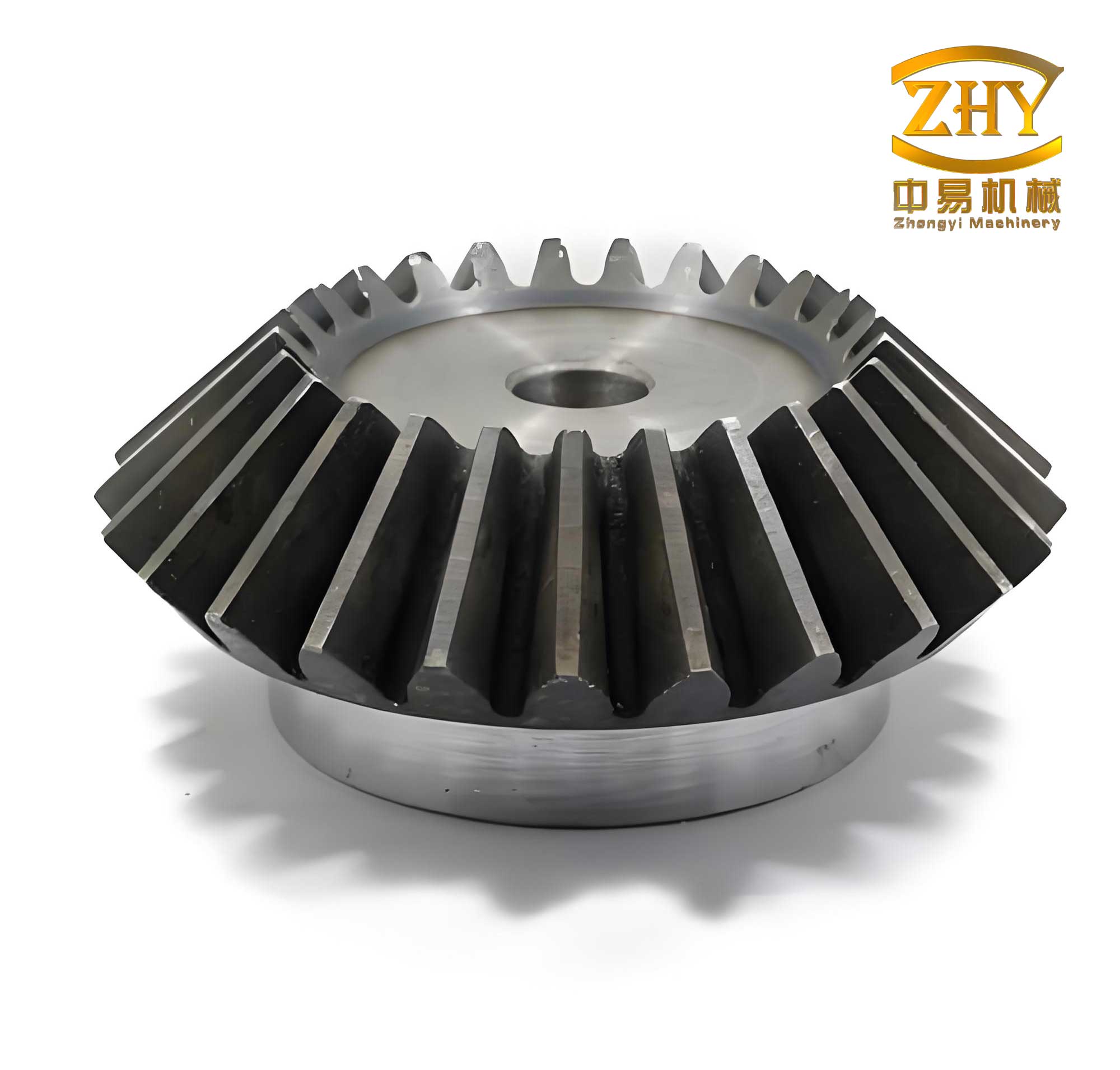
System Architecture and Key Technologies
The optimization system is constructed on a three-tier Browser/Server (B/S) model. This architecture decouples the user interface, business logic, and computational core, facilitating maintainability, scalability, and remote access. Asynchronous JavaScript and XML (AJAX) techniques are employed to create a responsive user experience, allowing for dynamic data exchange with the server without requiring full page reloads.
The architectural workflow is as follows:
- Presentation Layer (Client Browser): The user inputs design requirements—such as transmitted power, input speed, gear ratio, shaft angle, material properties, and target reliability—via a structured web form. This data is packaged into a request object.
- Business Logic Layer (.NET Web Server): The server receives the request, validates the data, and prepares it for processing. Its critical role is to act as a bridge between the client and the computational engine.
- Data Access/Computation Layer (MATLAB Engine): The prepared parameters are passed to a MATLAB environment where the core Genetic Algorithm, formulated with the fuzzy reliability constraints, is executed. This layer performs the heavy computational lifting.
- Result Return: The optimization results (optimal parameters, performance metrics, convergence history) are sent back through the business logic layer, formatted, and finally rendered dynamically in the user’s browser.
The seamless integration between the .NET platform (using C#) and MATLAB is achieved through a specific project build process. The MATLAB code containing the GA and the bevel gear models is compiled into a .NET assembly (a .dll file). This assembly is then referenced within the C# web application, allowing the server-side code to instantiate MATLAB classes and call their methods directly, passing and receiving data via specialized array types (MWNumericArray). This hybrid programming approach leverages MATLAB’s superior mathematical and algorithmic toolboxes while utilizing the .NET framework’s robust web development and deployment capabilities.
Mathematical Modeling for Optimization
The optimization problem is formulated with the primary objective of minimizing the total volume (and thus the weight and material cost) of the bevel gear pair, subject to rigorous performance constraints based on fuzzy reliability.
Design Variables
The independent variables defining the geometry of a straight bevel gear pair are selected as:
$$ \mathbf{x} = [z_1, m, \psi_R]^T = [x_1, x_2, x_3]^T $$
where:
- $z_1$: Number of teeth on the pinion.
- $m$: Module at the large end of the bevel gear.
- $\psi_R$: Face width coefficient, where the face width $b = \psi_R R$, and $R$ is the cone distance.
Objective Function: Volume Minimization
The combined volume $V_{total}$ of the pinion and gear is derived from the geometry of two truncated cones. For a gear with pitch diameter $d$, cone distance $R$, face width $b$, and pitch cone angle $\delta$, the volume can be approximated. For a pair with a shaft angle $\Sigma = 90^\circ$, the objective function is:
$$ \text{minimize: } f(\mathbf{x}) = V_1 + V_2 $$
$$ V_1 = \frac{\pi}{3} b \cos\delta_1 \left[ \left(\frac{m z_1}{2}\right)^2 + \frac{m z_1}{2} \cdot \frac{(R-b)}{R} \cdot \frac{m z_1}{2} + \left( \frac{(R-b)}{R} \cdot \frac{m z_1}{2} \right)^2 \right] $$
$$ V_2 = \frac{\pi}{3} b \cos\delta_2 \left[ \left(\frac{m z_2}{2}\right)^2 + \frac{m z_2}{2} \cdot \frac{(R-b)}{R} \cdot \frac{m z_2}{2} + \left( \frac{(R-b)}{R} \cdot \frac{m z_2}{2} \right)^2 \right] $$
where $z_2 = u \cdot z_1$ (gear ratio), $R = \frac{m}{2} \sqrt{z_1^2 + z_2^2}$, $\delta_1 = \arctan(z_1/z_2)$, and $\delta_2 = 90^\circ – \delta_1$.
Constraints Based on Fuzzy Reliability
Instead of traditional deterministic constraints (e.g., contact stress ≤ allowable stress), a fuzzy reliability model is adopted. This approach recognizes that both the induced stress ($S$) and the material strength ($\delta$) are random variables. Furthermore, the fatigue strength limit is treated as a fuzzy variable with a normal membership function $H_A(x)$, accounting for epistemic uncertainties.
It is assumed that the contact stress $S_H$ and bending stress $S_F$ follow normal distributions, $N(\mu_S, \sigma_S^2)$. The fuzzy fatigue strength $\delta$ has a membership function:
$$ H_A(x) = \exp\left( -\frac{(e_x – a)^2}{D} \right) $$
where $a$ and $D$ are parameters derived from material fatigue properties (e.g., a Gerber equation), and $e_x$ represents the stress level.
The fuzzy failure probability for a given stress component (contact or bending) is calculated by integrating over the fuzzy strength domain:
$$ P_x(A) = \sqrt{\frac{D}{2\sigma_{S_x}^2 + D}} \cdot \exp\left[ -\frac{(a – \mu_{S_x})^2}{2\sigma_{S_x}^2 + D} \right] \cdot \left[ h(y_1) + h(y_2) \right] $$
where $h(\cdot)$ is the standard normal distribution function, and $y_1, y_2$ are integration bounds related to the support of $H_A(x)$.
The fuzzy reliability $R_x$ for that failure mode is $R_x = 1 – P_x(A)$. The optimization constraints are then formulated to ensure this reliability meets or exceeds a designer-specified target $R’$ (e.g., 0.995):
- Contact Fatigue Reliability Constraint: $g_1(\mathbf{x}) = 1 – P_H(A) – R’ \geq 0$
- Bending Fatigue Reliability Constraint: $g_2(\mathbf{x}) = 1 – P_F(A) – R’ \geq 0$
Additional geometric constraints (e.g., minimum pinion teeth to avoid undercutting, bounds on module and face width coefficient) are also applied as simple boundary limits.
Genetic Algorithm Implementation
The formulated problem—a nonlinear, constrained minimization with three variables—is solved using MATLAB’s GA toolbox. The `ga` function is configured to search for the optimum:
$$ [\mathbf{x}_{opt}, f_{val}] = \text{ga}(@fitnessfun, nvars, A, b, Aeq, beq, lb, ub, @nonlcon, options) $$
where `@fitnessfun` is the volume function $f(\mathbf{x})$, `@nonlcon` is the function containing constraints $g_1(\mathbf{x})$ and $g_2(\mathbf{x})$, and `lb`, `ub` are the lower and upper bounds on $\mathbf{x}$. The algorithm’s parameters (population size, crossover fraction, mutation rate, etc.) are tuned for balance between exploration and convergence speed in the context of bevel gear design.
System Functionality and Optimization Analysis
The web interface is designed for usability. A primary input panel allows the entry of all necessary operational and material parameters for the bevel gear pair. Upon submission, the system invokes the backend GA process.
The results are presented comprehensively:
- Optimal Design Parameters: The final values for $z_1$, $m$, and $\psi_R$.
- Convergence Plot: A graph showing the best and mean fitness value (volume) across generations, visualizing the GA’s progression toward the optimum.
- Performance Verification: Calculation of the resulting contact and bending safety factors, precise reliability values, and the total volume.
For a case study involving a closed-drive straight bevel gear pair with a $90^\circ$ shaft angle, transmitting a specified power and speed, the system yields a clear optimal design. The GA typically converges within 100 generations, identifying a combination that minimizes volume while satisfying all fuzzy reliability constraints.
Comparative Analysis of Results
The superiority of the proposed integrated system and the fuzzy reliability approach is validated through comparison.
Table 1: Algorithm Efficacy Comparison
| Optimization Method | Key Parameters ($z_1, m, \psi_R$) | Optimal Volume (mm³) | Computational Load |
|---|---|---|---|
| Proposed GA (Fuzzy Reliability) | 20, 2.0, 0.25 | 58,119.2 | Moderate (suited for web) |
| MATLAB `fmincon` (Fuzzy Reliability) | 19.63, 2.0, 0.25 (unrounded) | 56,653.1 | Higher |
| MATLAB `fmincon` (Fuzzy Reliability, Rounded) | 20, 2.0, 0.25 | 58,119.2 | Higher |
The table shows that while a traditional nonlinear solver (`fmincon`) can find a similar optimum, its computational load is higher and less predictable, making it less suitable for a responsive web application. The Genetic Algorithm provides a robust and efficient alternative for the B/S environment. More importantly, the result matches after practical rounding of the pinion teeth to an integer, proving the GA’s effectiveness.
Table 2: Constraint Methodology Comparison
| Constraint Type in GA | Key Parameters ($z_1, m, \psi_R$) | Optimal Volume (mm³) | Satisfies Traditional Strength Check? | Achieved Fuzzy Reliability |
|---|---|---|---|---|
| Fuzzy Reliability | 20, 2.0, 0.25 | 58,119.2 | Yes | > 0.995 |
| Traditional Deterministic | 19, 2.0, 0.25 | 49,830.6 | Yes | ≈ 0.890 |
This comparison is critical. A design optimized using only traditional stress-based constraints achieves a smaller volume. However, when evaluated under the more rigorous fuzzy reliability model, its predicted reliability drops significantly below the acceptable threshold (0.995). This demonstrates that traditional methods can produce seemingly valid but potentially unreliable designs. The proposed system, by embedding fuzzy reliability directly into the optimization loop, guarantees the final design meets the specified probabilistic safety target, offering a more scientifically rigorous and safer outcome for bevel gear transmissions.
Conclusion
This work successfully establishes a framework for the optimal design of bevel gear transmissions by integrating a Genetic Algorithm with a fuzzy reliability model on a .NET-based web platform. The system addresses key shortcomings of conventional design processes: inefficiency, lack of global optimality assurance, and reliance on deterministic safety factors. The B/S architecture makes advanced optimization accessible from any standard browser, promoting collaborative and efficient design workflows. The mathematical formulation prioritizing volume minimization under fuzzy reliability constraints ensures that the resulting bevel gear designs are not only lightweight and material-efficient but also possess a quantifiable and high probability of successful operation. The comparative analyses validate that the GA is effective for this domain and that the fuzzy reliability approach is essential for generating truly robust designs, marking a significant step towards more intelligent and reliable mechanical power transmission design.