
In my years of experience as a maintenance engineer, I have encountered numerous challenges related to power transmission systems, particularly with bevel gears. Bevel gears are crucial components in various machinery, such as drilling machines, automotive differentials, and industrial equipment, where torque must be transmitted between intersecting shafts. Their complex geometry and high precision requirements make them prone to issues like excessive noise, vibration, and premature failure if not properly manufactured or maintained. This article delves into the on-site inspection techniques for bevel gears, focusing on radial runout assessment, fault diagnosis, and practical solutions derived from real-world scenarios. Throughout this discussion, I will emphasize the importance of understanding bevel gears’ intricacies to ensure reliable operation.
Bevel gears come in various types, including straight, spiral, and hypoid, each with unique characteristics. Straight bevel gears, like those in the original case, have straight teeth that converge at the apex of the conical pitch surface. Key parameters define their performance, such as diametral pitch, pressure angle, number of teeth, and pitch diameter. For instance, in a typical pair of straight bevel gears, the pinion (small gear) and the gear (large gear) must mesh accurately to minimize noise and wear. Below is a table summarizing common parameters for bevel gears, which I often refer to during inspections.
| Parameter | Symbol | Description | Typical Value Range |
|---|---|---|---|
| Diametral Pitch | P | Number of teeth per inch of pitch diameter | 5 to 20 |
| Pressure Angle | α | Angle between tooth profile and radial line | 20° or 25° |
| Number of Teeth (Pinion) | z₁ | Teeth count on the smaller gear | 10 to 30 |
| Number of Teeth (Gear) | z₂ | Teeth count on the larger gear | 20 to 60 |
| Pitch Diameter | d | Diameter of the pitch circle | Varies with application |
| Chordal Height | h_c | Height from chord to tooth tip | Calculated based on design |
| Chordal Thickness | t_c | Thickness at the pitch circle | Calculated based on design |
The geometry of bevel gears can be analyzed using mathematical formulas. For example, the pitch diameter for a bevel gear is related to the number of teeth and diametral pitch: $$d = \frac{z}{P}$$ where \(d\) is the pitch diameter, \(z\) is the number of teeth, and \(P\) is the diametral pitch. Another critical aspect is the chordal thickness, which is used in inspection. The theoretical chordal thickness at the pitch circle is given by: $$t_c = d \cdot \sin\left(\frac{90^\circ}{z}\right)$$ This formula assumes standard conditions, but in practice, adjustments are needed for backlash and tolerance. Understanding these parameters is essential when diagnosing issues with bevel gears, as deviations can lead to operational problems.
In one memorable instance, I was tasked with repairing a vertical drilling machine that exhibited a continuous, loud noise after replacing a pair of straight bevel gears. The old bevel gears, though worn, did not produce such noise, and the bevel gear generator machine used for manufacturing seemed accurate. This led me to suspect radial runout of the gear tooth ring as the primary cause. Radial runout, or tooth-to-tooth composite error, occurs when the gear’s axis of rotation does not coincide with its geometric axis, often due to misalignment during cutting. For bevel gears, this can result in uneven loading and excessive noise. The standard inspection method, as per guidelines like ISO 1328, involves precise gauges, but in field conditions, such equipment might be unavailable. Therefore, I developed an alternative approach using chordal thickness measurements to assess radial runout qualitatively.
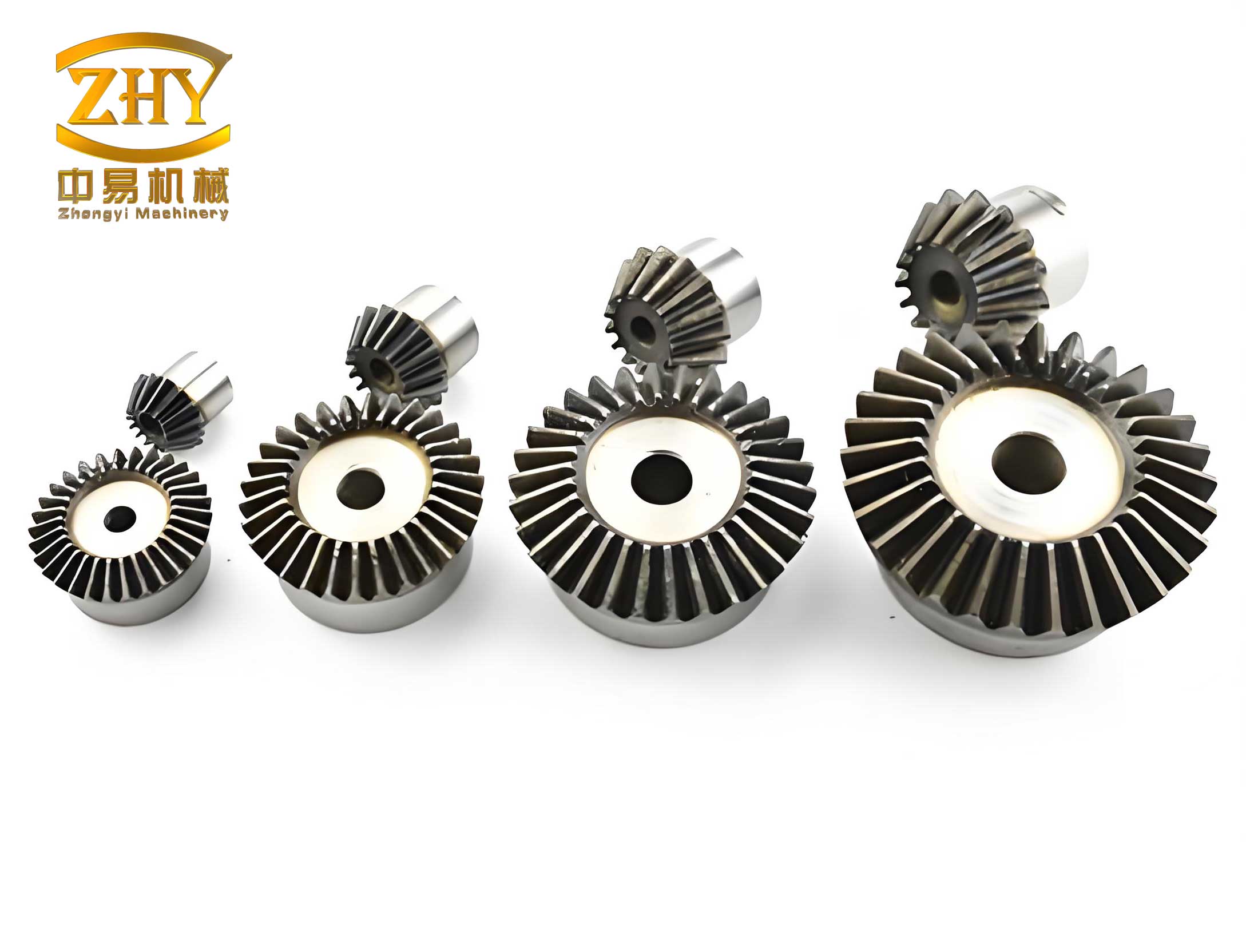
My on-site inspection process for bevel gears begins with checking the radial runout of the gear tip circle, which is relatively straightforward using dial indicators. If this is within tolerance, I proceed to the tooth ring radial runout. Instead of specialized tools, I measure the chordal thickness at the pitch circle for each tooth. For a gear with an even number of teeth, pairs of teeth directly opposite each other (180° apart) are grouped; for odd numbers, the grouping is adjusted to near-opposite positions. By comparing the chordal thickness within each group, I can identify inconsistencies. If the thickness varies significantly between teeth, it indicates radial runout. The maximum difference in chordal thickness, denoted as Δt_max, serves as a proxy for the error magnitude. This method is not as precise as laboratory techniques but is sufficient for go/no-go decisions in maintenance contexts.
To quantify the radial runout error, I adapt formulas from gear modification theory. In profile-shifted gears, the radial displacement is analogous to runout. For a bevel gear, the radial runout error ΔF_r can be approximated using the chordal thickness difference. Considering that the radial runout causes one tooth to have increased thickness and the opposite tooth decreased thickness, the relationship can be expressed as: $$\Delta F_r \approx \frac{\Delta t_{\text{max}}}{2 \cdot \tan(\alpha)}$$ where α is the pressure angle. This derivation assumes small angles and linear behavior, which is reasonable for typical bevel gears. For example, in the case I handled, the large bevel gear had parameters: diametral pitch P = 10, pressure angle α = 20°, number of teeth z₂ = 40. The measured chordal thickness values varied, with Δt_max = 0.15 mm. Substituting into the formula: $$\Delta F_r \approx \frac{0.15}{2 \cdot \tan(20^\circ)} \approx \frac{0.15}{0.7279} \approx 0.206 \text{ mm}$$ Comparing this to the tolerance from standards like ISO 1328, where for an equivalent virtual gear with pitch diameter d_v = 100 mm, the allowable radial runout might be around 0.05 mm, the calculated error was over four times higher, confirming excessive runout and justifying rejection of the gear.
This experience underscores the importance of rigorous inspection for bevel gears. Radial runout is just one of many potential faults; others include tooth surface wear, pitting, and misalignment. To aid in comprehensive diagnosis, I often use vibration analysis, especially for high-speed applications. Vibration spectra can reveal faults in bevel gears and associated components like bearings. For instance, in a paper mill dryer system, I once analyzed vibration data from a roller equipped with bevel gears. The spectrum showed peaks at characteristic frequencies, indicating bearing outer race spalling. The fault frequency for a rolling element bearing is given by: $$f_o = \frac{z \cdot n}{2} \left(1 – \frac{d_b}{D_p} \cos(\beta)\right)$$ where \(f_o\) is the outer race fault frequency, \(z\) is the number of rolling elements, \(n\) is the rotational speed in Hz, \(d_b\) is the ball diameter, \(D_p\) is the pitch diameter, and \(\beta\) is the contact angle. By matching these frequencies with observed peaks, I diagnosed the issue accurately. Below is a table summarizing common fault frequencies for bevel gear systems, which I use as a reference.
| Fault Type | Characteristic Frequency | Typical Symptoms |
|---|---|---|
| Gear Mesh Frequency | $$f_m = z \cdot n$$ | High noise at gear engagement rate |
| Radial Runout | $$f_r = n$$ (once per revolution) | Periodic thickness variation |
| Bearing Outer Race Defect | $$f_o = \frac{z}{2} \cdot n \left(1 – \frac{d_b}{D_p} \cos(\beta)\right)$$ | Spalling or pitting vibrations |
| Bearing Inner Race Defect | $$f_i = \frac{z}{2} \cdot n \left(1 + \frac{d_b}{D_p} \cos(\beta)\right)$$ | Similar to outer race but modulated |
| Tooth Root Crack | Sidebands around \(f_m\) | Localized stress concentrations |
Beyond inspection, proper lubrication is vital for bevel gears’ longevity. In another case, involving high-speed centrifugal fans with bevel gear drives, I addressed chronic oil leakage by switching from oil bath lubrication to grease. The selection of lubricant depends on factors like the speed parameter \(n \cdot d_m\), where \(n\) is speed in rpm and \(d_m\) is the mean bearing diameter in mm. For values above 500,000 mm·rpm, grease might be suitable if chosen correctly. I opted for a lithium-based grease with molybdenum disulfide additive, which has a dropping point above 180°C and works well for speeds up to 10,000 rpm under moderate loads. The grease quantity should fill about one-third of the housing to allow heat dissipation. The relubrication interval can be estimated using: $$T = \frac{K}{\sqrt{n}} \cdot d_m^{1.5}$$ where \(T\) is the service time in hours, and \(K\) is a constant typically around 10 for industrial fans. This change eliminated leakage and reduced maintenance costs, highlighting how bevel gears’ performance is intertwined with ancillary systems.
Manufacturing accuracy for bevel gears is paramount. In the original case, the faulty large bevel gear was recut on the same bevel gear generator after recalibration, and the noise disappeared upon installation. This underscores that machine tool alignment is critical. The cutting process for bevel gears involves complex kinematics, and errors can propagate. For straight bevel gears, the tooth profile is generated using a planing or milling process, where the cutter must maintain precise orientation relative to the gear blank. Any deviation in the workpiece spindle can cause radial runout. To mitigate this, I recommend regular machine tool verification using master gears or laser alignment. Additionally, the use of statistical process control (SPC) can help monitor key dimensions like chordal thickness during production. The formula for process capability index \(C_pk\) for bevel gear thickness is: $$C_{pk} = \min\left(\frac{USL – \mu}{3\sigma}, \frac{\mu – LSL}{3\sigma}\right)$$ where \(USL\) and \(LSL\) are the upper and lower specification limits, \(\mu\) is the mean thickness, and \(\sigma\) is the standard deviation. A \(C_{pk}\) above 1.33 indicates a capable process for bevel gears.
In field maintenance, when replacing bevel gears, I always conduct a run-in procedure to ensure proper meshing. This involves running the gears at reduced load and speed initially, then gradually increasing to full operation while monitoring temperature and noise. For bevel gears, the contact pattern can be checked using marking compounds; a centered pattern indicates good alignment. Misalignment can lead to edge loading and accelerated wear. The wear rate for bevel gears can be modeled using Archard’s equation: $$V = k \cdot \frac{W \cdot s}{H}$$ where \(V\) is the wear volume, \(k\) is a wear coefficient, \(W\) is the normal load, \(s\) is the sliding distance, and \(H\) is the hardness. For bevel gears, sliding occurs due to the varying radius along the tooth, so proper lubrication reduces \(k\).
To summarize, bevel gears are sophisticated components requiring diligent inspection and maintenance. My approach combines practical field methods with theoretical insights. For radial runout assessment, chordal thickness measurement provides a quick check, complemented by vibration analysis for dynamic faults. Lubrication and alignment are equally important. Over the years, I have refined these techniques through trial and error, and they have proven effective in ensuring the reliability of machinery involving bevel gears. The key takeaway is that understanding the fundamentals of bevel gears—from geometry to fault mechanisms—empowers engineers to preempt failures and optimize performance. As technology advances, tools like digital twins and IoT sensors may enhance monitoring, but the core principles remain rooted in sound engineering practice.
In conclusion, bevel gears play a pivotal role in mechanical systems, and their health directly impacts operational efficiency. Through this narrative, I have shared insights on inspection methodologies, error calculation, and holistic maintenance strategies. Whether dealing with noise issues in drilling machines or leakage in fans, a systematic approach focused on bevel gears can yield significant improvements. I encourage fellow practitioners to adopt these practices and continuously learn from real-world challenges. After all, the durability of bevel gears is not just about manufacturing precision but also about vigilant upkeep in the field.