
In modern mechanical engineering, gear shafts play a critical role in transmitting power and motion within various machinery, such as construction equipment, automotive systems, and industrial gearboxes. To enhance the durability and performance of these gear shafts, carburizing treatment is widely employed, as it improves surface hardness, wear resistance, and fatigue strength while maintaining a tough core. However, traditional carburizing processes often involve high temperatures, prolonged treatment times, and significant energy consumption, leading to increased costs and potential distortions in gear shafts. In recent years, the development of BH energizing agents has revolutionized carburizing by accelerating the process, reducing temperatures, and minimizing deformation. This study focuses on the application of BH energizing craft specifically for gear shafts, leveraging first-hand experimental data to explore its mechanisms, benefits, and practical implications. We aim to provide a comprehensive analysis that underscores the importance of this technology in optimizing gear shaft manufacturing.
The fundamental principle behind BH energizing craft lies in its ability to enhance carburizing efficiency through multiple mechanisms. Firstly, the BH agent contains trace components that undergo explosive decomposition, generating intermittent shockwaves. These shockwaves disrupt the gas film layer on the surface of gear shafts, thereby increasing the contact between active carbon species and the material. This phenomenon can be analogized to pressure pulsation in fluidized bed or vacuum carburizing systems, where periodic pressure changes improve diffusion kinetics. Mathematically, the enhancement in surface activation can be modeled using a modified Arrhenius equation for reaction rates: $$ k = A \exp\left(-\frac{E_a}{RT}\right) + \Delta k_{\text{BH}} $$ where \( k \) is the effective rate constant, \( A \) is the pre-exponential factor, \( E_a \) is the activation energy, \( R \) is the gas constant, \( T \) is the temperature, and \( \Delta k_{\text{BH}} \) represents the additional contribution from BH energizing due to increased surface activity. Secondly, the BH agent promotes the decomposition of carburizing atmospheres, producing positively charged carbon ions (e.g., \( \text{C}^{4+} \)) alongside neutral carbon atoms. These ions, being smaller and more reactive, diffuse more rapidly into the austenite matrix of gear shafts, overcoming diffusion barriers. The diffusion process can be described by Fick’s second law: $$ \frac{\partial C}{\partial t} = D \frac{\partial^2 C}{\partial x^2} $$ where \( C \) is the carbon concentration, \( t \) is time, \( D \) is the diffusion coefficient (which may be enhanced by BH energizing), and \( x \) is the depth from the surface. With BH energizing, \( D \) effectively increases, leading to faster carburizing. Thirdly, the agent includes decomposition accelerants that ensure steady gas generation, inhibiting soot formation and improving atmosphere stability. This allows carburizing to initiate at lower temperatures (as low as 880°C), reducing thermal stress and distortion in gear shafts. Overall, these mechanisms collectively contribute to a more efficient and controlled carburizing process for gear shafts, making BH energizing a valuable innovation in heat treatment technology.
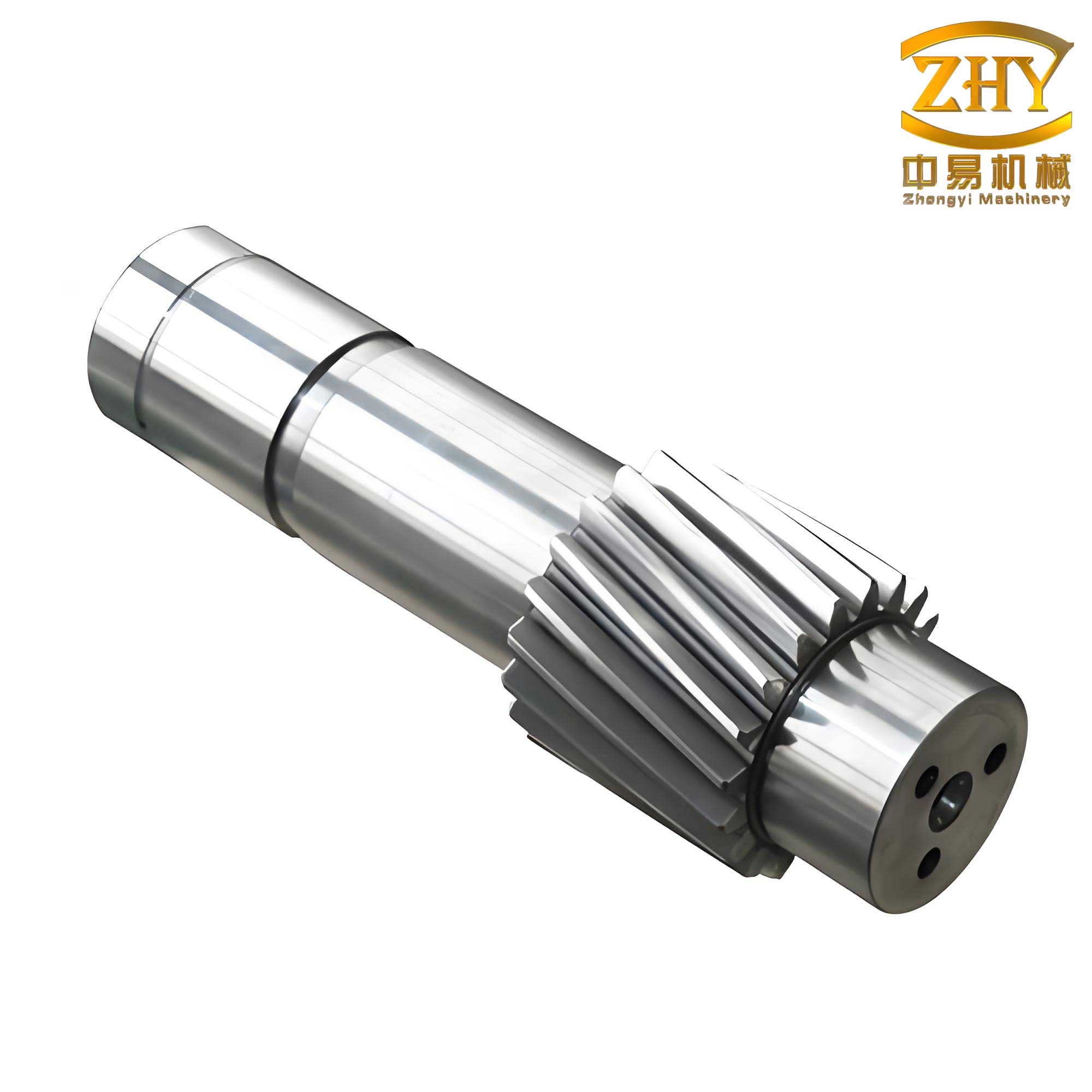
In our experimental investigation, we utilized gear shafts made from 20CrMnTi steel, a common material for high-strength applications due to its excellent hardenability and toughness. The gear shafts, with a module of \( m = 12 \), were subjected to carburizing in an IPSEN multi-chamber furnace (model TQF-27-ERM). We designed two distinct process routes: a conventional carburizing method and a BH energizing-assisted method. For both processes, the carburizing temperature was maintained at \( 920 \pm 10^\circ \text{C} \) to ensure comparability, but the BH process involved shortened treatment times based on the accelerative effects of the energizing agent. The key parameters for each process are summarized in Table 1, which illustrates the time reduction achieved with BH energizing. This approach allowed us to directly assess the impact of BH energizing on carburizing kinetics for gear shafts without altering other variables.
| Process Stage | Conventional Process Time (h) | BH Energizing Process Time (h) |
|---|---|---|
| Heating | 1.5–2 | 1.5–2 |
| Strong Carburizing | 14 | 11.5 |
| Diffusion | 3 | 2 |
| Cooling | 2 | 2 |
| Quenching Hold | 1 | 1 |
| Total Time | 21.5–22 | 18–18.5 |
The reduction in total carburizing time by approximately 16% for gear shafts treated with BH energizing highlights the efficiency gains. To quantify this, we can express the carburizing speed enhancement factor \( \eta \) as: $$ \eta = \frac{t_{\text{conventional}} – t_{\text{BH}}}{t_{\text{conventional}}} \times 100\% $$ where \( t_{\text{conventional}} \) and \( t_{\text{BH}} \) are the total times for conventional and BH processes, respectively. For our gear shafts, \( \eta \approx 16\% \), indicating significant time savings. This acceleration is particularly beneficial for high-volume production of gear shafts, as it lowers energy consumption and increases throughput. Moreover, the shortened exposure to high temperatures reduces the risk of grain growth and distortion, which are critical concerns for precision components like gear shafts.
Following carburizing, we evaluated the effective case depth of the gear shafts using micro-hardness testing. The criterion for effective depth was set at a hardness value greater than 515 HV. The results, presented in Table 2, demonstrate that BH energizing not only speeds up the process but also enhances the carburizing depth for gear shafts. This can be attributed to the improved diffusion kinetics discussed earlier. The increased depth contributes to better load-bearing capacity and fatigue resistance in gear shafts, essential for demanding applications.
| Process Type | Surface Carbon Content (%) | Effective Case Depth (mm) |
|---|---|---|
| Conventional Carburizing | 0.75 | 2.09 |
| BH Energizing | 0.78 | 2.19 |
To further analyze the microstructural effects, we examined the metallographic organization of the gear shafts. Samples were sectioned from the tooth regions of both conventional and BH-treated gear shafts, prepared as polished specimens, and observed under an XJG-05 optical microscope. The microstructures revealed distinct differences: conventional carburizing produced a matrix of martensite and retained austenite with a grain size of 8 (according to ASTM standards), while BH energizing resulted in a finer grain size of 9, along with a more uniform distribution of carbides at a level 1 rating. The refinement in grain structure for BH-treated gear shafts can be explained by the lower effective thermal exposure and the catalytic role of BH agents in promoting nucleation. Using the Hall-Petch relationship, we can relate grain size \( d \) to yield strength \( \sigma_y \): $$ \sigma_y = \sigma_0 + \frac{k_y}{\sqrt{d}} $$ where \( \sigma_0 \) and \( k_y \) are material constants. Finer grains (smaller \( d \)) lead to higher strength, which is advantageous for gear shafts subjected to cyclic stresses. Additionally, the BH process minimized excessive retained austenite, often a byproduct of prolonged high-temperature carburizing, thereby improving dimensional stability and hardness consistency in gear shafts.
Another critical aspect of carburized gear shafts is the hardness gradient from the surface to the core. A smooth gradient is vital to prevent spalling, pitting, and sudden failure under contact fatigue. We measured hardness profiles using a micro-Vickers hardness tester, plotting hardness against depth for both process types. The data, represented mathematically, show that for conventional gear shafts, the hardness decline follows a steeper curve, whereas for BH-treated gear shafts, the gradient is more gradual. This can be modeled using an exponential decay function: $$ HV(x) = HV_{\text{surface}} \cdot \exp(-\alpha x) $$ where \( HV(x) \) is the hardness at depth \( x \), \( HV_{\text{surface}} \) is the surface hardness, and \( \alpha \) is the decay constant. For BH energizing, \( \alpha \) is smaller, indicating a slower hardness drop. This improvement stems from the more controlled carbon diffusion facilitated by BH agents, ensuring a better transition in mechanical properties. Enhanced gradient profiles contribute to the longevity and reliability of gear shafts in service, reducing maintenance needs and downtime.
In terms of dimensional stability, we observed that BH energizing significantly reduces distortion in gear shafts. Measurements taken before and after treatment indicated a decrease in deformation by approximately 0.02–0.03 mm for BH-processed gear shafts compared to conventional ones. This reduction is quantitatively expressed as: $$ \Delta d = d_{\text{conventional}} – d_{\text{BH}} $$ where \( \Delta d \) is the deformation difference. The minimized distortion simplifies post-machining adjustments and improves the fit and function of gear shafts in assemblies. This benefit aligns with the broader goal of precision manufacturing, where tight tolerances are paramount for gear shafts used in high-performance systems.
Expanding on the practical implications, BH energizing craft offers substantial economic and environmental advantages for gear shaft production. By shortening process times, it reduces energy consumption, which can be calculated using the formula: $$ E_{\text{saved}} = P \cdot (t_{\text{conventional}} – t_{\text{BH}}) $$ where \( P \) is the power rating of the furnace. For instance, if a furnace operates at 100 kW, the energy savings per batch of gear shafts could be substantial over time. Additionally, the extended furnace lifespan due to lower operating temperatures and reduced soot accumulation lowers maintenance costs. These factors make BH energizing a sustainable choice for manufacturers focusing on green initiatives and cost efficiency. Our findings are consistent with broader industry trends where BH technology has been successfully applied to various carburized components, including bearings, piston pins, and chains, but the specific focus on gear shafts underscores their unique requirements for strength and precision.
To further optimize the BH energizing process for gear shafts, we propose a predictive model based on diffusion kinetics. The enhanced diffusion coefficient \( D_{\text{BH}} \) can be estimated as: $$ D_{\text{BH}} = D_0 \cdot \exp\left(-\frac{Q}{RT}\right) \cdot f_{\text{BH}} $$ where \( D_0 \) is the pre-exponential factor, \( Q \) is the activation energy, and \( f_{\text{BH}} \) is an enhancement factor (typically >1) accounting for BH effects. By integrating this into finite element simulations, manufacturers can tailor process parameters for specific gear shaft geometries, achieving uniform case depths and minimal distortions. Such models empower iterative design improvements, ensuring that gear shafts meet increasingly stringent performance standards.
In conclusion, our comprehensive study on BH energizing craft for gear shafts demonstrates its multifaceted benefits. Through experimental validation, we have shown that BH agents accelerate carburizing by approximately 16%, increase effective case depth, refine grain structure, smooth hardness gradients, and reduce distortion. These improvements translate to enhanced mechanical properties, longer service life, and lower production costs for gear shafts. As the demand for high-performance transmission components grows, adopting advanced technologies like BH energizing becomes imperative. Future work could explore synergies with other surface treatments or materials, further pushing the boundaries of gear shaft performance. We advocate for the widespread adoption of BH energizing in industrial heat treatment practices, particularly for critical applications involving gear shafts, to foster innovation and efficiency in the manufacturing sector.
Throughout this analysis, we have emphasized the centrality of gear shafts in mechanical systems and how BH energizing craft addresses their specific challenges. By leveraging scientific principles and empirical data, we hope this research contributes to the ongoing evolution of heat treatment methodologies, ensuring that gear shafts continue to meet the rigorous demands of modern engineering. The integration of tables and formulas herein provides a robust framework for understanding and applying these insights, paving the way for optimized production processes and superior product quality in the realm of gear shafts.