
In modern gear manufacturing, the presence of burrs and flash at the intersection of the tooth crest and the involute surface of cut gears is a critical issue. These imperfections can lead to scoring and gouging on the tooth roots of mating gears during transmission, significantly reducing the operational lifespan and reliability of gear systems. Chamfering, as an essential finishing process, mitigates these problems by removing sharp edges, reducing stress concentration, and enhancing aesthetic and safety aspects. Traditional chamfering methods, particularly for complex gear geometries like spiral bevel gears, often involve rotary indexing with disc-shaped tools, which may result in inconsistent chamfer sizes and angles. Moreover, these techniques are not directly applicable to helical gears due to their distinct tooth geometry and helical nature. This study introduces a novel bilateral chamfering method specifically designed for helical gears, where both addendum lines of a tooth space are chamfered simultaneously using a specialized taper cutter. The method integrates mathematical modeling, automated tool path planning, and numerical simulation to ensure uniform chamfer dimensions and high processing efficiency. By leveraging advanced数控 simulation software like VERICUT, the proposed approach is validated, demonstrating its feasibility and accuracy for industrial applications.
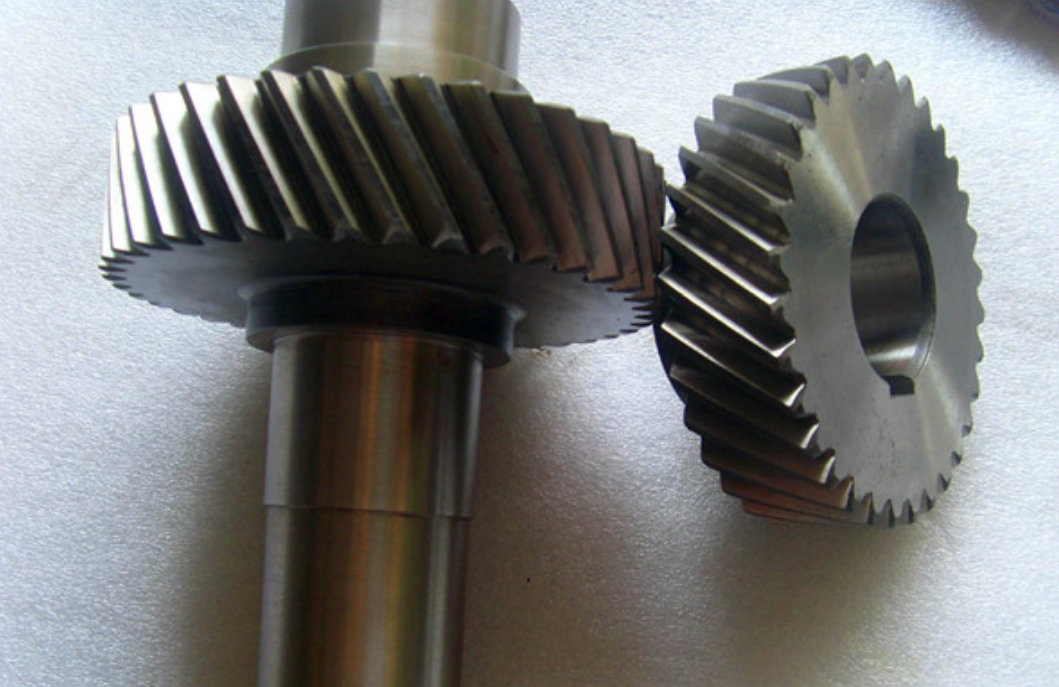
The helical gear, characterized by its angled teeth that engage gradually, offers smoother and quieter operation compared to spur gears. However, its complex geometry poses challenges for precision chamfering. The helical gear’s tooth crest forms a spatial curve influenced by the helix angle, making traditional planar chamfering techniques inadequate. This research focuses on developing a comprehensive solution for helical gear chamfering, encompassing theoretical foundations, computational algorithms, and practical implementation. The bilateral method not only addresses quality concerns but also enhances productivity by processing both sides of the tooth space in a single operation. Throughout this article, the term ‘helical gear’ will be emphasized to underscore its centrality to the study, with detailed analyses of parameters, tool design, and simulation outcomes.
The mathematical modeling of helical gear chamfering begins with defining the addendum line equation. For an internal helical gear, the addendum line can be visualized as a helix traced on the addendum circle. By unfolding this helix into a plane, the relationship between axial and circumferential displacements is established. Consider a helical gear with addendum radius $r_a$, helix angle $\beta$, and tooth space half-angle $\phi$. When a point on the addendum line moves by an axial distance $\Delta Z_0$, the corresponding horizontal displacement on the unfolded plane is given by:
$$\Delta L = \Delta Z_0 \times \tan(\beta)$$
This displacement corresponds to an angular rotation $\theta$ on the addendum circle:
$$\theta = \frac{\Delta L}{r_a} \times \frac{180^\circ}{\pi}$$
Combining these equations, the parametric form of the addendum line in Cartesian coordinates $(x, y, z)$ is derived as:
$$x = r_a \times \cos(\phi + \theta)$$
$$y = r_a \times \sin(\phi + \theta)$$
$$z = \frac{r_a \times \theta}{\tan(\beta)} \times \frac{180^\circ}{\pi}$$
This equation describes the spatial trajectory of the addendum line, which serves as the reference for chamfering operations. The helix angle $\beta$ plays a crucial role in determining the curvature, underscoring the unique geometry of the helical gear. To facilitate chamfering, the tool must follow this path while maintaining proper orientation relative to the tooth surfaces.
The chamfering principle involves using a taper cutter with a conical profile that matches the desired chamfer angle. The cutter is mounted on a数控机床 spindle, rotating about its axis while moving along the vertical (Z-axis) direction. The workpiece, i.e., the helical gear, rotates about its central axis with a synchronized motion ratio relative to the tool’s movement. This setup enables simultaneous machining of both addendum lines in a tooth space. The key parameters include the chamfer depth $h$, chamfer angle $\alpha$, and tool geometry such as the cutter tip diameter and cutting edge length. The bilateral approach ensures symmetry, as the tool’s central axis aligns with the tooth space centerline throughout the process.
Tool path planning is critical for achieving precise chamfer dimensions. The involute profile of the helical gear’s tooth flank must be considered to avoid interference and ensure accurate material removal. In the transverse plane, the tooth profile is an involute curve derived from the base circle radius $r_b$. For a helical gear with tooth number $z$, normal pressure angle $\alpha_n$, and normal module $m_n$, the transverse pressure angle $\alpha_t$ is calculated using the helix angle:
$$\alpha_t = \arctan\left(\frac{\tan(\alpha_n)}{\cos(\beta)}\right)$$
The involute equation for the right flank, parameterized by $\mu$, is given by:
$$x = r_b \times \cos(\sigma_0 + \mu) + r_b \times \mu \sin(\sigma_0 + \mu)$$
$$y = r_b \times \sin(\sigma_0 + \mu) – r_b \times \mu \cos(\sigma_0 + \mu)$$
where $\sigma_0$ is the initial angle, determined by gear parameters:
$$\sigma_0 = \frac{\pi}{2 \times z} – \tan(\alpha_t) + \alpha_t – \frac{2 x_n \tan(\alpha_n)}{z}$$
Here, $x_n$ is the normal profile shift coefficient. The intersection points $M$ and $N$ between the involute and the addendum circle (radius $r_a$) define the tooth space boundaries. The parameter $\mu$ for point $N$ is obtained from:
$$\tan \mu = \frac{\sqrt{r_a^2 – r_b^2}}{r_b}$$
These coordinates are essential for calculating the tool’s engagement position. To determine the cutter’s tip diameter, the chamfer depth $h$ and angle $\alpha$ are used. At point $M$, the tangent vector components $v’$ and $w’$ are derived from the involute derivatives:
$$\frac{dx}{du} = r_b \times \mu \cos(\mu + \sigma_0)$$
$$\frac{dy}{du} = r_b \times \mu \sin(\mu + \sigma_0)$$
The local angle $\alpha$ between the tooth flank and the addendum surface is:
$$\alpha = \arctan\left(\frac{v’}{w’}\right)$$
Given the chamfer depth $h$, the lateral offset $l$ from the addendum line is:
$$l = \frac{h}{\tan(\alpha)}$$
The total tool span $S$ across the tooth space, accounting for both sides, is approximated as:
$$S = 2 \times (|Y_M| + l_0)$$
where $l_0$ is an initial offset based on the chamfer design. For helical gears, the effective contact length $S_1$ is adjusted for the helix angle $\beta$:
$$S_1 = S \times \cos(\beta)$$
Tool radius compensation is applied to generate the tool center trajectory, ensuring the cutter’s tip follows the desired chamfer path. The coordinate transformation involves rotating the workpiece coordinate system by an angle $\Phi = \frac{360^\circ}{2 \times z}$ to align the X-axis with the tooth space center. The transformed coordinates $(X_M’, Y_M’, Z_M’)$ for point $M$ are:
$$\begin{bmatrix} X_M’ \\ Y_M’ \\ Z_M’ \end{bmatrix} = \begin{bmatrix} \cos(\Phi) & \sin(\Phi) & 0 \\ -\sin(\Phi) & \cos(\Phi) & 0 \\ 0 & 0 & 1 \end{bmatrix} \begin{bmatrix} X_M \\ Y_M \\ Z_M \end{bmatrix}$$
This transformation facilitates tool path planning in the machine coordinate system. The taper cutter’s geometry is designed based on these calculations, with the tip diameter $d_t$ given by:
$$d_t = 2 \times \left( \frac{S_1}{2} – h \times \tan(\alpha) \right)$$
assuming the cutter’s taper angle matches the chamfer angle $\alpha$. The cutting edge length must exceed the tooth depth to prevent bottom interference. Table 1 summarizes the key parameters involved in the mathematical model for a typical helical gear chamfering operation.
| Parameter | Symbol | Equation or Value |
|---|---|---|
| Addendum radius | $r_a$ | Calculated from gear geometry |
| Base circle radius | $r_b$ | $r_b = r_a \times \cos(\alpha_t)$ |
| Helix angle | $\beta$ | Specified for the helical gear |
| Tooth space half-angle | $\phi$ | $\phi = \frac{\pi}{z}$ |
| Chamfer depth | $h$ | User-defined (e.g., 2.3 mm) |
| Chamfer angle | $\alpha$ | User-defined (e.g., 45°) |
| Tool tip diameter | $d_t$ | Derived from $S_1$ and $h$ |
| Effective contact length | $S_1$ | $S_1 = 2 \times (|Y_M| + l_0) \times \cos(\beta)$ |
To implement this method efficiently, an automated programming software was developed using Microsoft Foundation Classes (MFC). The software interface comprises four main sections: input of helical gear basic parameters, output of calculated gear parameters, input of tool basic parameters, and generation of chamfering G-code. Users enter data such as tooth number, normal module, pressure angle, helix angle, profile shift coefficient, and gear type (internal or external). The software computes derived parameters like addendum diameter, dedendum diameter, pitch diameter, and base diameter using standard gear formulas. For instance, the addendum diameter $D_a$ for an internal helical gear is given by:
$$D_a = m_n \times z \times \cos(\beta) + 2 \times (1 + x_n) \times m_n$$
Tool parameters, including tip diameter, taper angle, cutting edge length, and chamfer depth, are inputted to customize the operation. The software then executes the tool path planning algorithm, incorporating the mathematical models described earlier. It generates数控 G-code that controls the four-axis machine tool, synchronizing the rotary motion of the workpiece with the linear and rotary motions of the cutter. This automation significantly reduces manual programming effort and minimizes errors, making it suitable for batch production of helical gears. The G-code can be directly exported to simulation environments like VERICUT for validation.
The numerical simulation of helical gear chamfering was conducted using VERICUT software, a powerful platform for virtual machining. The process began with creating a three-dimensional model of the internal helical gear in UG NX, utilizing its gear modeling toolkit. The gear model was exported in STL format and imported into VERICUT. A four-axis数控机床 model was configured, consisting of three linear axes (X, Y, Z) and one rotary axis (A) for workpiece rotation. The taper cutter was modeled as a conical tool with specified dimensions, attached to the spindle. The coordinate system was set with the origin at the gear’s top face, aligned such that the X-axis coincided with the tooth space center after rotation by $\Phi$.
The simulation workflow involved several steps: setting up the machine kinematics, defining the workpiece and tool assemblies, loading the G-code generated by the automated software, and configuring cutting parameters. The G-code was interpreted with tool tip programming, and radial compensation was disabled to match the theoretical tool path. During simulation, the tool moved along the Z-axis while rotating, and the workpiece rotated synchronously to maintain the relative motion required for helical gear chamfering. The material removal process was visualized in real-time, allowing for interference detection and verification of chamfer uniformity. Table 2 lists the simulation parameters for a case study involving an internal helical gear.
| Parameter Category | Specific Parameters | Values |
|---|---|---|
| Helical Gear Specifications | Normal module ($m_n$) Tooth number ($z$) Normal pressure angle ($\alpha_n$) Helix angle ($\beta$) Profile shift coefficient ($x_n$) Tooth width |
15.8 mm 109 20° 8.35° 0 100 mm |
| Chamfer Requirements | Chamfer angle ($\alpha$) Chamfer depth ($h$) |
45° 2.3 mm |
| Tool Geometry | Taper angle Tip diameter Cutting edge length |
45° 15 mm (calculated) 30 mm |
| Machine Settings | Spindle speed Feed rate Rotary axis ratio |
1000 rpm 50 mm/min Synchronized with helix |
After simulation, the chamfered gear model was exported and analyzed in UG NX. To evaluate accuracy, discrete points were sampled along the chamfered edge using curve extraction tools. For comparison, theoretical addendum and chamfer lines were plotted based on the mathematical models. The theoretical addendum line follows the helix equation:
$$x = r_a \cos(\phi + \theta), \quad y = r_a \sin(\phi + \theta), \quad z = \frac{r_a \theta}{\tan(\beta)} \times \frac{180^\circ}{\pi}$$
The theoretical chamfer line is offset from this by distance $h$ in the direction normal to the tooth surface, derived from the involute geometry. Using MATLAB, scatter plots of the simulated points were overlaid with the theoretical curves. The results showed close alignment, with deviations within acceptable tolerances. For instance, the chamfer depth error was within ±0.05 mm, and the angle error was less than 2°, confirming the method’s precision. This bilateral approach for helical gear chamfering ensured symmetrical chamfers on both sides, with consistent dimensions along the entire tooth space.
The advantages of this method are multifold. First, simultaneous bilateral chamfering doubles productivity compared to sequential single-side methods. Second, the use of a taper cutter with controlled path eliminates inconsistencies in chamfer size and angle, which are common in indexing-based techniques. Third, the automated software streamlines the programming process, reducing human error and setup time. Fourth, the integration with VERICUT allows for thorough virtual validation, minimizing trial runs on physical machines. These benefits make the approach particularly suitable for high-precision applications involving helical gears, such as in automotive transmissions, wind turbines, and industrial machinery.
Further analysis involves optimizing tool life and surface quality. The cutting forces during helical gear chamfering depend on parameters like feed rate, depth of cut, and tool material. Empirical models can be developed to predict tool wear based on simulated data. For example, the volumetric material removal rate $Q$ for a taper cutter is approximated by:
$$Q = f \times h \times S_1$$
where $f$ is the feed rate. This can be correlated with tool wear rates to schedule maintenance. Additionally, the surface roughness of the chamfered edge is influenced by the tool’s rotational speed and the helix angle of the helical gear. Experiments can be designed to refine these parameters for optimal results.
In conclusion, this study presents a comprehensive bilateral chamfering method for helical gears, combining mathematical modeling, automated programming, and numerical simulation. The helical gear’s unique geometry is accurately captured through parametric equations, enabling precise tool path planning. The developed software automates G-code generation, enhancing efficiency and repeatability. Simulations in VERICUT validate the method, showing that uniform chamfers with tight tolerances can be achieved. This approach not only addresses quality issues in gear manufacturing but also paves the way for advanced chamfering techniques for other gear types, such as double-helical or curved-tooth gears. Future work may focus on real-time adaptive control and integration with industrial数控 systems to further improve performance.
The helical gear remains a cornerstone in power transmission systems, and its proper finishing is crucial for reliability. By advancing chamfering technology, this research contributes to longer service life and reduced maintenance costs. The bilateral method, with its emphasis on symmetry and automation, represents a significant step forward in gear manufacturing processes. As industries demand higher precision and productivity, such innovative solutions will play a vital role in meeting these challenges, ensuring that helical gears continue to operate smoothly and efficiently in diverse applications.