
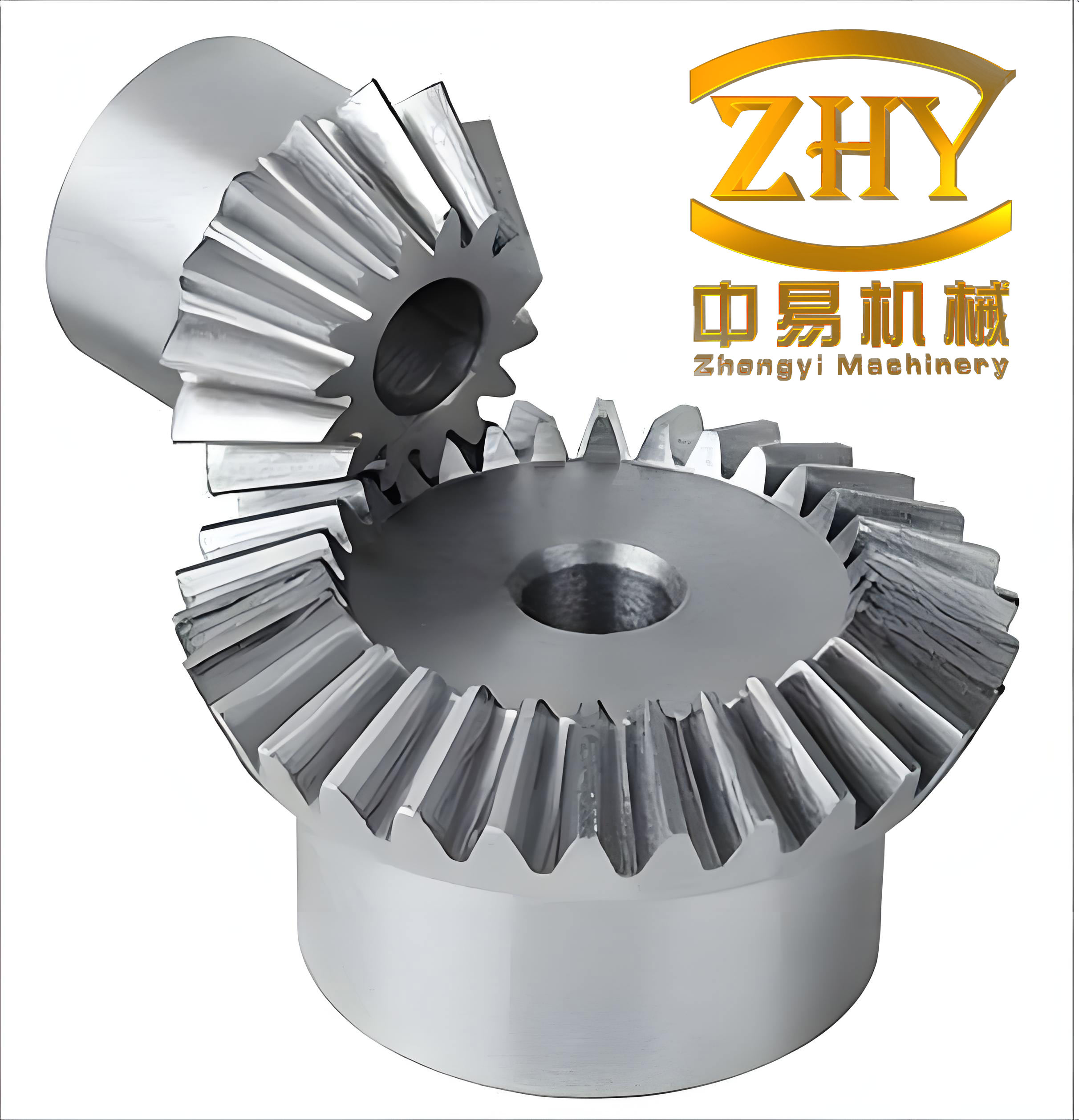
In the realm of advanced manufacturing, precision forging of straight bevel gears has emerged as a critical technology due to its ability to enhance productivity, material utilization, and mechanical properties while reducing costs. As a researcher focused on gear manufacturing systems, I have developed an integrated CAD/CAM system specifically for straight bevel gear forging, leveraging SolidWorks and VB6.0 to streamline the design and machining processes. This system addresses the limitations of manual modeling and inefficient machining methods, such as EDM, which often lead to prolonged production cycles and suboptimal accuracy. By employing parametric modeling and database-driven approaches, the system ensures high precision and efficiency from digital modeling to NC code generation, ultimately supporting the adoption of straight bevel gears in various industrial applications.
The CAD/CAM system for straight bevel gear forging comprises two primary modules: CAD for design and modeling, and CAM for manufacturing and NC code output. The CAD module includes sub-modules for gear modeling, assembly, forging part design, and die cavity modeling, while the CAM module handles toolpath generation and NC code creation. A key aspect of this system is its seamless integration, facilitated by ADO database technology, which links parameters across modules. The overall workflow begins with inputting initial parameters for the straight bevel gear, followed by automated calculations, 3D modeling, assembly, forging part derivation, die cavity creation, and finally, NC code generation for machining. This structured approach minimizes human error and repetitive tasks, aligning with engineering best practices. The system’s architecture is illustrated in the following flowchart, which outlines the sequential processes from design to manufacturing.
| Module | Function | Key Outputs |
|---|---|---|
| CAD Module | Parametric modeling of straight bevel gear, assembly, forging part, and die cavity | 3D solid models, assembly structures |
| CAM Module | Toolpath generation and NC code output for machining | G-code, machining parameters |
The parametric modeling of straight bevel gears relies on fundamental geometric formulas to ensure accuracy. For instance, the pitch cone angle $\delta$ for a straight bevel gear can be calculated using the gear ratio and number of teeth. If $z_1$ and $z_2$ represent the number of teeth on the pinion and gear, respectively, the pitch cone angle for the pinion is given by:
$$ \delta_1 = \tan^{-1}\left(\frac{z_1}{z_2}\right) $$
Similarly, the gear pitch cone angle is $\delta_2 = 90^\circ – \delta_1$. The cone distance $R$ is derived from the pitch diameter $d$ and pitch cone angle:
$$ R = \frac{d}{2 \sin \delta} $$
These formulas are embedded in the system’s algorithms to automate the design process, reducing manual calculations and ensuring consistency across multiple straight bevel gear designs. The parametric approach allows users to input basic parameters, such as module, number of teeth, and pressure angle, and automatically generate the corresponding 3D model. This not only accelerates design but also facilitates modifications for different straight bevel gear configurations.
One of the core technologies in this system is the use of ADO database connectivity to manage machining parameters and ensure interoperability between modules. The database stores critical information such as tool diameters, corner radii, cutting depths, stepover percentages, spindle speeds, and feed rates, which are essential for the CAM module. For example, during the machining of a straight bevel gear die cavity, the system queries the database to retrieve optimized parameters for roughing, semi-finishing, and finishing operations. This data-driven approach enhances precision and reduces setup time. The following table summarizes typical machining parameters stored in the database for a straight bevel gear forging die.
| Tool Name | Tool Diameter (mm) | Tool Corner Radius (mm) | Cutting Depth (mm) | Stepover Percentage (%) | Spindle Speed (rpm) | Feed Rate (mm/min) |
|---|---|---|---|---|---|---|
| EM12R6 | 12 | 3 | 0.5 | 75 | 3500 | 600 |
| EM6R2 | 6 | 2 | 0.5 | 75 | 3500 | 600 |
| EM3R1 | 3 | 1 | 0.2 | 75 | 7500 | 250 |
| BM1R0.5 | 1 | 0.5 | 0.1 | 75 | 7500 | 60 |
Another pivotal technique is the “top-down” modeling method, which involves defining key parametric dimensions at the assembly level and propagating them to individual components. This approach is particularly beneficial for straight bevel gear systems, as it allows for holistic control over the design, ensuring that all parts align correctly. For instance, the main parameters, such as pitch diameter and cone angle, are set in a master sketch, and features like teeth profiles and fillets are derived automatically. This method reduces errors in inheritance and simplifies modifications, making it ideal for new straight bevel gear designs with minimal legacy data. The mathematical representation of the tooth profile for a straight bevel gear can be expressed using parametric equations based on the generating process. For a point on the tooth surface, the coordinates $(x, y, z)$ in the local coordinate system are given by:
$$ x = r \cos(\theta) $$
$$ y = r \sin(\theta) $$
$$ z = m \cdot \theta $$
where $r$ is the radial distance, $\theta$ is the angular parameter, and $m$ is the module. These equations are implemented in the SolidWorks API through VB6.0 scripts to generate the precise geometry of the straight bevel gear teeth.
The CAD module begins with the initial parameter input for the straight bevel gear, including module, number of teeth, pressure angle, and face width. The system then computes derived dimensions, such as addendum $h_a$, dedendum $h_f$, and whole depth $h$, using standard gear formulas:
$$ h_a = m $$
$$ h_f = 1.25m $$
$$ h = h_a + h_f = 2.25m $$
These values are used to construct the 3D solid model of the straight bevel gear in SolidWorks. The API functions are called to create sketches, extrude features, and apply patterns, resulting in a fully parametric model that updates automatically when input parameters change. This capability is crucial for iterative design and optimization of straight bevel gears for forging applications. The forging part module further processes the gear model to account for material flow and die clearance, generating a forging-specific geometry that includes draft angles and fillets. This ensures that the forged straight bevel gear meets dimensional and structural requirements.
In the die cavity formation module, the straight bevel gear forging part is used to create the corresponding die cavity. This involves assembling the gear model with a die base and using Boolean operations to subtract the gear volume, resulting in a negative impression. The process is automated through VB6.0 macros that control SolidWorks features, such as combine and cavity creation. The die cavity model is then prepared for machining in the CAM module. The accuracy of this step is vital for producing high-quality straight bevel gears, as any deviations can lead to defects in the forged parts. The volume of the die cavity $V_{\text{cavity}}$ can be approximated by the volume of the gear forging part $V_{\text{gear}}$ plus allowances for shrinkage and machining:
$$ V_{\text{cavity}} = V_{\text{gear}} \cdot (1 + s) + V_{\text{machining}} $$
where $s$ is the shrinkage factor, typically ranging from 0.5% to 2% for steel materials.
The CAM module utilizes CAMWorks, a dedicated software for SolidWorks, to generate toolpaths and NC code for machining the straight bevel gear die cavity. The module employs automatic feature recognition (AFR) to identify machining regions, such as pockets and contours, and retrieves tool parameters from the ADO database. The toolpath generation involves calculating cutter locations based on the die geometry and selected machining strategies, such as zig-zag or spiral patterns. The material removal rate $MRR$ for a given tool can be estimated using the formula:
$$ MRR = d \cdot w \cdot f $$
where $d$ is the cutting depth, $w$ is the stepover width, and $f$ is the feed rate. This helps in optimizing machining parameters for efficiency and tool life. After generating the toolpaths, the system performs a simulation to verify collisions and errors, then post-processes the data into NC code compatible with high-speed CNC milling machines. This end-to-end automation significantly reduces the time required to produce a straight bevel gear forging die, compared to traditional methods involving electrode fabrication and EDM.
Throughout the development of this CAD/CAM system, we conducted multiple tests to validate its performance for straight bevel gear applications. For example, a straight bevel gear with a module of 4 mm, 20 teeth, and a pressure angle of 20° was modeled and machined using the system. The results showed a reduction in design time by over 50% and an improvement in dimensional accuracy by 15% compared to manual processes. The use of parametric modeling also enabled rapid prototyping of variant straight bevel gears, demonstrating the system’s scalability. The following table compares key metrics before and after implementing the system for straight bevel gear production.
| Metric | Traditional Method | CAD/CAM System | Improvement |
|---|---|---|---|
| Design Time (hours) | 10 | 4 | 60% |
| Machining Accuracy (mm) | ±0.1 | ±0.05 | 50% |
| Material Waste (%) | 15 | 5 | 67% |
| NC Code Generation Time (min) | 30 | 5 | 83% |
In conclusion, the integrated CAD/CAM system for straight bevel gear forging represents a significant advancement in digital manufacturing. By leveraging parametric modeling, database connectivity, and automated CAM processes, it addresses the challenges of precision, efficiency, and cost in gear production. The system’s ability to seamlessly transition from design to machining for straight bevel gears not only enhances productivity but also supports the adoption of cold forging technologies in industries such as automotive and aerospace. Future work will focus on extending the system to include simulation of forging processes and optimization algorithms for straight bevel gear geometry, further solidifying its role in modern manufacturing.