
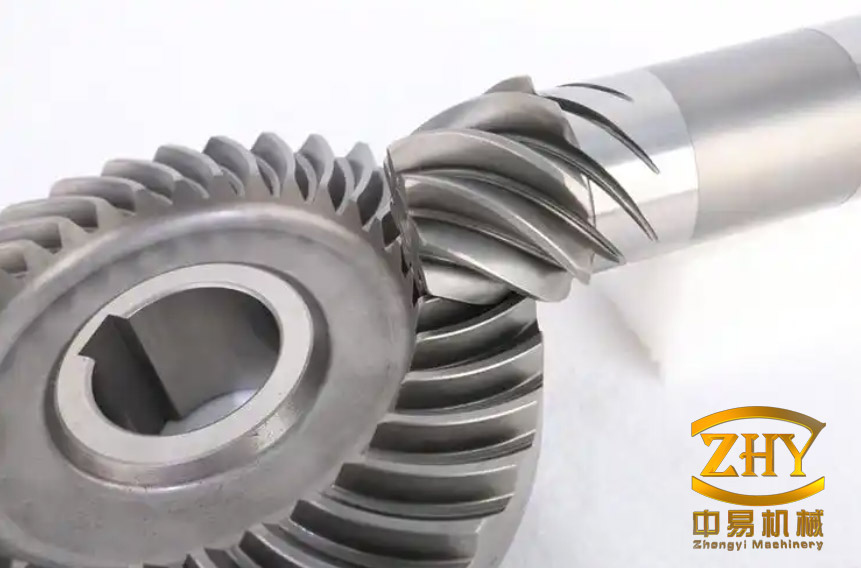
Spiral bevel gears transmit torque between intersecting shafts. Their curved teeth enter mesh gradually, keep more than one tooth pair in contact over part of the cycle, and reduce impact relative to straight bevel teeth. For heavily loaded drivelines, service behavior depends jointly on tooth geometry, contact pattern, and the microstructure beneath the loaded flank. A forming route that leaves a coarse or inhomogeneous cast structure can therefore limit the benefit of an accurate tooth form.
The conventional route for such gears is ingot casting → breakdown → cutting → upsetting → punching → ring rolling → machining. It involves repeated hot working and considerable machining allowance. The cast ingot is also prone to structural inhomogeneity, and the intermediate steps consume material and energy. Cast–forging compound forming takes a different path: molten steel → cast spiral bevel gear blank → rough forging → finish forging. The casting step creates a near-net blank; the forging steps impose enough thermomechanical work to replace the cast structure with a recrystallized one. The intended result is a more uniform starting microstructure with fewer process steps and less reheating.
Material and Process Window
The gear blank was made of 20CrMoH, a low-alloy gear steel, and produced by sand casting. Its volume was approximately 430,808 mm3. The casting parameters were fixed at a casting temperature of 1520 °C and a pouring time of 518 s. Forging was carried out in H13 die steel with a die preheat of 200 °C, an environment temperature of 25 °C, and a friction coefficient of 0.65.
The forging trials varied deformation amount, forging temperature, and forging speed one at a time. Deformation amount ranged from 10% to 40%, forging temperature from 850 °C to 1150 °C, and forging speed from 10 mm/s to 40 mm/s. The optimum for each factor was selected from optical micrographs on the basis of fine, uniform recrystallized grains rather than from mechanical testing.
| Parameter | Range examined | Optimum |
|---|---|---|
| Workpiece material | 20CrMoH | 20CrMoH |
| Casting method | Sand casting | Sand casting |
| Casting temperature | 1520 °C (fixed) | 1520 °C |
| Pouring time | 518 s (fixed) | 518 s |
| Forging deformation amount | 10, 20, 30, 40% | 40% |
| Forging temperature | 850, 950, 1050, 1150 °C | 1050 °C |
| Forging speed | 10, 20, 30, 40 mm/s | 20 mm/s |
| Die material | H13 | H13 |
| Die preheat temperature | 200 °C (fixed) | 200 °C |
| Environment temperature | 25 °C (fixed) | 25 °C |
| Friction coefficient | 0.65 (fixed) | 0.65 |
As-Cast Microstructure
The sand-cast gear consisted mainly of dark pearlite and light ferrite. No recrystallized structure was identified. This is the expected starting condition for a cast blank: the constituents reflect solidification and subsequent cooling, not deformation-induced recrystallization. The forging step therefore has to do two things at once—deform the blank into the tooth form and generate a new grain structure from the cast starting condition.
Effect of Forging Deformation
At a fixed forging speed of 20 mm/s and forging temperature of 1050 °C, increasing the deformation amount from 10% to 40% changed the microstructure from a coarse grain structure to a finer one. New recrystallized nuclei appeared at grain boundaries and in regions of high dislocation density. A threshold deformation was needed before new grains began to form at the boundaries; once dynamic recrystallization started, further deformation refined and homogenized the structure. The 40% condition gave the finest and most uniform microstructure among the levels tested.
This response is consistent with the stored-energy argument for dynamic recrystallization. Deformation raises the dislocation density and stores energy in the material. Grain boundaries and dislocation-rich regions are preferential nucleation sites. With increasing deformation, more nuclei form and the original cast structure is progressively replaced. The practical point is that a minimum amount of deformation is required; below that level, the cast structure survives the forging pass.
Effect of Forging Temperature
With deformation fixed at 40% and speed at 20 mm/s, increasing the forging temperature from 850 °C to 1150 °C first refined the grains and then made them slightly coarser. The 1050 °C condition produced the finest and most uniform structure. At the lower end, thermal activation was insufficient for the same degree of recrystallization and boundary migration. At the upper end, the recrystallized grains had enough thermal energy to grow, so the refinement achieved by deformation was partly lost.
The temperature effect is therefore non-monotonic. A hot forging pass must supply enough thermal activation for dislocations to rearrange and for new boundaries to migrate, but excessive temperature shifts the balance from nucleation toward grain growth. The window around 1050 °C is the compromise observed in this steel and gear geometry.
Effect of Forging Speed
At 40% deformation and 1050 °C, decreasing the forging speed from 40 mm/s to 10 mm/s also produced a refine-then-coarsen trend. The 20 mm/s condition gave the finest and most uniform grains; slower forging at 10 mm/s produced slightly larger grains. At high speed, the deformation time is short and recrystallization may not be complete. At low speed, the material remains at temperature longer, so recrystallized grains have more time to grow. The optimum at 20 mm/s reflects that balance.
Across the three variables, the same microstructural signature appeared: new grains nucleated at grain boundaries or high-dislocation-density regions, and the cast ferrite–pearlite structure was replaced by a recrystallized structure. The finest structure was not obtained by simply maximizing all three variables. It occurred where deformation provided sufficient stored energy, temperature provided sufficient boundary mobility, and speed allowed the recrystallization process to proceed without excessive growth.
Optimal Window and Engineering Interpretation
Within the tested range, the process window that produced the finest and most uniform microstructure was: casting temperature 1520 °C, pouring time 518 s, forging deformation 40%, forging speed 20 mm/s, forging temperature 1050 °C, environment temperature 25 °C, die preheat 200 °C, and friction coefficient 0.65. The die material was H13 and the workpiece was 20CrMoH. These values are a microstructure-based optimum, not a full qualification of the gear’s load capacity.
The main technical value of the cast–forging route is that it uses the casting step for shape and the forging step for structure. Compared with the conventional ingot-to-ring-rolling route, the sequence removes several intermediate hot-working and machining stages and reduces repeated heating. The microstructure evidence supports the claim that forging can convert a cast ferrite–pearlite structure into a finer recrystallized one. It also identifies a practical window for doing so in a 20CrMoH spiral bevel gear.
The scope of the evidence should be kept clear. The parameter comparison is based on optical microstructure; it does not quantify hardness, tensile strength, toughness, residual stress, dimensional accuracy, or contact-fatigue life. For a gear in service, a fine recrystallized microstructure is a desirable starting condition, but it is not by itself a service-life prediction. Any subsequent heat treatment, grinding, contact-pattern control, and fatigue testing remain part of the qualification chain. The optimum above should therefore be read as the best microstructure window among the tested levels of deformation, temperature, and speed, not as a universal setpoint for all spiral bevel gear sizes or loading conditions.