
As an internal gear manufacturer, understanding the nuances of tool wear and its impact on gear geometry is crucial. Internal gears are widely used in various mechanical systems, and their precision directly affects performance. One common issue faced during manufacturing is the reduction in the root diameter of internal gears after repeated resharpening of the shaper cutter. This phenomenon becomes particularly pronounced when the internal gear has a high modification coefficient. In this article, I will analyze the reasons behind this change and propose methods to mitigate it, ensuring consistent quality in internal gear production.
The shaper cutter used for machining internal gears is essentially a modified gear with rake and relief angles. Its cutting angles, tooth profile, and pressure angle corrections are similar to those used for external gears. However, as the cutter is resharpened, the root diameter of the internal gear it produces continuously decreases. This occurs because the modification coefficient of the cutter changes with each resharpening, altering the meshing conditions between the cutter and the gear. For internal gear manufacturers, this can lead to deviations from design specifications, especially in high-precision applications.
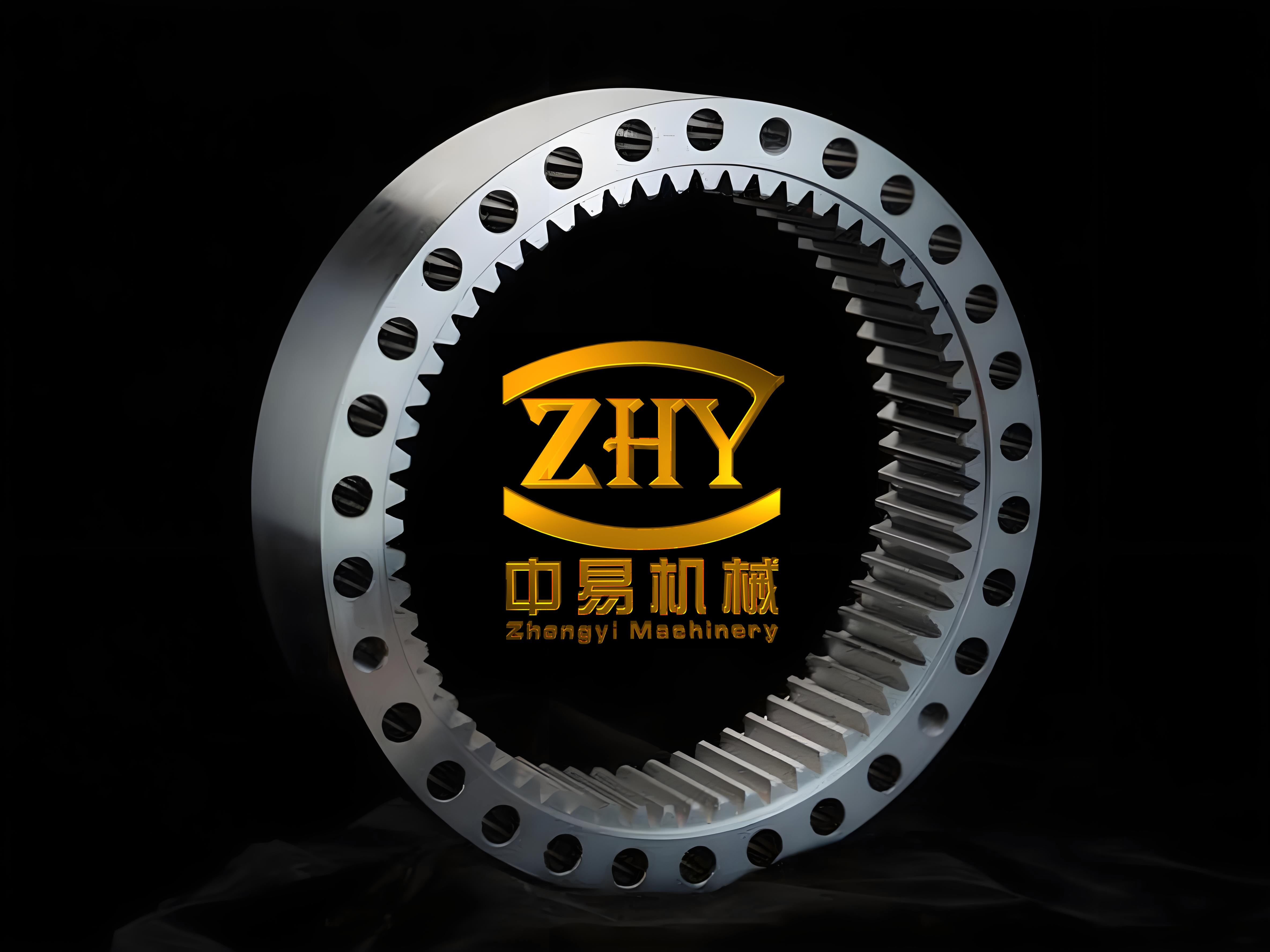
To comprehend why the root diameter changes, we must delve into the principles of internal gear meshing. In a pair of internal gears, the meshing angle, denoted as $\alpha_{12}$, is the angle between the line of action and the common tangent of the two pitch circles. The center distance $A$ between the shaper cutter and the internal gear is given by:
$$A = \frac{m(Z_2 – Z_1) \cos \alpha}{2 \cos \alpha_{12}}$$
where $m$ is the module, $Z_1$ is the number of teeth on the shaper cutter, $Z_2$ is the number of teeth on the internal gear, $\alpha$ is the standard pressure angle, and $\alpha_{12}$ is the meshing angle. The meshing angle itself depends on the modification coefficients of the cutter and the gear:
$$\text{inv} \alpha_{12} = \frac{2(\xi_2 – \xi_1) \tan \alpha}{Z_2 – Z_1} + \text{inv} \alpha$$
Here, $\xi_1$ is the modification coefficient of the shaper cutter, and $\xi_2$ is the modification coefficient of the internal gear. The function $\text{inv} \alpha$ represents the involute function, defined as $\text{inv} \alpha = \tan \alpha – \alpha$. For internal gear manufacturers, these equations highlight that the center distance and meshing angle are influenced by the cutter’s modification coefficient. As $\xi_1$ decreases due to resharpening, $\alpha_{12}$ increases, leading to a larger center distance $A$.
The outer diameter of the shaper cutter, $d_{a1}$, is another critical parameter. It is calculated as:
$$d_{a1} = d + 2m(h_{a1}^* + \xi_1)$$
where $d$ is the pitch diameter of the cutter, and $h_{a1}^*$ is the addendum coefficient. This equation shows that $d_{a1}$ decreases as $\xi_1$ decreases. The root diameter of the internal gear, $d_f$, is determined by the cutter’s outer diameter and the center distance:
$$d_f = d_{a1} + 2A$$
Combining these relationships, we see that as $\xi_1$ decreases, $d_{a1}$ decreases linearly, but $A$ increases at a diminishing rate. Consequently, $d_f$ tends to decrease with each resharpening cycle. This behavior is consistent across various internal gear designs and poses a significant challenge for internal gear manufacturers aiming to maintain tight tolerances.
To illustrate this phenomenon, consider a practical example commonly encountered by internal gear manufacturers. Suppose an internal gear has the following parameters: module $m = 0.6$, pressure angle $\alpha = 20^\circ$, number of teeth $Z_2 = 86$, major diameter $53.45$ mm, minor diameter $50.7$ mm, and pitch circle tooth thickness $0.826$ mm. A shaper cutter with $Z_1 = 42$ teeth is used, with an addendum coefficient $h_{a1}^* = 1.35$ and total tooth height coefficient $2.7$. The following table shows how the cutter’s outer diameter and center distance vary with different modification coefficients $\xi_1$:
| Modification Coefficient $\xi_1$ | Outer Diameter $d_{a1}$ (mm) | Center Distance $A$ (mm) |
|---|---|---|
| 1.0 | 28.02 | 12.6605 |
| 0.8 | 27.78 | 12.8384 |
| 0.6 | 27.54 | 12.9863 |
| 0.4 | 27.30 | 13.1182 |
| 0.2 | 27.06 | 13.2397 |
| 0.0 | 26.82 | 13.3537 |
| -0.2 | 26.58 | 13.4618 |
| -0.4 | 26.34 | 13.5653 |
| -0.6 | 26.10 | 13.6648 |
| -0.8 | 25.80 | 13.7611 |
| -1.0 | 25.62 | 13.8545 |
From this table, internal gear manufacturers can observe that as $\xi_1$ decreases, $d_{a1}$ decreases steadily, while $A$ increases but at a reducing rate. For instance, when $\xi_1$ drops from 1.0 to 0.8, $A$ increases by approximately 0.1779 mm, but when $\xi_1$ decreases from -0.8 to -1.0, the increase in $A$ is only about 0.0934 mm. This nonlinear relationship causes the root diameter $d_f$ to shrink over time. Calculating $d_f$ for each case:
$$d_f = d_{a1} + 2A$$
we see that $d_f$ decreases from $28.02 + 2 \times 12.6605 = 53.341$ mm at $\xi_1 = 1.0$ to $25.62 + 2 \times 13.8545 = 53.329$ mm at $\xi_1 = -1.0$. Although the change seems small in this example, it can be significant for internal gears with higher modification coefficients or tighter tolerances.
The root cause lies in the fundamental geometry of internal gear meshing. As the shaper cutter is resharpened, its tooth thickness at the pitch circle decreases, reducing $\xi_1$. To achieve the required tooth thickness on the internal gear, the center distance must be adjusted. From the equations, internal gear manufacturers can derive that the minimum center distance occurs when the meshing angle $\alpha_{12}$ is minimized, which happens when $\xi_1$ is maximized. Therefore, to control the root diameter variation, it is essential to select an appropriate initial modification coefficient for the shaper cutter.
For internal gear manufacturers, the selection of $\xi_1$ should prioritize two aspects: ensuring the root diameter of the internal gear meets specifications and managing the trend of root diameter change after resharpening. Ideally, the new shaper cutter should produce a root diameter at the upper limit of the tolerance zone, so that subsequent resharpening moves it within acceptable bounds. The key insight is that when $\xi_1 = \xi_2$, the meshing angle $\alpha_{12}$ equals the standard pressure angle $\alpha$, resulting in a center distance that yields the nominal root diameter. Thus, setting $\xi_1$ equal to $\xi_2$ can help internal gear manufacturers achieve consistent results.
In practice, internal gear manufacturers must also consider the cutter’s tooth strength and avoidance of interference. The maximum $\xi_1$ should be chosen such that the cutter’s tooth tip does not become too sharp and the tooth space does not cross. The following formula can be used to check the tooth tip width $s_a$ of the shaper cutter:
$$s_a = d_{a1} \left( \frac{s}{d} + \text{inv} \alpha – \text{inv} \alpha_{a1} \right)$$
where $s$ is the tooth thickness at the pitch circle, and $\alpha_{a1}$ is the pressure angle at the tip circle. For internal gears, ensuring $s_a > 0.25m$ is generally sufficient to prevent weak teeth. Internal gear manufacturers can use this criterion to validate their design choices.
To further elaborate, let’s explore the general relationship between the modification coefficient and root diameter for internal gears. The rate of change of $d_f$ with respect to $\xi_1$ can be derived by differentiating the equations:
$$\frac{d d_f}{d \xi_1} = \frac{d d_{a1}}{d \xi_1} + 2 \frac{d A}{d \xi_1}$$
From earlier, $\frac{d d_{a1}}{d \xi_1} = 2m$, and $\frac{d A}{d \xi_1}$ can be found from the center distance equation. Using the chain rule:
$$\frac{d A}{d \xi_1} = \frac{d A}{d \alpha_{12}} \cdot \frac{d \alpha_{12}}{d \xi_1}$$
First, differentiate $A$ with respect to $\alpha_{12}$:
$$\frac{d A}{d \alpha_{12}} = \frac{m(Z_2 – Z_1) \cos \alpha}{2} \cdot \frac{\sin \alpha_{12}}{\cos^2 \alpha_{12}}$$
Then, differentiate the involute function equation for $\alpha_{12}$ with respect to $\xi_1$:
$$\frac{d}{d \xi_1} (\text{inv} \alpha_{12}) = \frac{d}{d \xi_1} \left( \frac{2(\xi_2 – \xi_1) \tan \alpha}{Z_2 – Z_1} + \text{inv} \alpha \right)$$
Since $\text{inv} \alpha$ and $\xi_2$ are constants, this simplifies to:
$$\frac{d}{d \xi_1} (\text{inv} \alpha_{12}) = -\frac{2 \tan \alpha}{Z_2 – Z_1}$$
Using the derivative of the involute function, $\frac{d}{d \alpha_{12}} (\text{inv} \alpha_{12}) = \tan^2 \alpha_{12}$, we get:
$$\frac{d \alpha_{12}}{d \xi_1} = -\frac{2 \tan \alpha}{(Z_2 – Z_1) \tan^2 \alpha_{12}}$$
Combining these, internal gear manufacturers can compute:
$$\frac{d A}{d \xi_1} = \frac{m(Z_2 – Z_1) \cos \alpha}{2} \cdot \frac{\sin \alpha_{12}}{\cos^2 \alpha_{12}} \cdot \left( -\frac{2 \tan \alpha}{(Z_2 – Z_1) \tan^2 \alpha_{12}} \right)$$
Simplifying:
$$\frac{d A}{d \xi_1} = -\frac{m \cos \alpha \sin \alpha_{12}}{\cos^2 \alpha_{12}} \cdot \frac{2 \tan \alpha}{2 \tan^2 \alpha_{12}} = -\frac{m \cos \alpha \sin \alpha_{12} \cdot 2 \tan \alpha}{2 \cos^2 \alpha_{12} \tan^2 \alpha_{12}}$$
Since $\tan \alpha_{12} = \frac{\sin \alpha_{12}}{\cos \alpha_{12}}$, this reduces to:
$$\frac{d A}{d \xi_1} = -\frac{m \cos \alpha \cdot 2 \tan \alpha}{2 \cos \alpha_{12} \tan \alpha_{12}} = -\frac{m \cos \alpha \tan \alpha}{\cos \alpha_{12} \tan \alpha_{12}}$$
Using trigonometric identities, $\cos \alpha \tan \alpha = \sin \alpha$, so:
$$\frac{d A}{d \xi_1} = -\frac{m \sin \alpha}{\cos \alpha_{12} \tan \alpha_{12}} = -\frac{m \sin \alpha}{\sin \alpha_{12}}$$
Thus, the overall rate of change is:
$$\frac{d d_f}{d \xi_1} = 2m – \frac{2m \sin \alpha}{\sin \alpha_{12}} = 2m \left( 1 – \frac{\sin \alpha}{\sin \alpha_{12}} \right)$$
For internal gears, since $\alpha_{12} > \alpha$ when $\xi_1 < \xi_2$, $\sin \alpha_{12} > \sin \alpha$, so $\frac{d d_f}{d \xi_1} > 0$. This confirms that as $\xi_1$ decreases, $d_f$ decreases, which aligns with the observations from the table. Internal gear manufacturers can use this formula to predict the magnitude of root diameter change for different gear sets.
In addition to theoretical analysis, practical considerations for internal gear manufacturers include the number of resharpening cycles and the total tool life. Each resharpening reduces the cutter’s diameter and modification coefficient. The total allowable reduction in $\xi_1$ depends on the initial design. For example, if a shaper cutter starts with $\xi_1 = 1.0$ and is resharpened to $\xi_1 = -1.0$, the change in root diameter can be estimated using the formula above. Assuming $m = 0.6$, $\alpha = 20^\circ$, and $\alpha_{12}$ varying from about $19.5^\circ$ to $20.5^\circ$, the rate $\frac{d d_f}{d \xi_1}$ ranges from $2 \times 0.6 \times (1 – \frac{\sin 20^\circ}{\sin 19.5^\circ}) \approx -0.012$ mm to $2 \times 0.6 \times (1 – \frac{\sin 20^\circ}{\sin 20.5^\circ}) \approx 0.010$ mm per unit change in $\xi_1$. Over a change of $\Delta \xi_1 = -2$, the total change in $d_f$ could be up to $0.024$ mm, which might be critical for high-precision internal gears.
To address this, internal gear manufacturers can adopt several strategies. First, optimize the initial shaper cutter design by setting $\xi_1 = \xi_2$. This ensures that the nominal root diameter is achieved initially, and any decrease due to resharpening stays within tolerance longer. Second, monitor the cutter’s wear and adjust machining parameters accordingly. For instance, compensating the center distance based on real-time measurements can help maintain consistency. Third, use advanced tool materials and coatings to reduce wear rates, extending the usable life of the cutter.
Another approach is to implement a predictive maintenance system where the cutter’s modification coefficient is tracked after each resharpening. Internal gear manufacturers can create a database linking $\xi_1$ to root diameter outcomes, allowing for proactive adjustments. For example, the following table summarizes typical root diameter changes for a series of resharpening cycles:
| Resharpening Cycle | Modification Coefficient $\xi_1$ | Root Diameter $d_f$ (mm) | Deviation from Nominal (mm) |
|---|---|---|---|
| 0 (New) | 1.0 | 53.341 | +0.021 |
| 1 | 0.8 | 53.335 | +0.015 |
| 2 | 0.6 | 53.328 | +0.008 |
| 3 | 0.4 | 53.320 | 0.000 |
| 4 | 0.2 | 53.312 | -0.008 |
| 5 | 0.0 | 53.304 | -0.016 |
| 6 | -0.2 | 53.296 | -0.024 |
| 7 | -0.4 | 53.288 | -0.032 |
| 8 | -0.6 | 53.280 | -0.040 |
| 9 | -0.8 | 53.272 | -0.048 |
| 10 | -1.0 | 53.264 | -0.056 |
In this scenario, if the tolerance for root diameter is ±0.03 mm, the cutter remains usable up to the seventh resharpening cycle. Internal gear manufacturers can use such data to plan tool replacement schedules and minimize scrap rates.
Furthermore, for internal gears with high modification coefficients, the impact of $\xi_1$ changes is more severe. This is because the term $(\xi_2 – \xi_1)$ in the meshing angle equation amplifies the variation. Internal gear manufacturers should carefully calculate the maximum allowable $\xi_1$ drop based on the gear’s specification. For example, if $\xi_2 = 0.5$ for an internal gear, setting $\xi_1 = 0.5$ initially ensures that the root diameter starts at nominal. As $\xi_1$ decreases, the root diameter will fall below nominal, but the rate can be calculated using the earlier formula.
In conclusion, the reduction in root diameter of internal gears after resharpening shaper cutters is an inherent issue driven by changes in the cutter’s modification coefficient. For internal gear manufacturers, understanding the mathematical relationships between $\xi_1$, $A$, and $d_f$ is essential for controlling this variation. By selecting an initial $\xi_1$ equal to the gear’s modification coefficient, monitoring tool wear, and implementing compensatory measures, manufacturers can maintain the quality of internal gears throughout the tool’s life. Continuous improvement in tool design and process optimization will further enhance the consistency of internal gear production, meeting the demands of modern mechanical systems.
As an internal gear manufacturer, I recommend regular training for technicians on these principles and investing in software that simulates meshing conditions for different tool states. This proactive approach not only reduces waste but also strengthens the competitiveness of internal gear products in the market. The insights provided here form a foundation for addressing root diameter changes, but ongoing research and development are needed to refine these methods for emerging materials and applications in internal gear manufacturing.