
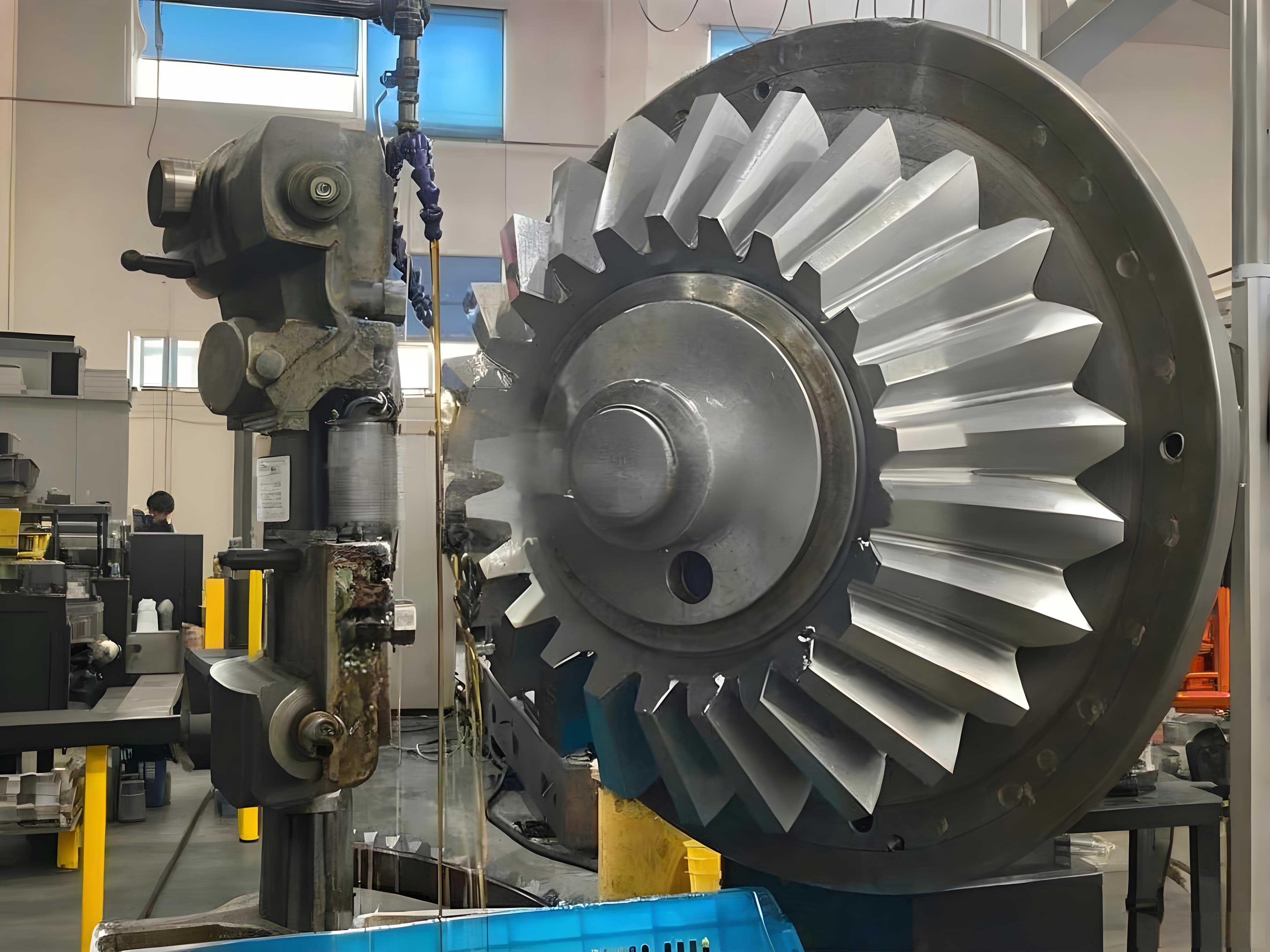
In mechanical transmission systems, miter gears play a pivotal role due to their ability to transmit power between intersecting shafts, typically at a 90-degree angle. As a specialized type of bevel gear, miter gears are widely employed in applications requiring precise motion control, such as automotive differentials, industrial machinery, and aerospace mechanisms. However, the nonlinear dynamics inherent in miter gear systems—stemming from factors like backlash, time-varying mesh stiffness, and manufacturing errors—can lead to undesirable chaotic vibrations. These chaotic motions exacerbate noise, increase wear, and potentially cause system failure, thus necessitating effective control strategies. In this article, we explore a novel approach for suppressing chaos in miter gear systems by leveraging an improved particle swarm optimization (PSO) algorithm to optimize a fuzzy neural network (FNN) controller. Our methodology aims to stabilize chaotic trajectories into periodic orbits with minimal parameter perturbations, offering a robust solution for enhancing the reliability and performance of miter gear transmissions.
The dynamics of miter gear systems are inherently complex, involving multiple degrees of freedom and nonlinear interactions. To model these systems, we consider a 7-degree-of-freedom (DOF) representation that accounts for translational and torsional vibrations along the gear axes. Using a lumped mass approach, the equations of motion are derived, incorporating key nonlinearities such as gear backlash and periodic mesh stiffness variations. The dimensionless governing equations for the miter gear system can be expressed as follows:
$$ \ddot{x}_1 + 2\xi_{x1}\dot{x}_1 + 2a_4\xi_{h1}\dot{\lambda} + k_{x1}x_1 + a_4 k_{h1} f(\lambda) = 0 $$
$$ \ddot{y}_1 + 2\xi_{y1}\dot{y}_1 – 2a_5\xi_{h1}\dot{\lambda} + k_{y1}y_1 – a_5 k_{h1} f(\lambda) = 0 $$
$$ \ddot{z}_1 + 2\xi_{z1}\dot{z}_1 – 2a_3\xi_{h1}\dot{\lambda} + k_{z1}z_1 – a_3 k_{h1} f(\lambda) = 0 $$
$$ \ddot{x}_2 + 2\xi_{x2}\dot{x}_2 – 2a_4\xi_{h2}\dot{\lambda} + k_{x2}x_2 – a_4 k_{h2} f(\lambda) = 0 $$
$$ \ddot{y}_2 + 2\xi_{y2}\dot{y}_2 + 2a_5\xi_{h2}\dot{\lambda} + k_{y2}y_2 + a_5 k_{h2} f(\lambda) = 0 $$
$$ \ddot{z}_2 + 2\xi_{z2}\dot{z}_2 + 2a_3\xi_{h2}\dot{\lambda} + k_{z2}z_2 + a_3 k_{h2} f(\lambda) = 0 $$
$$ -a_1\ddot{x}_1 + a_2\ddot{y}_1 + a_3\ddot{z}_1 + a_1\ddot{x}_2 – a_2\ddot{y}_2 – a_3\ddot{z}_2 + \ddot{\lambda} + 2a_3\xi_h\dot{\lambda} + a_3 k_h f(\lambda) = f_{pm} + f_{pv} + f_e \Omega^2 \cos(\Omega \tau) $$
Here, \( x_j, y_j, z_j \) (for \( j=1,2 \)) represent the dimensionless displacements of the miter gears along coordinate axes, while \( \lambda \) denotes the relative torsional displacement along the mesh line. The parameters \( \xi_{ij} \) and \( k_{ij} \) correspond to damping ratios and stiffness coefficients, respectively. The nonlinear backlash function \( f(\lambda, b) \) is defined as:
$$ f(\lambda, b) = \begin{cases}
\lambda – b & \lambda > b \\
0 & |\lambda| \le b \\
\lambda + b & \lambda < -b
\end{cases} $$
where \( b \) is the half-backlash. The time-varying mesh stiffness \( k_h(\tau) \) for miter gears is modeled as a Fourier series:
$$ k_h(\tau) = 1 + \sum_{l=1}^{N} \frac{\Lambda_{kl}}{k_m} \cos(l\Omega \tau + \phi_{kl}) $$
with \( \Omega \) being the dimensionless meshing frequency ratio. These equations capture the essential dynamics that can lead to chaotic behavior in miter gear systems under certain parameter ranges.
To analyze the chaotic dynamics of the miter gear system, we numerically solve the governing equations using the fourth-order Runge-Kutta method. By varying the meshing frequency ratio \( \Omega \) within the interval [1.5, 1.7], we observe a rich bifurcation behavior. The bifurcation diagram, plotted with the dimensionless displacement \( x_1 \) against \( \Omega \), reveals transitions from periodic to chaotic motions. Specifically, as \( \Omega \) increases, the system undergoes period-doubling bifurcations, enters a period-3 state, and then transitions to chaos via Hopf bifurcations before settling back to periodic motion. For instance, at \( \Omega = 1.64 \), the phase portrait exhibits irregular, non-repeating trajectories, and the Poincaré section shows a scattered point distribution, confirming chaotic dynamics. This chaotic state poses significant challenges for the stable operation of miter gear transmissions, motivating the need for effective control.
Traditional chaos control methods, such as the OGY approach, often struggle with high-dimensional non-smooth systems like miter gear arrays due to issues like Jacobian matrix sensitivity and fixed-point localization. Therefore, we propose an intelligent control strategy based on a fuzzy neural network (FNN) controller, whose parameters are optimized using an enhanced particle swarm optimization (PSO) algorithm. The FNN controller is designed to generate small perturbations to a system parameter—specifically, the meshing frequency ratio \( \Omega \)—based on the Euclidean distances between consecutive points on the Poincaré section. The input to the FNN is the vector \( D(k) = [d(k), d(k-1)] \), where \( d(k) = \| X(k) – X(k-1) \| \) represents the distance between Poincaré points at iterations \( k \) and \( k-1 \), and \( X(k) \) denotes the state coordinates. The output is the perturbation \( \Delta \Omega \), which is added to the nominal value \( \Omega_0 \) to stabilize the system.
The FNN controller architecture consists of five layers: input layer, fuzzification layer, fuzzy rule layer, defuzzification layer, and output layer. In the fuzzification layer, each input is partitioned into five fuzzy sets (e.g., very large, large, medium, small, very small) using Gaussian membership functions:
$$ \mu_i^M = \exp\left( -\frac{\| D – C_{iM} \|^2}{b_{iM}^2} \right) $$
where \( C_{iM} \) and \( b_{iM} \) are the center and width of the \( M \)-th membership function for the \( i \)-th input. The fuzzy rule layer computes the firing strengths \( \alpha_M \) via product operations, while the defuzzification layer normalizes these strengths. Finally, the output layer produces the control signal:
$$ U(k) = \sum_{M=1}^{5} \bar{\alpha}_M w_M $$
with \( w_M \) being the weight matrix connecting the defuzzification and output layers. The perturbation is constrained within bounds \( |U(k)| \leq u_{\text{max}} \) to ensure practicality.
To optimize the FNN parameters—namely, the weights \( w \), centers \( C \), and widths \( b \)—we employ an improved PSO algorithm. Standard PSO suffers from premature convergence and poor exploration in high-dimensional spaces, which is critical for tuning the FNN controller in miter gear systems. Our enhanced PSO incorporates several modifications: (1) chaotic initialization using the Piecewise map to ensure diverse particle distribution, (2) adaptive inertia weight and learning factors for balancing global and local search, and (3) a dynamic Lévy flight mechanism with center migration to escape local optima. The adaptive inertia weight \( w \) is given by:
$$ w = (w_{\text{max}} – w_{\text{min}}) \cdot \tan\left( 0.875 \cdot \left(1 – (t/T)^k\right) \right) + w_{\text{min}} $$
where \( t \) is the current iteration, \( T \) is the maximum iterations, and \( k=0.6 \). The learning factors \( c_1 \) and \( c_2 \) vary nonlinearly:
$$ c_1 = 2 \cdot \sin\left( \frac{\pi}{2} \cdot \left(1 – t/T\right) \right)^2, \quad c_2 = 2 \cdot \sin\left( \frac{\pi}{2} \cdot (t/T) \right)^2 $$
The position update incorporates a Lévy flight strategy:
$$ p_{is}(t+1) = b_2 \cdot p_{is}(t) + b_1 \cdot p_{g\text{best}} + 0.01 \cdot S_{\text{Lévy}} \cdot (p_{is}(t) – p_{g\text{best}}) $$
where \( S_{\text{Lévy}} = \mu / |v|^{1/\beta} \) follows a Lévy distribution with \( \beta=1.5 \), and \( b_1, b_2 \) are dynamic coefficients that shift focus from exploration to exploitation. A Bernoulli-based selection mechanism with probability \( p=0.5 \) chooses between this update and the standard PSO update. The fitness function for optimization is defined as the sum of absolute errors between the desired and actual Poincaré distances:
$$ f(P_i) = \sum_{k=1}^{L} |d^* – \| X(k) – X(k-1) \| | $$
where \( d^* \) is the target distance for periodic motion, and \( L \) is the data length. This approach ensures that the FNN controller parameters are optimally tuned without manual trial-and-error, enhancing control performance for miter gear systems.
We validate the improved PSO algorithm using benchmark functions, comparing it with standard PSO. The results, summarized in Table 1, demonstrate superior convergence and accuracy of our enhanced algorithm. For instance, on the Griewank and Rastrigin functions, the improved PSO achieves near-zero errors, highlighting its robustness for high-dimensional optimization.
| Test Function | Original PSO Result | Improved PSO Result |
|---|---|---|
| Ackley | 5.0574e-04 | 8.8817e-16 |
| Alpine | 0.145318988148 | 6.0014e-141 |
| Griewank | 1.1504e-07 | 0 |
| Rastrigin | 8.188847064707494 | 0 |
| Schaffer | -0.995115820950763 | -1 |
| Weierstrass | 2.503866314153974 | 0 |
Applying the optimized FNN controller to the miter gear system at \( \Omega = 1.64 \), we simulate the control process starting from the chaotic state. The controller parameters obtained via improved PSO are listed in Table 2 for period-1 control and Table 3 for period-3 control. These parameters enable the FNN to generate appropriate perturbations \( \Delta \Omega \) that quickly stabilize the system.
| Parameter Type | Values for Period-1 Control |
|---|---|
| Weights \( w \) | [3.6333, 0.3153, 2.5269, 0.0590, 0.1842] |
| Widths \( b_{1M}, b_{2M} \) | [(0.3362, -1.0568), (-1.1805, -0.3960), (-0.3753, 0.7872), (2.5240, 0.3347), (2.6771, 3.6370)] |
| Centers \( C_{1M}, C_{2M} \) | [(3.2058, 0.3838), (3.0718, 2.4506), (3.2917, 0.0920), (0.3000, -0.2998), (-0.6434, 2.5122)] |
| Parameter Type | Values for Period-3 Control |
|---|---|
| Weights \( w \) | [-2.1479, 2.7273, 0.4573, -0.4460, 0.1964] |
| Widths \( b_{1M}, b_{2M} \) | [(1.9751, 1.9751), (0.1322, 0.1322), (3.2080, 3.2080), (4.0000, 4.0000), (2.9706, 2.9706)] |
| Centers \( C_{1M}, C_{2M} \) | [(4.0000, 3.9327), (0.5962, 3.8547), (4.0000, 3.8477), (4.0000, -0.2208), (3.3554, -0.2319)] |
The simulation results show that within a few iterations after applying perturbations (starting at iteration 200), the chaotic trajectories converge to stable periodic orbits. For period-1 control, the phase portrait collapses to a single closed curve, and the Poincaré section reduces to a fixed point. Similarly, for period-3 control, the system exhibits three distinct closed curves in the phase plane and three points in the Poincaré section. The perturbation signals \( \Delta \Omega \) remain small (within ±0.05), indicating minimal control effort. This demonstrates the efficacy of our approach in taming chaos in miter gear systems without disrupting normal operation.
The success of this control strategy hinges on the synergy between the FNN’s approximation capabilities and the improved PSO’s optimization power. The FNN learns to map Poincaré distance errors to optimal parameter adjustments, while the enhanced PSO efficiently searches the high-dimensional parameter space. This method avoids the pitfalls of traditional chaos control, such as the need for explicit system linearization or exact fixed-point computation. Moreover, it is adaptable to various operating conditions of miter gear transmissions, including changes in load and speed.
In conclusion, we have presented a comprehensive framework for controlling chaotic vibrations in miter gear systems using an improved PSO-optimized fuzzy neural network. By modeling the 7-DOF dynamics of miter gears, identifying chaotic regimes, and designing an intelligent controller, we achieve stable period-1 and period-3 motions with negligible parameter perturbations. The enhanced PSO algorithm ensures rapid and accurate tuning of the FNN, making the approach practical for real-time applications. This work underscores the potential of hybrid intelligent control methods in advancing the reliability and efficiency of miter gear transmissions, paving the way for smoother and more durable mechanical systems. Future research could extend this methodology to other gear types or incorporate additional nonlinearities, further solidifying its role in modern engineering.