
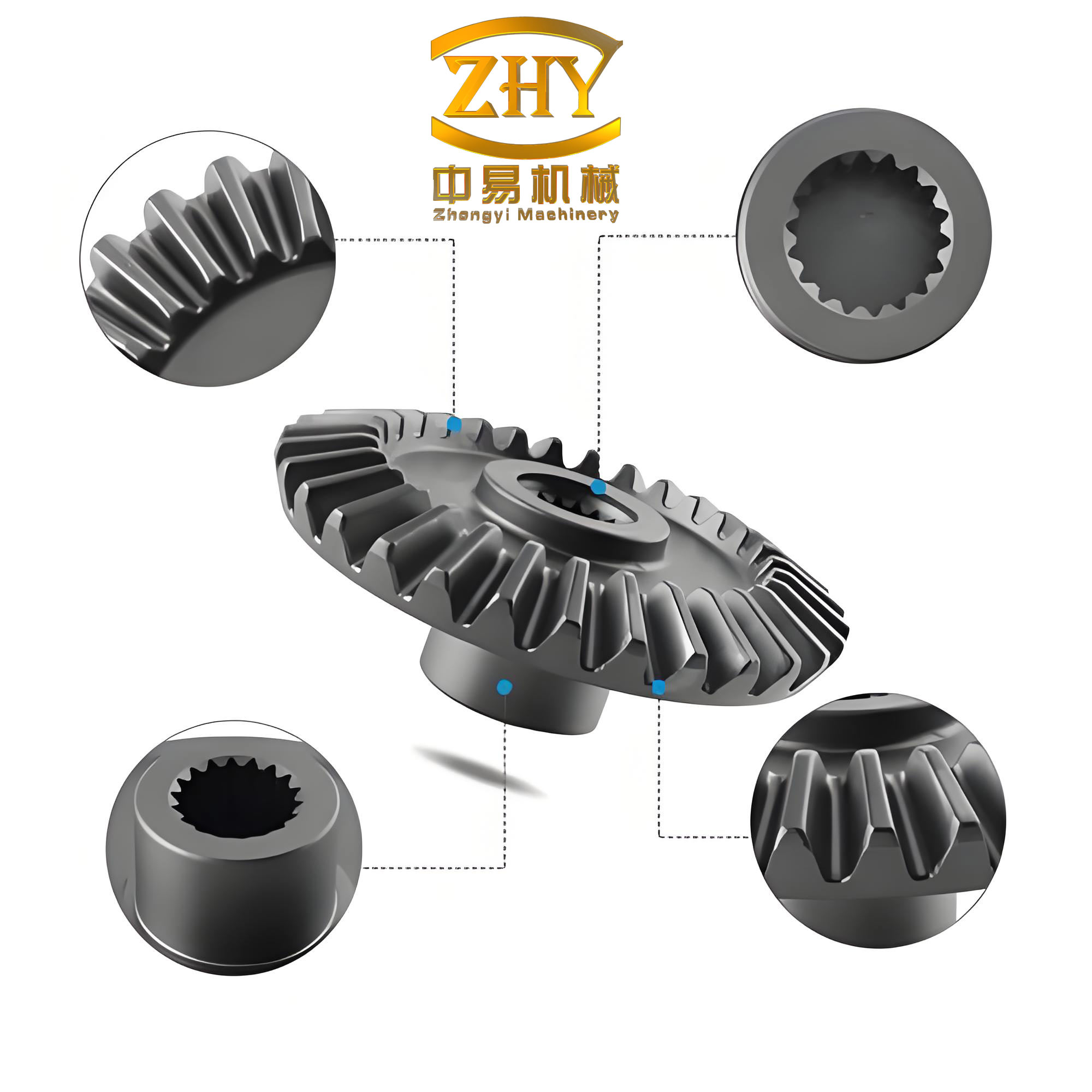
In mechanical transmission systems, straight bevel gears are widely used due to their ability to transmit motion between intersecting shafts. However, nonlinear factors such as backlash, time-varying stiffness, and support clearances can induce chaotic vibrations in straight bevel gear systems, leading to reduced performance and potential failure. This study addresses the chaotic motion control of a 7-degree-of-freedom straight bevel gear transmission system by integrating an improved particle swarm optimization algorithm with a fuzzy neural network controller. The approach eliminates the need for prior knowledge of system Jacobian matrices or fixed-point locations, offering a universal solution for nonlinear vibration control in straight bevel gear systems.
The dynamics of straight bevel gear systems are governed by nonlinear equations that account for factors like gear meshing stiffness, damping, and backlash. A lumped mass method is employed to model the system, and the Runge-Kutta numerical method is used to solve the equations, revealing transitions from periodic to chaotic motion within specific parameter ranges. For instance, when the dimensionless meshing frequency ratio $\Omega$ varies between 1.5 and 1.7, the system exhibits bifurcations, including period-doubling and Hopf bifurcations, culminating in chaotic behavior at $\Omega = 1.64$. The Poincaré section at this point shows irregularly distributed points, confirming chaos. To mitigate this, a control strategy is developed where the Euclidean distance between points on the Poincaré section serves as input to a fuzzy neural network, and the perturbation to the system’s controllable parameter (e.g., $\Omega$) is the output.
The fuzzy neural network controller consists of five layers: input layer, fuzzification layer, fuzzy rule layer, defuzzification layer, and output layer. The input variables are the Euclidean distances $d(k) = \| \mathbf{X}(k) – \mathbf{X}(k-1) \|$ and $d(k-1) = \| \mathbf{X}(k-1) – \mathbf{X}(k-2) \|$, where $\mathbf{X}(k)$ represents the coordinates on the Poincaré section at iteration $k$. The output is the perturbation $\Delta \Omega$ applied to the frequency ratio. The membership functions in the fuzzification layer are Gaussian, defined as $\mu_{i}^{M} = \exp\left(-\frac{\| D – C_{iM} \|^2}{b_{iM}^2}\right)$, where $i$ denotes the input index, $M$ is the fuzzy subset, $C_{iM}$ is the center, and $b_{iM}$ is the width. The fuzzy rule layer computes the firing strength $a_M = \mu_{1}^{i} \mu_{2}^{i}$, and the defuzzification layer normalizes this to $\bar{a}_M = \frac{a_M}{\sum_{j=1}^{M} a_j}$. Finally, the output layer produces the control signal $U(k) = \sum_{i=1}^{M} \bar{a}_i w_i$, where $w_i$ are the weight parameters.
To optimize the parameters of the fuzzy neural network controller (e.g., weights $w$, centers $C$, and widths $b$), an improved particle swarm optimization algorithm is proposed. Traditional PSO tends to converge prematurely and struggle with local optima, especially in high-dimensional problems. The enhancements include chaotic initialization using the Piecewise map, adaptive inertia weight, dynamic learning factors, and a Lévy flight strategy with dynamic center migration. The Piecewise map for initialization is given by:
$$ p(t+1) = \begin{cases}
\frac{p(t)}{q} & 0 \leq p(t) \leq q \\
\frac{p(t)-q}{0.5-q} & q \leq p(t) < 0.5 \\
\frac{1-q-p(t)}{0.5-q} & 0.5 \leq p(t) < 1-q \\
\frac{1-p(t)}{q} & 1-q \leq p(t) < 1
\end{cases} $$
where $q = 1$. The adaptive inertia weight $w$ is updated as:
$$ w = (w_{\text{max}} – w_{\text{min}}) \cdot \tan\left(0.875 \cdot \left(1 – \left(\frac{t}{T}\right)^k\right)\right) + w_{\text{min}} $$
with $w_{\text{max}} = 0.9$, $w_{\text{min}} = 0.1$, $t$ as the current iteration, $T$ as the maximum iterations, and $k = 0.6$. The learning factors $c_1$ and $c_2$ are dynamically adjusted:
$$ c_1 = 2 \cdot \sin\left(\frac{\pi}{2} \cdot \left(1 – \frac{t}{T}\right)\right)^2, \quad c_2 = 2 \cdot \sin\left(\frac{\pi}{2} \cdot \frac{t}{T}\right)^2 $$
The Lévy flight strategy modifies the position update to enhance diversity:
$$ p_{is}(t+1) = b_2 \cdot p_{is}(t) + b_1 \cdot p_{g\text{best}} + 0.01 \cdot S_{\text{Lévy}} \cdot (p_{is}(t) – p_{g\text{best}}) $$
where $S_{\text{Lévy}} = \frac{\mu}{|\nu|^{1/\beta}}$, $\mu \sim N(0, \sigma_\mu^2)$, $\nu \sim N(0, \sigma_\nu^2)$, $\sigma_\nu = 1$, $\beta = 1.5$, and $\sigma_\mu$ is computed as:
$$ \sigma_\mu = \left( \frac{\Gamma(1+\beta) \sin(\pi \beta / 2)}{\Gamma[(1+\beta)/2] \beta 2^{(\beta-1)/2}} \right)^{1/\beta} $$
The coefficients $b_1$ and $b_2$ are time-varying to balance exploration and exploitation. A Bernoulli distribution-based selection mechanism with probability $p=0.5$ is used to choose between the standard PSO update and the Lévy-enhanced update.
The straight bevel gear system’s dimensionless equations of motion are derived as follows. The relative torsional displacement along the meshing line is $\lambda = \Lambda_n / b_h$, where $\Lambda_n$ is the displacement and $b_h$ is the half-backlash. The equations for the 7-DOF system are:
$$ \begin{aligned}
&\ddot{x}_1 + 2\xi_{x1} \dot{x}_1 + 2a_4 \xi_{h1} \dot{\lambda} + k_{x1} x_1 + a_4 k_{h1} f(\lambda) = 0 \\
&\ddot{y}_1 + 2\xi_{y1} \dot{y}_1 – 2a_5 \xi_{h1} \dot{\lambda} + k_{y1} y_1 – a_5 k_{h1} f(\lambda) = 0 \\
&\ddot{z}_1 + 2\xi_{z1} \dot{z}_1 – 2a_3 \xi_{h1} \dot{\lambda} + k_{z1} z_1 – a_3 k_{h1} f(\lambda) = 0 \\
&\ddot{x}_2 + 2\xi_{x2} \dot{x}_2 – 2a_4 \xi_{h2} \dot{\lambda} + k_{x2} x_2 – a_4 k_{h2} f(\lambda) = 0 \\
&\ddot{y}_2 + 2\xi_{y2} \dot{y}_2 + 2a_5 \xi_{h2} \dot{\lambda} + k_{y2} y_2 + a_5 k_{h2} f(\lambda) = 0 \\
&\ddot{z}_2 + 2\xi_{z2} \dot{z}_2 + 2a_3 \xi_{h2} \dot{\lambda} + k_{z2} z_2 + a_3 k_{h2} f(\lambda) = 0 \\
&-a_1 \ddot{x}_1 + a_2 \ddot{y}_1 + a_3 \ddot{z}_1 + a_1 \ddot{x}_2 – a_2 \ddot{y}_2 – a_3 \ddot{z}_2 + \ddot{\lambda} + 2a_3 \xi_h \dot{\lambda} + a_3 k_h f(\lambda) = f_{pm} + f_{pv} + f_e \Omega^2 \cos(\Omega \tau)
\end{aligned} $$
where $x_j, y_j, z_j$ are dimensionless displacements, $\xi_{ij}$ are damping ratios, $k_{ij}$ are stiffness coefficients, $a_1 = \cos \delta_1 \sin \alpha_n$, $a_2 = \cos \delta_1 \cos \alpha_n$, $a_3 = \cos \alpha_n$, $\delta_1$ is the pitch cone angle, $\alpha_n$ is the pressure angle, and $f(\lambda, b)$ is the backlash function:
$$ f(\lambda, b) = \begin{cases}
\lambda – b & \lambda > b \\
0 & |\lambda| \leq b \\
\lambda + b & \lambda < -b
\end{cases} $$
The time-varying meshing stiffness $k_h(\tau)$ is expressed as a Fourier series:
$$ k_h(\tau) = 1 + \sum_{l=1}^{N} \frac{\Lambda_{kl}}{k_m} \cos(l \Omega \tau + \phi_{kl}) $$
where $k_m$ is the average stiffness, $\Lambda_{kl}$ are harmonic amplitudes, and $\phi_{kl}$ are phase angles. The load excitation $f_{pv}$ is given by:
$$ f_{pv} = \sum_{l=1}^{N} f_{Fl} \cos(l \Omega_F t + \phi_{Fl}) $$
Key parameters for the straight bevel gear system are summarized in the table below, which includes gear geometry, operating conditions, and controller settings. These parameters are essential for simulating the system dynamics and optimizing the controller.
| Parameter | Symbol | Value |
|---|---|---|
| Number of teeth (pinion) | $z_1$ | 47 |
| Number of teeth (gear) | $z_2$ | 53 |
| Pressure angle | $\alpha_n$ | 20° |
| Pitch cone angle (pinion) | $\delta_1$ | 41.57° |
| Pitch cone angle (gear) | $\delta_2$ | 48.43° |
| Base circle radius (pinion) | $r_1$ | 0.047 m |
| Base circle radius (gear) | $r_2$ | 0.053 m |
| Dimensionless damping ratio | $\xi_{ij}$ | 0.01 |
| Meshing damping ratio | $\xi_h$ | 0.05 |
| Stiffness coefficient | $k_{ij}$ | 1 |
| Backlash | $b_h$ | 1.0 |
| Dimensionless frequency ratio | $\Omega$ | 1.5–1.7 |
| PSO population size | $N$ | 150 |
| Maximum iterations | $T$ | 100 |
The fitness function for the improved PSO is defined as the sum of absolute errors between the desired and actual Euclidean distances on the Poincaré section:
$$ f(\mathbf{P}_i) = \sum_{k=1}^{L} |d^* – \| \mathbf{X}(k) – \mathbf{X}(k-1) \| | $$
where $d^*$ is the target distance for periodic motion, and $L$ is the length of the data sequence. The optimization aims to minimize this fitness function by adjusting the controller parameters.
Simulation results demonstrate the effectiveness of the proposed method. For the straight bevel gear system operating in a chaotic regime at $\Omega = 1.64$, the controller successfully stabilizes the motion to period-1 and period-3 orbits. The controlled phase trajectories show closed curves, and the Poincaré sections reduce to discrete points, indicating periodic behavior. The perturbation $\Delta \Omega$ applied by the controller is small, ensuring minimal impact on system operation. The table below lists the optimized parameters of the fuzzy neural network for period-1 control, obtained through the improved PSO algorithm.
| Parameter Type | Values |
|---|---|
| Weights $w$ | 3.6333, 0.3153, 2.5269, 0.0590, 0.1842 |
| Widths $b_{1M}$, $b_{2M}$ | (0.3362, -1.0568), (-1.1805, -0.3960), (-0.3753, 0.7872), (2.5240, 0.3347), (2.6771, 3.6370) |
| Centers $C_{1M}$, $C_{2M}$ | (3.2058, 0.3838), (3.0718, 2.4506), (3.2917, 0.0920), (0.3000, -0.2998), (-0.6434, 2.5122) |
Similarly, for period-3 control, the parameters are optimized as follows, showcasing the adaptability of the approach for different target motions in straight bevel gear systems.
| Parameter Type | Values |
|---|---|
| Weights $w$ | -2.1479, 2.7273, 0.4573, -0.4460, 0.1964 |
| Widths $b_{1M}$, $b_{2M}$ | (1.9751, 1.9751), (0.1322, 0.1322), (3.2080, 3.2080), (4.0000, 4.0000), (2.9706, 2.9706) |
| Centers $C_{1M}$, $C_{2M}$ | (4.0000, 3.9327), (0.5962, 3.8547), (4.0000, 3.8477), (4.0000, -0.2208), (3.3554, -0.2319) |
The improved PSO algorithm’s performance is validated using benchmark functions, such as Griewank, Rastrigin, and Ackley, where it achieves lower error values and faster convergence compared to standard PSO. For example, on the Ackley function, the improved PSO reaches a fitness value of $8.8817 \times 10^{-16}$, while standard PSO stagnates at $5.0574 \times 10^{-4}$. This enhancement directly benefits the optimization of the fuzzy neural network controller for straight bevel gear systems.
In conclusion, the integration of an improved PSO algorithm with a fuzzy neural network provides an effective and generalizable method for controlling chaotic vibrations in straight bevel gear transmission systems. The controller requires no explicit system model or Jacobian matrix, making it suitable for real-world applications. By applying small perturbations to the frequency ratio, chaotic motion is suppressed, and the system stabilizes to periodic orbits. Future work could explore the application of this method to other gear types or multi-stage transmission systems, further validating its robustness. The straight bevel gear system serves as an ideal testbed due to its complex nonlinear dynamics, and the proposed approach offers a scalable solution for enhancing mechanical transmission reliability.