
The widespread adoption of industrial robots, automated rotary tables, CNC machine tool turrets, and AGVs has been significantly enabled by the core component known as the RV reducer. However, achieving mass domestic production with consistent quality remains a critical challenge within the industry. The cycloidal gear, a central component of the RV reducer, plays a decisive role. The machining quality of its complex cycloidal tooth profile and the crank shaft holes directly governs the final transmission accuracy, torsional rigidity, and overall performance of the entire RV reducer.
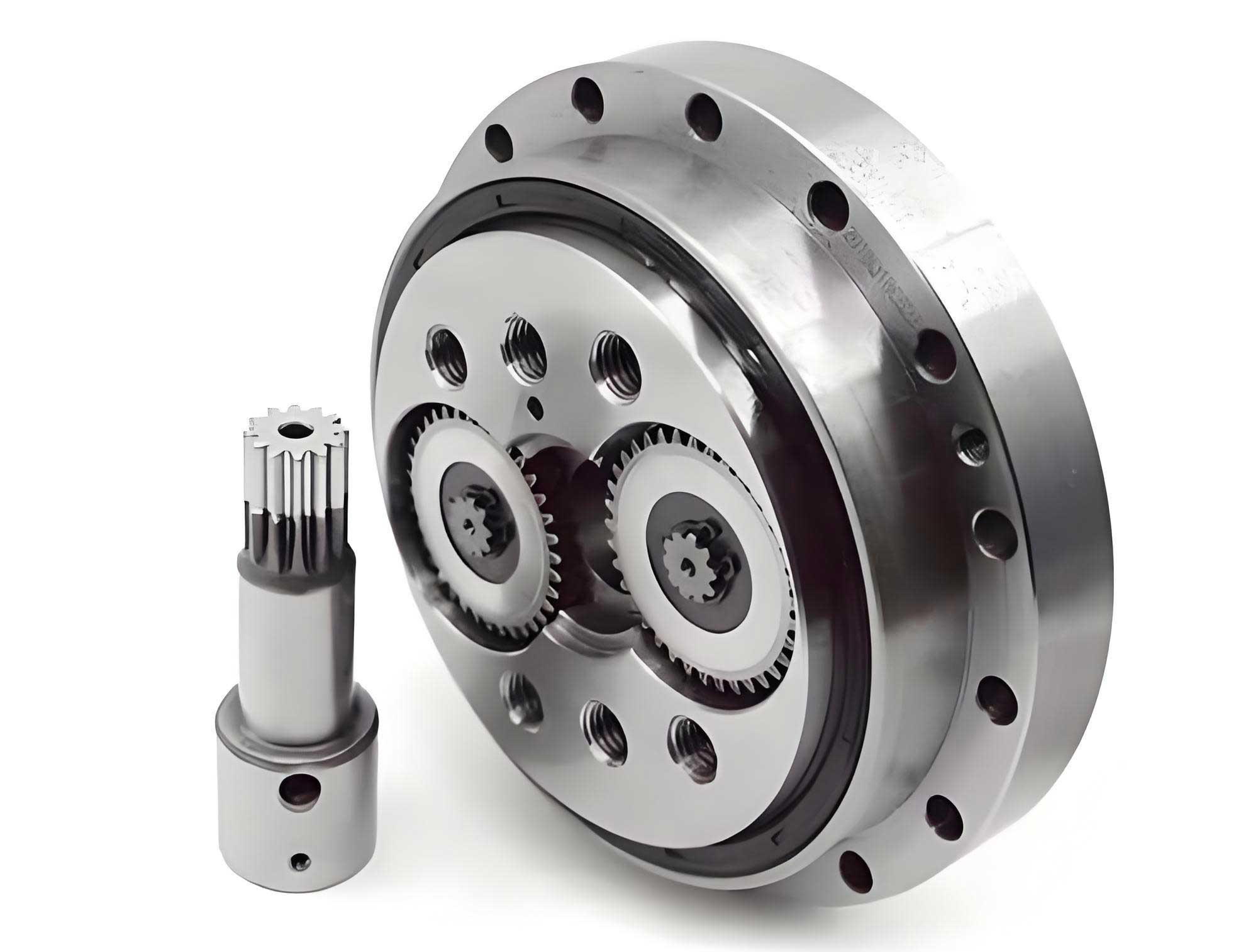
This article details an optimized CNC milling process for the cycloidal gear, addressing common bottlenecks in its production. By focusing on fixture redesign, strategic tool selection, and advanced toolpath planning, we achieve a significant improvement in both machining efficiency and geometric accuracy for this critical part of the RV reducer.
1. Challenges in Conventional Machining and Proposed Integrated Solution
Traditionally, the cycloidal tooth profile and the various internal holes (crank shaft holes, input shaft pass-through holes, and planet carrier pass-through holes) are machined in separate operations. A common sequence involves first machining all internal holes, then re-fixturing the part using the crank shaft holes as a datum to finally mill the external cycloidal teeth. This approach presents two major drawbacks for the high-volume production of RV reducer components:
- It necessitates the design and use of dedicated fixtures for the second operation, increasing non-cut time for fixture changes and part handling.
- Due to the small radius of curvature inherent to the cycloidal profile, preventing undercutting or gouging forces the use of very small diameter milling tools. This drastically reduces the possible metal removal rate per pass, leading to excessively long cycle times.
To overcome these limitations, a new integrated machining strategy is proposed. The core philosophy is to machine all critical features—the cycloidal profile, crank holes, and pass-through holes—in a single setup. This eliminates secondary fixturing errors and reduces idle time. Furthermore, the tooth profile is segmented based on its geometric properties, allowing the use of larger, more efficient cutters for roughing and semi-finishing, followed by a smaller tool for final precision finishing. This strategy is central to optimizing the production of the cycloidal gear for the RV reducer.
2. Fixture Design for Single-Setup Machining
The success of the integrated strategy hinges on a robust and precise fixture design. The primary goal is to use the input shaft pass-through hole as the main locating and clamping datum for the entire operation.
The procedure begins by securing a custom fixture to the machine table. The fixture features a precision-machined pilot that simulates the input shaft datum. This pilot is indicated and set as the program zero point (G54, for instance). The cycloidal gear blank is placed over this pilot, locating on the input shaft hole’s diameter. A dedicated clamp plate, carefully designed to avoid interference with all features to be machined, is then used to secure the part by applying force uniformly on the top and bottom faces.
Key considerations during implementation for the RV reducer gear include:
- Secure Clamping: The part must be held rigidly to prevent any movement or vibration during aggressive milling operations, which could cause geometric errors between the tooth profile and the crank holes.
- Face Parallelism: The parallelism of the gear blank’s top and bottom faces must be controlled (e.g., < 0.03 mm). This ensures the perpendicularity of the machined profiles and holes relative to the gear faces.
- Machining Sequence: The internal holes (crank, input, planet carrier) are machined first within this setup. This establishes solid geometry before proceeding to the more complex external profile milling, which can generate higher cutting forces.
3. Tool Selection and Optimized Toolpath Strategy for the Cycloidal Profile
The machining involves two main feature groups: the internal holes and the external cycloidal teeth. While the holes are straightforward to mill using pocketing and contouring cycles, the cycloidal profile presents a unique challenge. Its shape is defined by a parametric equation derived from the rolling action of a generating circle. The mathematical definition of the cycloidal tooth profile for the RV reducer gear is given by:
$$
\begin{aligned}
x_c(\theta_1) &= (r_p – r_{rp}) \cos\left( (1 – i^{H}) \theta_1 \right) – e \cdot \left[ k(\phi_1, \theta_1) \right]^{i^{H}} \cos\left( \phi_1 – i^{H} \theta_1 \right) \\
y_c(\theta_1) &= (r_p – r_{rp}) \sin\left( (1 – i^{H}) \theta_1 \right) + e \cdot \left[ k(\phi_1, \theta_1) \right]^{i^{H}} \sin\left( \phi_1 – i^{H} \theta_1 \right)
\end{aligned}
$$
Where the auxiliary function $k(\phi_1, \theta_1)$ is:
$$
k(\phi_1, \theta_1) = 1 + \frac{1}{1 – \frac{2e}{r_p} \cos(\phi_1)}
$$
and the following relations hold:
$$
\phi_1 = \arctan\left( \frac{\sin((1 – i^{H})\theta_1)}{ \frac{r_p}{e} – \cos((1 – i^{H})\theta_1) } \right), \quad i^{H} = -\frac{Z_I}{Z_C}, \quad k_p = \frac{e Z_I}{r_p}.
$$
Symbol Definitions:
| Symbol | Description | Unit |
|---|---|---|
| $r_p$ | Radius of the pin pitch circle | mm |
| $r_{rp}$ | Radius of the pin (roller) | mm |
| $e$ | Eccentricity (offset) of the generating circle | mm |
| $Z_I$ | Number of pins (rollers) | – |
| $Z_C$ | Number of cycloidal gear teeth | – |
| $\theta_1$ | Rolling angle parameter (0 to $2\pi$) | rad |
The primary constraint in milling this profile is avoiding tool interference (gouging) at the root and tip regions where the curvature is high. A conservative rule dictates that the tool diameter $D$ must be less than or equal to the pin radius: $D \le r_{rp}$. For typical RV reducer sizes, this often forces the use of tools with $D \le 6$ mm for the entire operation, leading to poor productivity.
Our optimized strategy breaks this constraint by employing a multi-stage, offset-machining approach. The core idea is to use the mathematical model of the profile to create “offset” or “stock-to-leave” geometries. We progressively machine the tooth slot using a series of tools with decreasing diameters, each removing a portion of the stock along a path that is a calculated offset from the final profile. This allows the use of larger, more robust tools for the bulk of material removal.
The tooling strategy is summarized in the following table:
| Tool Designation | Primary Role | Diameter Strategy | Path Description |
|---|---|---|---|
| Tool #1 (Largest) | Roughing | Largest possible that avoids collision in open areas of the profile. | Machines a gross offset contour, removing ~70-80% of the slot stock. High feed rates. |
| Tool #2 (Medium) | Semi-Finishing | Smaller than Tool #1, able to navigate tighter areas of the offset geometry. | Machines a closer offset to the final profile, leaving a uniform stock (e.g., 0.3-0.5 mm) for finishing. |
| Tool #3 (Smallest) | Finishing | $\le r_{rp}$ (e.g., 6 mm or less) to perfectly clean the root and tip. | Machines the final theoretical cycloidal profile in a single, full-depth, low-stepover contour pass to achieve final size and surface finish. |
All tools are coated carbide end mills for wear resistance. Given the part thickness (>10 mm), a layered (Z-level) machining strategy is employed for Tools #1 and #2 to manage cutting forces and chip evacuation. Tool #3 performs a final full-depth finishing pass to ensure perfect form and surface integrity on the RV reducer gear teeth.
4. Machine Tool Requirements and Final Machining Results
Executing this precision process, especially the finishing pass with a small-diameter tool, places specific demands on the machining center. The geometric tolerance between the cycloidal profile and the crank holes is typically less than 0.02 mm. To achieve this under high spindle speeds necessary for small tools, the following elements are critical:
- Machine Tool: High rigidity, high positional accuracy, and a stable, high-speed spindle are mandatory.
- Tool Holding: High-precision, rigid holders (e.g., heat shrink or precision collet chucks) with very low runout (< 0.005 mm) are essential to prevent tool deflection and maintain profile accuracy.
- Coolant: Effective high-pressure coolant is crucial for heat dissipation, chip flushing, and preventing built-up edge on the small finishing tool.
Based on these requirements, a suitable machining setup can be specified as follows:
| Category | Model / Type | Key Parameters |
|---|---|---|
| CNC Machining Center | High-Precision Vertical Machining Center | Spindle Speed: max ≥ 8,000 rpm; Positioning Accuracy: ≤ 0.005 mm; CNC Control: Capable of high-speed NURBS interpolation (e.g., FANUC, Siemens). |
| Tool Holder | Precision Hydraulic Shrink Fit or Thermal Shrink Holder | Max Speed: ≥ 25,000 rpm; Guaranteed Runout: ≤ 0.003 mm. |
| Cutting Fluid | Synthetic or Semi-Synthetic Water-Miscible Fluid | Designed for high lubricity and cooling in finishing operations on hardened steels. |
Implementing the optimized fixture, tooling, and path strategy on such a capable setup yields significant results for the RV reducer cycloidal gear. The single-part cycle time is reduced by approximately 30% compared to the conventional two-setup, small-tool-only method. Dimensional inspection, typically using a coordinate measuring machine (CMM) to scan the tooth profile, shows that the form error of the cycloidal teeth is controlled within ±0.01 mm. The positional accuracy (true position) between the tooth profile and the crank shaft holes is consistently better than 0.015 mm. These results fully meet the stringent requirements for a high-performance RV reducer.
5. Conclusion
The production bottleneck for the cycloidal gear, a core component of the RV reducer, can be effectively addressed through a holistic review and optimization of the CNC milling process. The key improvements involve: 1) Designing a fixture for single-setup machining of all critical features, 2) Employing a multi-tool, offset-path strategy based on the cycloidal profile’s mathematics to maximize metal removal rates, and 3) Selecting machine tools, tool holders, and cutting fluids that support high-precision, high-speed finishing. This integrated approach demonstrates a measurable increase in productivity (30% reduction in cycle time) while simultaneously achieving the demanding geometric tolerances required for the reliable and precise operation of the RV reducer in advanced industrial applications.