
Abstract: Aiming at the non-orthogonal spiral bevel gear surface milling, this paper proposes a load contact mechanical performance evaluation method. Based on this, an adaptive data-driven collaborative optimization approach for tooth surface geometric accuracy is studied. The research provides insights into achieving high precision and optimal performance in spiral bevel gear manufacturing.
Keywords: spiral bevel gear milling; geometric accuracy of tooth surface; adaptive data-driven; load contact performance; multi-objective optimization
1. Introduction
Spiral bevel gears and hypoid gears serve as critical components for power conversion between shaft transmissions. The geometric shape of their tooth surfaces directly impacts load contact mechanical performance. However, the geometric characteristics, processing techniques, and manufacturing processes of spiral bevel gears complicate geometric accuracy control.
Traditional methods primarily focus on geometric accuracy, neglecting the integrated consideration of load contact mechanical performance. With the development of new technologies, there is an increasing need for collaborative optimization that combines both geometric accuracy and load contact performance. This paper presents an adaptive data-driven approach for achieving this integration.
2. Literature Review
Machine tool settings are the primary design variables for tooth surface modeling, tooth surface shape error correction, and tooth contact analysis (TCA). These settings form the basis of an adaptive optimization design, enabling precise data-driven compensation for geometric accuracy errors arising during manufacturing.
Recent advancements, such as the Universal Motion Concept (UMC), have broadened the scope of machine tool settings, transcending previous limitations associated with different tooth systems, processing techniques, and hypoid generators. UMC facilitates online prediction and compensation of new tooth surface errors on five-axis CNC gear milling machines.
Researchers like Ding et al. [10] have established a basic framework for collaborative manufacturing of spiral bevel gears, considering both tooth surface geometry and physical properties. However, their framework is limited to recent applications of corrections, with data-driven control remaining unexplored.
3. Methodology
3.1 Tooth Surface Modeling and Simulation
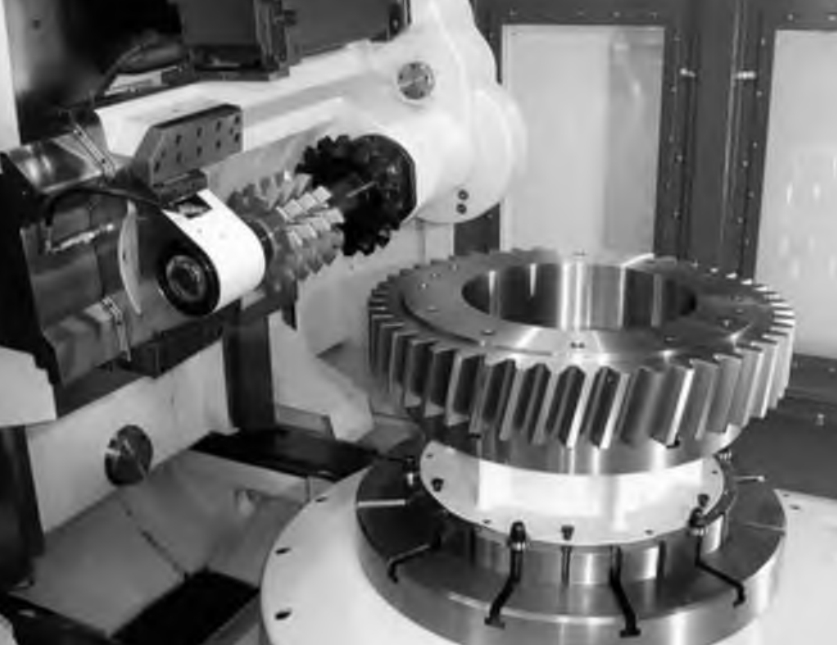
To address the complexity of non-orthogonal spiral bevel gears, this paper employs dual spiral surface milling for tooth surface modeling and simulation. The improved TCA method addresses gear assembly issues, providing a foundation for subsequent analyses.
3.2 Load Contact Mechanical Performance Evaluation
The Normal Load Tooth Contact Analysis (NLTCA) method, based on Hertz contact theory, is adopted to establish a data-driven relationship between load contact mechanical performance and assembly errors. This relationship is crucial for subsequent optimization processes.
Table 1: Geometric Design Parameters of the Spiral Bevel Gear
| Parameters | Pinion | Gear |
|---|---|---|
| Number of teeth | 31 | 38 |
| Average normal modulus | 5.3 mm | 5.3 mm |
| Face width | 32 mm | 32 mm |
| Pressure angle | 22.5° | 22.5° |
| Outer cone distance | 208.81 mm | 208.81 mm |
| Root angle | 22.4° | 27.733° |
| Helix angle | 23.167° | 28.833° |
| Spiral direction | RH | LH |
| Tooth tip | 5.09 mm | 3.44 mm |
| Tooth root | 4.65 mm | 6.30 mm |
3.3 Adaptive Data-Driven Collaborative Optimization Model
The proposes an adaptive data-driven collaborative optimization model driven by load contact performance for precise dual spiral surface milling geometric accuracy control. The model integrates multi-objective optimization (MOO) for load contact mechanical performance evaluation and assembly error correction for tooth surface geometry optimization.
3.4 Optimization Strategy
Considering efficiency, accuracy, and reliability, the collaborative optimization decision-making process is divided into two subsystems:
- MOO for Load Contact Mechanical Performance: Determines the target tooth surface.
- Geometry Optimization through Assembly Error Correction: Optimizes the tooth surface geometry.
Sensitivity analysis is employed to select a limited number of assembly errors as design variables for optimization.
4. Results and Discussion
4.1 Basic Parameter Design and Simulation
Table 2 presents the machine settings for dual spiral surface milling of spiral bevel gears, based on the basic design parameters in Table 1. Detailed tooth surface dual spiral surface milling, considering initial assembly errors, was simulated for both gear and pinion tooth surfaces.
Table 2: Machine Settings for Dual Spiral Surface Milling of Spiral Bevel Gears
| Machine Settings | Gear | Pinion |
|---|---|---|
| Tool radial setting (Sr) | 164.02 mm | 164.13 mm |
| Workpiece offset (Em) | 0 mm | 0.13 mm |
| Sliding base setting (XB) | -3.96 mm | -3.33 mm |
| Tool root angle (γm) | 27.73° | 20.13° |
| Blade inclination (σ) | 0.63° | 3.44° |
| Blade rotation angle (ζ) | 14.83° | 2.54° |
4.2 Geometric Accuracy Verification
Geometric accuracy verification involves optimizing assembly error corrections by selecting a limited number of assembly error evaluations as design variables. Sensitivity coefficients for various assembly errors were determined, revealing P and G as the most significant factors.
Figure 1: Data-Driven Modeling of Tooth Surface for Non-Orthogonal Spiral Bevel Gears
(Illustration of tooth surface and root fillet modeling)
4.3 Optimization Results
Three optimization scenarios were considered:
- Scenario 1: Optimization using P and G.
- Scenario 2: Optimization using P, G, and e.
- Scenario 3: Optimization using P only.
Scenario 2 yielded the best optimization results in terms of geometric accuracy and computational efficiency. The final optimized assembly errors were determined as (G, P, e, α)* = [0.1532 mm, -0.0929 mm, 0.07861 mm, 1.0°], with corrections of (ΔG, ΔP, Δe, Δα) = [-0.0968 mm, 0.071 mm, 0.02861 mm, 0°].
Table 3: Comparison of Optimization Results for Different Strategies
| Parameters | Before Optimization | Scenario 1 | Scenario 2 | Scenario 3 |
|---|---|---|---|---|
| G/mm | 0.25 | 0.13 (+0.12) | 0.15 (+0.10) | 0.25 |
| P/mm | -0.20 | -0.11 (+0.09) | -0.10 (+0.10) | -0.08 (+0.12) |
| e/mm | 0.05 | 0.08 (+0.03) | 0.08 (+0.03) | 0.05 |
| α/(°) | 1.0 | 0.86 (-0.14) | 1.0 | 1.0 |
5. Conclusion
This paper proposes an adaptive data-driven collaborative optimization method for geometric and load contact mechanical performance in non-orthogonal dual spiral bevel gear surface milling. The following conclusions are drawn:
- Tooth Surface Modeling: Dual spiral surface milling is employed for simulation modeling, addressing complex tooth surface geometries of non-orthogonal spiral bevel gears.
- Data-Driven Relationship: NLTCA determines the data-driven relationship between load contact mechanical performance evaluations and assembly errors, considering MOO for load contact mechanical performance.
- Optimization Model: An adaptive data-driven collaborative optimization model is established, involving MOO for target tooth surface determination and geometry optimization through assembly error correction. Sensitivity analysis selects optimal design variables.
The proposed method offers significant improvements in tooth surface geometric accuracy and load contact mechanical performance, demonstrating its potential for optimizing spiral bevel gear manufacturing processes.